IRidescent by Accident

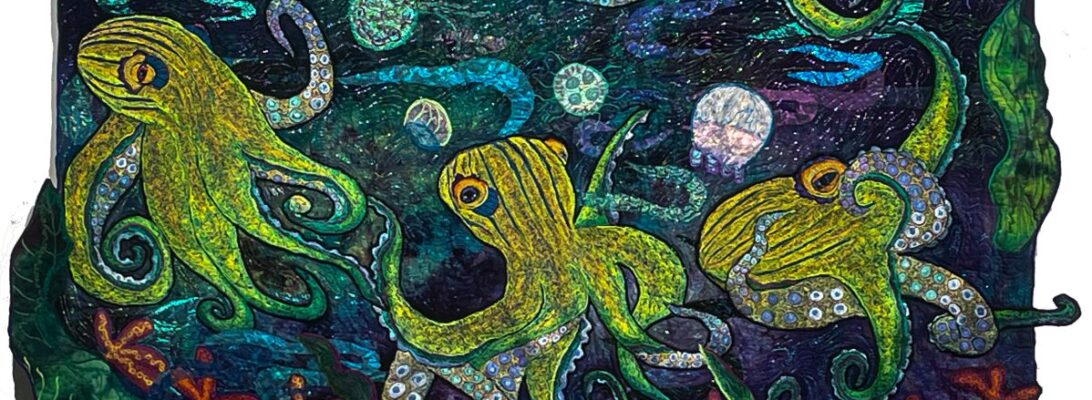
Nothing is quite as daunting as a really large embroidery. This babe is almost as tall as I am (4′ 10″). I haven’t measured him yet, but he doesn’t fit on a yard of fabric and we’ll have to sort that out soon.

Part of what is daunting is seeing the whole on a piece like this. Part of it is that when things go through that awkward half-embroidered stage, they look really weird for quite some time while you’re finishing off.

I’ve always made a point of showing you all of my errors. Partially because I view that kind of honesty as helpful and partially because I don’t necessarily view them as errors. They are the path through that particular piece of art. Sometimes they even turn out to be helpful.


I finished binding one quilt in a bright green in the middle of working on this quilt. Went back the next morning, and finished a large swath of feathers, only to find they were that very bright green. I was appalled. I picked up the mustache trimmer, looked at the immense patch of green, and quailed.

Then I thought for a while. Part of the problem with herons is that they are mostly grey and dark blue. With bits of rust. They are exquisitely formed but the color scheme leaves much to be desired.

But what is grey? Any color can be made into grey either by adding a lot of white or a lot of black. It’s a matter of value.

So I gathered up all the colors I had that were the same values, not colors. I added a lot of rust that gives it a warmer color, which means I’ll need a background with warmer shades as well.

All those colors sort of made it rainbow-colored. And rainbow colors make iridescence. But since they’re the same values, it’s still greyish. I think it’s going to be all right. I’ll know in several days when it’s all stitched in.

A word about the photography. I just got a new to me iPhone 12 mini. I do think the pictures are an improvement. Let me know what you think.

If you’d like more information about ripping with a mustache trimmer, see the blog To Rip or Not to Rip.

Does Anybody Know What Time It Is?-Establishing time of Day with your Background

I’ve been working for a week on a flamingo quilt. It’s a commission of sorts, so I’m working with the owner’s druthers. Blissfully, we have similar druthers and I think she’s quite pleased.

Part of this week’s fun has been choosing the background The flamingo is all embroidered, so the next step is building her world. I was looking at colors when I pulled out fabric opportunities, but I discovered quickly that what really happened is that the background changed the time of day.


The background changes the time of day and that in itself is a powerful statement. One way or another she’s walking in surf but is it night? Is it in moonlight? Twilight? Afternoon? Early cool morning?

Those are more than logical questions. They make a statement about the quilt itself and what it conveys. They tell me about this bird, who she is, where she is, and what her world is like.

All done by a simple choice of cloth. It never ceases to amaze me. Mostly the fabric choice is about letting the subject shine, but that choice carries meaning as well as color. Hand dye is a miracle that happens all the time but only once for each piece. The miracle we choose opens all kinds of choices and shuts other possibilities out. I’m thinking this will be the “right” background

Final Choice!

I turned around the darker one so that her face is in the light. We have a winner!

Still deciding about the moons. Do I want arced moons or just one? Decisions…..decisions.

Want more information about backgrounds and hand dye? Check out Where will it land? Spotlight on Backgrounds

Cut Off the Same Cloth: Elements that Work for More than One Quilt

Years ago someone asked me how many mushrooms go in a quiche. I asked back, “How many mushrooms do you have?”

I don’t make copies of things. I do make variations, and I find it useful to rethink some things I’ve done before, or more importantly tried to do before. I might get lucky. You never know.

But there are some things I know I can always use. There are never enough dragonflies, daisies, frogs, or mushrooms. They make an excellent point of interest for a visual path through a piece. And every so often I make batches of them.

The last two quilts had lots of frog and mushroom action. But they are such different pieces. Why did that work? Why do the same color elements work in two really different color backgrounds?

I’ve thought about it a bit and have decided that bright is a color all of its own. Green Heron Hunting features a bright fall-red sky, a stream, and some rocks. High Rise Living is a soft-colored background as a garden with lobster claw plants dangling in the breeze. The backgrounds couldn’t be different. But both backgrounds are a strong contrast to the mushrooms and frogs. High Rise Living is almost pastel. Green Heron Hunting is a bit somber. Both of them are high-contrast against the backgrounds

Batching regular elements has changed my work a lot. I find I can do larger elements with much less distortion. The downside is they need to be stitched down afterward. The mushrooms get stitched down with the most prevalent color on the edge. The frogs and other elements usually get stitched down with black. I don’t always like the heavier black borders, but it eliminates a lot of pucker and distortion.

So I continue to make batches of the elements I know I’ll use again and again, Contrast, any contrast makes elements work together. And there’s always room for one more frog.