Done: When the Quilt is Finished

I finished three quilts this week. That felt great but I always have a kind of wobbly moment when a project is done. With the machine troubles, I wasn’t able to back or bind things easily, so it waited. I had 6 quilts backed up, ready to bind. I have three done, three left to bind.

After you finish, you look around the studio and try to figure out what’s next. In this case, a whole lot more binding. It’s not encouraging.

In Myers-Briggs speech, I’m an INFP. The P stands for perceptive. The N for intuitive. What that means is that I don’t like finishing.

When I start a piece of art, it’s truly a part of me. It comes out and is connected to each day in the studio.

But as it grows, it develops a life of it’s own. There are things that quilt will demand. Some of which aren’t what you normally do. So you separate slowly, as the work finishes.

When it’s finished, it’s itself. It has it’s own destiny. It will do what it’s supposed to do. And I desperately need another piece to fill the void.

I suppose it’s separation anxiety.

I’m very anxious when I finish work. I don’t know what to do with myself until I start something new. The process itself is how I live and breathe. One quilt flows into another. One piece suggests something else that has to be tried.

Lucky me, I have three more quilts to back and bind. It’s not my favorite part. By the time I’ve finished that, I’m done. And part of me longs to be off with another piece, figuring out its background and thread colors.

But there is something wonderful that happens when a top becomes a quilt.

It feels finished. It feels complete. It’s ready to be shown and shared. It’s a finished chapter.

It leaves a hole.

I’ve been riding a I need to take my new work, this new wind and use it to safe a place for my work. Besides, it makes me crazy not to show it off. It has a life of it’s own. That life shouldn’t be just the closet.

So I’ll grind through bindings, and flip through books until the next thing grabs me by the neck and must be made.

The embroidery makes me happiest. After all, it’s color therapy in thread.

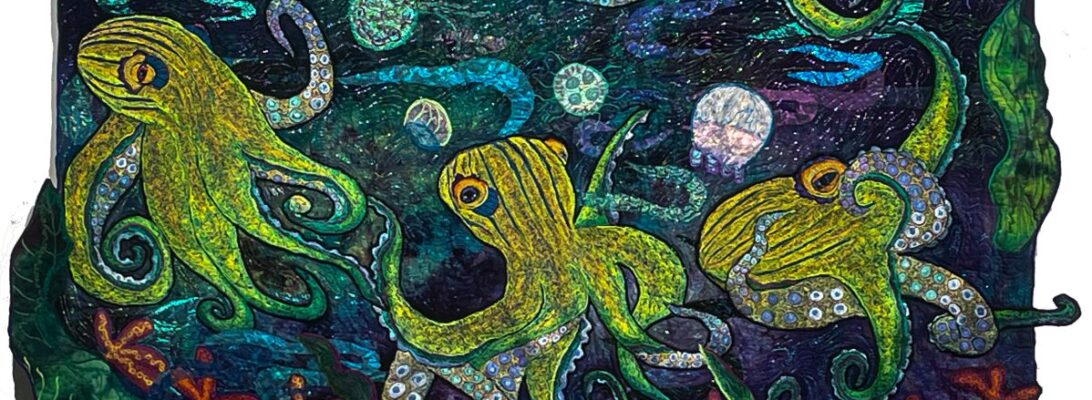
I’ve randomly added pics of the finished quilts. They are up and for sale on Etsy

This article has good information about the Myers-Briggs personality types. It’s a helpful way at looking at how others view their worlds.


Oil Can: A Cautionary Tale

Do you remember in the Wizard of Oz when they fixed the tin man with an oilcan?

Let’s just start this out by saying I am not a mechanic. By training or inclination. I have 60 years of working with sewing machines by way of experience. I am in no way recommending this proceedure. I’m telling you it worked for me.

You know I’ve been wrestling with my machines. It all came to a head last week when the working 930 Bernina froze solid, mid stitch. This is the fourth machine that has done that.

Don looked at me and said, “Have you oiled it?” Of course I oiled it. All the places in the book.

Fixing is Don’s job. Oiling is mine. Besides, I was restless and distraught and desperate. I got out the new shop light and oiled everything that moved metal against metal. There were a lot of places I would have never found without the light. It felt fruitless. Don said, “Let it sit.” That felt awful, but there wasn’t anything else to do.

The next day, the wheel budged just a bit. I pushed at it. It rotated a bit in a jerky way. Don said, “Let it sit.” I oiled it again like watering the garden.

The next day it didn’t move at all. Or the day after that, Or the day after that. I kept oiling.

Today was the day I pushed the wheel and it moved. All the way around. I got out the light and saw a hunk of thread I’d missed. I pulled it out bit by bit with a hemostate. I oiled again He put it back together and it ran. I kissed both him and the machine.

It sounds simple, but it’s not. The manual on your machine suggests several oiling parts. The idea is that your mechanic will get the other spots during a tune up. That assumes your machine is under ten years old. And being serviced regularly. And that your mechanic knows the older machines. As machines age, they get dry. In places that are hard to reach and not documented.

So the oil can be the cure. Except when it’s not.

Know your machine

What is your machine made of? Outsides don’t count. Insides do. Oil will abrade plastic, and possibly nylon. So you NEVER oil something that’s plastic on metal or plastic on plastic. Only oil metal on metal. Tap on it with your screwdriver if you aren’t sure. You’ll hear the difference.

Get a really good shop light.

I was shocked with what I could see with a magnifying shop light. I have several, but this is clearly the best of them. I found places on my machine I’d never heard about, and I do have a mechanics manual.

You also don’t want to open anything that will void the waranty. My machines are 20-40 years old, so that doesn’t matter. Newer machines are also much more complex. You may want to talk to your dealer.

If you’re cleared, take off the panels you can. We’re looking for the secret spots. They hide in the dark.

This is an answer for a machine that is stuck. If your machine is really truly broken instead of stuck, it will tell you. Listen. Pops, bangs, screams, grinds, smoke, the smell of burned plastic, or sounds like it’s chewing, are all indications that something broke. Stop immediately. This will not self heal. Oil it, but don’t expect that to fix the problem.

When and where do you oil?

If your machine is working well enough to move the wheel by hand, you can see all the places where it moves. Oil moving parts that are metal on metal. You will find more places if you can turn the wheel to see where they are.

If it’s not moving at all, oil what you can see. Check that what you’re oiling is metal on metal.

Don’t be upset if you don’t get an immediate response. Oil seeps in. If it won’t move at once, give it some time to penetrate.

What kind of oil? Buy your oil at the dealership. Oil is not all the same. Some kinds actually have shellac in them. If like me, you have many machines, you can buy in bulk. Bernina Jeff. of High Fashion Sewing, in Junction, CO, was kind enough to show us the oil he uses: Velocite # 10 spindle oil. I trust Bernina Jeff. His videos are accessible. He is knowledgeable and kindly. I purchased a number of small bottles and a pint of oil.

Can you oil too much? Of course you can. If you’ve got a puddle, there you are. Wipe it up and call it done. I like to use flannel to clean up oil.

Do check out Bernina Jeff. He has great machining toys for sale, knows his stuff and is a good and gentle teacher.

I do hope you never need this. But I intend to oil every machine I’ve got down to the nubs.

Marching On: Struggling Along to New Tech

Detail of fish in water elements

I have to say that this week has left me exhausted. My new to me 930 froze mid stitch, and I am, again. scrambling. Currently working are the 220 and the 20 U Singer.

If it sounds like a first world problem, you’re probably right. But I sew every day, usually around 3-4 hours a day. It’s more than a job. It’s not quite an adventure. It’s certainly my mental health.

When I was teaching, occasionally I’d get a student who would ask me how to do something. Usually it was an amazing idea. But I’d never tried it. I was sorry to tell them I didn’t know exactly how to do that, but that they eventually would. Art is not all about inspiration, and public statements. It’s often fed by the ability to hunt the snark, find a way to make things as you wish. It’s damn hard work.

But if it’s important enough, you find a way. And many artists have the decency to make their journey available to others, so that our art grows, not just in volume or in content but in ability. It’s why we write. It’s why we teach.

If I said that to you in class at one point, I apologize profusely. Just because it’s true doesn’t mean it’s what you wanted to hear. And I thank you for not having hit me.

The art quilt movement rebuilt quilting. Part of it hunted down old skills: hand stitching, hand quilting, pattern pieces, paper piecing and the like. Part of it is new tech: rotary cutters, machine work, computer design, different materials and stabilizers, different threads.

This is not the glamourous part of art. It’s grueling. Try one thing, try another. Look for an answer. Take the best compromise you’ve got.

Edging with three hoops on the 20U

I’m currently working on a koi fish quilt, working title, Upstream. It includes a kick ass koi and waterfalls over cliffs. I’m proud to say I figured out how to do the detail stitching on the 20 U. It involved 3 metal stackable hoops. I’m waiting with some anticipation for my Maggie Frame to arrive. It may really change the whole hooping process

The hoops are important because I can’t get a foot to work on the 20 U. The one foot that works won’t deal with the thickness of the quilt sandwich. Other feet I tried didn’t work with the machine or allow for a zigzag stitch.

For those not familiar with how sewing machines work, your machine will not form stitches if your fabric isn’t held taunt. Your pressure foot usually provides that stability. Without it, something else has to hold your fabric tight. Hense, the hoop. This video does a nice job of explaining how a stitch forms.

So I have to figure out the hoop thing.

On another front, my new crashed Bernina 930 is in pieces soaking in machine oil. I’m sure we’ll figure it out.

Stitched down with water elementals

I’m struggling with finding ways to utilize the Singer 20U. I added in my cliffs, direct applique with the 20U, using that stack of hoops. It’s a less elegant stitch line, but it worked.

Next steps: stipple in, add water splashes, back, quilt and bind.

A Big Hooping Deal

20 U Singer Industrial

Those of you who follow me know I’ve been working on getting the 20 U Singer industrial to work for zigzag embroideries. I’ve been positive about it, although that’s been more of an affirmation than a reality. We’re still not there yet.

I spoke with a mechanic last week who said, “You can’t get that machine to do that.” He’s speaking out of his experience, but I’m feathered if I let a little thing like someone’s experience stop me. Besides, I did used to work large embroideries on this machine. It went too fast, it broke thread and needles right and left, but I could use it with a screw tight embroidery hoop.

We’ve solved the broken thread fast issue with a servo motor. That’s working quite well.

But did I mention I hate hooping? Stitch three inches, move the hoop. Stitch another three inches. It’s painfully slow. This is the front and back of my test piece. The moth is straight stitch. The squiggle is zigzag. A hoop will work, without a foot.

Maggie Frame

Which is why I’m ecstatic about the hoop I purchased today. Maggie Frame is a magnetic hoop set for embroidery machines. But I don’t see any reason why I can’t use it free motion. The hoop snaps and is held in place with magnets. This video gives you an idea how it works.

Here is a comparison between the Maggie Frame and Mighty Hoop.

The sandwich I’m using to embroider is a layer of hand dye, felt, stitch and tear and totally stable. Stuffing that into a screw down hoop is hopeless. This video showed them hooping four layers of terry towels. I can’t wait!

I’ve ordered a 10″ x12″ hoop. As always, I’ll share my journey with you as I try this new tech out.

Water Ripples: Adding an Extra Splash

I love organza and lace for natural elements. I can make water easily with some fusible and sheers. I cut c shapes in various sizes and colors, and fit them into pond or river water.

This is a process I usually do right before I put on my embroidered components. I get everything embroidered, so I’m sure it fits in, and then add the elements (air, wind, water, clouds, smoke) to the background itself before I stitch down any of the embroideries. Only after tthe sheers are stitched on, do I stitch the components down.

There is one problem with that. It leaves my fish and reeds all out of the water. They are in front of the water, but not in it.’

What I’m looking for is the feeling of layers. I usually cut c shapes and swirls. Then I mix them together until I have water amalgamated with different temperatures and depths.

If you think about real water, it’s always in layers. You put your toes in, and maybe you feel the sun warmed top layer, Go further in, and the lower levels feel colder. How do we express that as art? I think the deeper the colors are, the colder they feel. We can make layered water, warm on the top, but colder as we go further in.

So the last thing I often do is to lay a few pieces of organza and lace over top of the fish. Not completely. but enough that they’re completely clearly in the water.

Anything less would be all wet.

Cheesecloth: What Grade Is It In?

20 weight cheesecloth with organza trapped underneath

I’ve used cheesecloth for years. It’s an unexpectedly versatile sheer that dyes beautifully, takes iron heat, and fuses easily. It’s a studio staple for me. When I dye other fabric, I almost always dye a fresh batch of cheesecloth.

40 weight cheesecloth flower

But I wasn’t aware that there were different kinds. No one ever mentioned that it came in different grades. I just bought the box I found at Joann’s. If it had a grade marking, I missed it. My guess is that it would have been perhaps grade 40.

The grades have to do with the purpose of the cheesecloth. As the name suggests, it’s about how it’s used in food prep.

This is a quote from the Organic Cotton Market

Grade 10: The thinnest and most open weave, ideal for applications requiring good airflow and water drainage, such as straining some types of broth or when a very open weave is needed for crafting. 

Grade 40: A versatile medium-weight cheesecloth, good for general food straining, polishing, and crafting. 

Grade 50: Another versatile option, often used for food prep and crafts. 

Grade 60: Suitable for straining, polishing, and cleaning, and is also used in testing for fire hazards. 

Grade 90: The most durable and tightly woven, suitable for tasks requiring strength and fine filtration, like making cheese or nut milk. It’s also washable and reusable, making it a good choice for repeated use in the kitchen. 

Grade 100: The highest grade, providing the tightest weave and greatest durability. 

The grade number reflects the number of threads per square inch, with higher numbers indicating a denser weave according to Organic Cotton Mart. For example, Grade 10 has 20 x 12 threads per square inch, while Grade 90 has 44 x 36 threads per square inch according to Online Fabric Store.  “

The box I bought before must have been a 1. It was wide open, pilled easily and very formless.

#20 Cheesecloth pine trees.

My last box was 60 You can actually iron it onto fabric without a pressing cloth.

Your best clue for unmarked cheesecloth is the usage they suggest for it. If they’re making craft ghosts out of it, you know it’s a lower grade. If they’re straning jam with it, it’s a 90-100,

60 weight cheesecloth leaves

What will I do with that information? I’m almost tempted to have several grades in the studio for different applications. Cheesecloth is my go to for leaves and flowers. Nothing is as light or as easy to iron on and the texture is fabulous. But it never occurred to me that it came in different textures. I have a fish that will need some surf to swim through. It may end up as cheesecloth to the rescue.

Arkwright Cheesecloth was the one that was most clearlly marked on Amazon, and the widest number of choices.

For more information about cheesecloth, check out The Miracle of Cheescloth: Not Just for Turkey Anymore