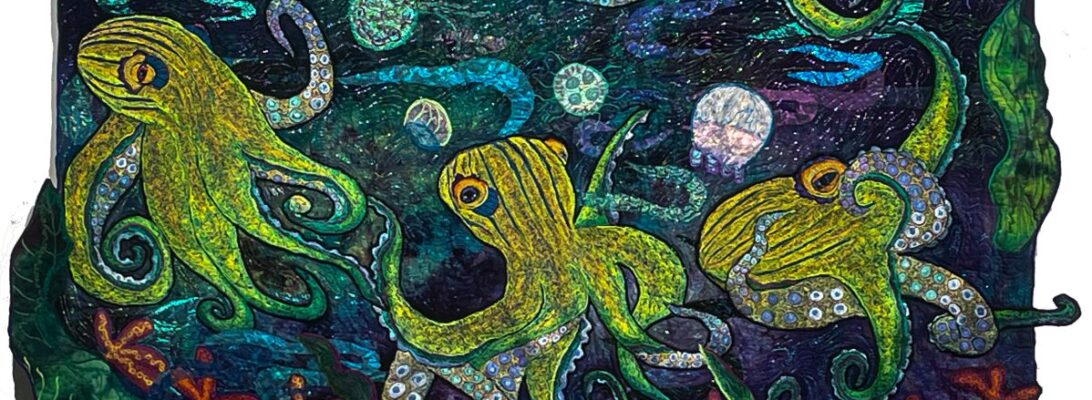
Hello, My Darlings: You Are the Heart of My Art

There aren’t many times in your life when you bring home a new sewing machine. Even for those who work in the industry, it’s a red letter day.

Thursday, I brought home a new to me (gently used ) 770 Bernina from Feed Mill Fabrics and Quilting in Oneida, IL. Don took this picture of me having fallen into the machine sewing. Yes. Like that. I sew until the machine and I are one.

I’m not a high tech girl, and I’ve worked most of my life on mechanical machines. But there are things about this bemouth that are to love. The throat size. The quiet motor. The speed of it. The excellence of the stitch.

My 630 is gratefully on the side as a backup, but I can see this new machine is going to take center stage of my sewing. It’s just as well the dogs and cats are banned from the studio, because I think it could eat a cat solid. We just won’t go there.

You don’t just buy a sewing machine. You buy the ability of a sewing machine. You buy the ability it gives you. I don’t need the embroidery capability. But this is the kind of solid sewing I crave, and what I test out every day doing the crazy stitching I do.

So this is what I did the first day I brought it home. I stitched my ass off for an afternoon, 12,000 stitches according to the machine! It ran like a top.

It needs a moth, I think!

Most of all, I’m touched by the support I’ve had. Don has believed in me and given me more backing than I’ve known in my life. He gave me my studio and walked me into get this machine. He leaves me amazed. He sits in the studio and cheers me on day after day. I adore him.

We kind of crisped our plastic purchasing it, but it was possible at all because people like you bought quilts and made it possible. The quilts are all still on sale until Sept. 21, in case you would like one, or like to help.

But all of you who helped me, bought quilts, backed me up, went to my classes, read my blogs and have wished me well, Thank you! You’ve made it possible for me to follow my art. You are a part of my heart and my heart.

You can hear me with my heart beating in time with the machine. I’m in love.

No Place Like Home: Quilt Stores Make Our Community

Yesterday, I had the pleasure of doing a live Facebook show with Beth Rylander in her delightful shop, Feed Mill Fabrics and Quilting in Oneida, IL. I talked about free motion stitchery, and brouht in a small trunk show of work.

I’d visited Beth’s lovely shop, looking for a new Bernina. I believe I’ve found my machine, a lovely 770 that is coming in as an experienced machine someone has pre loved for me.

Today was so much fun! She does this every Saturday. She reaches out to her group by doing a live show weekly, so people can know what is new, fun, exciting and there for them.

Beth’s shop is stuffed stem to stern, and top to bottom with beautiful fabrics. And she not only sells Berninas, she has two lady mechanics. I’m impressed.

But her store bears something much more precious even that fabric. She has made a store in a feed mill in Oneida, that is a community for a huge circle of other women, like you and like I who love fabric, sewing, and each other’s company. What a quilting store does best is it makes community. Which is why all quilt stores are precious, and need our support. Because they support us all.

Here is the video we ran this morning.

Batch Quilting: How Many Quilts Do You Have Unfinished? How Many Quilts Can You Finish At Once?

I’ve never understood people who worry about unfinished work. I treasure my unfinished quilts because they are springboards to more new quilts, just waiting for their time.

I learned a while back that it was easier to set the machines for one process and work a number of pieces at a time. It seems a bit scattered, but it works for me. I spent yesterday working on 8 quilts at once.

It makes sense to do all your dyeing at one time. It also works to do oil rubbed fabric in batches. I could do one at a time, but the mess is prodigious for both of those. Here’s the rubbed pieces of fabric I used for my quilt batch today.

Once I started straight stitching with metallic, some quilts needed more. Some need couching, some need extra flowers, some needed either applique or embroidered applique. So I line them up by the techniques involved. Then I set my machine for the next process and do them all at once.

It creates a lot of work in a hurry. Which is good right now because I’ve sold a number of small quilts over the sale, and am going to add these to the sale as soon as they’re done.

So, no guilt! Unfinished quilts are invitations to new work. And they finish quicker if you do each process at a time.

I find myself taking things in batches. Each quilt gets exactly what it needs. But I can work smoother and quicker by taking them in batches and working one process at a time, not just one quilt.

Look for these quilts up for sale early next week. They’ll be on Etsy at www.etsy.com/shop/EllenAnneEddy

Farewell, My Lovely: What Can You Do When Your Sewing Machine Dies?

It’s the words no one wants to hear. Yes, if it’s stopped changing stitches, the board is probably going out soon. Gasp. No. It’s my machine!

Lots of desperation here. I do have backups, but they are not meant as major machines and they won’t back me up long.

My dear friend Elaine always knew when I called her at 7am, that I’d trashed my machine again. I’d call to ask if I could borrow hers. She’d thank me for having waited until 7, That bad.

I may be retired, but I’ve sewn and quilted all my life and probably will until they dig the final hole. I need a new machine.

But the other difference when you’re retired is that the easy money is much harder to find. So I’ve put all my quilts on a 40 % sale. I have a number of great new works at every price range. And I’m willing to let them go to make sure I can get a new machine. The sale will be on until September 21.

If you’ve been wanting a quilt of mine, this is the best time! The prices won’t go lower, because they really can’t. And I have some fabulous new work.

IF you are new to my work, please take some time to see what I’ve made. I feel each quilt is a separate world of it’s own, there to warm you from your wall, visually.

Prices on the web page and on Etsy will show the full price and give you the discount in your cart.

I’m asking your help to replace my machine.

Thanks!

Designing Ways: East Meets West

972 Shelter from the Storm

This is another modified blog from almost ten years ago. It’s still an interesting story. And an interesting way to think about how we design our art.

It’ss almost impossible to talk about our art without talking about the art that comes before us. Before we talk about design, it’s worth saying that there are many different design aesthetics. It’s not that a design is good or bad necessarily. It’s designed to be part of the statement. The notions that fuel our art choices are a statement loud and clear past subject matter and past our technical handling of fabric and thread.

As quilters, a lot of us have backed into art by accident. We started with squares and one day found ourselves with an odd quilt that somehow was an art quilt. Maybe it had too much orange in it or you found yourself like me, embroidering frogs and bugs into the borders. There’s a tender soft spot in most quilter’s artistic persona. The part that said that you should have gone to art school or studied water color. So our first designs spring out of a personal view. Later, as we become more facile, we realize that the choices in design are a huge statement all their own.

My first artistic love was the impressionists. I grew up near Chicago, and there was a pilgrimage every year to the Art Institute. I strolled through the halls looking for paintings like old friends. Since they were my first real introduction to art, they felt bland to me. Safe. Something soft and soothing out of my childhood.You know it’s become mainstream when you see it on a birthday cake. This astonishing cake is by Megpi, a pastry chef in Silver Lake. California. You can see her work if you follow the link to Flickr. 

impressionist cake by megpi

impressionist cake, a photo by megpi on Flickr Since you can buy Van Gogh’s work on umbrellas and coffee cups, it’s easy to miss the point that he was a raving revolutionary in his time. His work nauseated the current critics, got him hospitalized, was refused for all the important salon shows, and the subject of ridicule in the press. Time and familiarity have made him a lionized artist, but that was not who he was when he began.

I was immediately in love when I discovered Japanese prints. It was a while before I realized why. The Impressionists took much of their new artistic vision from the prints out of Japan. The first prints that came out of Japan hugely influenced them as beginning artists.

In contrast, this is a painting  called Nocturne from around 1825 by Turner. Turner would have represented the design aesthetics from the early 19th century, that Van Gogh and the other impressionists and Post Expressionists blew out of the water.

Early 19th Century Western art was about permanence. It honored stability. It was a world of people in their proper places, forever and ever. It used Greek and Roman scenes  and portraits of nobility as an way of saying we had an eternal understanding of a changeless world.


Japanese art was about the moment. It moved. It created a path for the eye to follow. It went off the page. The impressionists saw it, fell in love with the concept and incorporated it into the designing of their art. The movement is called Japanisme. It was in my humble opinion, the beginning of modern art. And changed us all.


Myself, I cherish movement. I plot my quilts to travel from one side to another, taking the eye on a journey across the surface. The visual path and vertical path quilts I’ve been exploring are all about the traveling eye.

The decisions behind design are the most telling. Without a word they say so much about what we create, what we find important, and what we value. The way we structure our art is at least half the story we have to tell.

971 Waterlily Pond

The Lunatic Fringe: Where Do You Get Your Courage?

972 Shelter from the Storm detail 3

This is a reblog from around ten years ago, but I still think it holds true. How do we gather the courage to do art? And the courage to show it and let it into our lives like a strange wild cat? T

I’ve been teaching now for almost 30 years, so it’s not uncommon to find people who’d had class with me teaching, writing, creating amazing art and winning awards. Students in the quilt world are not like students in other places. They’re often experts in their own right. They’re there in class to pick your brain, but they’ve already got amazing skills. So it’s not like that student owes you very much. They’re another traveler, perhaps out ahead, perhaps a step or two behind. But you’ve showed them a cool trick or two and they may well have showed you as well. It’s more like meeting a pilgrim on a similar path.

I used to give everyone three scraps of fabric: A red badge of courage, a green lunatic fringe and a purple heart, because if you’re doing brave things, of course they’re shooting at you. At some point, in the four thousand things that have to get done before class, I stopped. 

I also always used to wear a badge. At one point someone gave me the most wonderful bug pin. I put it on my badge and it was part of it. At another point, I lost it. No one seemed to miss it.
My old student asked me if I was still giving badges. I think I had him in class 15 years ago.
It still mattered to him.

Every so often, someone would stop me and tell me they lost their badge. I gave them explicit permission to make another for yourself or for someone else. 

Perhaps the badges need to come back. Am I as brave as I need to be? Are my students? Are any of us?

The wizard of oz behind the curtain

A sacrament is an outside sign of an inward grace. A symbol can be one too. Can an ordinary person can stand behind a curtain, make a great deal of noise and convince people to be brave and have a heart simply by giving them one? Yes, perhaps. Symbols do work

Should I start making badges again?
Do we need the lunatic fringe rampant?
Would you stand in the lunatic fringe?

10 years later, I’m no longer teaching. But I am struggling for my own courage, my own celebration of my wounds, and my understanding that of course I’m out in the fringe. I ask you how you hold your courage to create? What badge, pledge or thought holds you straight and strong at your art? And if I made you a badge at some time, would you let me know if it worked?

Laughter for Drama Queens

For fun I was looking at some old posts of mine. I found this fun and wanted to share it with you.

I am a redirected Drama Queen, Daughter of a Drama Queen Delux. My mother was not a happy girl until she had a drama 10 feet high and too wide to get through the door. It was all about telling stories.

Now Margaret Eddy was the queen of all stories. And a serious fan of silly. She told amazing whoppers, one-liners, true tales spun into gold from straw, hopeless lies and astonishing steaming piles. She loved her drama. She had a somewhat loose relationship to truth. She was a devastating school teacher, because much of that could indeed come out in a teacher conference meeting or a family reunion. But she had a special gift for looking within and without. First she’s build you a verbal image of herself as she felt about the story. But then she’d draw you into an outer view, where you could see her spinning in what she knew was a silly situation, build for howling laughter.

It happens to me in my quilts. I’m quilting along and I realize that this silly thing I’ve drafted is someone I know. Or worse, me. There with all my rather small fears and desires. I’m not overly deep. I’m just noisy. At that point, it seems just to the point to let it be silly. I am. It is. And the world is better for it.

This quilt, The Orchid Olympics, wasn’t meant to be funny. It just happened. I’d found a great picture of a frog in an odd pose and worked with it. One afternoon in a class demo, I was placing it into the piece and trying to put a sun over his head. It wouldn’t go. It just wouldn’t go. Not over. Not to the side. 

I looked again at the frog and thought, “If you get into that pose, it has to be for something like the Olympics. No one would willingly bend like that otherwise.” The sun fell into her hand like an award and there we were.

Mirror, mirror on the wall, I am my mother after all. But I try never to tell a story on myself until I’ve found the funny part. Perhaps it helps to be short, round and have a pug nose. My gray hair also seems to give me an amnesty for silliness. And why not? 

Eye Popping Color: Charting Color in Fantasy Mushrooms

I’ve written a lot about color because I think a lot about color. I It fascinates me, from dye, to fabric to thread. I’ve been working on a batch of mushrooms for some new quilts and I decided to look at the colors through the color wheel just to codify what I was choosing.’

I’m not going to talk about color theory here, precisely. Instead I’m going to talk about relationships in color. Color theory can be deeply and obscurely discussed in millions of ways. I’ve seen it discussed as building blocks, tonal poems, wave lengths and light waves. I’m not sure how much of that is useful. I thought it might be helpful to simplify instead. I’m not dissing color theory. But I am trying to think about it differently.

I’m also not going to use color names. I want you to look at the relationships of the colors instead. But here’s the distinction I find most helpful. Color harmony has to do with how close colors are on the wheel. Contrast has to do with how far away they are. Harmony is of course beautiful. But contrast is what draws our eyes, It is what makes colors pop.

Contrasts come in several style. The colors themselves are their positions on the wheel. Darkened and lightened colors make the tones and tints. Then there is the clear colors. So for fun, sit back, get drunk on the colors and ignore the names. But look where the contrasts and the harmonies are in these color choices.

Notice the range of purples together that create a smooth section of colors and the yellow and greens that contrast. Notice the differences between the dark blues and purples and the lighter yellow and greens. The further distance colors are from each other, the stronger the contrast. The contrast creates the pop.

It’s not as simple as a recipe. It’s not what I was doing. But I did pick full swaths of colors next to each other with a few colors opposite from them. I also actively chose light/dark ranges for harmony and for contrast. It’s not about what we name colors. It’s about their relationship together. The very light green makes the sparkle on this ‘sroom. It looks white. But the green heightens the contrast.

Shading looks different than colors put side by side, but they still meld into each other. The eye blends thread colors that are sitting side by side.

Where are they going? They’re not in place yet, and I’m hoping for smaller frogs to go with, but bright kick ass mushrooms are exactly what I had in mind. I think I’m going to make it rain.

In process forest floor with mushrooms

I’m going to leave you with a small gift here. There are two color wheels here that I made for this blog, one empty and one fully colored. I invite you to use them to chart your own color on a project as you work. Down load them, print them up and use them to see how the colors you use chart up and relate to each other. And let me know what you find. It can be eye opening.

You are welcome to download these two pictures to chart your own colors!

The Light of the World: Creating a Fabric Universe

The blue fabric creates the light that shades these flowers with blue, and pale green as well as white

You would think that the light in a quilt begins with the color choices of either thread or fabric. It does, and it doesn’t.

The red/fuchsia/ soft orange shades this white mantis with bits of pink and yellow as well as white.

It comes back to hand dyed fabric. I dye fabric because it creates a world of it’s own. The color of the fabric creates the light of that world.

I’ve been working with an idea of frogs on a false bird of paradise vine. I wanted a daylight background that would bespeak greenery without being strictly green. So I started looking for a piece that create that world.

I did not dye fabric for this specifically. This is what I had in house.

So which will I choose? I pulled out the purple first thinking it would give more contrast. But it was absolutely glum. The blue looked like a good choice but it was in itself too watery and not long enough. I didn’t mean to pull up the piece with the lavenders and greens, but I love what it does with the purple stitching in the frogs.

And look what it does with the red/yellow fabric for the vines. The fabric makes the light of the world I’m building.

Had I dyed fabric for it, I might not have been as pleased. When I do, I dye at least three-five pieces in a range to get one I like. Hopefully.

But all those purples, greens and yellows can’t be too wrong.

I’ll show you more of this piece as it goes along.