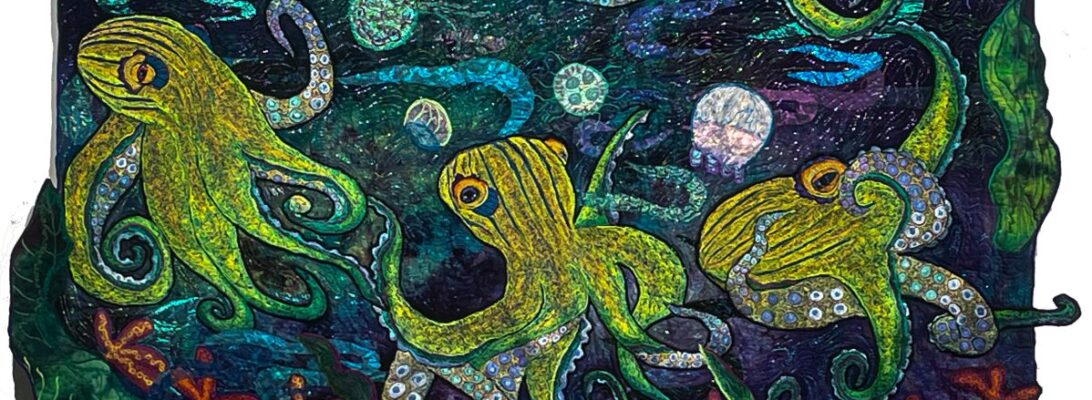
Most of my quilts are about me exploring ideas and forms. Within that, I indulge myself quite a lot. My interest is creating images in thread, and landscapes in dye. And I pursue it endlessly.
But not all my quilts are for me or for show. There’s a small number of quilts I make for others: for their particular delight, for healing, for an expression of who they are as well as what I do.
Don might be the hardest person to buy presents for in the world, unless you are ok on buying someone a river of underwear and socks. He can’t or won’t ( I can’t tell) tell you what he would like for a present.
And there is a need for presents. Not just for the recipient but a need to let someone know that they mean the world to you. That needs to be marked in some way tangible and real.
So you send a card. Of some sort. I hate working in paper. It’s unforgiving and fragile. So I make him small quilts each year that would be cards if they weren’t quilts.
A quilt for someone else is about them. It’s your relationship with them. These include the kids (and if you are wondering that would be the three dogs and two cats). And because they are for fun, and not about the wheel of produced art, they include all kinds of fabrics and silliness, which is a kind of silliness I really don’t let into my art pieces. It’s just for him.
When we make something especially just for one person, it reflects who we are with them and who they are with us. It’s a gift not only of the hands but the head and the heart.
I sat down yesterday and mixed the colors for dyeing. It felt like I was sitting in a circle of old friends. Scarlet, sitting next to Fuschia who had just made friends with a new color Dragonfruit, and was waving across the color wheel to the Lemon/lime.
I’m dyeing fabric today in preparation for surgery. If I’m going to have to go through heart surgery, there better be a really big pony after all the poop. So a pile of fresh fabric waiting for me is sensible. It fills the time while I’m waiting and it leaves me with a lovely pile of fabric to dream about until I can sew again. It’s good preparation I think. And a good way to fill the waiting time.
I started dyeing fabric at thirteen. I found a book in the library that blew me out of the water, with it’s papercut illustrations. The Emperor and the Kite, by Jane Yoland used paper in variegated colors that resembled the hand dye I still do. I wanted to work with the technique and it never occured to me to dye or paint paper. I dyed fabric with Rit.
This all happened in the kitchen sink and my father who was the major cook in the house had opinions about it. My father was almost non-verbal, but he looked like I’d kicked his puppy when he saw the kitchen after I was done. He unblocked the sink, scrubbed it down and said nothing. He always understood the passion around projects. He had his own, and he often helped with mine.
But it set something in me. I don’t really want colors that stand apart from each other .I want them to mingle and to dance within the fabric itself. I’ve been dyeing fabric in some form ever since.
Colors are about relationships. They have relationships with each other that depend on how they are formulated. I am not a dye master. Or someone who can responsibly measure dye and mix it reliably. I dump dye into a cup. I buy a bevy of colors and use them knowing how they relate to each other.
“Knowing the definition of a word is a pinpoint on a map. It tells you where you are. It doesn’t tell you how to get where you want to go. It’s the rawest of beginnings.
In the same way, color theory feels like the the dreariest driest subject in the catalog of art education. We look at the wheel and say the canticle, red and blue make purple, red and yellow make orange…. It feels like a recitation from kindergarten. And sadder still, it’s not always true. We’ve all mixed yellow and blue to get the most grizzly browns. It feels like finding out about Santa Claus or the Easter Bunny. A nice story for children but not really true.
Part of what we’re missing with that is the reality that it’s a theory. It works, simply when it does work and when it doesn’t, we need to explore why. Color theory doesn’t account for imperfect color. Color me surprised. Another thing that is imperfect in a imperfect world.
The most interesting distinction with mixing color for me is the contrast in thermal energy. Each color in its imperfections leans a bit towards the yellow sunny side, or the greenish shady side. If you mix all sun colors or a shade colors, the combinations are clear and bright. If you mix sun and shade, you get earth colors.
So if I place Lavender and Orchid together, as sun colors they blend into each other. If I add Lilac, a shade color, the combination browns out a bit. Still light purple but with a browned quality. If I add a sun color like Clear yellow, it will stay clear. Lemon yellow with its shade qualities will brown it out.
The real question is not where we are on the map but where can we go. What color theory really describes is the relationships between colors. Within the color wheel, the spots within that wheel define the same kinds of relationships between different colors. Those relationships go back to that primary list of monochromatic, complementary, and analogous color themes that seem so very dull. Because they define the tension between colors.
For dyeing, you have to know the name and know the color. They all lean one direction or another. There are no perfect primaries, secondaries or tertiaries. If you know which way they lean, you can predict the effect. But you never know exactly what the dye on fabric will do. And it’s never the same. Each piece of fabric is unique.
The distance between colors, creates the pull across the wheel. The closer they are to each other, the least pull. The least tension. The least excitement.
The farthest distance any color combination has is directly across from each other, as complements. Those are combinations that tug and pull and electrify us. Colors right on top of each other are smooth and slide into each other.
It’s not one combination. It’s a circle of combinations that create the same feeling. We can move the circle endlessly and get the same energetic result.”
Which is why it’s such a good thing I know these colors as my friends. I know who the mix with and who they fight with and what it will look like after they have a party together.
I’m spending two days dancing with color to pour myself into that joy, instead of the apprehension about the surgery. After all, color is really an antidepressant. And I’ll have a lovely pile of new fabric to play with after I’m back and healed.
I need to say “Thank you!” to everyone who has responded to my news about my medical condition. People have been so generous in buying quilts and I now feel confident that I can take care of the immediate unexpected cost that was looming.
I’m going to leave quilts up set for discounts. They’re in my Etsy Shop. If you offer a price, it will either accept it, or you can contact me and we’ll do our best. I want to make sure everyone who wanted either have a quilt or help at this time got what they needed. I’ll take it down once we know for sure exactly what and when my surgery will be, probably mid-November.
The quilt community is full of the best people on earth. I’ve learned that after 40 years of teaching, writing, and showing quilts. That you came behind when I needed you is not a surprise. But it is a huge blessing, and I am so grateful.
Last Friday night, we opened my show at the Peoria Art Guild! It was a lovely opening. Lots of folk. Lots of friends. Lots of artists I just met. I couldn’t have been more pleased. Or more humbled.
For all of us, who do art seriously, it’s a really private process. Even if you share your process online or in class, there are some things you really do in a very private space. All the left turns, small errors, large disasters and turn-arounds happen in that private space with presumably no one watching.
I’ve never felt very precious about that. I treat my mistakes as learning curves and have always tried to share them, just as a point of being real with students and other artists. It’s especially true if you teach. You owe people the truth about your process.
But when it’s in front of the public that feels very exposed. All the things you wished were better, smoother, flatter are out there, just as they are.
It reminds me what art is for. Art is about retelling our story. It’s the ability to see our world in a way that changes us, and the things around us to be stronger, better, more beautiful, more whole, more brave inside or out. And the journey we take as a storyteller is much more transformative than the story itself. and an inscrutable process, all of its own.
I love when my friends come to a show. They’ve walked with me sometimes close by, sometimes at a distance as I’ve made this work. It’s as much a part of them as it is me.
I love when I meet other artists in this same inscrutable process, doing something no one ever thought of doing before and finding their way to put it into being. They are a privilege. The glimpses we share of our processes are like watching thoughts take form, flesh, and flight.
And then there are the people who come to see that transformation. And respond. I’m always humbled that the images I have to work with have meaning to other people. And grateful for their kindness. This was a huge gift for me, and I want to thank the Peoria Art Guild, Shannon, John and Jeff, and Dana for opening this amazing opportunity for me. And Don for his endless help and support!
So come see the show! It will be up for the month of September. And come join me next weekend for classes. We’ll learn how to make Fantasy Flowers and Bobbinwork Dragonflies next weekend. And talk about how to build a visual pathway through your art.
I’ve just finished two pieces I started earlier this year. It’s a good thing because the show at the Peoria Art Guild hangs next Saturday. I’m fighting off a summer cold and feeling drained. Except that I wish my nose would drain.
Endings are hard for me. It’s hard for me to finish a quilt. All that passion, all that energy stopped. It feels wrong in some ways. I’m a bit like the artist who is done when someone takes the piece away from them.
Except that at some point, you really are done.
So this is why I almost always have a number of pieces in process. I still need to work through the last of Great Blue. I’m lost after I finish a major piece. I’m hunting for the next passion. And it needs to be a passion. To go through the drawing, the stitching, the dyeing, the quilting, and the embellishment is an immense amount of work. That takes endless energy, which is fueled by passion.
What am I looking for? What is it that I need?
color
Amazing color is always a draw! It can come through the dyed background or from my subject, but I can’t work without color. The images have their own color, but the light of the piece is the fabric background itself. Like a colored lense it sets the tone of the art. Everything is seen through that lense.
Form
The shape of things is incredibly exciting! Bird wings, frogs jumping, the intricacy bugs, the Fibonnacci progression numbers in space and time leave me breatheless.
Movement
The way those forms move. To see them in flight, in water, in repose, in play. I want to play with them.
Memory
Some moments change your life. Watching a heron land on a friend’s pond. Standing eye to eye with a Komodo dragon at the National Zoo. Standing in a training pond with dolphins. Watching the sun rise over a little waterfall at Spring Lake, through a fringe of wildflowers. I am imprinted with memories that always call me back to that point of wonder.
A Male Cassowari watching me …
So what do I do, when a piece finishes? I wander through books looking for the color, the form and the movement for the passion for the next piece. Do I know what’s next? I’m finding Cassowaries interesting. It’s like a thug dressed up for the ball. How dare you be that blue, that red with that yellow? Maybe.
I’ve been working on this pair of herons for a while. The working title is Little Blues. When I put it up on Facebook someone asked me, what happens to the frog?
Usually, I talk with you about how I do things. But that’s a why question. Why did I put a frog in that kind of peril?
Why questions are troublesome. Sometimes we’re happier not knowing. Sometimes it just needs to be asked.
And it would be easier to answer if I actually did know why. Sometimes I just don’t. I’m compelled to work with certain images. I’ve learned to follow that down because my nature quilts aren’t strictly just nature quilts. Most of the time it’s people I know in situations. Before they actually happen. Most often, it’s me in some regard. The tricky part is that the part of me that makes art knows things long before the rest of me does.
But in answer to the question: the frog lives! He may be in a perilous state, but he thrives in spite of it. You may notice the butterfly over his head that he has not yet seen. His hunch is here too.
I think most of us live almost unconsciously in a state of peril. It’s a dangerous world out there. But we find our safety and thrive despite it. Art is a part of that. How we build our own stories changes our place in those stories. We make your safe space: physically, emotionally, and spiritually. It may be right next door to uncertainty, but we build our own safety and joy within it.
Is it true? How would I know? I just get images, and they eventually tell me where they should go.
This is a special week for me. After 10 years, I’m teaching in a guild again. I’ll be lecturing at Gems of the Prairie Wednesday, May 3rd, and teaching the class The Stitch Vocabulary Book on May 4th. The class is full, but I’m told the guild welcomes non-members for the lecture. You are all very welcome to come!
It’s my developmental lecture.: How I became an artist. That’s a misnomer by the way. We are artists by the way of being human. It’s how I stumbled into my own art, and where it has taken me.
Every year I try to do something I’ve never done before. for my birthday. This year, I’m teaching a lecture and class, after a ten-year hiatus.
And on May 5th, I turn 70. I’ve always dreaded that. It sounds so old. Yet here we are. And if you’re a contemporary, so are you. As someone quite wise said to me, “If you made it, you celebrate it.” I intend to.
My life has always been a bit upside down. I’m too dyslexic to do things in a rational linear order. I started doing my art in my 20s. I married at 62. I borrowed other people’s children, although I always gave them back. And I had a lot of physical limits. 10 years ago, I pretty much stopped doing art and wrote books instead. And then Don gave me his old house for a studio. And my art flared up like a forest fire. Only a bit less destructive. It was back.
Making art is an expression of vision. Teaching is the sharing of technique. They really aren’t very similar. But they balance each other on the see-saw for good art is always bound by technique, and the ability to share technique extends everyone’s ability to share vision.
In prepping for class, I’ve done some things I really haven’t done for a while. I wrote and published a new classroom book for the class. Classroom books are all about technique, and this one is chocked full of different ways to use free motion: zigzag stitching, straight stitching, garnet stitch, hard edge applique, soft edge applique and bobbin work, with extra chapters on silk flowers, globbing and Angelina fiber. Bookmaking is a skill. It was nice to come back to that again.
And I’ve brushed up that lecture. It was shocking to realize how much my technique had changed in three years. The revised lecture needed to cover that. My stabilizer techniques, my drawing techniques, and my stitching techniques are massively different.
To celebrate the class, I’ve put quilts on sale. I’ll have them at lecture and class but you can also purchase them on my Etsy site at www.etsy.com/shop/EllenAnneEddy
What was more shocking, was that I had enough quilts to do a full trunk show out of that three years of work, with no older work included. Old work is fun for a lecture, but I think my new work is much more exciting. Yes. I will let you touch them. It’s astonishing what gets done if you are doing it daily.\
My point is that life isn’t linear. It’s a spiral, just like time in a garden. It doesn’t start at one place and just go to another. It cycles, it stalls, it spins out, It shoots up. Flares down. But even when things stop, they come back again in a different form at a different time in a different way. I don’t think I need a thing for this birthday, except, note to Don, some new books. The journey is the gift.
You are so welcome to come to my lecture. for Gems of the Prairie. It’s at St Paul Lutheran Church 1427 W Lake Avenue, Peoria, IL, United States, May 3rd, at 6:30 PM. I’m bringing piles of fabric, books and hand-dyed threads so people can play with the toys I use.
All time is a spiral. Wait long enough and things lost come back in their own way and time. I am grateful.
This classroom book takes you through all the techniques I use to create my art in 5 easy exercises on 9″ squares. Then you take those exercises and bind them into your own reference book, there to remind you what works best for you.
I love classroom books. I think it’s important to give people the whole recipe for something, with nothing left out. That’s what I tried to do here.
It includes free motion techniques on straight stitch, zigzag, bobbin work, hard edge applique, soft edge applique, rocks, Angelina fiber, globbing, couching, silk flowers and leaves, and all machine binding.
I’ve talked before about using old-fashioned appliances for dyeing. They are hidden gems for dyers! They are made especially for cotton and other plant fibers and work brilliantly in processing cotton.
Now that I’m no longer constantly on the road, I don’t dye as much as I used to. I used to dye around 50 yards of fabric a month. Now I dye around 20 per three months. It’s usually for my own use now, although I make some available in my Etsy shop, and you can always call me up and pick out the fabric you’d like on Zoom or Messenger.
But 50 yards or 20, that’s a lot of fabric to wrangle around. I’ve written about mangles. They are awesome ironing tools. But the other ancient appliance I depend on is a wringer washer.
Am I washing out with it? Ah, no. Cotton has to be soaked in solution and then wrung out. I don’t quite have the space even in a full kitchen dye space to wrangle 20 yards in the sink. Enter, the wringer washer. It will hold ample washing soda solution and fabric, and then wring your fabric out for you.
Unfortunately, like most appliances from the 40s and 50s, they’re a little old and cranky by now. When my beloved Maytag started to smoke, it was old enough to put in for social security as well as vote. We went hunting another wringer washer.
It’s not as easy as it sounds. Most of the ones out there have retired to being lawn ornaments. We found one that looked like it was in good shape except for the rust and the fact that it wasn’t moving when we plugged it in. A parts machine, as Don put it.
It seemed like an easy thing to fix. Maytag made the same wringer washer for around 40 years. These washers were 20 years apart, but almost identical. But we needed to meld them into Frankenwasher! A it of this, a bit of that, put together.
We come to our heros of this adventure. I called around Galesburg, looking for someone who might help us with the frankenwasher project. I got a resounding no. No one had wringer washers. No one knew how to fix a wringer washer. No one would want one, would they?
Until I called Dillons Appliance. I love mom and pop stores. I got Sam who knew is father, Jack, used to work on them.. Jack talked his grandson, Jackson through it. And Jackson, who is a brilliant young mechanic, learned from his grandfather how to fix a wringer washer. IT LIVES!
So the moral of the story is don’t let anyone tell you no. All they are telling you is that they can’t help. Keep going till you find someone who says yes.
And find the really good mom and pop businesses that do say yes, because they are treasures, not only because they are willing to help, but because they have wells of knowledge others may have forgotten, and are there for you.
Do check out Dillons if you need an appliance in Galesburg. Frank and Frankson are my heros.
343 S Chambers St. Galesburg, IL 61401. · (309) 343-0476.
The other hero of all of this is Don, who is willing to drive all over the countryside searching for ancient appliances and his friend Joe who has moved more appliances with Don than I can count. Did I tell you I’m a lucky girl?