Codifying Your work: Making Your Own Rules

Yesterday I gave a lecture on the Visual Path at the Peoria Art Guild. The best thing about lectures is that they help you think about what you do without thinking. I know that a major component of my design decisions is largely about making work move. Lectures give you a reason to think it through so you can talk about it.

Every artist has conundrums they are trying to solve within their work. For myself, making movement is one of those. If I’m filling the world with images of birds, bugs, lizards and frogs, I would hope that they would be breathing, living, moving birds, lizards and bugs. So how do I do that?

Here’s a section of my lecture with some of the rules I’ve decided help me.

These rules may seem silly or simple. But I use them every day. If I want to make things move, I can tilt them, change the size dimensions, create the illusion that they’re falling, or put them in a progressively larger or smaller conga line. All of those are cheap tricks. But they work.

That got me thinking, how many artists have rules they’ve made for themselves that help them to do what they want with their art? And what happens when we break those rules? Are we reminded why we thought to do that in the first place? Or are we liberated by realizing that rule isn’t all that ironclad?

The very cool thing about all this is that no one gets to apply those rules to us as artists except ourselves. It’s not so much a box we’re stuck in as a useful gridwork we can choose to use, or not.

My visual path pieces always make me think about how to make my eye travel through my whole quilt, just for fun. So if I were to bend my rules a bit, what would that look like? Each quilt is an answer to a question that I haven’t figured out just yet.

Peoria Art Guild 

Natural Threads Ellen Anne Eddy Show September 1-28

Peoria Art Guild, 203 Harrison St, Peoria, IL, 61602, 309 637 2787 

Hours: Monday 9-4, Tuesday 9-6:30, Wednesday 9-6:30, Thursday 9-6:30, Friday 9-4 Saturday 9-2, Sunday CLOSED

The Art of Documenting Your Art: How to KEep Track of Your Work

Today we take 16 quilts over to the Peoria Art Guild to hang the show opening next Friday night, Sept. 1st. In the rush to finish a couple more pieces, find all the unlabeled work, and get all the hangings on, the rods cut, and the cat fur off, there’s a final task that has to happen. I need to do my documentation.

There are 1,107 quilts on my price list since the 1980s. There are around 200 quilts in house. I’m not good at keeping track. I regularly find I’ve got a piece at a gallery I thought I’d lost. I don’t even panic anymore. The chances are excellent that the missing piece is safe in a store where I left it, coming home in time.

But I do have some documentation tricks that help.

photos, photos, Photos

Take full and detailed shots of your work, without Fido in the background. It helps to take process shots too.

Everything Has a Number

Each piece has a number of its own. Its number is the next sequence, plus the year it was made. That gets documented in an Excel file that has the size, and price of each quilt.

The price list is the listing for each quilt by number.

Everything has a Signature

I always sign my work. Right in the stippling. Sometimes it’s obvious. Sometimes it’s not. But it’s always there. Yes, I can sign it backwards in case I have the cool thread in the bobbin.

Everything Has a Label

I’ve done everything for labels at one time or another: written in pen on the back, or stitched on a computerized machine. Now I run them through the computer. I use June Tailor’s Iron on Quick Fuse Fabric, an ink jet printer, and Avery’s free label printing site. I can print a sheet full of any kind of label I want and cut it out with a rotary cutter.

Labels are a safety feature. How does anyone know it’s your quilt if you don’t label it? I have a recognizable style, but it’s hubris to pretend everyone would know. Telling one quilt from another on a price list can be harder than it looks. And it has my contact information so someone can send it back to me or contact me if they should find it. I don’t send quilts out without a label.

So how do I manage to lose quilts? I’m so tired at the end of this I don’t always mark off when something sells or when it goes somewhere. The best system is subject to human error, and boy, am I human.

These are some quilts that just came home. They’re on my Etsy site on sale.

The opening for the Peoria Guild Show is at:

Peoria Art Guild 

Natural Threads Ellen Anne Eddy Show September 1-28

Peoria Art Guild, 203 Harrison St, Peoria, IL, 61602, 309 637 2787 

Hours: Monday 9-4, Tuesday 9-6:30, Wednesday 9-6:30, Thursday 9-6:30, Friday 9-4 Saturday 9-2, Sunday CLOSED

The Next Piece: What is the Next Passion?

I’ve just finished two pieces I started earlier this year. It’s a good thing because the show at the Peoria Art Guild hangs next Saturday. I’m fighting off a summer cold and feeling drained. Except that I wish my nose would drain.

Endings are hard for me. It’s hard for me to finish a quilt. All that passion, all that energy stopped. It feels wrong in some ways. I’m a bit like the artist who is done when someone takes the piece away from them.

Except that at some point, you really are done.

So this is why I almost always have a number of pieces in process. I still need to work through the last of Great Blue. I’m lost after I finish a major piece. I’m hunting for the next passion. And it needs to be a passion. To go through the drawing, the stitching, the dyeing, the quilting, and the embellishment is an immense amount of work. That takes endless energy, which is fueled by passion.

What am I looking for? What is it that I need?

color

Amazing color is always a draw! It can come through the dyed background or from my subject, but I can’t work without color. The images have their own color, but the light of the piece is the fabric background itself. Like a colored lense it sets the tone of the art. Everything is seen through that lense.

Form

The shape of things is incredibly exciting! Bird wings, frogs jumping, the intricacy bugs, the Fibonnacci progression numbers in space and time leave me breatheless.

Movement

The way those forms move. To see them in flight, in water, in repose, in play. I want to play with them.

Memory

Some moments change your life. Watching a heron land on a friend’s pond. Standing eye to eye with a Komodo dragon at the National Zoo. Standing in a training pond with dolphins. Watching the sun rise over a little waterfall at Spring Lake, through a fringe of wildflowers. I am imprinted with memories that always call me back to that point of wonder.

A Male Cassowari watching me …

So what do I do, when a piece finishes? I wander through books looking for the color, the form and the movement for the passion for the next piece. Do I know what’s next? I’m finding Cassowaries interesting. It’s like a thug dressed up for the ball. How dare you be that blue, that red with that yellow? Maybe.

What Happens to the Frog?

I’ve been working on this pair of herons for a while. The working title is Little Blues. When I put it up on Facebook someone asked me, what happens to the frog?

Usually, I talk with you about how I do things. But that’s a why question. Why did I put a frog in that kind of peril?

Why questions are troublesome. Sometimes we’re happier not knowing. Sometimes it just needs to be asked.

And it would be easier to answer if I actually did know why. Sometimes I just don’t. I’m compelled to work with certain images. I’ve learned to follow that down because my nature quilts aren’t strictly just nature quilts. Most of the time it’s people I know in situations. Before they actually happen. Most often, it’s me in some regard. The tricky part is that the part of me that makes art knows things long before the rest of me does.

But in answer to the question: the frog lives! He may be in a perilous state, but he thrives in spite of it. You may notice the butterfly over his head that he has not yet seen. His hunch is here too.

I think most of us live almost unconsciously in a state of peril. It’s a dangerous world out there. But we find our safety and thrive despite it. Art is a part of that. How we build our own stories changes our place in those stories. We make your safe space: physically, emotionally, and spiritually. It may be right next door to uncertainty, but we build our own safety and joy within it.

Is it true? How would I know? I just get images, and they eventually tell me where they should go.

Have you Heard This One? What happens if you add Water to a Matisse?

I get caught in themes. I get excited by birds or fish or bugs, which I do for a while. That’s fun, and it lets me explore different stitchery. But every so often, something new lures me elsewhere.

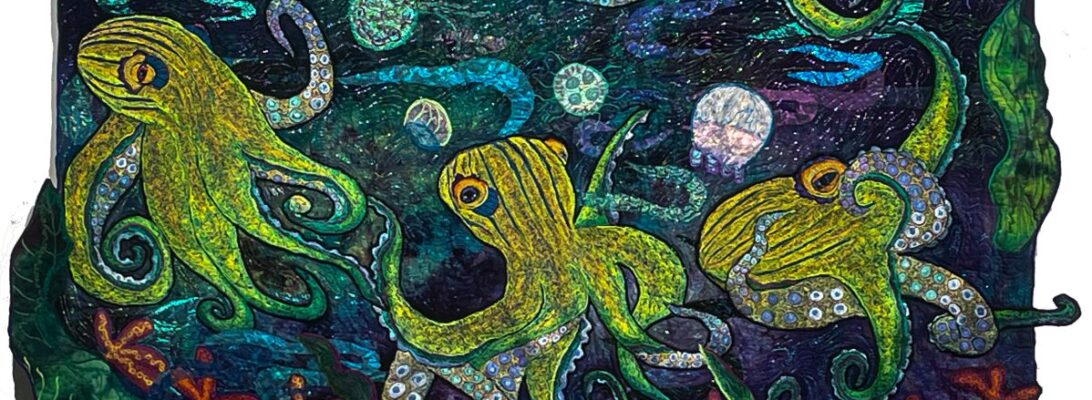
I’ve been mesmerized by octopui lately. About their wonderful movements and their textures. I’ve been reading a book called Remarkably Bright Creatures, by Shelby Van Pelt. It’s a delightful tale largely of an octopus and a cleaning lady.

I’ve lived almost all of my life with my creatures as my closest companions. Can an octopus and a 70-year-old lady be friends? I’m jealous. I’d love an octopus as a friend.

And Matisse. How do octopi and Matisse mix together?

Matisse did a lot of work that centered on movent and patterns. I deeply love his paintings for their rhythms and movements. Can you see how this starts to mix together? The alien grace of an octopus reminds me of these ladies in their dance.

I’ve always loved these dancers. Now imagine them as octopi. I know. It’s kind of an art joke. But I’ve been wanting to do this for months.

These are the octopus I have planned for the quilt. I think they should all join tentacles and dance. Again, it’s about movement together.

Both the quilt and the painting are about fluid motion, the dance between us as a group. So that must be what I’m working on. I rarely understand a piece until it’s finished, sometimes much after that.

Why do art jokes? Because they make us think differently. And that is largely what art is for. And things need to lighten up a bit right now.

I’ll be showing you more of these octopi as I go along. Next week we’ll talk about garnet stitch zigzag and straight and how to shade with it. Right now I’ve been doing sucker.

Tune in next week for tentacles!

telling the Story: How backgrounds Change Everything

Today I needed a color break. I’ve been frantically finishing the Stitch Vocabulary Book for three weeks, and I was terribly tired of computer work. So I sorted out the fabric I intend to bring to sale at Gems of the Prairie in May, That meant I set aside the pieces I wanted to work up.

Of course, that was an immense pile, Somewhere in it, I found this owl.

He really wasn’t lost. I knew he was around. I just wasn’t sure what pile. He was the third of three owls I made for a quilt that simply never worked.

I found several pieces that I thought would be amazing backgrounds. But a very strange thing happened. It wasn’t just that the fabric made the owl feel different. They actually started telling really different stories about him.

So this had a golden open door he’s going through.

Investigating a flower in the garden. Perhaps with small mice or butterflies.

Flying toward a red moon. Or is it a rose?

Is that a fire or a sunset? Is he flying towards it or in flight away from it?

Or somehow a moonlit winter night. Perhaps with snow. Or a flowering tree with moths?

I’m always astonished by hand-dyed fabric. It’s so versatile and offers so much to design. But I hadn’t seen it as a backdrop to a story. And that’s exactly what it did.

Which will I choose? I’m not sure yet. Normally I’m drawn to color. But there’s something fabulous about that winter moon. And while I work on it, perhaps it will tell me its story.

In Black and White: Using Black and White Photography as a Design Tool

I have a secret design tool. You probably have it too. In your pocket. Yes! It’s your camera phone.

We’ve most of us succumbed to using our cell phones as our cameras. It’s one less thing to stuff in my bra, since most of my clothes lack pockets.

One of the hardest things to evaluate in your art is value. Value is the darks and lights in a piece. Color is like candy. Or antidepressants. You reach for them because it feels great.

But value is so much harder. And vital. Texture and color shine out. But value separates the different components in your piece. The best way is to see it in black and white.

I haven’t mussed much with black and white photography since you had to give black and white pictures to newspapers. I’m really dated by now.

But a black and white image will show how the values are playing in your quilt. And will help show you how your design is moving. Your eye will follow a path made by the brightest object. If you make those objects into a path through the piece, you have a visual path that will showcase your work best.

And current cell phones make it simple. There’s a preset in your camera program that will give you a black-and-white photo.

I used this technique when my friend Sharon asked for some design help on her quilt. You’ll find it at A Visit to the Studio: Dsignng with Another Pair of Eyes,

Every design has a path through it. It can be clear and obvious. But what if it isn’t? And how can you tell?

The black and white photos tell us everything we need to know.

This is the beginning picture with the fish with reeds. This didn’t quite move the way I wanted it to. The reeds didn’t form a clear enough path.

Here we see the placement for the smaller fish. But you’ll also find the placement of the reeds moves things better.

Here’s the final picture with bubbles. The eye travels through the piece with grace.

I always encourage you to take pictures of your piece as you work on it. It’s great to have documentation about your work. But it’s also a great design tool.

The next time you’re unsure about the design of a piece, take out your phone, take a picture, and see it in black and white. It will tell you all you need to know.

Turning Over a New Leaf

We’ve talked about ways to make leaves more real. Leaves are wonderful shapes in themselves, but because they bend and fold and move, they add movement to your piece.

I’ve been working on a fish quilt that I wanted to frame roughly in kelp leaves, and it seemed like a good study on making leaves fold. Kelp is a water plant that bends completely to the movement of the water. But it has a definite back and front. We’re going to experiment with making the leaves fold for this quilt. Here we have just raw cut leaves.

I can see some purples in this as shadows, perhaps, but what I really want my thread color to do is to define the front and the back of the leaves. I intend to stitch the edges pretty heavily, so I’m going to do the leaves separately. I’ve cut leaves freehand from several scraps of green and glued them to felt with Steak a Seam 2. On the back, I have Stitch and Tear which is a crisp tear-away non-woven interfacing. So my embroidery sandwich is my hand dye, Steam a Seam 2, and Stitch and Tear.

I took a piece of the release paper from the Steam a Seam 2 leaf cuts and have folded it in different ways so you can see how that affects the leaf. The front side edges will have heavy crenellation on them. The back sides will be smooth where the folds are.

My thread zones are back and front sides. The front needs to be bright/dark /intense colors. The back needs to be muddy, greyed, soft colors.

It seems like the fabric should define the leaves completely, but I’ve found that’s never really so. What defines much of the leaf color is the thread. If the thread is purple it’s at least a purplish leaf. Sometimes that’s the way to go.

stitching the leaves

Here’s a video showing the crenelated stitched edges.

The leaves fold in the water. On the front side, their edges are crinkled and bright. The edges on the back sides are smooth and greyed out. once they’re applied to the quilt I can take sheers and lace and overlay them with water so they look wet.

Here are some of my separate leaves, made to fold in the water.

I’m not so sure about this layout. I think I need to leave it on the wall for a while and see if I have the placement right. I may have overdone. But since nothing is stitched down, nothing is written in stone. I’ll see how it looks in the morning.

To explore more ways to make leaves check out my previous blog post, Over and Under

Tip ME

I’m a bit shy about this, but all art runs not only on desire or passion solely. There are bills to pay and we hope all of us as artists to sell enough work to pay them.

But those of us who have taught, who have shown, who have written to share their art know that much of what we do is never paid for, except in the sense that we pay back the people who came before us. It’s how we make a community for all the artists we know.

So if you would like to support me, buy me a cup of coffee, or let me know I’ve helped or inspired you in some way, here’s a tip jar. I know you’ve supported me all along my journey as an artist. If you’d like to express that in a monetary way, I’d be much obliged. Thanks!

Tip me