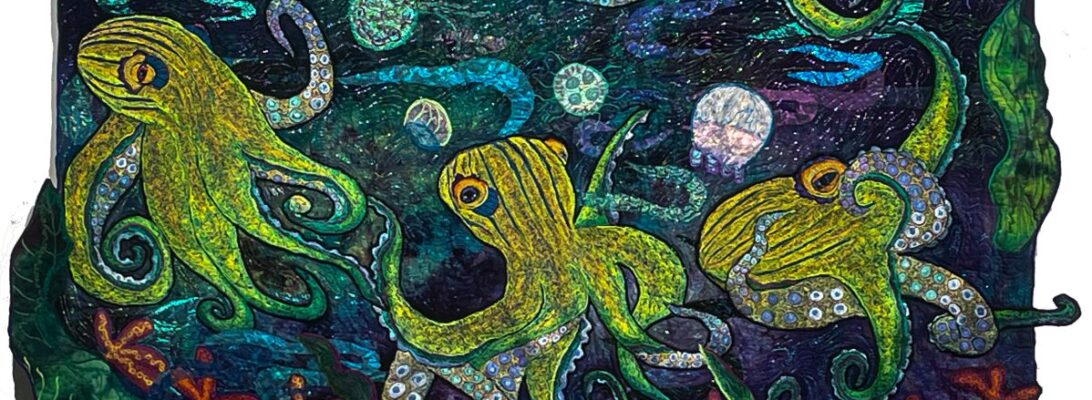
2025: A Year of Experimentation

I didn’t have any shows this year. Which is ok. Every artist has ideas they aren’t quite sure how to approach. Instead, I spent a lot of time trying out ideas I wanted t do my quilts. That takes time and effort. It messes with production significantly. So I’m glad to have spent my studio time this last year in this way.

I learned how to make waterfalls.

I learned how to make a reflection of my subject in water.

I worked on seashells and tenacles.

I experimented with extreme borders.

I learned to make my own rubbing plates from stencils.

I learned to incorporate those plates into my work.

I worked in desert landscapes.

I finally worked out the cat head fountain.

It’s been a good year for learning. If you’ve followed my blog, you know, because each week I show you what I’m working out, working on, and working through.

Here’s to 2025:

Major quilts

Small work

Unfinished work

I couldn’t do this without your support. Not necessarily monetarily, but spiritually, personally, and energetically. No art is in a vacuum. I suspect that I would do art if it were just me arranging deck chairs on the Titanic, but your company on this journey has made it much more worthwhile.

Thank you!

fluffy: Making Feathers with the Long and Short Stitch

This is what I did this week. She’s a secretary bird.

I have to thank John Muir Laws book Law’s Guide to Drawing Birds for its descriptions and information about different kinds of feathers. I’ve been pleased with my pinions, tails and wing feathers for some while, although I wanted them to be less stripey.

I like these pinions. But even with overstitching, they look a bit stripey to me. I’ve been working at overcoming that look by more irregular uneven stitching on the feathers and overstitching.

Body feathers are different. They’re fluffy. They aren’t a part of the flight system. Instead, they are a body cover.

The Long-Short Stitch

I went back to an old embroidery stitch pattern that gave me exactly what I needed, The long short stitch is made by moving your hands unevenly from side to side with your stitching. I made the scallops I would have made for breast feathers, but ragged and without outline so they blend into each other.

Long-short stitch

  • Fills in beautifully.
  • Doesn’t need an outline.
  • Doesn’t need to completely cover the fabric to be effective.
  • Is easy and forgiving.
  • Utilizes a simple zigzag stitch moved from side to side.
  • Progresses nicely. You can add multiple colors of stitchery to build shadow and form without adding a hard line.

The long short stitch in freemotion embroidery has nothing to do with a machine stitch set on your machine. It’s all in how you move your fabric through the needle.

The piece shades from dark underneath to brighter up the neck. But because there’s no internal outline, it looks like fluffy feathers. It’s a bit tougher because we’re shading to white. It needs to look white without actually being a white hot spotlight.

I’m planning this background and sun. Not sure what happens after that. Heavy grasses, I think.

For more information about the long-short stitch check out The Long and the Short of It.