A while back I decided to see if I could recreate the energy from a piece I was particularly pleased with. If you’ve been following the blog, I’ve documented it as I’ve worked.
I wouldn’t call it a success. I went through three separate fish, not happy with any of them. I embroidered the best of them and still felt bland.
So I passed on the bass and did a catfish, which I’m not displeased with. The bass went back into the pile.
I can plan all I want. There’s a serendipity to art that is inescapable. While I was scraping out the studio, I found a piece of fabric I’d totally forgotten about.
All of a sudden, my wallflower fish had gone dramatic. I built him a whirlpool/vortex.
My fish fooled me again. I spent some time embroidering some nice metallic minnows that shyly blended right into the background.
They are pretty, but they have no punch.
So I’m trying these brighter gold minnows. I’m still not sure. They’re embroidered from poly, and they might stand out too much. I may need to do some from metallic gold.
Late last year I did a fish quilt that I thought was really successful. As an experiment, I took some of the same elements to see if I could make something that matched it in energy and beauty. Not copying. Just trying for the same feel. It failed. It laughed in my face.
This is not a new thing. I have piles like an archaeologist’s dig of pieces that didn’t work, tucked into the corner or another. And I raid those piles regularly, looking for the next thing.
Here is my failed experiment. I found it tucked in one of those piles. Could it work a different way?
first fish for fish rising
I blame the fish. He’s a nice fish. A little clueless. But not compelling.
New catfish
So we/re trying again. Same background. New fish. Something with more drama going on.
At that point, I abandoned the idea of using the same components. This quilt needs its its own water and world. I put in sun motes across the surface. I decided against small embroidered fish because I already had some wonderful ones rubbed into the fabric in gold.
Fish Rising, with a different fish
Once I added the new fish, I felt more assured. Full disclosure, I cut off the white tail ends since they made it look like Pac-Man. Much improved.
We’re not done yet. Lots of layers of stitching and sheers left to go. But it doesn’t feel like a loser anymore. My experiment was very useful. You really can’t step into the same piece of art twice.
I try really hard not to rate my pieces as I make them. I find that my opinions of things change over time, largely in reaction to people’s reactions. If I suspend my judgment of work, I find I learn more from it. Suspending judgment allows me to flesh out ideas and move on. Finish the quilt. Next quilt, please. The learning is the goal. The quilt is almost a byproduct.
But sometimes I do a piece that knocks my socks off and throws me across the room. It’s not an everyday thing. When that happens, I find myself asking some of the same questions that I ask when I do something I hate. What happened here? Why is this piece wonderful? Or awful? What?
Was it the color palette? Technique? Is it about my background? The image itself?
A fabulous piece makes you think, “Can I do this again? How did this happen?”
I love this piece so much. So I’m going to try not to reproduce it, but to focus on its successful elements.
Part of what I love here is the quiet palette. I normally go for eye-sore colors. This was restrained. Luckily, the last batch I dyed had a piece, not exactly in the same palette, but in the same tone.
The fish can be the same threads. And I think it needs to be.
I had trouble with the fish. I wanted a fresh image, not the same, but in the same colorations. So I started several fish, only to find them wrong. I love these. But in terms of direction and size, they’re just not right.
I went through my collection of drawings. My embroidery process uses a pattern drawn on Totally Stable that goes into the back of the piece as a pattern and a stabilizer. So each drawing is consumed by the embroidery itself.
Not to worry. For the last 3 years, I’ve saved a tracing of my drawings for later. It’s turned into a jumping-off point for other pieces, and I consider that collection a treasure. I found a fish that had to be at least 10 years old, which I don’t believe I ever used.
This will be reversed when I’m done. I’m half way through the embroidery.
Originally I used a tree rubbing plate both for the trees themselves and for the reflection in the pond.
And I want to explore the rubbed oil paint trees. This piece of fabric evokes a stream rather than a pond.
Now that I’ve analyzed my elements, we’ll see where it goes. It’s at that awkward spot where everything looks wrong. But that’s the exact moment to suspend judgment and push through.
It may take all those elements and work well. It may not. There’s a mystery here I don’t understand. But I think that part of it is that a piece is not the sum of its parts. Instead, perhaps it’s a whole being itself. Maybe it can’t be reworked with the same success.
Push on. Finish the quilt. Next quilt, please. The learning is the goal.
Series really almost always just happen. You make one fish quilt and suddenly there are six fish quilts. Since you’re working them within a reasonable time of each other, their techniques tend blend in with each other. Instant series.
Series are about obsessions. They’re about images you just can’t let go of. For some reason or other you’re compelled to work an image over and over again, until something settles within you and says you’ve done enough.
But every so often, you choose to make a series. That can be for many reasons. If you’re not compelled by the images you are about to die of boredom But if you’re compelled, you know what you’re doing for the next three to six months. Series are exciting because they get to answer the what-if questions.
I spoke with a gallery that expressed an interest in a show. It’s a smaller gallery, and it made me think of Monet’s Orengaria
For those of you unfamiliar, here’s a short history
Offered to the French State by the painter Claude Monet on the day that followed the Armistice of November 11, 1918 as a symbol for peace, the Water Lilies are installed according to plan at the Orangerie Museum in 1927, a few months after his death. This unique set, a true « Sixtine Chapel of Impressionism » in the words of André Masson in 1952, testifies to Monet’s later work. It was designed as a real environment and crowns the Water Lilies cycle begun nearly thirty years before. The set is one of the largest monumental achievements of early twentieth-century painting. “
What an astonishing thing, to have a circular space, filled with Monet’s waterlilies
Monet is really the poster boy for series. His waterlilies illuminated his whole life. He painted many other things, but when I think of Monet, I think of waterlilies in the pond
Not to agrandize myself, but this little gallery would offer a chance to do an in the round kind of show experience.
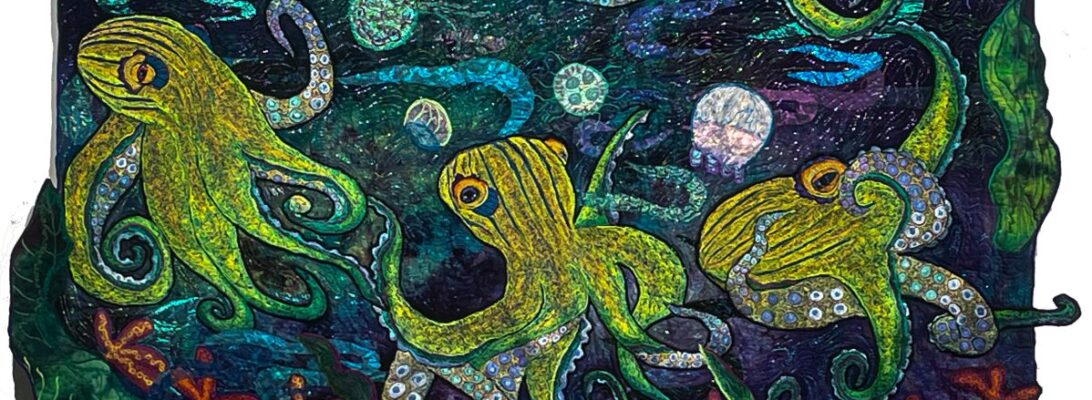
Lately I’ve had a fascination with octopuses. My passions in images have to do with movement. So much of my life I’ve been constrained with a body that just doesn’t move as well as it might, I’m fascinated by the movement of creatures who are not resrrained. Nothing can move like an octopus. They also change color. I don’t know if some of the pictures I’ve been looking at are ai or not. I’m playing. They can just be wild. Why not put them in a gallery in the round?
Here are my two prior octopus quilts. I think they’re a good start
So here are my drawings for the series. There might be more. I’m not sure if they are three quilts or four. I’ll know when they’re embroidered.
So we have one octopus mostly embroidered. I’ll keep you posted as I work up the others. Encircled by octopuses. Sounds pretty wild.
Between the cooking of birds and a small blizzard, we’ve had a pause in the world.. Don spent yesterday napping, I believe. I don’t know because I binged watched most of the extended Hobbit with Tolkein, my cat, and started a new sweater. Not what we normally do.
This was not a year for travel. Time and space have not cooperated. But it doesn’t mean that I felt people were distant. How did I manage to make friendships that have lasted 30 years, 40 years? How did that happen?
When we all could travel easier, many of us made friendsgiving, the day after thanksgiving. Now our bodies just aren’t cooperating. But strangely I felt everyone there. Don and I are only kids. We’re both, thankfully considering our parents, orphens. But we have family, rich and strong and very much loved. Thank you all.
Speaking of parents, my father fished as a religion. It was where he found peace, rest, calm and joy. I’ve never wanted to catch a fish in my life, but he took me in his small row boat, and immersed me in that world. Part of me has never left. When I stitch fish, I’m revisiting it. I offer it to you.
I spent the week batching luna moths for my cranes. I’m not sure whether they sit on the coast or not, but they’d be in the adjascent swamp land.
I love batch embroidery. It’s coloring in the zone. I use it for most of the small to medium elements in my quilts. So much can be done with small fish, flowers, frogs, birds, lizards, and anything else you can think of. I always make too many. It’s sort of like too much bacon. How could that happen? And of course, I can always think of a use for another fish or strip of bacon. Many pieces need a left over elements, just to round it out.
Batching elements helps me build a body of things to incorporate into a quilt to make it more love, to make it move, to make it flow.
It may be too much. This is the first pin up. They always shift by the time I get the water in and make adjustments. I think it needs rocks to ground it.
I’ve been working on this piece for a while. And then I’ve needed to let it sit.
Partially, I was waiting for weed stencils I could turn into rubbing plates. They came from Temu. and took forever. But I’m pleased with them. I want more, higher up on the right side.
Now we come to the tricky part. We have a blank space on the left hand side. You don’t have fish or frogs in surf. Maybe butterflies by the shore. I think rocks would be understated and wrong. What will I use to fill in?
Usually I know my options pretty well. I work a lot with grasslands and swamps, rivers, and ponds. Ocean shores, not so much. I’m not sure what is on the beach except for horseflies. Somehow, that’s not what I wanted.
Google didn’t help either. I looked up coastal insects and got lots of information about pest control. I was hoping for pretty pest control subjects. They did mention some pretty moths.
This is a moment I’m glad I’m a bibiloholic. I have in a series of books, Florida’s Fabulous insects. I have a terrible urge to use a lunar moth I already embroidered. IT worked pretty well. Moving moths could set the path for the eye through the quilt. When I looked it up, luna moths are down there.
So I drew out a series of luna moths. It’s more than this piece needs, but there is no such thing as a luna moth I won’t eventually use.
Design is a process. Solve one part of the puzzle, move to another part. Waiting is also part of the process. I find pieces grow into themselves rather than follow a design I had in mind.
I spent last week working on three cranes. I was fairly pleased with myself, when someone asked, “Are these cranes having sex?
I hadn’t seen it. I still kind of don’t. I looked up a picture of cranes in love, and it didn’t quite look that quiet. But I have my head in my hands trying to figure out what I do next.
I was inspired by a Japanese textile design in a Dover Pictorial Archive book. I’m pretty sure they didn’t see it as cranes in love. It was my own rendering of it, changed in the way we change everything we draw ourselves.
Usually I let people tell me anything about my art. If it comes from them, it’s theirs. I don’t mess with that. I meant what I meant. I’m not responsible for their response.
But this hits me in a place that makes me feel very vulnerable. Sex is about bodies and bodies are about vulnerability. Art is about visual vulnerability. I’m not really secure about body image. I work in animal imagery since I can’t bear to work in human flesh. I have a delicate detent with my body, somewhat riddled by the failures of old age and memories of high school.
It’s a response to really old tapes. I wasn’t just fat. I was born deformed. Admittedly, it was a small genetic oops. But my mother could build a tragedy out a broken nail.
IF you are harmed enough, people can frame you as being inhuman. If you are harmed deeply enough, you may even think that’s true. If other people think it’s true, they can do anything to you because you aren’t a human being. That was my whole childhood. It seems to be going around globally right now.
I’m not taking this anywhere except in my own life. And I don’t want anyone to explain situations where it is somehow ok. Or tell me to get over it. I don’t believe we get to dehumanize people.
The bottom line is that I’m terrified of naked vulnerability. My animals are me in some way. I’ve come to see my self through Don’s eyes and his vision is kinder than my memories. I usually let that stand. I’m not sure I can be a crane in love on a quilt.
I took the time to reoutline the birds. It usually makes things clearer. Maybe this time that’s not such a good idea.
So what do I do with a quilt with cranes possibly delecto inflagrante? Do I finish it? Put a bunch of cat tails around them? Do I stuff it in a drawer until I feel more brave? I tend to not just throw work out, even if I don’t like it. I could put a lower price on it, and it either sells or it doesn’t. That assumes I can bear to finish it. There’s a dark corner in the closet, perfect for storage.
So what do you think? Would you finish it? Show it? Put a fig leaf on it? What?
I’ve whined a bit about larger work this month, mostly because I had 6 full sized pieces to finish. Not fun. But all but one is done.
So in response to that, and in giving myself a break, I decided to do something smaller. These Japanese cranes have been on my mind for a wile. Originally they were on a textile.
People talk about making a smaller version of something and then blowing it up. I’ve never found that works. The size changes what you can do with your stitchery.
When I work large, my thread color choices have to fill in a space. It’s a larger space. I do have a formula for that. And a basic color strategy.
I work dark to light.
The color of my background is the light within the piece. So that color has to be part of the choices.
Everything is accentuated. I choose my colors to be more intense than the overall effect I want
Your eye will mix the colors. Even if they don’t seem to go together. Don’t be afraid.
I choose
A dark tone of my desired color.
A shader, usually either purple, brown, dark green or blue.Often I’ll use a complement from my desired color
Several shades of th chosen color.. They can differ in tone and clarity, but they need to be lined up dark to light.
A shocker. Usually the complement in a bright form
A light color that is the color of the piece.
The lightest color. Usually lighter than you want the piece to be as a highlight.
That fills in a lot of space.. It needs to. It allows for some intense coloration.
Smaller work is smaller space. No help for it. The stitching isn’t as intense and you end up with a much small space to fill in. So your choices pull in.
For your thread choices you’ll want.
The darkest tone of your color
A toner, complement, brown, blue, or purple
A mid color
Maybe a shocker
A light color
May be a highlight color
It’s the same theory, but it’s stepped down for smaller spaces. I don’t like to work that way because it makes wild choices feel more intense. It abstracts very quickly
So I worked on these cranes this week. They’re white, but I worked up to that with a lot of soft toned pastels and greys. I was completely worn out on them until I slipped in a bit of turquoise.
I’m not wildly unhappy with this, but I feel limited by it
.The joke is that the ended up fitting into a yard of hand dye, the size I most often use for large quilts.
I don’t often do this, but I have a pervasive urge to redraw the image bigger, and go wild with the colors, just to see what I get.
It’s always good to change things in your work. Any change is a challenge. Chainge the size, change your pallet, change your subject, and certainly at the right moment, change your undies. Change is good.
I’ve been prepping for a show proposal for weeks now. While I was working through my machine woes, I couldn’t back and bind the larger quilts. Now that I have a functional 930, I could accomplish that.
Two years ago, I started this heron piece. I don’t know what I was thinking. It’s a heron drawing I found in my files. It was lovely. So I embroidered it and fit it into a quilt.
But it’s large. The word large is inadequate. It’s roughly 59″ x 59″ It’s larger than I’m tall.
Embroidering it wasn’t’ the problem. But after you add a back and a layer of felt, you have a lump. A very large lump.
So it sat the corner. And I became afraid of it. I made a myth of it. It was too large. It wouldn’t fit through the machine. My arms aren’t as strong as they used to be.
I had a friend ask if I could make it work if I cut it up in some way. That shook me loose. It wasn’t a bad quilt, or even a failed quilt. It was just too big. And I was being a coward.
After that I went hunting my big girl panties.
All of those things are true. It’s too large, it did not fit prettily into the machine. I had to jam it under the machine head. And my arms may be less strong, but my will..? Never doubt my will. No one can tell me no but me.
There’s no can’t like won’t, Sometimes we build myths about our work. “It’s so good.” “It’s no good.” “It will never lie flat” Almost all of that is irrelevant. I won’t know i it’s good for some while after I finish it. I need to stop the negativity and just step into the task. It was backed, quilted and bound in 3 days.
Here’s the details on Great Blue
Here are the other quilts I’ve set up for my proposal. I think the heron’s really necessary. Big girl panties and all. Wish me luck.
Willow MarchEgretBlue FishOctopi ReelBsvkyard ConversationWaterfallBlue PondSnake in the GrassIn the ShellBig FishWaterfall