Walking a Visual Path: How Does The Design Invite Us Into Our Art

I’ve been a long time follower of the visual path. Our eye travels through a piece of art and makes its own journey. We can build that visual path with our objects and their placement.

A good visual path

  • should welcome you into that world,
  • should give you a good tour, covering the surface of the piece.
  • should graciously show you the way out.
  • should breathe.

But part of that pathway is perception. How does the structure of the design direct us to travel on that path? Where do we start?

There are some other good questions as well. What makes an entry point? How do we travel? Are we released from the piece at some point? Or does it try to make us stay focused within the piece?

I’ve begun to think about how we enter a piece when we see it. Where does the eye start? Does it make a difference? Being a good dyslexic, I always thought it didn’t, but I’m thinking I was wrong.

As Westerners, we read left to right. So do we enter a project visually from the left and travel over to the right hand side? And what does that do within the language of the piece? What does that positioning tell us?

Handedness is pretty hardwired, but some of it is cultural. We can see an image either from either left or right like flipping a slide. But how do we normally process that?

What matters is what we see first. Where does it direct us to look?

If it faces directly in front of us, that sort of stops the motion right there. We are where we are.

If the subject is facing us, headed left, we see it as the main object.

If the piece is standing facing from left to right, we see it as a main object, but we also see what it is focused on.

The entry point is either a spot that focus us for being open, or for grabbing our attention.

For our purposes, the red arrow is the entry point and the yellow arrows point out the path.

The entry point here is the from the view of our subjects. Everything carries them along in their quest. The movement is all left to right.

The bird is our entry point. We see what she sees. She’s focused on a pond beneath here.The rocks circle the pond, defining it, but also drawing our eye around it.

Our entry point leads us straight to the mocking bird facing left. . Her glance takes us around the piece following the lizards.

This is just a theory so far. I’m curious what you think about it. How does the facing of the subject change the story of the piece. What is the structural language? What are we saying?

So this is drawn with the eyes facing left. When it’s embroidered, it will be flipped horizontally and it will face to the right. We’ll be in a position to see the world as the fish does.

I’m not sure about this yet. It’s a theory. I’m curious to see what you think as well.

For more information about visual paths, check out It’s the Little Things Building a Visual Path

She Sells Sea Shells: A Study in Contrast

I haven’t made a lot of shells before. Starfish, yes. Jellyfish, inevitable. I find shells daunting. They’re not easy to draw, and they can’t be made to look like they’re moving. So this was an experiment.

Designg for contrast

One way to look at design is how to separate the field from the ground. You need to create differences that help the eye sort out what it’s looking at. The shells should be immediately different from the octopus and the sea.

This quilt required a shell for the octopus, And a tangible difference between them to be visually clear. The way to make things pop is to create a visual difference between differnt design elements of color, texture and size.

The color palate makes a clear separationg. The octopus is strongly orange, contrasted by the complemetary blue sea, and the off white and browns of the shells.

But we can make that contrast even stronger through the texture. Texture is made by stitching patterns, thread content, and thread size. Those design decisions clarify the design.

Shells are deeply textured with a smooth inside. I didn’t show the shiny insides of these shells. So the outsides needed to be crunchy and rough.

So the octopus is garnet stitch in polyester thread. The shells are out of both wound and flecked metallic threads. The threads contrast strongly. Metallic thread is much rougher than the smooth polyester. Both threads are 40 weight.

I also used a zigzagged scallop pattern for the shells. I stitched the rows irregularly with ribbed veins, so they’d seem more natural.

The water is stiched with an 8 weight metallic to separate it from the shells and the octopus.

Thread choices help the eye separate the shells, the octopus, and the water, ‘It helps your viewer unnderstand what is happening in your piece in a glance.

This piece is ready to back and bind. I’m just waiting for a cool enough day.

Wisteria Blossoms

Sometimes hand-dye designs your quilt for you.

I had embroidered a radiated spoonbill landing, and I needed a background for her. This purply brown piece seemed nicely swampy and I loved the range of purple running in an arc through it. It looked like a bower of wisteria, so that’s what I went through.

I’ve done wisteria before. I sometimes feel I can smell them in the studio as I stitch on them

I wanted particularly soft glowing wisteria for this very dark swamp. These were done mostly from hand-painted lace, stitched with poly neon.

And small bright birds sitting in them.

On thing leads to another. The bird leads to the swamp background. The swamp leads to a wisteria bower. And the wisteria need bright little birds.

Wisteria, like roses, sunflowers, and hollyhocks, are part of the garden of my dreams. I can’t help but slip them in wherever their fragrance and illumination are needed.

The next step is to fit everything in together with a pond at the bottom, birds, and small fish.

On the other side of the studio, we have 2 torn-up 930 Berninas. Don has been heroically deciding which will live and which will be a parts machine. I’m working on the only functional embroidery machine, an 807 Bernina from around 1970. It’s a tiny machine, originally for classroom. We’re waiting for the resurrection, which sometimes spreads more slowly than you would like. It means I’m not able to work the 2 large quilts I have laid out at the moment. So….

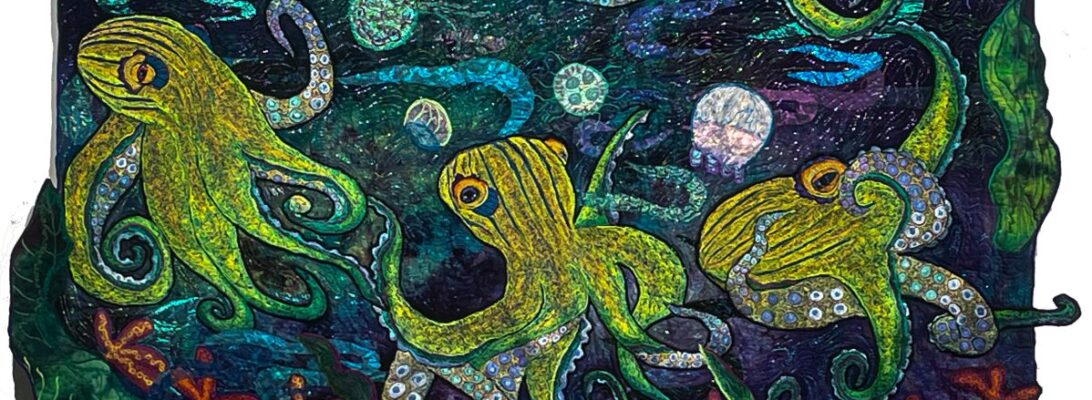
An ocean floor, several external tenacles lots of jellyfish, I think. On a much smaller piece of fabric.

fluffy: Making Feathers with the Long and Short Stitch

This is what I did this week. She’s a secretary bird.

I have to thank John Muir Laws book Law’s Guide to Drawing Birds for its descriptions and information about different kinds of feathers. I’ve been pleased with my pinions, tails and wing feathers for some while, although I wanted them to be less stripey.

I like these pinions. But even with overstitching, they look a bit stripey to me. I’ve been working at overcoming that look by more irregular uneven stitching on the feathers and overstitching.

Body feathers are different. They’re fluffy. They aren’t a part of the flight system. Instead, they are a body cover.

The Long-Short Stitch

I went back to an old embroidery stitch pattern that gave me exactly what I needed, The long short stitch is made by moving your hands unevenly from side to side with your stitching. I made the scallops I would have made for breast feathers, but ragged and without outline so they blend into each other.

Long-short stitch

  • Fills in beautifully.
  • Doesn’t need an outline.
  • Doesn’t need to completely cover the fabric to be effective.
  • Is easy and forgiving.
  • Utilizes a simple zigzag stitch moved from side to side.
  • Progresses nicely. You can add multiple colors of stitchery to build shadow and form without adding a hard line.

The long short stitch in freemotion embroidery has nothing to do with a machine stitch set on your machine. It’s all in how you move your fabric through the needle.

The piece shades from dark underneath to brighter up the neck. But because there’s no internal outline, it looks like fluffy feathers. It’s a bit tougher because we’re shading to white. It needs to look white without actually being a white hot spotlight.

I’m planning this background and sun. Not sure what happens after that. Heavy grasses, I think.

For more information about the long-short stitch check out The Long and the Short of It.

Bird Feet: The Difference in the Details

One of the reasons I like working larger is that I get to play with the details. Smaller images sometimes only need a line of stitching to define things. Larger images allow me to play with color and texture. And the space to make the details count.

There are a couple of defining factors. Are the legs and feet segmented? A solid line of black stitching defines that.

These feet were stitched with progressive colors in garnet stitch, small circles intertwined together.

Does the stitching flow into itself? These have simpler feet and legs with segments.

Does it have patterned stitching? These were stitched in u-shaped scales.

Garnet stitch textures these feet with quieter tones.

Of course, the angle of the legs creates the movement of the bird.

And you can cheat by putting the feet in water.

Different textures, different treatments make the kind of details that define the piece.

Deciding Rather than Designing: Starting from Scratch

I wish I were someone who could take a design and execute it. I can try. It’s a case of man proposing, and God laughing. Instead, a series of decisions are to be made at each point. Each decision points to the next.

One of the most useful things I do in a class is to start a piece from scratch. It’s not like there is a direct list of what you do next. But there are some decisions to be made. It helps to have a plan.

Here is the list of things I need to decide for each piece.

  • Background-The hand dye creates the light and the atmosphere for the piece. It usually is the first choice. Does it have a sunspot? A pool? A field of flowers within it? It dictates almost everything, especially the lighting in a piece.
  • Major Images-These are the main focus. I draw them in Totally Stable, backwards. They iron on to the back of the piece and remain inside the piece as a pattern.
  • Atmospherics-Water, light, smoke clouds, and sometimes leaves and flowers are atmospherics. They are usually made of commercial sheers, handpainted lace, and dyed cheesecloth. They make a translucent presence in the piece.
  • Details/pathway-These are smaller embroideries, or stones, or leaves that can be used to create a visual pathway through the surface.
  • Texturizing the surface/stippling- after all that embroidery, the rest of the piece needs to be integrated. The stippling over the surface can pulls the piece together.

There are no right or wrong answers. There are simply decisions. Each defines the piece. What I choose not to do also shapes the definition. I’m OK with that. I’ve learned that each decision I reject can be featured in the next piece. Or the one after that. I’m not making one perfect piece of art. I’m creating a body of art that explores the limits and range of my techniques and my skills.

This piece, like most of them, started with a piece of fabric and the idea of herons. I dye a number of pieces of fabric as cenotes, wells of color. Some times the cenotes make a light source, but this piece made a wonderful pond.

The birds started as whistling herons. But at a certain point, they were indistinguishable from the Louisiana Blues. So I did them as blue herons. It’s important to finish the major embroideries first because they shrink. You don’t know how they’ll fit in until they’re embroidered and cut out.

The atmospherics for this piece are water and grass. The grass is an oil paint stick rubbing of a ceiling tile. The water is accentuated with c-shapes of hand painted and commercial lace. Then I put in rocks to anchor the pond and direct the eye.

I decided on damsel flies and grasshoppers, as pathway elements. They did not work the way I had hoped. The damsel flies fit in, but I’m not sure of the grasshoppers. I’ll have to finish them to be sure.

Finally, I wanted seedlings growing up through the water. I made big beautiful bold seedlings the size of God’s underpants. Again, not the best choice. I scaled that down and it was much more effective, although I might want bigger ones at the bottom.

This piece is pinned in position. I’ll be stitching soon. But most of the decisions are made, step by step, before it’s stitched down.

A River Runs Through it: Creating Stunning River background with Oil Paint Sticks

You know I go crazy over oil paint stick rubbing. My first tries with rubbings were not successful. But at this point, I use them regularly to texturize backgrounds. Mostly I use commercial rubbing plates. They’re pretty and flexible. But they’re not very big. The technique lends itself to smaller pieces. They’re fun. But covering a half yard of fabric with a 6″ square design takes forever

This was a leftover piece for it. I love it but it’s just too small. And I wanted a piece that would give me perspective on the river I wanted to build for my frog river.

I love this background. I found I had a leftover frog and dragonfly, and they suited each other quite well. But the fabric didn’t feel enough like a river. It needed water and rocks.

. Unfortunately, I haven’t found any rock rubbing plates.That just meant I wasn’t looking in the right place. Lowes has some rock backsplash tile I’d purchased. I love the texture.

Here’s the extra rock tiles I found. They are backsplash tiles from Lowes. They are on a thread mesh, but they are real rocks.

Rivers are often defined by the pebbles at the bottom. So I decided to build my river with some rock rubbings.

So I went back to Lowes. In the backsplash section, I found a collection of rock tiles in different sizes.

I also picked some rubbing plates that make good river foliage.

I drew some chalk lines to show me where to put the river. Then I began with the smallest rock tile

I went to the larger rocks landing at the bottom. Then I rubbed blue and purple ripples through the river area.

This is subtle. But I do like it. Here the frog and the dragonfly fit into the river and sky. I’m planning on minnows and cat tails along the edges.

I finished off the composition with water patterns over the rocks. Then I added a layer of blue and green sheers for that wet look. I can hear the water running

What’s the take away? I can build depth into my piece by making a path that starts near me and gets smaller as it retreats. I also can find stones and tiles that pass as rubbing stones at any good hardware store. And I can make a river out of a paint stick, a backsplash of rocks, and a water rubbing plate on top of them. That’s a lot to ask of a piece of fabric and some paint. But we all know that oil paint stick-rubbed fabric is a magic of its own.

Check out this earlier blog on working with oil paint sticks if you’d like a tutorial on using paint sticks.

A Very Buggy New Year: Streamlining Quilting with Component Techniques

Component quilting lets me streamline my quilting. I have two quilts I’m working on that will need some bugs. Why?

Both of these pieces are going to need some help building a pathway. Bugs are a great way to do that. They flitter across the surface and they create movement. But these need a significant number of bugs. It’s just easier to make a batch. I think ended up making 35 in all.

I did damsel flies, moths, and small white butterflies for the frog/turtle quilt.

For the bluebird quilt, I wanted larger white butterflies.

This batch of bugs was a color lesson for me. Normally I ignore gold and silver thread. When there’s purple and green metallic thread, why would I use gold or silver.

All of the bug bodies are from Madeira FS2/20 thread. The black core thread really looks like beading up close.

I tried the opalescent white as a butterfly wing. I was underwhelmed. I really don’t like the pink quality.

I needed the white that silver brings. I tried going over it with silver afterwards. It was not improved.

Opalescent white under silver does a nice bright white. For those birds, nothing else will do.

I wanted a softer quality for the moths and the swamp. So they were done from polyester threads.

For the damselle flies I needed a solid carapace and see-through wings. The iridescent thread did the wings nicely, even with the pink cast.

Different threads offer really big differences in the result. In this case, it keeps the bugs separate from each other and from the other elements in the quilt.

Size is a limit with component quilting. Things under an inch and a half are hard to keep crisp and have too heavy an outline when they’re applied. But for most elements, it allows me to choose where to put what. Choice is good.

Art Jokes: Is that Really Funny?

I have been known every so often, to make an art joke. Not a play on artists’ names or a verbal exchange. Every so often, I take a fairly well known piece of art and place its content within the artmostphire where I live.

The new roseated spoonbill quilt is named Pinkie, after the Gainsborough Pinkie

Why? Partially because it amuses me. I see most people as animals, not in a negative way, but in the sense that we live as animals do in a flesh-and-blood world. I embroidered my pinkie as a roseated spoonbill in her wild coastal setting.

Does it change the value of my Pinkie, to know that about her? May be. It’s nice to know where things come from.

But like all good art, it changes how we think. My Pinkie is a lovely creature, looking formidable and wild and yet fragile where she is. The girl, Sarah Moulton (1783–1795), is just as formidable. Her ribbons were thrown to the wind, but I get the feeling she could make her commands known and obeyed. Basically, your standard teenager. For all that, her father deserted her and she ended up in school in England where she died of a cough when she was twelve.

My point is that neither beauty or poise keep us safe in this world. It’s an odd mix of good luck and strongminded will that keeps us going,

I know. It’s not funny. But in the tradition of court jesters everywhere, the point is to make us think differently. I’m short enough. I might as well apply for the job.

I also did this with Matisses The Dance.