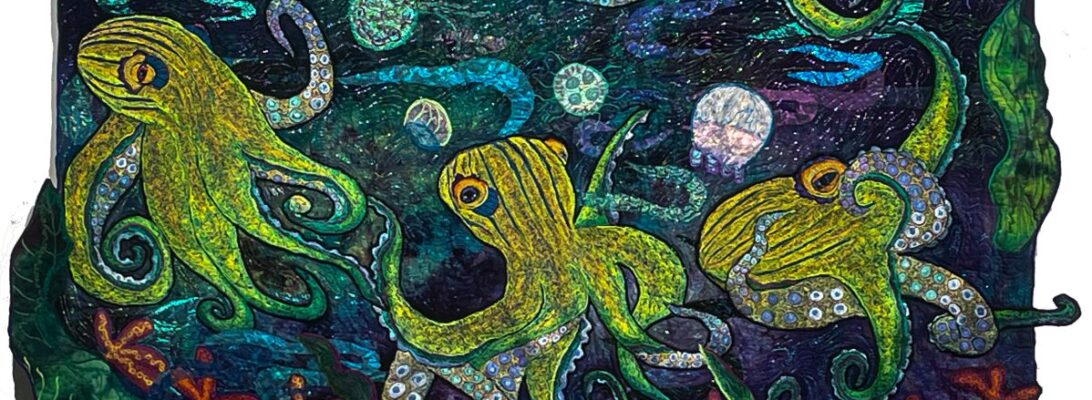
Whenever you do any kind of representative art, you end up needing to do your research. Does the frog have three toes or two? Does it matter?
Sometimes it really does. Sometimes it really doesn’t. But it’s always more impressive to get your details right.
I do water lilies a lot. Lotus, not so much. And I’m really not sure why. But for this quilt. I want lotus, with their big stand-up pads and their flowers standing proudly on their stems. I need the vertical motion of them.
So I went looking for pictures. When I did, I found lotuses and waterlilies side by side in the search for lotuses. So what is the difference?
I decided it was in the way the petals curved inward, Instead of having a petal shaded differently on each side, I shaded them so that the shadow was in the middle of the curve.
Each quilt gives me an opportunity to explore the shapes, colors, and shadings.. We look as artists for formulas that we can use. But in the end, it’s all observation set in the colors we play with. And a dance of choices, individual but built on all the choices before.
I love minnows! My dad used to bring me home minnows when he’d been fishing, so I could watch them. They aren’t exactly like fish visually. They have parts that are solid, but they also have fins and underbits that are really translucent. How do you do that in thread?
I used to not pay much attention to the kinds of metallic threads I used. I mixed them all together by color and that was that. But lately, I’ve been paying more attention. Metallic thread is not only shiny. It comes in different kinds of transparency.
Why would that matter? A more transparent crystal thread gives a translucency to your embroidery. It’s not quite see-through. Most wound metallic threads are not at all see-through. But the flecked metallic threads can be to some extent.
Most metallic threads are not. They are a strictly shiny surface that reflects, in both ways, the solidity of metal.
Metalic-colored threads have the shine, but they are not see-through either.
Crystal metallics are different. They have a translucency that translates into your stitching as being see-through.
With some careful planning, the bodies of the minnows are mostly solid, but the mixture of metallic silver and iridescent white crystal makes for transparent-looking fins.
It’s a trick, but it’s a cool trick.
These minnows will be in Shadow on the Shore. I’m not sure how many minnows we’ll use, but there’s always room for leftovers.
For some while I’ve been wanting to make reflections in water, and work with shadows. I also have usually only done river and pond water. This image made me want to break out into shore surf. The heron has her wings up, so that they distort the shadow and the fish won’t see her.
I’m a bit uneasy about what the surf should look like. So I did some research. I love Japanese art, and looked through some imagery on waves on shore. Sometimes it helps to have a good idea what something looks like. These drawings were great waves. They gave me a place to start.
I broke down the drawings into simple shapes. And I cut them in a lot of different blues, and a specific glistening white.
But I needed to make the shadow. There may be more sophisticated ways to do this, but I traced the embroidery onto Steam a Seam 2.
I’ve changed backgrounds a lot on this. I finally settled on something a bit brighter, so you could see sand and sky.
The first one I cut was purple. It simply wasn’t dark enough.
Black glitter tulle worked better. I patted on some glitter tulle and cut the shape out.
I cut out wave shapes and layered them together.
The sky is pure sun headed into greenery, and I didn’t want to do something bold with it. Instead, I added spirals heading from gold to green to feel like the sun shimmering down.
I’m pleased with this although I haven’t ironed it down yet. The placing of the heron is really delicate. So I’m looking at it for a while before I commit.
Things to know about layering sheers:
Sheers may look different once you’ve ironed them. Have a test piece so you know what it will look like.
Your Steam a Seam 2 will make your needle skip if it’s not ironed down properly. That’s harder to do with multiple layers. And if you use lace the glue will come through
Layered sheers take more ironing to stick. But you don’t want to melt them. Use a no stick pressing cloth to iron them down and clean it after each piece is ironed. I use a non-stitck Scotch-Brite Scrubby. When you are all done, lay a piece of cotton scrap over the top of it and iron on hot. The excess glue will melt into the scrap. Make sure you don’t transfer glue from the scrap to your piece.
Sheers make wonderful shadows. I’ll stitch all this down with monofilament nylon so there are no hard edges, just shadow, sun and sea.
There’s a constant pathway in my studio. It’s not the one through the piles of fabric, although that would be useful. Often one quilt sparks another quilt, either in concept or in terms of left overs.
The fish in Swish and Koi were once supposed to be in one quilt. It just didn’t work out that way. I guess if you’re a red fish you need a space of your own.
You know I always make extras of everything. Right now I’m working on some green and silver minnows. I can’t go wrong here. They’re right for the heron I’m working on, but those I don’t use are bound to fit in a quilt somewhere.
Rose MoonRose Moon detailOwl StreamOwl StreamHunters Moon
These 3 owls all look similar in style. That’s because they were all made for one quilt. That quilt simply didn’t work. I have those moments, like everyone else. It sat in a pile for around 8 years/and I decided to use one of the owls. Then another. Then another. I consider any quilt that sits in a pile for 8 years unfinished to be probably not working. Unless I have a miracle revelation when I find it in the pile.
This is how my studio works. I produce work in many stages. Sometimes those stages work immediately as I envision them. Sometimes they don’t. But there is surprisingly little waste. Almost everything gets used somewhere. It’s a process of finding the right place to put it.
There’s another side to this. I get to take an image and put it into a different place. Which is exciting because a different piece of fabric puts it into a different world. That’s a wonderful experiment. Will the light change it? Will the stippling change the light. So many questions to ask in sequence. And to answer.
The price tag for this is the ability to change your mind. Understand this is a process you are not in control of. And enjoy the ride as your pieces develope under your hands.
This piece has been sidelined several times this year. I’m grateful to have it up on the wall ready to back and bind.
I’ve lately been hearing people saying, “Don’t stipple.” I couldn’t quite figure out what they were talking about. Stippling serves to anchor and detail the negative space in your work. One of the problems with intense embroidery is that you can’t just leave the fabric around it blankly unstitched. It looks very puffily unfinished if you do that.
The stipple also sets the shine for the piece. Depending on the threads you chose, the difference in the shine can help your eye separate sky from land and sea. The moon is stippled with monofilament nylon. All you see is the waves in it but no color change. The area around the heron is air, stippled with a multi-colored Madeira Super Twist.
The water stipple is with 8 weight metallic thread. Both the Supertwist and the thick metallic threads are stitched from the back. The 8 weight thread is too thick to go in the top so it’s in the adjusted bobbin. The Supertwist is a bit fragile, so it’s stitched from the back with a regular bobbin case.
The cool thing about stitching over the sheer overlays is that includes them in the water movement. I did not do that with the air overlays.
So what was that lady talking about? I finally figured it out. She was talking about that random puzzle piece kind of stipple. She is right. There are a million ways to stipple a piece. But that puzzle stipple does nicely in the air here. The thick and thin metallic threads separate water and air.
The stitching you use as stippling defines and fills the negative space in between your objects, giving them meaning that goes with their gorgeous looks.
If you are looking for other ways to stipple look up Leah Day’s 365 Free Motion Quilting Designs. It will give you all kinds of ways to add texture and free motion without the puzzle piece stipple pattern. It’s a brilliant book!
Yesterday I gave a lecture on the Visual Path at the Peoria Art Guild. The best thing about lectures is that they help you think about what you do without thinking. I know that a major component of my design decisions is largely about making work move. Lectures give you a reason to think it through so you can talk about it.
Every artist has conundrums they are trying to solve within their work. For myself, making movement is one of those. If I’m filling the world with images of birds, bugs, lizards and frogs, I would hope that they would be breathing, living, moving birds, lizards and bugs. So how do I do that?
Here’s a section of my lecture with some of the rules I’ve decided help me.
These rules may seem silly or simple. But I use them every day. If I want to make things move, I can tilt them, change the size dimensions, create the illusion that they’re falling, or put them in a progressively larger or smaller conga line. All of those are cheap tricks. But they work.
That got me thinking, how many artists have rules they’ve made for themselves that help them to do what they want with their art? And what happens when we break those rules? Are we reminded why we thought to do that in the first place? Or are we liberated by realizing that rule isn’t all that ironclad?
The very cool thing about all this is that no one gets to apply those rules to us as artists except ourselves. It’s not so much a box we’re stuck in as a useful gridwork we can choose to use, or not.
My visual path pieces always make me think about how to make my eye travel through my whole quilt, just for fun. So if I were to bend my rules a bit, what would that look like? Each quilt is an answer to a question that I haven’t figured out just yet.
Today we take 16 quilts over to the Peoria Art Guild to hang the show opening next Friday night, Sept. 1st. In the rush to finish a couple more pieces, find all the unlabeled work, and get all the hangings on, the rods cut, and the cat fur off, there’s a final task that has to happen. I need to do my documentation.
There are 1,107 quilts on my price list since the 1980s. There are around 200 quilts in house. I’m not good at keeping track. I regularly find I’ve got a piece at a gallery I thought I’d lost. I don’t even panic anymore. The chances are excellent that the missing piece is safe in a store where I left it, coming home in time.
But I do have some documentation tricks that help.
photos, photos, Photos
Take full and detailed shots of your work, without Fido in the background. It helps to take process shots too.
Everything Has a Number
Each piece has a number of its own. Its number is the next sequence, plus the year it was made. That gets documented in an Excel file that has the size, and price of each quilt.
The price list is the listing for each quilt by number.
Everything has a Signature
I always sign my work. Right in the stippling. Sometimes it’s obvious. Sometimes it’s not. But it’s always there. Yes, I can sign it backwards in case I have the cool thread in the bobbin.
Everything Has a Label
I’ve done everything for labels at one time or another: written in pen on the back, or stitched on a computerized machine. Now I run them through the computer. I use June Tailor’s Iron on Quick Fuse Fabric, an ink jet printer, and Avery’s free label printing site. I can print a sheet full of any kind of label I want and cut it out with a rotary cutter.
Labels are a safety feature. How does anyone know it’s your quilt if you don’t label it? I have a recognizable style, but it’s hubris to pretend everyone would know. Telling one quilt from another on a price list can be harder than it looks. And it has my contact information so someone can send it back to me or contact me if they should find it. I don’t send quilts out without a label.
So how do I manage to lose quilts? I’m so tired at the end of this I don’t always mark off when something sells or when it goes somewhere. The best system is subject to human error, and boy, am I human.
These are some quilts that just came home. They’re on my Etsy site on sale.
I’ve just finished two pieces I started earlier this year. It’s a good thing because the show at the Peoria Art Guild hangs next Saturday. I’m fighting off a summer cold and feeling drained. Except that I wish my nose would drain.
Endings are hard for me. It’s hard for me to finish a quilt. All that passion, all that energy stopped. It feels wrong in some ways. I’m a bit like the artist who is done when someone takes the piece away from them.
Except that at some point, you really are done.
So this is why I almost always have a number of pieces in process. I still need to work through the last of Great Blue. I’m lost after I finish a major piece. I’m hunting for the next passion. And it needs to be a passion. To go through the drawing, the stitching, the dyeing, the quilting, and the embellishment is an immense amount of work. That takes endless energy, which is fueled by passion.
What am I looking for? What is it that I need?
color
Amazing color is always a draw! It can come through the dyed background or from my subject, but I can’t work without color. The images have their own color, but the light of the piece is the fabric background itself. Like a colored lense it sets the tone of the art. Everything is seen through that lense.
Form
The shape of things is incredibly exciting! Bird wings, frogs jumping, the intricacy bugs, the Fibonnacci progression numbers in space and time leave me breatheless.
Movement
The way those forms move. To see them in flight, in water, in repose, in play. I want to play with them.
Memory
Some moments change your life. Watching a heron land on a friend’s pond. Standing eye to eye with a Komodo dragon at the National Zoo. Standing in a training pond with dolphins. Watching the sun rise over a little waterfall at Spring Lake, through a fringe of wildflowers. I am imprinted with memories that always call me back to that point of wonder.
A Male Cassowari watching me …
So what do I do, when a piece finishes? I wander through books looking for the color, the form and the movement for the passion for the next piece. Do I know what’s next? I’m finding Cassowaries interesting. It’s like a thug dressed up for the ball. How dare you be that blue, that red with that yellow? Maybe.
I’ve never gotten over sheers. As I child, I couldn’t imagine how I could ever wear them. outside They required a life I couldn’t imagine. Or really want. Someone who sat politely in a clean room and was polite to incredibly stuffy people, who made a life of being “beautiful”. It never appealed. But organza! And sparkle fabric! And shot sheers? I was mesmerized.
When I started working at Vogue Fabric in Evanston, I was a quilter and a cotton girl. It was some while before I thought about what would polyester sheers look like on a quilt. But they were pretty. I think I saw Ann Fahl use some tulle on a quilt as shadows. It was eye-opening.
Then I got to thinking about the things that really were see-through. Mist, water, air, clouds, and of course, flowers. Yes you can applique sheers. They’re perfect for direct applique with fusibles.
I’ve been making flowers with sheers for a while. The technique is fused sheers on felt with a lot of free-motion zigzag stitching. It’s not hard. It is time consuming, but you have all the colors of thread for your crayolas. And it’s pretty.
The Sandwich
The surface you stitch on is the sandwich. For this technique I use a layer of Stitch-and -Tear, a layer of felt, and sheers and lace backed with Steam-a-Seam 2, I used to put in a layer of hand dyed fabric either to match the sheer or the background, but I’ve found it unnecessary if I’ve chosen my felt well. The color of the felt will naturally show through. That tends to accentuate the color of the flowers.
Working on a separate sandwich means I don’t have to worry about distortion.
Zigzag stitching always pulls up and distorts the piece. No matter how much it bumples up, I can cut the distortion away at the edge of my stitching and it will be flat enough.
The stitching on them is free motion zigzag gone wild. And the shading is made to make each petal individual and each flower its own star. The color of the flower is largely defined by the sheer and the felt behind it. But the shading of the petals is all threadwork.
For more information about making flowers from sheers, see