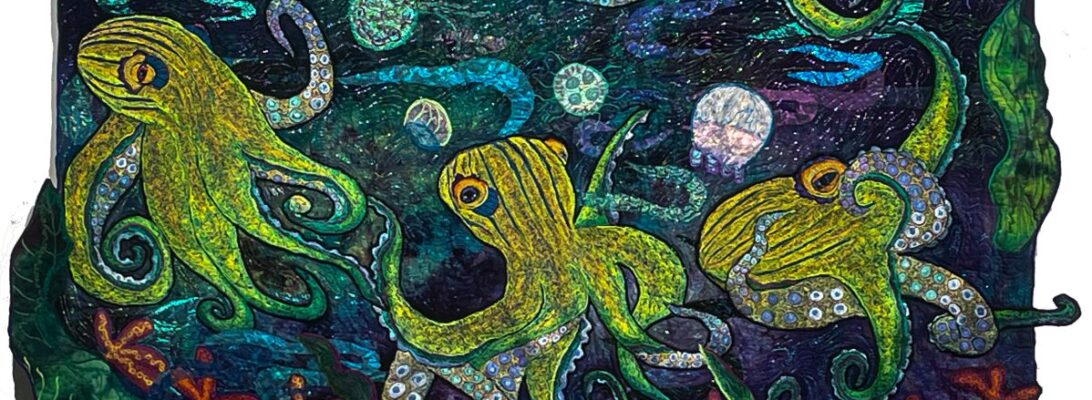
Arse Over Teakettle: The Art of Stubborn Bobbin Work

I spent the week fighting with a sewing machine, and a thread. That’s not anything new. I spend a lot of time fighting with a sewing machine and thread.

But I have learned some sneaky tricks. And one of the best of them is bobbin work.

Why is bobbin work stubborn? Because you need to just leap in and do it. It can feel a bit weird and it takes getting used to. But it makes all kinds of stitching that’s really hard, quite doable.

Bobbin work is for thick threads. Thick threads go through an adjusted bobbin case, and you stitch from behind. It’s a great technique because the thread builds up quickly and is instant gratification.

But it’s also the answer for any thread that’s too fragile as well. Your thread goes through your needle 50 times before it lands in your fabric. Your thread comes off the bobbin straight into your fabric. So if you have a thick thread or a fragile thread, bobbin work is your friend. It will make you feel completely different about metallic thread, older rayon, or something with an attitude.

It’s also good because you can tie off each thread, as you finish. Since I use it to shade creatures, I use 10 or more colors at a minimum even for a small image. That’s forty poky thread ends looking up at you if you’re working from the top. No thread ends except on the back of bobbin work.

It has it’s peculiarities. All of the work is upside down, so it’s facing the other direction. That’s not hard. Your pattern is in the back and you can see everything on both sides. It does take a bit of faith about thread color, but you get a sense of that before too long.

Over the next couple weeks, I’ll be discussing several kinds of bobbin work and giving you some of the secret handshakes. It’s one of my favorite ways to work.

Here’s some facts about bobbin work.

Bobbin work is done upside down. So your pattern faces the opposite direction. Your stitching goes all the way through, and your pattern is in the back so you can always see where you’re going.

Your top thread should either match the bobbin thread or be something that blends with it. Because you will always see both threads on the right side. In bobbin work, the thin thread looks like it is couching the bobbin thread. You should like what you see, either way.

Unless it’s a very small image, I usually treat bobbin work as an applique. Like all stitching it puckers up like it wants a kiss. As an applique, I can cut the distortion away with the background

I use a sandwich of Totally Stable with my pattern drawn on it, Stitch and Tear, light weight felt, and hand dye as my surface for bobbin work. It makes a stable applique can is easy to cut on and stitch down.

I zone my colors on my pattern so I know where the colors go generally. After that, I set up a range of colors for that zone and progress through the space with them. The zones on the frog are the spots, the green body, the pastel tummy and the eyes which are always a separate zone done in sliver, a wet looking thin metallic.

Over the next several weeks we’ll discuss thick thread, thin metallic and hand dyed pearl cotton as ways to use bobbin work to create amazing creatures.

Another Fine Mess: Globbing: What’s on Your Floor?

Dragonflyl Mountain

What’s on my studio floor? Thread! I collect large wads of thread ends. It’s just what happens when you’re embroidering by machine. It’s everywhere, but it pools it places on the floor. It is pretty It seems like a waste, but like most things, it doesn’t have to be.

Threads

Let’s be clear about this. You can save all your thread ends, if you want. But they aren’t all the same. The threads you sewed your jeans with are probably not going to be pretty in an art quilt, unless you want a pretty rough looking texture. I save thread ends that are either poly or rayon, or more wonderfully thick#8 metallic like Candelight, Razzel Dazzel or Glamour. Or Sliver like threads. For me, this is all about the shine.

Nesting Ladies

What does that do for your quilt? It makes a floor of it’s own. Nature is messy. There’s all kinds of bits of things, on the forest floor, or at the bottom of a pond. A nice blob of thread looks a lot like that. It puts in a bottom without a hard line.

So you have this wonderful glob of thread. It’s pretty. You want it on your quilt. How are you going to stick it on?

Angelina moon

You can glue it. Steam a Seam will hold it down. You can trap in angelina fiber. It’s a beautiful addition to a moon.

You still have to stitch it down. If you try to just stitch it down with a darning foot, it will trap your foot and make you crazy. It makes me crazy.

My best answer is to put something over it. Some folk use tulle. It dulls the colors. I prefer using a corn starch film, like Aquafilm or Solvy. I pin it over the glob, and stitch it down. When you’re finished, spritz it with water until it disappears. Problem solved.

Hunters Moon 2

Globbing makes a beautiful addition to a quilt. And it uses up all that pretty thread.

All About the Line: Choosing the Right Stitch

For those of us who use a lot of embroidery, there are really two go-to stitches: straight stitch and zigzag. There are fancy embroidery stitches, but those two hold up the bulk of my work. The other stitches just don’t maneuver as well. You either want exactly what it can do or it won’t do what you want.

That’s ok. The variations between are vast and wonderful. The angle which your fabric goes through the machine controls how wide your stitch is and how the stitch itself is angled.

But you don’t often see people mix straight stitch and zigzag. There are reasons why, but we’re quilters, aren’t we? There isn’t any rule.

I was working on this batch of butterflies that I intend for a series I’m working on. They were meant to be black and white, although color always creeps in. The blue and purple you’re seeing at the edges is the felt I used to stabilize them. I did that on purpose, to make the lace patterns more visible.

Part of the fun was picking through my lace collection. I went through my black and whites and found some special things.

The border of this leaf lace made great wings.

But back to stitch types. This isn’t sexy but it’s the basics. Zigzag can go at a right angle through your machine and it makes a bulky solid stitch. At an angle, it makes a smooth outline. And if you run it straight either left or right, it makes a stitch that looks like a straight stitch, with some of the stitches missing. And then there’s the straight stitch.

Straight stitch won’t outline. It won’t make a bulky stitch without a lot of work. It is lyrical and can go any direction without looking scattered.

Zigzag covers edges well. It outlines well. It puckers up like it wants a kiss. And the out to the side angle fills in space very well.

How does that work out. Here’s some details and full shots to show you.

The zigzag stitching outlines really well. I’ve used it for shading inside the wings as well. It’s a feathered kind of stitch that gives a loose line.

I used a straight stitch to feather the wings on this bug. I love the smoothness of the stitch.

The lines on these wings were done with that zigzag out to the side. The line is a bit jagged but more pronounced.

When do you use zigzag?

When you want a strong border.

When you want to fill in a space .

When you aren’t worried about distortion.

When do you use straight stitch?

When you have an open space where the straight stitch will show next to the zigzag,

When you are worried about distortion.

When you want a clean and simple line.

Of course, you are the one who makes those decisions for your work. And everything does work. Play with it. See what you like.

Thick Thread, Thin Thread: Thread Work as Grain

One of the mostly lovely things about free motion is that there are no limits. Not in size, not in shape, not in color. Anything thought can be done.

One of the things that changes the look of an embroidery most is the size of the thread. Regular embroidery thread is 30-40 weight ( which means if you lay 30 threads side by side, it would make 30 inches.) It can be used either for zigzag stitching or straight.

8 weight thread needs to be stitched from the bobbin. It can only be used for straight stitch. The look is very different. But it’s also abstracted.

The size of the thread creates a grain, like a photograph. A thicker thread looks more abstract, and less detailed, but it has a strong visual impact. Here are some images in thick and thin threads for you to see the difference.

Thread choices make a huge difference in the look of embroidery. Pick your threads for your own delight.

The Miracle of Cheesecloth: Not Just for Turkey Anymore

I love sheers! I love the ability to have my background peak through the sheers to create the connection between background and an object.

But most sheers don’t paint or dye well. They are poly or nylon. They come in bright colors, but they have other problems. You can paint them in pastels. They don’t dye with fiber reactive dyes at all. And if you get your iron temperature wrong, they melt.

But cheesecloth does all that well! It’s all cotton, and woven loosely. And you can iron it on fry and it behaves like cotton.

You know cheesecloth. You just aren’t used to it in the sewing room. It’s an airy woven cotton people used to use to make cheese (hence the name). Or on turkies to keep the breast moist. You may have used it to make Halloween ghosts or Christmas angels.

But dyed, it can be any color in the universe. I include it in a regular dye batch and it dyes like a champ with fiber reactive dyes. And it washes out easily in your regular washer in a nylon lingerie bag.

It makes amazing leaves! The weave in the cheesecloth looks like the cells of the leaves and the stitching defines the color.

My favorite thing to do with cheesecloth is to make mushrooms. Child of the 60s that I am, they are a flora that fascinates me. And they are an excuse for eye popping color

I do make them in batches. I’ll line up a set of mushrooms on a piece of felt, using Steam a Seam 2, pull out my brightest polyester embroidery thread and stitch up batches of mushrooms at a time, that I’ll use in many different quilts. The bright colors and zigzag stitch pop the the colors to a peak intensity. Now, who doesn’t want that?

What I did differently, is I made some smaller ones for pins and patches for my friend, Sherrill Newman who owns the South Shore Market in Porter, Indiana.

I almost never make these available to people except as finished quilts. But she talked me into it. I made a small batch for her store. Some of the left overs I’ve put on sale on Etsy. They have pins backs on them, but if you wished to use them as a patch, it would be a matter of a moment to remove that with a seam ripper.

Hand dyed cheesecloth might just be the sheer you’ve been longing for. Bright, cotton, and beautifully texturized, it makes great flowers, leaves and ‘shrooms.