Process VS. Product: How do you learn Best?

I tend to learn about things when I’m neck-deep in a mess trying to rescue something that has just gone pear-shaped. It becomes a puzzle to solve. Sometimes I get a great solution that I use after that for that issue. Sometimes it’s more of a bandaid and it becomes something I regularly work on remedying, hoping for the right answer. Often there are many answers that vary their results enough to be used periodically.

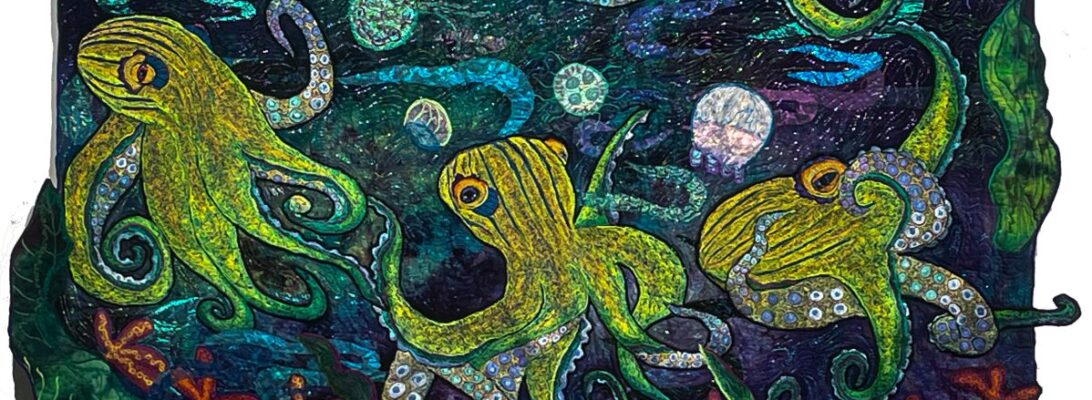
But it isn’t like I did the piece just to learn something, usually. I get an idea. I create my creature, and then I build his or her world around them. It’s like dancing to a different tune each time. The answers aren’t always the same. But they push you further.

But classroom is different. Classes get divided into process classes and project classes. Most people like a project class. They get to see a lot of techniques, and they get to incorporate them into their piece.

But that’s a lot of pressure to put on one day. Most of my work involves hundreds of processes in one small piece. I am happy to show them all in class. Sometimes that’s what students want. Sometimes they want to create something to take home. Sometimes, sadly, they don’t get as far along as they would like with their project.

So I developed my Stitch Vocabulary Book class. It started with the stitch vocabulary I did in most classes. I’d have students doodle, draw, work with zigzag, stipple, do garnet stitch and sign their name on a 9″ square of cotton. That really includes almost all the techniques I do. After that, they could use that square or another one to practice or try something else.

Straight Stitch

Bobbin Work

The Stitch Vocabulary Book class is 5 squares. It includes Straight Stitch, Zigzag Stitch, Bobbin Work, Soft Edge Applique, Hard Edge Applique, Couching, Beading, and Globbing. Because it’s all small squares of fabric, it can be bound together with bias tape into a reference book for your studio. And you can write your notes on the stabilizer on the back.

Soft Edge Applique

I will be teaching the Stitch Vocabulary Book Class for Gems of the Prairie, May 4th, in Peoria, IL. To honor that, I’m putting together a little classroom booklet on the class to go with it. It will be available in early May for sale.

Classroom booklets are another part of process-learning. Rather than being galleries of work, they are crammed with information, directions, and advice. I much prefer them to handouts, because they’re pretty, they’re concise and they aren’t just white paper.

So if you learn best from learning processes or if you’re more satisfied with a product this booklet should open some amazing new doors for you, for you to explore in your own work.

I will be previewing some of the work on the book on my website. If you’re taking my class in Peoria, it will be a fun sneak peek. But if you’re just hungry to learn new free-motion skills, it’s an easy no-risk way to explore what is possible. I’ll add new sections as I get them done, and some extra resource bits to help.

Check my Thread Magic Stitch Vocabulary Book page to see the latest chapter. I’ll show you how it progresses over the next several weeks.

A Visit to the Studio: Designing with An Extra Pair of Eyes

I

I always love it when people visit my studio. Studios are workplaces, the equivalent of an artist’s ivory tower. They also can be messy, wild, and full of possibilities. But they can feel lonely. I remember a conversation with an African Fiber artist. She told me she was writing from Darkest Africa. I don’t doubt that, but I told her I was within the shadow of the cornfield. It’s true.

So it’s wonderful to share studio time with others, to get their input, to help them with their work, to share the vision, and to get an extra pair of eyes.

My friend Sharon had been working on a contemporary quilt that had her nervous to start. Sharon’s a veteran seamstress with fine quilting skills, but she wasn’t used to the contemporary approach. She spent an afternoon where we tried a whole lot of things, just to see.

She wanted to do a piece with triangles on it. We placed the background on the wall. She had triangles cut of yellow, purple, and fuchsia cotton prints. We place them up randomly. It didn’t quite do it. But we took a black-and-white picture to see what was happening.

Black and white photos show us value. The light and dark of a piece define how it will be seen, what will stand out, and what will be the background. We noticed that the yellow really stood out. So we decided to use the yellow as subject and let the other colors support the yellow as the background for it.

It was still pretty random, so I suggested drawing a pathway across the quilt. She drew a path. She arranged the yellow triangles on the path and made a background of the fuchsia and purple triangles. Much better.

But the yellow was an odd calico, and it didn’t have a lot of punch. we pulled out some yellow sheers and lame`s. Since they were so shiny against the cottons, they illuminated the path. We cut triangles out of those and replaced the yellow calicos.

The black-and-white photo confirms that this is a strong design.

Sharon’s really pleased with this quilt. She’s ready to sew and sure of her design. I’m sure her niece will be thrilled when she gets it. I was delighted we had worked through some design decisions in a way that will help Sharon as she works on her next masterpiece. Studio time is holy.

I do have people schedule studio time. I even have a guest room at the studio where they can stay if they wish. And I do video conferences as well. We do whatever my student wants. I either teach them what they want to know, supply moral and technical support or help them work through design decisions.

Is it like class? No. It’s much more personalized. It’s a way of connecting artist to artist, with a second pair of eyes, to explore where your work might go next.

As for myself, it makes me think about things I never really work with ordinarily. That’s always a good thing. And I love the company.

Do you want to come to the studio? Contact me and we’ll set it up.

Take Away Demo Classes at Feed Mill Fabric and Quilting!

I’ll be at Feed Mill Fabrics and Quilts in Oneida, IL Friday and Saturday with demos,take away classes and a trunk load of quilts and fabrics to show you!

Mary Walck and I filmed from Feed Mill Fabric and Quilts

We’ll be offering two fabulous demos Friday Sept. 29th and Saturday Oct. 1st.

Watch the demo and do it yourself. It’s easy, fun and fabulous! From 11:00 am to 300. Drop in any time, watch the demo and make your own.

Texturized Treasures:
Oil Paint Stick Rubbing on Fabric

Sept 30,2022 11:00 AM to 3 :00 PM

Texturized Treasures: Oil Paint Stick Rubbing
Create your own texturized fabric with rubbing plates and oil paint sticks. hand dyed cotton. So easy, so fun and so fabulous!

$7.00 fee each person

Gilding the Lily: Christmas Ornaments

October 1, 2022

Gilding the Lily Ornaments

Take those marvelous Christmas prints and gild them with free motion stitchery to make a fabulous Christmas Ornament

$5.00 fee each person

11AM to 3PM each day at Classroom Building Join us For All the FUN!!😃😃😃

Feed Mill Fabrics and Quilting is in Oneida, IL right on Route 34.