
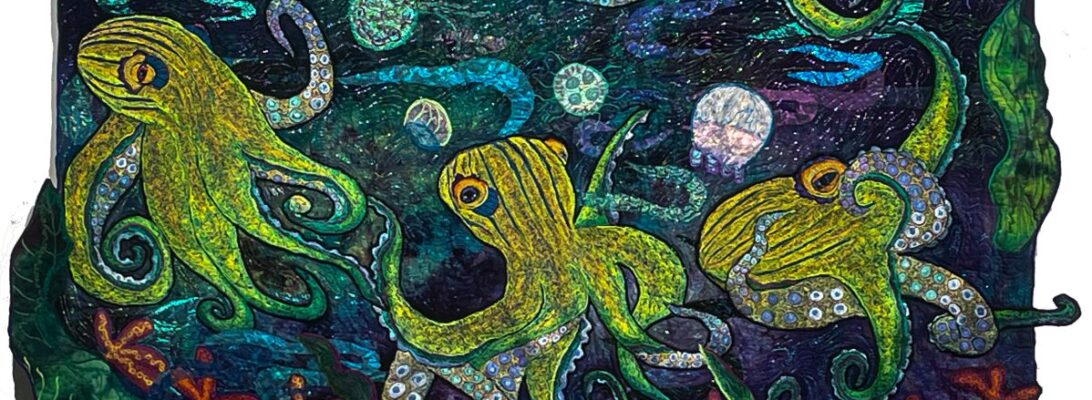


I have to say that this week has left me exhausted. My new to me 930 froze mid stitch, and I am, again. scrambling. Currently working are the 220 and the 20 U Singer.
If it sounds like a first world problem, you’re probably right. But I sew every day, usually around 3-4 hours a day. It’s more than a job. It’s not quite an adventure. It’s certainly my mental health.
When I was teaching, occasionally I’d get a student who would ask me how to do something. Usually it was an amazing idea. But I’d never tried it. I was sorry to tell them I didn’t know exactly how to do that, but that they eventually would. Art is not all about inspiration, and public statements. It’s often fed by the ability to hunt the snark, find a way to make things as you wish. It’s damn hard work.
But if it’s important enough, you find a way. And many artists have the decency to make their journey available to others, so that our art grows, not just in volume or in content but in ability. It’s why we write. It’s why we teach.
If I said that to you in class at one point, I apologize profusely. Just because it’s true doesn’t mean it’s what you wanted to hear. And I thank you for not having hit me.
The art quilt movement rebuilt quilting. Part of it hunted down old skills: hand stitching, hand quilting, pattern pieces, paper piecing and the like. Part of it is new tech: rotary cutters, machine work, computer design, different materials and stabilizers, different threads.
This is not the glamourous part of art. It’s grueling. Try one thing, try another. Look for an answer. Take the best compromise you’ve got.

I’m currently working on a koi fish quilt, working title, Upstream. It includes a kick ass koi and waterfalls over cliffs. I’m proud to say I figured out how to do the detail stitching on the 20 U. It involved 3 metal stackable hoops. I’m waiting with some anticipation for my Maggie Frame to arrive. It may really change the whole hooping process
The hoops are important because I can’t get a foot to work on the 20 U. The one foot that works won’t deal with the thickness of the quilt sandwich. Other feet I tried didn’t work with the machine or allow for a zigzag stitch.
For those not familiar with how sewing machines work, your machine will not form stitches if your fabric isn’t held taunt. Your pressure foot usually provides that stability. Without it, something else has to hold your fabric tight. Hense, the hoop. This video does a nice job of explaining how a stitch forms.
So I have to figure out the hoop thing.
On another front, my new crashed Bernina 930 is in pieces soaking in machine oil. I’m sure we’ll figure it out.

I’m struggling with finding ways to utilize the Singer 20U. I added in my cliffs, direct applique with the 20U, using that stack of hoops. It’s a less elegant stitch line, but it worked.
Next steps: stipple in, add water splashes, back, quilt and bind.


