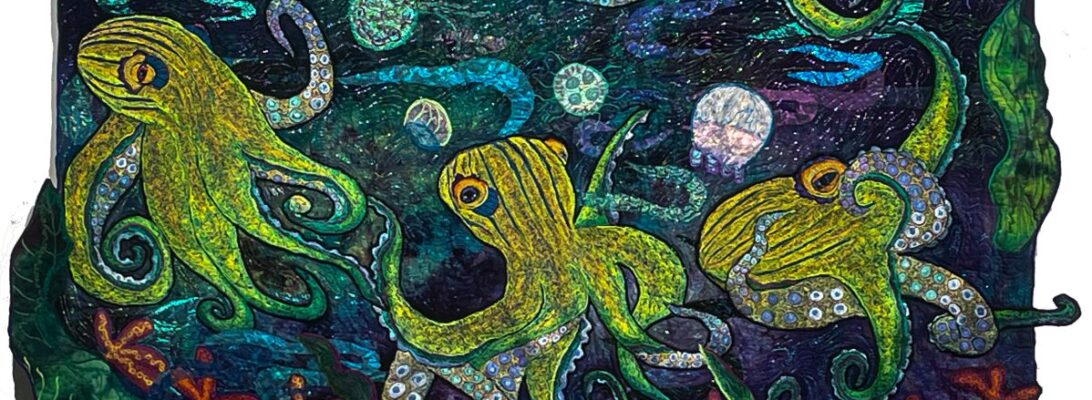
Sometimes I think I should call my blog Studio for Real. I probably make the same bumbles and false starts as anyone else. I do try to show them to you for several reasons. It’s good for you to see that perfect is an abstract that doesn’t exist. That anything worth doing is worth doing badly. And that everything is basically an experiment. It’s Wednesday at the Micky Mouse Club. Anything can happen.
I’ve been working on the purple heron for a while When I put in the white lotuses, I wanted more. More of that white sparkle. So I started some white metallic butterflies.
I had some leftover felt squares and I used them for stabilization. But they weren’t all the same color. I didn’t want to put a layer of hand-dye into the sandwich so I didn’t.
Three quarters through the butterfly I turned it over to photo it. It was ugly. Irredemably ugly. I’d stitched my colors from periwinkle, sage green, silver, to crystaline white. Was it that really pale green that did it? How did it get grungy?
That happens a fair amount. Particularly when a piece is half done. A lot of times it gets better as you go on. Or put the eyes in.
It is better cut out. But compared to the ones on teal or white felt? No contest!
It’s official. I’ve found an officially ugy color. That soft sage green is only good for fish and frog tummies. I won’t use it with something I want sparkly white.
But it’s also deeply affected by the bright green background behind it. My backgrounds make a big difference, particularly if I don’t add in a layer of hand dye. That dark green did me no favors.
Next I decided just to see what the difference would be, to make up some butterflies in Poly Neon with white felt. I thought I might need more brightness.
Surprise! I’ll use these brighter butterflies, but not in this quilt. The metallic ones are more subtle. I wouldn’t have bet on choosing subtle, but this time it’s right.
Do I always thrash around about decisions? No, not unless I do. We all need the time in our art journey to try things out, to take false steps, and to turn, turn again until we come round right.
Late this September I was diagnosed with a leaky heart valve, an aneurysm, and a capillary blockage. Since then I’ve been waiting for the doctors to make up their minds.
It’s serious. It’s very serious. And the doctors seem to need to talk about it very seriously for the next month and a half to figure out what to do first. I’m very frustrated by having to hurry up and wait. They tell me the diagnosis is early enough that we can take some time to decide.
In a way, that’s a good thing. I’ve found myself in a grief process connected with this, and it’s given me time to get past my disbelief, shock, rage, and depression associated with it.
It also gave me some time to sell some quilts to have the funds to take care of whatever else isn’t in Medicare or insurance. For those of you who have purchased quilts to help me, I don’t have words to thank you enough. I feel much more secure and safe because of you.
For the moment, it seems like nothing is going to happen before Thanksgiving. Christmas we’re still figuring out.
So in the middle of that, I’m doing the one thing I know how to do best. I’m working on new quilts, and new techniques. I’m focusing on new work. And I’m grateful for the love and support you’ve all shown me. Especially Don.
I’ll keep you posted. It’s all happening eventually. And until then, it’s all right now.
I needed some kelp for the bottom of this shore scene. I wanted something textural and yet not dense.
There aren’t a lot of great pictures of kelp. But I found these in an art nouveau book of botanicals. It twists. And it’s long and narrow with crinkled edges.
As a lucky find, there was this strange yarn at the rescue mission sale. Both of these are loopy yarns. They were in vogue several years ago for scarfs. They have loops woven in that will make great kelp. The color also fits into the scheme, blending with the heron.
It can be spread apart to look like kelp. That’s a difficulty all its own. You can spread yarn apart, but there aren’t enough fingers to hold it that way and free motion over it. You also can’t free-motion it without it being caught in the darning foot.
So I took a two-pronged approach, I knotted the yarn where I wanted it to spread,
I couched it in place with a regular presser foot, so that I could control the width of the yarn.
I covered it with a Dissolvable stabilizer. Then I stitched it all down with the darning foot where I wanted the kelp to be. I wet down the stabilizer to make it go away.
Some yarns need special care. Don’t be afraid to use several approaches to get what you want. In the end, all that matters is the result.
Whenever you do any kind of representative art, you end up needing to do your research. Does the frog have three toes or two? Does it matter?
Sometimes it really does. Sometimes it really doesn’t. But it’s always more impressive to get your details right.
I do water lilies a lot. Lotus, not so much. And I’m really not sure why. But for this quilt. I want lotus, with their big stand-up pads and their flowers standing proudly on their stems. I need the vertical motion of them.
So I went looking for pictures. When I did, I found lotuses and waterlilies side by side in the search for lotuses. So what is the difference?
I decided it was in the way the petals curved inward, Instead of having a petal shaded differently on each side, I shaded them so that the shadow was in the middle of the curve.
Each quilt gives me an opportunity to explore the shapes, colors, and shadings.. We look as artists for formulas that we can use. But in the end, it’s all observation set in the colors we play with. And a dance of choices, individual but built on all the choices before.
I love minnows! My dad used to bring me home minnows when he’d been fishing, so I could watch them. They aren’t exactly like fish visually. They have parts that are solid, but they also have fins and underbits that are really translucent. How do you do that in thread?
I used to not pay much attention to the kinds of metallic threads I used. I mixed them all together by color and that was that. But lately, I’ve been paying more attention. Metallic thread is not only shiny. It comes in different kinds of transparency.
Why would that matter? A more transparent crystal thread gives a translucency to your embroidery. It’s not quite see-through. Most wound metallic threads are not at all see-through. But the flecked metallic threads can be to some extent.
Most metallic threads are not. They are a strictly shiny surface that reflects, in both ways, the solidity of metal.
Metalic-colored threads have the shine, but they are not see-through either.
Crystal metallics are different. They have a translucency that translates into your stitching as being see-through.
With some careful planning, the bodies of the minnows are mostly solid, but the mixture of metallic silver and iridescent white crystal makes for transparent-looking fins.
It’s a trick, but it’s a cool trick.
These minnows will be in Shadow on the Shore. I’m not sure how many minnows we’ll use, but there’s always room for leftovers.
We talked to the surgeon Friday. It didn’t go as we figured it would, but for a very good reason.
It seems that when I had the angiogram a couple weeks ago besides the aneurysm and leaking valve they also found blockages in one of the veins of the heart. We both read the report but somehow missed that. Now we know.
So that is now three things that need fixing. the doctor presented two scenarios. One, they go in and do everything at once, putting in a bypass to the blockage. Problem is that means they have to harvest a vein from her leg. that gives me another wound and by report more pain than the chest cracking. Also another chance for infection.
Or…they go in and put a stent in that vein to open it up. That has the same benefit as the bypass but does not require the leg wound. They go in the groin and do the job, not requiring chest opening. The down here is they cannot do the big surgery until the stent has had 3-6 months to settle down. During that time I must take blood thinners, and they don’t want to do the surgery with her taking those. The advantage is much less pain, and both procedures give the same benefit. The down is I have to wait for the surgery a few months. One good point is the aneurysm is just over the threshold for doing something, not ballooning out dangerously. This means they can wait a bit to do the surgery.
We talked it over with the doc and indicated the stent seems like the way to go. He will talk with my other two heart/vascular docs and let us know the proposed decision in a couple weeks. So we’re still in the waiting mode. We need to get it all fixed, and opening the blockage seems like the primary thing at the moment.
So as usual nothing is as simple as it first seems. It’s more of a marathon than a sprint. We’ll get there.
You have been my support in every way! Think good thoughts, pray if you can. And thank you!
For some while I’ve been wanting to make reflections in water, and work with shadows. I also have usually only done river and pond water. This image made me want to break out into shore surf. The heron has her wings up, so that they distort the shadow and the fish won’t see her.
I’m a bit uneasy about what the surf should look like. So I did some research. I love Japanese art, and looked through some imagery on waves on shore. Sometimes it helps to have a good idea what something looks like. These drawings were great waves. They gave me a place to start.
I broke down the drawings into simple shapes. And I cut them in a lot of different blues, and a specific glistening white.
But I needed to make the shadow. There may be more sophisticated ways to do this, but I traced the embroidery onto Steam a Seam 2.
I’ve changed backgrounds a lot on this. I finally settled on something a bit brighter, so you could see sand and sky.
The first one I cut was purple. It simply wasn’t dark enough.
Black glitter tulle worked better. I patted on some glitter tulle and cut the shape out.
I cut out wave shapes and layered them together.
The sky is pure sun headed into greenery, and I didn’t want to do something bold with it. Instead, I added spirals heading from gold to green to feel like the sun shimmering down.
I’m pleased with this although I haven’t ironed it down yet. The placing of the heron is really delicate. So I’m looking at it for a while before I commit.
Things to know about layering sheers:
Sheers may look different once you’ve ironed them. Have a test piece so you know what it will look like.
Your Steam a Seam 2 will make your needle skip if it’s not ironed down properly. That’s harder to do with multiple layers. And if you use lace the glue will come through
Layered sheers take more ironing to stick. But you don’t want to melt them. Use a no stick pressing cloth to iron them down and clean it after each piece is ironed. I use a non-stitck Scotch-Brite Scrubby. When you are all done, lay a piece of cotton scrap over the top of it and iron on hot. The excess glue will melt into the scrap. Make sure you don’t transfer glue from the scrap to your piece.
Sheers make wonderful shadows. I’ll stitch all this down with monofilament nylon so there are no hard edges, just shadow, sun and sea.
Most of my quilts are about me exploring ideas and forms. Within that, I indulge myself quite a lot. My interest is creating images in thread, and landscapes in dye. And I pursue it endlessly.
But not all my quilts are for me or for show. There’s a small number of quilts I make for others: for their particular delight, for healing, for an expression of who they are as well as what I do.
Don might be the hardest person to buy presents for in the world, unless you are ok on buying someone a river of underwear and socks. He can’t or won’t ( I can’t tell) tell you what he would like for a present.
And there is a need for presents. Not just for the recipient but a need to let someone know that they mean the world to you. That needs to be marked in some way tangible and real.
So you send a card. Of some sort. I hate working in paper. It’s unforgiving and fragile. So I make him small quilts each year that would be cards if they weren’t quilts.
A quilt for someone else is about them. It’s your relationship with them. These include the kids (and if you are wondering that would be the three dogs and two cats). And because they are for fun, and not about the wheel of produced art, they include all kinds of fabrics and silliness, which is a kind of silliness I really don’t let into my art pieces. It’s just for him.
When we make something especially just for one person, it reflects who we are with them and who they are with us. It’s a gift not only of the hands but the head and the heart.
I sat down yesterday and mixed the colors for dyeing. It felt like I was sitting in a circle of old friends. Scarlet, sitting next to Fuschia who had just made friends with a new color Dragonfruit, and was waving across the color wheel to the Lemon/lime.
I’m dyeing fabric today in preparation for surgery. If I’m going to have to go through heart surgery, there better be a really big pony after all the poop. So a pile of fresh fabric waiting for me is sensible. It fills the time while I’m waiting and it leaves me with a lovely pile of fabric to dream about until I can sew again. It’s good preparation I think. And a good way to fill the waiting time.
I started dyeing fabric at thirteen. I found a book in the library that blew me out of the water, with it’s papercut illustrations. The Emperor and the Kite, by Jane Yoland used paper in variegated colors that resembled the hand dye I still do. I wanted to work with the technique and it never occured to me to dye or paint paper. I dyed fabric with Rit.
This all happened in the kitchen sink and my father who was the major cook in the house had opinions about it. My father was almost non-verbal, but he looked like I’d kicked his puppy when he saw the kitchen after I was done. He unblocked the sink, scrubbed it down and said nothing. He always understood the passion around projects. He had his own, and he often helped with mine.
But it set something in me. I don’t really want colors that stand apart from each other .I want them to mingle and to dance within the fabric itself. I’ve been dyeing fabric in some form ever since.
Colors are about relationships. They have relationships with each other that depend on how they are formulated. I am not a dye master. Or someone who can responsibly measure dye and mix it reliably. I dump dye into a cup. I buy a bevy of colors and use them knowing how they relate to each other.
“Knowing the definition of a word is a pinpoint on a map. It tells you where you are. It doesn’t tell you how to get where you want to go. It’s the rawest of beginnings.
In the same way, color theory feels like the the dreariest driest subject in the catalog of art education. We look at the wheel and say the canticle, red and blue make purple, red and yellow make orange…. It feels like a recitation from kindergarten. And sadder still, it’s not always true. We’ve all mixed yellow and blue to get the most grizzly browns. It feels like finding out about Santa Claus or the Easter Bunny. A nice story for children but not really true.
Part of what we’re missing with that is the reality that it’s a theory. It works, simply when it does work and when it doesn’t, we need to explore why. Color theory doesn’t account for imperfect color. Color me surprised. Another thing that is imperfect in a imperfect world.
The most interesting distinction with mixing color for me is the contrast in thermal energy. Each color in its imperfections leans a bit towards the yellow sunny side, or the greenish shady side. If you mix all sun colors or a shade colors, the combinations are clear and bright. If you mix sun and shade, you get earth colors.
So if I place Lavender and Orchid together, as sun colors they blend into each other. If I add Lilac, a shade color, the combination browns out a bit. Still light purple but with a browned quality. If I add a sun color like Clear yellow, it will stay clear. Lemon yellow with its shade qualities will brown it out.
The real question is not where we are on the map but where can we go. What color theory really describes is the relationships between colors. Within the color wheel, the spots within that wheel define the same kinds of relationships between different colors. Those relationships go back to that primary list of monochromatic, complementary, and analogous color themes that seem so very dull. Because they define the tension between colors.
For dyeing, you have to know the name and know the color. They all lean one direction or another. There are no perfect primaries, secondaries or tertiaries. If you know which way they lean, you can predict the effect. But you never know exactly what the dye on fabric will do. And it’s never the same. Each piece of fabric is unique.
The distance between colors, creates the pull across the wheel. The closer they are to each other, the least pull. The least tension. The least excitement.
The farthest distance any color combination has is directly across from each other, as complements. Those are combinations that tug and pull and electrify us. Colors right on top of each other are smooth and slide into each other.
It’s not one combination. It’s a circle of combinations that create the same feeling. We can move the circle endlessly and get the same energetic result.”
Which is why it’s such a good thing I know these colors as my friends. I know who the mix with and who they fight with and what it will look like after they have a party together.
I’m spending two days dancing with color to pour myself into that joy, instead of the apprehension about the surgery. After all, color is really an antidepressant. And I’ll have a lovely pile of new fabric to play with after I’m back and healed.