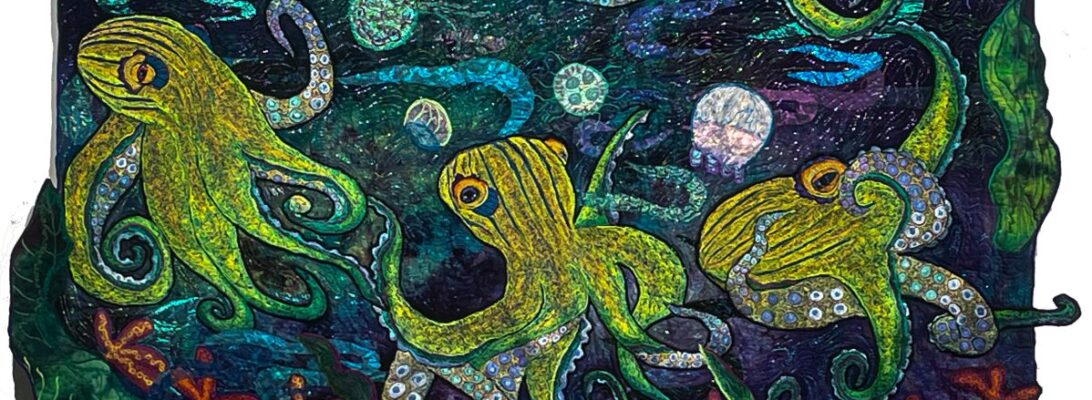
Yellow Birds: Following the Compulsion

Anyone who has written an art statement knows that meaning is illusionary. I think it may be whether you are visually oriented or verbally oriented. Verbally-oriented people can tell you what everything means. They understand their visual architecture. I find them fascinating because I can’t do that.

I get haunted by images, by different animals. and by small worlds. I work with those images until I’ve worked it out. Sometimes I have an idea of what it means. Mostly I don’t until and only after I’m long done. Somewhere my mind must know what it’s about. But it’s not conscious. Instead, the images need to work their way out.

This year, I’ve had a compulsion for little yellow birds.

Those of you who know me well, know I had a rough time in high school and before. I was targeted by people who chased me, hurt me, and humiliated me, while other nice little apaths stood against the wall and watched snickering. I do not want to hear I should be over this. You don’t get over this. It’s happened and it’s who you are, forever. Because it happened, you live in a world where it always could happen again.

It’s not that I remain a victim. It’s that I have no patience with bullies, sociopaths, apaths, and people bored enough to do this for fun.

So most of my quilts are social commentary. They’re about living in a dangerous environment where there are predators. They’re about finding a safe way through.

Not safe, necessarily. Livable.

So in a world where we are discussing canceling peoples’ basic human rights, we’re not to complain, and where we’re supposed to trust a rapist to protect us, it seems no surprise that I’ve had little yellow birds finding their way through my quilts.

May they find their way. May we find ours.

Ferning: Adding Fake ferns to a Quilt

I’m a big fan of silk flowers and leaves. I love them as an inclusion. They add extra texture and color in a marvelous way.

So I was delighted when I went into the Galesburg Mission sale to find a pile of fake silk ferns.

I love swamps and wet lands, and ferns are just part of that. But they’re not easy to do either as stitchery or as applique. They are detailed, fussy and wonderful. But I haven’t ever stitched a fern I was truly happy with.

Not every fake fern will do. You need one that’s fabric rather than plastic. They usually come with a plastic support glued to the middle of the fern. That peels right off.

Your left with a lovely fern. They can be bent in any direction to fit right into your piece.

I’ve been working on this spoonbill quilt for some while now and I’m almost done. But my trees had bare bottoms. Ferns to the rescue!

I’ll show you how to stitch the ferns down next week. I could try to trace the edges, but they’re bound to do the shimmy under the needle. So instead, I’ll add a layer of cornstarch clear topping (Solvy) pinned over the top and stitch through that. The topping makes everything lie flat. If you use monofilament nylon, the stitching is invisible. When it’s all stitched down, you spritz the topping with water and it dissolves.

It goes without saying that you can do that to silk leaves and flowers as well. Check out It Came from the Dollar Store: Including Silk Flowers and Leaves in Quilts for more information.

Romantic Roses: Valentine’s Day for the Somewhat Grown Up

Do you remember Valentine’s Day as a kid?

I loved it. My mother made me a red and white dress for the day, and you brought valentines for everyone, and then you filled their mail box with them and found your own filled.

I was not much of a social butterfly. And I’m not sure I would have gotten any valentines if everyone didn’t send them to everyone.

But most of all, I loved all that color in the middle of the snow. Red, pink, and orange warm my heart whatever the temperature. Add a dash of purple. I could get drunk on it.

Valentine’s day is sort of a bust for a number of reasons around here. Mostly, Don doesn’t do holidays. And if either of us really wants something, we just go buy it. But I still get off on the colors.

Don takes me for a color bath every fall. He drives me around the stately homes of Galesburg and I gasp at the amazing leaves. This time, I happened to look down at the red roses beneath the trees. Absolutely breathtaking. Red, orange, pink. I might as well be drunk. So I started with a batch of red roses. I’d been wanting to do a garden quilt.

I have several ways I make roses, but my favorite is with spirals.

After cutting spirals, I glue them to felt. The felt is red because the color will show through. That’s a promise.

Once they’re all stitched, you can see the form better from the back.

Here’s how they look cut out.

I intend a sunflower and some hollyhock for this quilt as well. Yellow birds as an accent.

This is just pinned up and the leaves for the roses and the hollyhocks aren’t finished yet. But I’m excited. With all those fall leaves falling, we’ll need a garden in bloom. It’s just like Valentine’s day.

Branching out: A Different Approach to Bird Nests

I’m never really satisfied with my drawing skills. Drawing is like writing. The only way to get better is to keep drawing. I cut better than I draw. Which sounds stupid until you look at the cuttings Mattise did at the end of his life. He couldn’t paint with his limitations, so he did cut outs instead. They are magnificent!

I don’t know that my cut outs work that well. But I am more confident with them for floral/tree ideas. So when I went to make a rosiated spoonbill nest (which is basically sticks), I cut out branches rather than try to draw them.

Of course, they’re flat before you stitch them. There’s about three colors of brown hand dye in them. But the stitching is the definition.

Usually, I build bark with my stitching. With this much going on, it’s hard to see, but I added a layer and savaged it to make bark that pealed and curved.

This time I went for something a bit different.

Laws puts out drawing how-to and journaling books that I really like.

Not only does it show you how to draw an object. It gives you a thousand ways to see what it looks like at a different angle or at a different point of view. And how and why it changes. I turn to these books to push myself to better drawing.

Lost in the Woods: Redeeming design Decisions

Every piece involves an endless number of choices. Sometimes I think it’s fun to share them with you. Creation is a journey best taken with friends.

I love the woods. I can’t walk in them anymore. I can’t walk anywhere far at any length. But I can make the woods for myself.

I’ve been working on a roseated spoonbill for some while. I chose a fabric that had that deep wood blue greens in it. With a big pink bird on it, I knew I was on the right track.

I considered what kinds of trees I wanted. I wanted a deep wet swamp. Pine trees would work for that. I made beautiful deep green branches on them.

I pinned up my gorgeous trees and watched them disappear into the background.

Back to redesign. That kind of redesign takes me a minute. I left it up on the wall a bit to think. Yesterday I dusted the tops of the branches with the brightest light greens I had in my threads.

They looked much better.

Then I put them up and photoed them. They looked great on the photo wall.

Odd things happen with photos. I usually take photos of what I’ve done at the end of the day as a record of my process. I give the photos to the owners when they purchase a quilt to invite them into my process. I don’t always remember what exactly I did, so it’s a good practice.

This time the photos deceived me. The trees looked way too bright. But when I came back to the studio, they looked so much better.

I’ve had another problem with this piece all along. I couldn’t get the head pointed the right way. I cut the head off so I could reposition it, but it’s still not right.

Yes, you can cut embroideries apart. After enough stitching, who would know? I do it whenever needed.

So I separated the neck and tucked it in at a stronger angle. It pleases me more. She looks like the birds have disturbed her but she’s in motion.

Do I know what I’m doing? Don’t be silly. I try things, put them on the wall and stare them down until I’m sure.

The tool that makes this all possible is my photo wall. If I don’t take the time to look at it, I really won’t know when it’s not right. Why?

Because I don’t want to take the time. I want to get done. That doesn’t always work. Two days looking at the piece is infinitely better than knowing forever I needed to move something over 1/2″. Or ripping it out.

If you don’t have a photo wall, you should. You’ll never know what you’ve got until you really look at it. For more information about building a photo wall, look up Studio Essentials: The Glory of the Photo Wall

Greens Are Good For You: Color Theory for Frogs and Turtles

I think the most exciting moment for me when I’m planning a quilt is when I pull my threads for the coloring. Thread painting really does act like painting, with several small differences. You mix paint. You layer thread on top of other threads, and your eye mixes the colors.

Threads are tiny. This means that the colors can be brighter, darker, and showier than you might want for paint. Thread painting is for showoffs.

So here are our color choices. I’m tempted to let the frog be metallic, but the color choices are much more limited. I can dust it with metallic thread afterwards to make a sheen. But I want the full range of colors poly will give me.

The biggest difference is the background fabric I’ve chosen for a base. The background always shows through. The brown background will make the turtle much more brown.

This drawing has three color zones: the snail, the frog, and the turtle. Somehow we need to make those three zones demonstratively different from each other. That is done by contrast. We can contrast color, texture, sheen, and tone. We have to make them visibly different from each other.

Another question. Do I embroider them separately or together? I drew them in one piece. But each image is going to distort, but not in the same way. The textures need to be different so they will tug and pull differently from each other. So I can’t really predict what will happen. The images may distort a bit. So I separated my drawings to embroider them each alone.

I also can place the creatures exactly where I want them. That solves my problem. If I separate the drawings, they’re remain in proportion to each other.

The turtle is easy. There’s some rhythmic patterning in the shell. That can create a textural difference. I also want to lean into the brown/yellow greens that make it contrast against the blue-green water. So instead of blending these colors, I’ve laid them next to each other to create scales.

The frog needs to be the star here. I want to lean towards bright greens that lean into yellow and a smooth skin texture. So he’s on a bright green blue. Bright green threads will make him very green indeed.

Both creatures feature garnet stitch. Garnet stitch is moved in circles across the embroidery. The texture makes for lumpy bumpy turtle/frog skin. For more information, check out “The Variable Garnet Stitch: Building Texture

I used the same accent colors for both. The reds and oranges are exactly the same. I’m hoping that will help tie them together.

The snail is sort of the cherry on top. It’s naturally a beige and brown item, but something fun needs to happen here. Need to do some research. I haven’t stitched on it yet.

The other thing I want to do with this quilt is a water reflection. I’m not good at these, but they are so exciting. I’m going to try again on them. That’s next week’s blog.

\

Gilding the Lily: Adorning Fabric Rubbings

A couple of weeks ago, I did a series of small rubbing pieces. I use rubbing plates and oil paint stick. I focused on different backgrounds, flowers, bees, dragonflies and butterflies. It’s an endless river of design choices in a tiny scale.

I’ve loved working with tiny pieces. It’s nice to have a quick result, and they’ve proved to be popular. Who wouldn’t want a delightful piece of art that fits everywhere and doesn’t cost much.

The rubbing plates I’ve been using are a limit of sorts. I still haven’t figured out how to make my own. I will. I want it bad enough, I’ll do it.

But I’ve enjoyed working with these flower plates to stretch what they might be.

But there’s another side. It’s soothing to spend a couple days just stitching. The rhythm of the machine, the movement of design, and the feeling of watch thread flow from the needle to the fabric all create a tao that’s gotten me through endless tough times. Demanding focus to actually color in the lines is very good for me. A lot of my stitching can be mindless. This is not. I have to try to hit the line.

I’m going to show you some of these before and after I’ve stitched them. It’s a magical change that always thrills me.

They are transformed by stitching. They’re lovely, just as fabric rubbings but they change in amazing ways, once they’ve been stitched.

These are supposed to be waterlilies. But with some background and color changes, I think they make fine Dahlias.

These are supposed to be forget me nots.

But I love them as carnations

But there’s another side. It’s a place to explore and work with colors differently and stitches differently. Not endless change, but small differences not tried before. Is there anything I haven’t tried. Of course there is. Move it over a quarter of an inch and add peach, and I’ll bet I’ve never done it before.

I’ll be finishing these little quilts in a day or two, and they’ll go up on the website and onto Etsy for sale. You’ll find tutorials on rubbings and stitching on the video page.

Take time to try things out in little ways or big ones, as your work needs. It feels great to stretch a bit.

Over and Over Again: Ladybugs, and the Need for Serieous Work

No. I did not misspell that. All art, all creative process is a journey where we ask questions about design, color, shape, materials and techniques. Each piece we do is an answer for the question. Do I make a big moon or a small one? Out of Angelina Fiber? Or tulle? Or that strange gold brocade I just brought home? Do I make rays? Or a big circle, or spirals woven into each.

How do you do the black and white parts of a ladybug? Bobbin work again, but showing different directions.

Put them all together and they make a series. Series work helps us answer a billion and one questions.

There are no right or wrong answers. But each quilt gives you other questions to try. And since experience is the best teach, each quilt is a new experience, even if you will never do it again. Try a new thread. Will it work from the top or shall I put it in the bobbin? This machine likes this kind of poly monofilament. Will it work better with a cone holder? Horizontal or vertical? Endless questions that can only be answered by an endless dance of doing.

But the other reason is fascination. We regularly explore bits of the world that fascinate us. I’m fascinated by bugs of all kinds, but in red? Red? Where’s the red?

Well of course, I now have a reason to explore all those reds together. What if she isn’t really red?

Do I find repetition boring? NO! I find repetition changes everything as we put together the puzzle of each piece

So, if there’s something I don’t know the answer to, I sit down with a pile of new work that just might give me the answer. I’m not repeating myself? I’m on a journey. Who knows what I’ll find.

How Many Machines Do You Need?

Do I sew more than most people? Probably. I do sew every day, usually 5-6 hours of studio time. My machine that keeps track of that kind of thing says we’re at 22,275,775 stitches. It’s not the only machine I work with. It’s the only machine that counts stitches.

Years ago, when I started to sew, most people only had one sewing machine. The sewing machine stores used to insist on trading in machines so people would bond with your new one. It was fairly mean. Most of us bond with a machine almost for life. There’s a learning curve on almost all machines. So it’s a while before that machine and you are bonded.

Most Berninas last at least 15 years with care and feeding. It’s also true that not all machines do every task well. I’m a Bernina fan because of the stitch and the feet. But even within brands, there are differences between machines.

But for those of us who sew maniacally every day, that care and feeding is hard to keep up with. Most of my machines need servicing at least twice a year.

When I lived in Chicago, I sewed a lot at 3 AM. At 3 AM I’m delusional. I actually believe I can time a machine and fix the flywheel. This is the kind of behavior that ends up with you at the mechanics with your machine in pieces in a box.

So I would call my friend Elaine and borrow her machine. She wisely had two. She would politely thank me for waiting until 7 AM until I called.

At a certain point it became clear, one machine was not enough. Particularly when it takes a month to get your machine back from the shop.

At this point, I have some lovely older machines. They tend to be specialty machines that do one task or another particularly well. This 99 Singer is my favorite piecing machine. The stitch is unbeatable.

My three current machines are racing to see which can break down first. All three of my current machines are acting up. One of them is in pieces on my mechanic’s work table, waiting for the parts. My mechanic keeps pointing out I sew more than most people do.

I’ve decided three working machines is the proper number. One that is inevitably at the vet, one for working and one when the second machine joins the first machine in breaking down. That’s my theory and I’m sticking to it.

We bought a second hand 220 Bernina on Ebay. It arrived about a month ago and has run like a top ever since. If you don’t know Berninas, it’s a three/quarter head war-horse machine with moderate computerization. Everything else is waiting until my mechanic’s counter clears.

If you are wondering if you should have a second machine, if you need to sew once a week at least, you probably do. You may also want a machine that does other things than your full-time machine. Like a larger arm space, or a travel machine. But don’t let anyone tell you that you don’t need two. or three. Ask them if they want to be in a room with you when your one machine breaks down. Then, ask them how many screwdrivers they have. It’s simple math.