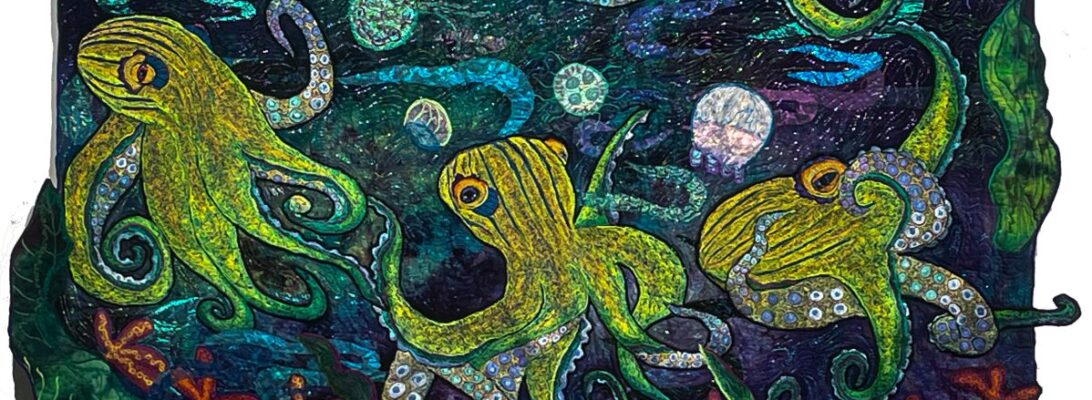
I didn’t have any shows this year. Which is ok. Every artist has ideas they aren’t quite sure how to approach. Instead, I spent a lot of time trying out ideas I wanted t do my quilts. That takes time and effort. It messes with production significantly. So I’m glad to have spent my studio time this last year in this way.
I learned how to make waterfalls.
There and Bacl Agaom
I learned how to make a reflection of my subject in water.
In the shell
I worked on seashells and tenacles.
B;lue Herons
I experimented with extreme borders.
I learned to make my own rubbing plates from stencils.
Three Cranes
I learned to incorporate those plates into my work.
I worked in desert landscapes.
I finally worked out the cat head fountain.
It’s been a good year for learning. If you’ve followed my blog, you know, because each week I show you what I’m working out, working on, and working through.
Here’s to 2025:
Major quilts
Small work
Unfinished work
I couldn’t do this without your support. Not necessarily monetarily, but spiritually, personally, and energetically. No art is in a vacuum. I suspect that I would do art if it were just me arranging deck chairs on the Titanic, but your company on this journey has made it much more worthwhile.
20 weight cheesecloth with organza trapped underneath
I’ve used cheesecloth for years. It’s an unexpectedly versatile sheer that dyes beautifully, takes iron heat, and fuses easily. It’s a studio staple for me. When I dye other fabric, I almost always dye a fresh batch of cheesecloth.
40 weight cheesecloth flower
But I wasn’t aware that there were different kinds. No one ever mentioned that it came in different grades. I just bought the box I found at Joann’s. If it had a grade marking, I missed it. My guess is that it would have been perhaps grade 40.
The grades have to do with the purpose of the cheesecloth. As the name suggests, it’s about how it’s used in food prep.
“Grade 10: The thinnest and most open weave, ideal for applications requiring good airflow and water drainage, such as straining some types of broth or when a very open weave is needed for crafting.
Grade 40: A versatile medium-weight cheesecloth, good for general food straining, polishing, and crafting.
Grade 50: Another versatile option, often used for food prep and crafts.
Grade 60: Suitable for straining, polishing, and cleaning, and is also used in testing for fire hazards.
Grade 90: The most durable and tightly woven, suitable for tasks requiring strength and fine filtration, like making cheese or nut milk. It’s also washable and reusable, making it a good choice for repeated use in the kitchen.
Grade 100: The highest grade, providing the tightest weave and greatest durability.
The grade number reflects the number of threads per square inch, with higher numbers indicating a denser weave according to Organic Cotton Mart. For example, Grade 10 has 20 x 12 threads per square inch, while Grade 90 has 44 x 36 threads per square inch according to Online Fabric Store. “
The box I bought before must have been a 1. It was wide open, pilled easily and very formless.
#20 Cheesecloth pine trees.
My last box was 60 You can actually iron it onto fabric without a pressing cloth.
Your best clue for unmarked cheesecloth is the usage they suggest for it. If they’re making craft ghosts out of it, you know it’s a lower grade. If they’re straning jam with it, it’s a 90-100,
60 weight cheesecloth leaves
What will I do with that information? I’m almost tempted to have several grades in the studio for different applications. Cheesecloth is my go to for leaves and flowers. Nothing is as light or as easy to iron on and the texture is fabulous. But it never occurred to me that it came in different textures. I have a fish that will need some surf to swim through. It may end up as cheesecloth to the rescue.
Arkwright Cheesecloth was the one that was most clearlly marked on Amazon, and the widest number of choices.
What do you do when your techniques are killing your machines?
This is about component embroidery. Lately, I’ve leaned more and more on component embroidery to create large astonishing embroidered images. I love the work it creates. I am completely reliant on my machines.
I have a love/hate relationship with most of my sewing machines. I really love them when they work. I’m in abject hell when they break down.
Since I’m a Bernina girl from way back, I’m used to tough well-built machines. Yesterday, my ancient 930 had a moment. I thought it was a screwdriver fix; It was not. We’re playing mix and match between the two 930s in the studio. Neither is quite ready for prime time. It has brought to mind how intensive my work is.
That was underlined by the 3 220s I managed to break last year, and my 770 which has spent 7 months out of the last year in need of several kind of repairs. And is once again in the shop.
These are lovely machines. They’re built tough, and I’m still having them break under me like I was shooting horses I’m riding on in a battle. I’m devastated. I know better than to have only one functional machine. Because always, inevitably, something will break.
When I talked with my mechanic she said “You do know you sew more than other people..” Which means I stitch very heavily to make my images. Meaning perhaps I’m asking more out of a machine than it’s built for.
Which leads to the question, do I need a different machine? Do I need a commercial machine?
I went through this several years ago when I bought my 770 Bernina. It’s fast. It’s got that nice long arm and some lovely features. It does not put up with mad-speed sewing. I love it. I’m afraid of it too. It threw its hook at me through the door on the bobbin mechanism. I wish I were kidding. And I don’t know what to do about a machine that’s off more than it’s on.
So here’s my 2025 Challenge.
Do I change my work because my machine won’t do it? Do I find another way? Do I look for other tools? Or do I back away from a stunning technique that lets me do things past my earlier abilities?
Which leads me to humming something like a Sheryl Crow song. “Are you tough enough to be my sewing machine?”
Being an artist is only peripherally about making art. It’s mostly about developing skills, ideas and visions. The art is a byproduct. It is a picture of where your art is at a particular moment. This is why I can always let go of a piece of art if it raises my abilities as an artist. Any artist’s first creation is the skills, techniques, and vision you make art from.
I’m looking. I need a zigzag machine that is commercial grade I can control the speed on. And I need to find some money to look with. I’m always willing to give up a piece of art to further what I can do as an artist.
Those of us who live an artist’s life live with constantly unbalanced finances. Don and I are on social security. I don’t discuss my difficulties hoping for a handout. But I have used my art to fund things I couldn’t buy any other way. I’ve offered work of mine at dead rock bottom prices, when the need arises. I’ve never asked for money itself. I’ve offered the work I have to make what I need happen. I’m doing that now.
These pieces represent work I couldn’t have done ten years ago. They’re made with component quilting elements, separately embroidered and incorporated into the quilt itself. It’s changed what I can do. I need a tough enough machine to do it.
If there’s something you are in love with, this is the time. And I’m open to offers. I am a motivated seller. If you wish to see more information on my body of work, it’s also on my Portfolio Page. The price on the portfolio does not reflect the sale price, but you can click through from the portfolio page to the Etsy shop.
Also, if you have knowledge about industrial or particularly tough zigzag machines, I’d love to talk with you. I need more options, and would appreciate your expertise. And if you have questions about a particular quilt, let me know.