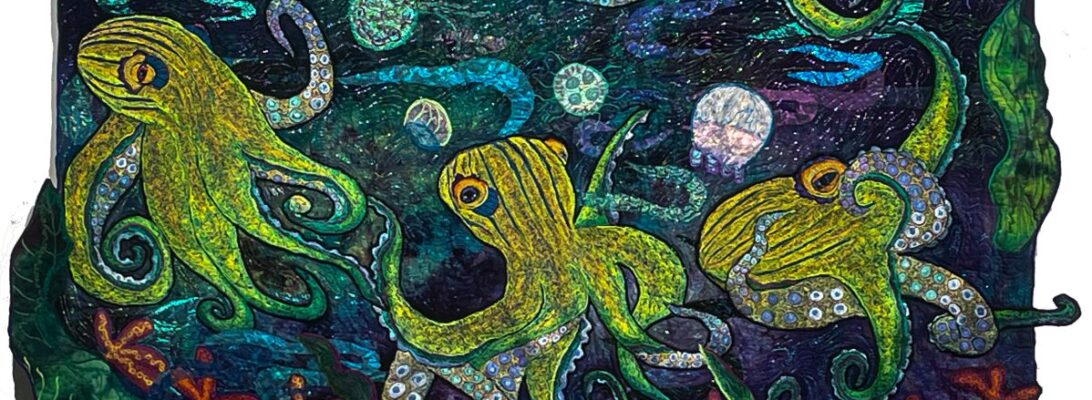
A while back I decided to see if I could recreate the energy from a piece I was particularly pleased with. If you’ve been following the blog, I’ve documented it as I’ve worked.
I wouldn’t call it a success. I went through three separate fish, not happy with any of them. I embroidered the best of them and still felt bland.
So I passed on the bass and did a catfish, which I’m not displeased with. The bass went back into the pile.
I can plan all I want. There’s a serendipity to art that is inescapable. While I was scraping out the studio, I found a piece of fabric I’d totally forgotten about.
All of a sudden, my wallflower fish had gone dramatic. I built him a whirlpool/vortex.
My fish fooled me again. I spent some time embroidering some nice metallic minnows that shyly blended right into the background.
They are pretty, but they have no punch.
So I’m trying these brighter gold minnows. I’m still not sure. They’re embroidered from poly, and they might stand out too much. I may need to do some from metallic gold.
I’ve been noodling around the idea of a series planned as a surround. I’ve done many series over the years, but this is different.
I suppose you could plan a series. But I’ve never seen it happen. You do one quilt with a subject that is either so fun or compulsive that you do another five more. That’s an organic process that I enjoy. But it doesn’t lend itself to consistency.
Spoonbill Series
These birds just happened. I love the shape of them, the bills and that crazy pink coloration. So I’ve made a number of roseated spoonbills.
We’re talking something different here. A surround has to be planned so that each piece flows into the other one. I can do that somewhat with the drawings. They need to flow across the different quilts into eachother. I can do that somewhat with background images. Rocks and seashells can make a pathway. I can also do that with small fish. I’m thinking of clownfish and something small and gold in color. That is the plan.
The coloration should be easy. The hand-dye needs to be all of the same intensity, and we’ll keep the octopuses bright. They should fitin with each other well.
The first octopus is embroidered and ready to place in background elements.
The second octopus is almost embroidered. I need to outline the suckers.
He’s already had a large change. Originally, I had one sucker tentacle closer to the head. It worked in the drawing but not in execution. So I cut it out, and moved it. I think it works better.
shell rubbings from another project
The next steps will be tricky. I plan to rub seashells into the fabric on the bottoms of all of these. They’ll need to fit into eachother. I’m not sure if I can display them all on one photo wall. But they need to dance across four pieces altogether. The last time I did something this large, I hung it off the back porch of my apartment building and walked down the alley to where I could see it as a whole. That was three homes ago. We’ll need to figure it out.
I’ll keep you posted as I work on this. I think it’s going to be a wild ride.
I’ve spent a lot of time working with making rubbing plates. Here’s one of the reasons. There are ways to make waves out of sheers and lame, or stitchery, but I want that feeling of white foam and spray.
It’s pretty. But it lacks definition. I can approach this with thread and/or sheer applique. It’s also a test case for my cranes.
This is what I’m aiming for. I’d rather not make my mistakes here. I’m waiting on some beach grass stencils to finish off this top. But I’m still unclear how I want to treat my water.
The two pieces give me the opportunity to try different ideas and compair them. For Making Waves 1 I treated the white bits as different from the darker blues. I stitched it with 40 weight madiera metallic supertwist first. That was miserable. Sometimes Supertwist will work with a 90 topstitching needle and a lot of Sewer’s Aid. This wasn’t that time. I got about three stitches before breakage. That’s past my tolerance.
So I went to plan b
So instead. I stitched the white waves from the top with poly 40 weight. The stitching from the top marks the back Then I traced the stitching with #8 weight candlight, rainbow.
I like this a lot. I went back in after that and stitched the rest with matching poly 40#.
Making Waves 2 is my second possibility.I stitched the waves withpoly 40#. More subtle but I like it too.
I also tried two different approaches to my sheer overlays. For Making Waves 1
I used white and purple cheesecloth. I found it too clunky.
Making Waves 1 sheers with cheesecloth
I like this treatment better. Metallic lace and white organza just blends in better.
Making Waves 2 sheerswith fish d1
So to recap. I like the thick threaded Candelight on the waves, 40 weight polyester on the darker sea, and metallic lace and organza on the waves. What do you think? What would you choose?
What are elementals? They’re not the subject or the background. They are layers of sheers usually that create the ilusion of air, water, clouds, fire. Things that are usually translucent or transparent. They change color and texture within the piece without being obtrusive. Usually they have no hard edges. Instead, we see through them, but they help create the illusion of those elements by shifting the colors.
I put in my elementals directly after I’ve chosen my background and finished embroidering my subject.
Up until now, I’ve made my elementals out of sheers, lace, hand painted lace, and dyed cheesecloth. I love those. But I always want more options.
Since I’ve been able to make my own rubbing plates, I’ve had options to create that layered effect. Most rubbing plates create texture or give you a subject. The ones I made with stencils are created to make trees, clouds, waves and waters. Why does rubbed fabric work for that? It has soft edges, It blends into colors, and you can layer your rubbings just like layers of sheers..
beginning backgroundembroidered fish
I’m very pleased with the background and the fish. But I wanted the feeling of reflected trees and pond surface.
Fish placed in background rubbed with tree images and water reflectons. Rocks added.
The water and the reflected trees add a hazy elemental layer. What now? I’m unsure. I think it needs a layer of sheer waters as well.
Layers suit water. If you’ve ever walked into a pond, you can feel the layers of water, warmer or colder. It makes sense in fabric as well. I’m hoping to create three worlds, the bottom of the pond, the surface of the water, and the bare trees above the surface. Time to get out the silk leaves and organza.
I’ve whined a bit about larger work this month, mostly because I had 6 full sized pieces to finish. Not fun. But all but one is done.
So in response to that, and in giving myself a break, I decided to do something smaller. These Japanese cranes have been on my mind for a wile. Originally they were on a textile.
People talk about making a smaller version of something and then blowing it up. I’ve never found that works. The size changes what you can do with your stitchery.
When I work large, my thread color choices have to fill in a space. It’s a larger space. I do have a formula for that. And a basic color strategy.
I work dark to light.
The color of my background is the light within the piece. So that color has to be part of the choices.
Everything is accentuated. I choose my colors to be more intense than the overall effect I want
Your eye will mix the colors. Even if they don’t seem to go together. Don’t be afraid.
I choose
A dark tone of my desired color.
A shader, usually either purple, brown, dark green or blue.Often I’ll use a complement from my desired color
Several shades of th chosen color.. They can differ in tone and clarity, but they need to be lined up dark to light.
A shocker. Usually the complement in a bright form
A light color that is the color of the piece.
The lightest color. Usually lighter than you want the piece to be as a highlight.
That fills in a lot of space.. It needs to. It allows for some intense coloration.
Smaller work is smaller space. No help for it. The stitching isn’t as intense and you end up with a much small space to fill in. So your choices pull in.
For your thread choices you’ll want.
The darkest tone of your color
A toner, complement, brown, blue, or purple
A mid color
Maybe a shocker
A light color
May be a highlight color
It’s the same theory, but it’s stepped down for smaller spaces. I don’t like to work that way because it makes wild choices feel more intense. It abstracts very quickly
So I worked on these cranes this week. They’re white, but I worked up to that with a lot of soft toned pastels and greys. I was completely worn out on them until I slipped in a bit of turquoise.
I’m not wildly unhappy with this, but I feel limited by it
.The joke is that the ended up fitting into a yard of hand dye, the size I most often use for large quilts.
I don’t often do this, but I have a pervasive urge to redraw the image bigger, and go wild with the colors, just to see what I get.
It’s always good to change things in your work. Any change is a challenge. Chainge the size, change your pallet, change your subject, and certainly at the right moment, change your undies. Change is good.
This last year has been a disaster for my sewing machines. Most of my work depends on intense embroidery. Lately I’ve depended more and more on that stitchery for my images. I love it. But it does wear and tear on the machines. I had 6 major machine breakdowns. last year. I broke down 3 220s, my 770, my 630 and a 930. Some have fixed. Some have not.
I’m a Bernina girl from way back and have been a Bernina Ambassador for most of my career. I work with Berninas because they are tough and they stitch accurately. That doesn’t mean they don’t break down, Particularly if you’re sewing at speed demon speed for hours on end. I was told this is my fault.
I suppose it is. It’s what I do. I can either back away from this kind of stitching or find another way.
Zigzag embroidery allows for intense detail and color, I can’t step away from it. I also can’t keep breaking machines. So something has to change.
Don is my miracle in this. He’s a wizard with older small motors. He’s not specialized in sewing machines, but very mechanically savvy. He’s collecting manuals and parts machines. As always, he’s my hero.
I really can’t function though without a working machine and I prefer 2 backups. I’m not exa sane without a sewing machine.
Years ago I bought a 20 U Singer for intense embroidery. That’s not what these machines are known for. In a way, they’re the cockroach of the sewing machine world. Not in the sense that they hide under the cupboards, but because they are pretty much unkillable. You find them most often in dry cleaner shops for repairs.
It was a mixed success. This thing eats babies and cats, breaks thread constantly, and is fast—too fast—even with different slower pulleys. And it was the weight of a tiny elephant. When I left Porter, I left it in my studio, where it has sat.
Ken, the person renting my house, offered to bring it to me. That in itself is a huge glft But I’ve had my reservations about making this machine work. I first felt I was stepping backward, Is it an answer to the same problem? Is this machine tough enough?
Well, we know it’s tough. Can we make it work with embroidery thread? There’s the question. It’s also paid for.
It had its problems before. But things have changed. I now use stronger threads. I no longer work in a hoop. And we found that a servo motor would step down the speed. So it’s coming to the studio sometime this month, and we try it out. I’ve gone from feeling like I’m stepping back to seeing new possibilities.
You can’t step in the same river twice. You are different and the water is different.
I’m digging out the studio this week to make room, which is why I don’t have new work to show you. I’ll let you know what happens next.
Wish me luck. I think it’s time for another spoonbill.
I’ve been working for a week on a flamingo quilt. It’s a commission of sorts, so I’m working with the owner’s druthers. Blissfully, we have similar druthers and I think she’s quite pleased.
Part of this week’s fun has been choosing the background The flamingo is all embroidered, so the next step is building her world. I was looking at colors when I pulled out fabric opportunities, but I discovered quickly that what really happened is that the background changed the time of day.
The different backgrounds suggest different times of day
The background changes the time of day and that in itself is a powerful statement. One way or another she’s walking in surf but is it night? Is it in moonlight? Twilight? Afternoon? Early cool morning?
Those are more than logical questions. They make a statement about the quilt itself and what it conveys. They tell me about this bird, who she is, where she is, and what her world is like.
All done by a simple choice of cloth. It never ceases to amaze me. Mostly the fabric choice is about letting the subject shine, but that choice carries meaning as well as color. Hand dye is a miracle that happens all the time but only once for each piece. The miracle we choose opens all kinds of choices and shuts other possibilities out. I’m thinking this will be the “right” background
Final Choice!
I turned around the darker one so that her face is in the light. We have a winner!
Still deciding about the moons. Do I want arced moons or just one? Decisions…..decisions.