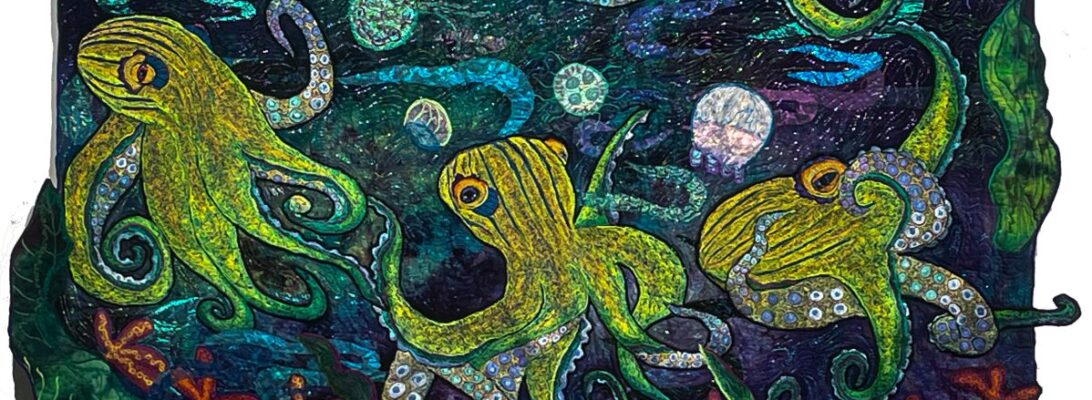
Again? Really? Yes. Really.

I try really hard not to rate my pieces as I make them. I find that my opinions of things change over time, largely in reaction to people’s reactions. If I suspend my judgment of work, I find I learn more from it. Suspending judgment allows me to flesh out ideas and move on. Finish the quilt. Next quilt, please. The learning is the goal. The quilt is almost a byproduct.

But sometimes I do a piece that knocks my socks off and throws me across the room. It’s not an everyday thing. When that happens, I find myself asking some of the same questions that I ask when I do something I hate. What happened here? Why is this piece wonderful? Or awful? What?

Was it the color palette? Technique? Is it about my background? The image itself?

A fabulous piece makes you think, “Can I do this again? How did this happen?”

I love this piece so much. So I’m going to try not to reproduce it, but to focus on its successful elements.

Part of what I love here is the quiet palette. I normally go for eye-sore colors. This was restrained. Luckily, the last batch I dyed had a piece, not exactly in the same palette, but in the same tone.

The fish can be the same threads. And I think it needs to be.

I had trouble with the fish. I wanted a fresh image, not the same, but in the same colorations. So I started several fish, only to find them wrong. I love these. But in terms of direction and size, they’re just not right.

I went through my collection of drawings. My embroidery process uses a pattern drawn on Totally Stable that goes into the back of the piece as a pattern and a stabilizer. So each drawing is consumed by the embroidery itself.

Not to worry. For the last 3 years, I’ve saved a tracing of my drawings for later. It’s turned into a jumping-off point for other pieces, and I consider that collection a treasure. I found a fish that had to be at least 10 years old, which I don’t believe I ever used.

This will be reversed when I’m done. I’m half way through the embroidery.

Originally I used a tree rubbing plate both for the trees themselves and for the reflection in the pond.

And I want to explore the rubbed oil paint trees. This piece of fabric evokes a stream rather than a pond.

Now that I’ve analyzed my elements, we’ll see where it goes. It’s at that awkward spot where everything looks wrong. But that’s the exact moment to suspend judgment and push through.

It may take all those elements and work well. It may not. There’s a mystery here I don’t understand. But I think that part of it is that a piece is not the sum of its parts. Instead, perhaps it’s a whole being itself. Maybe it can’t be reworked with the same success.

Push on. Finish the quilt. Next quilt, please. The learning is the goal.

Understanding Quilted Textures: Layering for Stunning Effects

Most quilters think in terms of one surface. You make a top. You quilt a top. It works for the traditional quilt.

It’s never worked for me. If you’re creating a natural world, one layer seems, well, flat. Layers change tones across a piece, build texture, create shading, and add elements that are present but not solid. They can be made from fabric layers, thread layers, and sheer layers.

I also have a layer of image embroidery which is a separate thing.

Hand dye is always my starting layer. Even now when it’s become a pain in the ass to dye, I still don’t want anyone’s fabric for my art but my own. It’s unique one piece to another and if you let it, it will tell you what to do. Who doesn’t need a leg up?

This last month I’ve added another possibility. I can have an oil paint stick rubbing layer that adds substance as well as texture.

Because I can make the rubbing plates I need. I’ve used rubbings for all kinds of things, but mostly, the commercia; plates are best for texture. Oil paint stick rubbing is not exactly transparent, but it does show the background through.

On this piece I wanted trees, water, and reflected trees. I wanted the actual trees to be more present, so I stitched them straight stitch with brown, black and blue.

The reflected trees and the water texture I simply let be. It feels, mirkier, wetter and more like water surface.

I have a beginning layer of sheer shapes for water under my fish.

After I’ve stitched down my fish, the second layer of sheers places them in the water.

A stippled thread layer of Madeiera Metallic colorizes the air portion and makes it shimmer.

A stipple layer of Sliver thread makes the water splash and shine.

Finally a layer of leaves defines the surface of the water.

My goal was to create three worlds, the pond, the surface and the air. I think I’ve got it.

Layers add texture, density and complexity to what I do.

Is This Off Color? Other People’s Perceptions

I spent last week working on three cranes. I was fairly pleased with myself, when someone asked, “Are these cranes having sex?

I hadn’t seen it. I still kind of don’t. I looked up a picture of cranes in love, and it didn’t quite look that quiet. But I have my head in my hands trying to figure out what I do next.

I was inspired by a Japanese textile design in a Dover Pictorial Archive book. I’m pretty sure they didn’t see it as cranes in love. It was my own rendering of it, changed in the way we change everything we draw ourselves.

Usually I let people tell me anything about my art. If it comes from them, it’s theirs. I don’t mess with that. I meant what I meant. I’m not responsible for their response.

But this hits me in a place that makes me feel very vulnerable. Sex is about bodies and bodies are about vulnerability. Art is about visual vulnerability. I’m not really secure about body image. I work in animal imagery since I can’t bear to work in human flesh. I have a delicate detent with my body, somewhat riddled by the failures of old age and memories of high school.

It’s a response to really old tapes. I wasn’t just fat. I was born deformed. Admittedly, it was a small genetic oops. But my mother could build a tragedy out a broken nail.

IF you are harmed enough, people can frame you as being inhuman. If you are harmed deeply enough, you may even think that’s true. If other people think it’s true, they can do anything to you because you aren’t a human being. That was my whole childhood. It seems to be going around globally right now.

I’m not taking this anywhere except in my own life. And I don’t want anyone to explain situations where it is somehow ok. Or tell me to get over it. I don’t believe we get to dehumanize people.

The bottom line is that I’m terrified of naked vulnerability. My animals are me in some way. I’ve come to see my self through Don’s eyes and his vision is kinder than my memories. I usually let that stand. I’m not sure I can be a crane in love on a quilt.

I took the time to reoutline the birds. It usually makes things clearer. Maybe this time that’s not such a good idea.

So what do I do with a quilt with cranes possibly delecto inflagrante? Do I finish it? Put a bunch of cat tails around them? Do I stuff it in a drawer until I feel more brave? I tend to not just throw work out, even if I don’t like it. I could put a lower price on it, and it either sells or it doesn’t. That assumes I can bear to finish it. There’s a dark corner in the closet, perfect for storage.

So what do you think? Would you finish it? Show it? Put a fig leaf on it? What?