What Rules? Testing Out Old Theories about guilding lilies

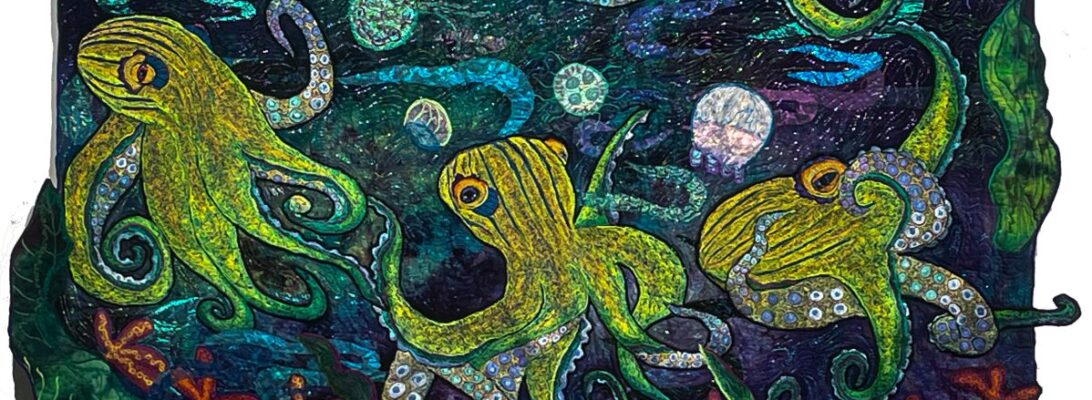
Swirling water, with metallic thread.

Whenever you teach, people want you to give you rules. Directions. Patterns. A safe way to get results.

That’s fair. That’s what they come to class for. What they’d really like is a formula. Add a plus b, divide by six and get your result. I do understand. And underneath it all, I have a list of odd rules as well.

But I do know that they’re odd. They’re based usually on experience. But sometimes they’re annoyingly limiting. And every so often, I test them out. I push the borders, just to see if it’s a superstition I’ve made for myself, or something really helpful. Or if the materials have changed.

This is a process I call gilding the lily. I take a really lovely print or rubbing and accentuate it with thread. I’ve taken to doing it a lot with oil paint stick rubbing.

One of the tricky things is working with metallic, of all sorts. Metallic goes with metallic, right? I used to be quite strict about that.

Until I had something I was embroidering there just wasn’t enough metallic colors for. And then I found my rule was silly. Of course I could dust something with metallic.

So lately I’ve been working with metallic oil stick paint. I’ve been embellishing rubbings with straight stitch and metallic thread, a technique I call Gilding the Lily. Did I have to use metallic thread? I thought so. I thought the poly thread would cover it up too much. I thought it needed the shine.

But I had to work the metallic thread from the top. And metallic thread, even the best metallic thread is touchy in the top of the machine. It goes through the needle 50 times before it lands in your fabric. So I tried it.

How silly of me. I sat down with a pile of rubbings and some beautiful poly neon. The look was different. But lovely. And my rules were so much eye shine.

It’s worth not shutting the doors of creativity because we have a safe sure method, a path we know. Sometimes we simply have to stumble past our safe path to experiment outside those possibilities to something new.

So if I waffled teaching you in class and couldn’t give you a complete formula for a perfect quilt, I hope you understood I’d given you permission to try anything your heart desired. Me too!

9

Another Fishy Story: Thoughts on Color Range

I’m working on another fish quilt. I’m not sure quite how these fish will go together, but I’m aiming for three different colorations out of the same color range.

I wanted gold fish. But good fish are not made of the same gold. Why? Well, seven fish all colored identically seems fishy to me. The nature of nature is variance.

So I pulled a range of colors that went through yellow greens and orange golds.

Coloration is about filling in space to a large degree. A large space accommodates a large range of colors. Usually colors are set with a base dark color, a shadow color, a range of progressively lighter colors, a shocker color and a lightest shade on top as a highlight. Except when it’s not. That works very well with large areas.

Fish have scales which usually aren’t that large. Usually there’s room for a base color, a shader, a center color, a shocker and then a highlight. This gets more limited as the fish get smaller.

For each of the small fish there’s a base color, a shader, the next brighter color, a softer shader and the next brightest color. I’m putting a shocker around the eye and in the bottom fins.

So I’ve done four fish in red/green, yellow/purple, orange/blue, and yellow orange/ purple, to explore the progressions on this. You’ll notice all the shaders are complements.

It’s a trick to have a number of elements in a quilt with different colors to match each other in tone. Since I’m choosing threads off the neon fluorescent chart, that kind of takes care of that.

There are three large fish, but I wanted to do several fish in the full range. Here are process shots on four of them.

Fish One

Fish Two

Fish Three

Fish Four

Notice what a difference in makes to outline them for the second time! The stitching inevitably creeps over the outline, so they need to be crisped up, sort of like fish sticks.

So here are the fish in process, small ones finished large ones left to go on the background. I worried about them feeling too different, but the range gives them variation without seeming like they don’t belong.

The Public Eye: Out there in front of Everyone

Yesterday we had the Pop Up Sale at the Galesburg Art Center. The center is a grand old historic building with much of it’s history in evidence, but the people are warm real artists with wide minds and smiles. It’s been a long time for me.

In your studio, your art is whatever you think it is. Good or bad. Honest or ludicrous. I’ve found those judgements change in a heart beat according to mood and blood sugar. Once you put a piece out where people can see it, there’s a whole other evaluation outside yourself.

I’ve lived a lot of my life out in public. You don’t travel and teach the way I did in a box. There’s a value in that, and a value in sacred space that no one intrudes in such as a studio. The real value is in the balance between.

Thank you everyone who came yesterday to visit! Thank you, Tuesday, for inviting me to show there. And thank you Don for your endless patience and support.

Ressurections: When it Turns

Tomorrow I have my first sole artist showing in over 10 years, I’ve been working for this for 2 years.

Tomorrow I will be at the Galesburg Art Center for a sole artist Pop Up Sale. I’ll have threads, fabrics and quilts all on sale for the day. Out in public.

Sometimes your art is your life. Sometimes your life is your art. I’ve had many people tell me they weren’t an artist, or that they no longer could do their art. I did not understand that when I was younger. I leapt from one project to another, I lived and breathed dye and thread.

But it changed. At one point I was teaching more than I was showing. And that was an obsession too. I opened as many good doors as I could for the people in my classes. Demoed daily on unfamiliar machines. Learned to help people find their way to do what they were working towards.

And then it changed. There weren’t the same opportunities. The teaching slowed. And the passion for my work was gone. I sank into the sunset, learned to knit and crochet, Dealt with my far too worn knees.

It got kind of grim. There are times when your art is your life. But when it isn’t, you really do have to make your life an art. Find ways to feed your eye. Ways to make your heart beat. Allow things to go fallow, I wrote three books, which I believe have probably annoyed everyone who read them. Raised a garden and some neighbor kids. Kept a pack of greyhounds. And I pretty much stopped quilting.

That was when Don came into my life. I’ve never been a believer in love in terms of a noun. I believe it as a verb. It’s not a thing, that you own. It’s actions made on choice. It was an astonishment.

Alumni and Faculty Book Signing; Homecoming 2018

I knew Don at college. But I don’t think either of us knew each other at all. He stood by me as I got my knees fixed. Three knees later, he gave me his home as a studio. And came with me every day as I worked on one piece after another. He opened doors for me I thought were shut forever. I don’t have words for it, but thank you is a start.

When I announced this show, someone posted on the list that she hadn’t heard from me in years and she thought I was retired. I wrote her back that I hadn’t died yet.

It’s changed. I’m in that place where I can’t stop working. I’m on fire. There are resurrections. I’m still here.

I don’t remember who made the post. But I have some hopes for her.

I hope she has a passion that lights her life.
I hope that when her life changes, as life does, she finds good things that heal her heart. I hope she understands that she is a human being and not a human doing. That we all have times when we can produce things and times when we cannot.That there are ways back, not to where we were but to what is next.

I hope she gets a resurrection too.

Tomorrow, August 27th, I’ll be at the Galesburg Art Center, 341 East Main Street, in Galesburg, IL from 9:00 to 3:00. I desperately need to sell some things. I’m out of dye, steam a seam, fabric and steam. But being out of things means I working as hard as I can. I am so grateful. To be able again.

It Was Sitting On The Floor: Swept Up in the Left Overs

One of the nicest things about finishing up a bunch of quilts is the things left over. I tend to batch my embroideries. Not the big ones. One four foot heron is enough usually. But the little bits that go into a quilt are important, and I tend to make batches of them.

How does that work designwise? You place your big objects, and then you build a pathway of smaller objects around them. Hence the need for a lot of small objects.

I used to sew these directly onto the quilt surface, but they do tend to pucker up. So now adays, I sit down to a batch of things, use what works, and then raid my stash of leftovers to fill things in. I thought it would be fun to show how the same batch shows up in one quilt after another.

I also used to embroider exactly what I needed, well, when I could figure that out. It never quite worked that way. Did I need four frogs, or six or five? They do shrink in process so it’s hard to tell from the drawings.

So I over produce. I draw a whole bunch of whatever it is and then embroider them. They either land on the quilt in mind or they find their home somewhere else.

Sometimes, you just have to embroider the needed bits. These were what I needed to add to the big fish head.

1026-22 Swish

In between? Well, in my younger days, they went into suit cases when I traveled and wandered from one spot to another in the studio when I was home. So they tended most often, to be found on the floor.

Which is not to say that I didn’t understand their worth. I’m just not good at organization. I’m better now. I put them in bags in one place in the studio. Which is good because I raided those bags for these three quilts.

I had extra flowers, fish, frogs, and dragonflies. Can’t go wrong on that.

left over hummingbird drawing filled in

I also had extra drawings. Embroidered applique is a lost wax method, in a way. The pattern goes into the back of the piece and is incorporated in it. But patterns are hand drawn and a bit sketchy, so I tend to trace a smooth copy of them before I embroider. I had some great left over drawings of a frog, some fish and a hummingbird.

All in all, the pieces came together, after I got them off the floor into three new Visual Path quilts. I love left overs!

1029-22 Forest Floor detail 1

Don’t Panic? Prepping a Quilt Show

Me? Panic?

I am happy to announce two events. I have the first couple of showings I’ve had in 10 years.

Open Studio: Quilted Tapestries of
Ellen Anne Eddy
Saturday, August 27th
Quilts, tapestries, books and hand dyed fabrics available for sale!

Hours:- Saturday 9AM – 3 PM
Contact: Ellen Anne Eddy
219-617-2021 Galesburg Art Center, 309-640-0005

Birds of a Feather: Quilted Tapestries by
Ellen Anne Eddy
Cove Center, Havana, IL

The Cove Center, in Havana, IL announces Birds of a Feather, a show of quilted nature tapestries by Ellen Anne Eddy August 30  through September, 30th 2022.
The Cove Center is in the Wahlfeld Building at
120 N. Plum St., downtown Havana Illinois.

Hours: Monday – Saturday 8 AM – 1PM
CLOSED SUNDAYS
~Gallery Opening: September 2nd 4 – 8 PM

Contact: Ellen Anne Eddy 219-617-2021Cove Center: 309-640-0005

Splash!

How do I feel about all of this? I haven’t hung a show in ten years. I’m past panicked.

Now, for an artist, panic is your friend. It’s the thing that helps you through the hoop of finishing, binding, hangers, signage and all the little details you remember the night before the opening. Along with raw terror, there’s all that extra energy if you can harness it. By now I’ve run out of steam and Steam a Seam 2 and most of my larger fabric chunks. My friend, Deborah Christman kindly embroidered a Don’t Panic towel In support.

But here’s the cool thing. I have, due to show panic and a small amount of hysteria, 15 new quilts and two new series to show.

So it’s not like I don’t have something to show. Or cool new work for sale. Please come join me! If you can’t make those dates, call and we can make a time for you to see things at the studio. Let me know what you think about the new work. And buy a quilt if you fall in love with one. I’m still out of Steam a Seam.

Seeing Right Through: Applique with Sheers

Splash! in process

I know it’s not supposed to be quilter’s fabric. Sorry. I can’t leave it alone. It’s too much fun to play with test tube babies. Over the years I’ve collected a special stash of laces, organzas, chiffons, brocades and just plain weird stuff.

It’s not anything I would piece. But no one would call me a piecer so that’s moot. But it’s wonderful for the things in this world that are, by nature transparent and/or translucent. I’ve talked earlier about finishing sheer edges with a soft edge finish, Sun Rocks, Wind, Water: Elements with Soft Edges.

But there are times you want that edge to show. Edging lace and sheer applique is a way of not only defining the edge of the applique but of controlling the color and controlling exactly how transparent it is.

I’m working on some moonflowers and some snow drops for a quilt called Splash. The quilt features a dark mostly blue background, and I wanted glowing white flowers for the background. Moonflowers are morning glories that bloom only at night. They’re perfect.

It’s also a way of lightening a darker quilt.

I used both lace and organza for my flowers. I do like them to have small differences, so they have their own individuality. Then I placed them with Steam a Seam 2 on a piece of white felt, with some green leaves. Why felt? It’s a spectacular stabilizer, with a layer of Stitch and Tear underneath. Why white? Because it’s all going to show. Whatever color felt I put under the lace will show through and define the color of the finished flowers. Organza will show through the most, lace less so, and Angelina fiber the least.

Knowing that is power. Felt comes in a full Crayola box of colors and it allows me an extra layer of shading in the process. The thread I use will also define the colors and shade things into darks and lights. Here’s a collection of flowers with different backing felt colors.

I use a number of pastels as well as different whites to stitch the edges to give depth. As usual, it’s darker where the sun isn’t shining.

shading the flower

I stitched the flowers with a free motion zigzag. Here’s a little video showing how that works.

I did these moonflowers separately from the piece because they’re relatively large and would have distorted the surface. But for the smaller snowdrops, I applied them directly with Steam a Seam ad then stitched on them directly. The cool thing about this is that the background peeks through, like all translucent flowers. It’s a cool effect.

snowdrops directly on the fabric

And it’s a great reason to play with sparkle lace. There should always be a reason for sparkle lace!

Studio Essentials: The Glory of the Design Board

1023-22 White Cherry Pond

Years ago I was in an Amish shop, where I made a purchase I really probably only could have made there. I bought 6 yards of black polyester double knit. The poor lady was scandalized. I was dressed in hand dye, obviously not only English but art quilting English. The Amish keep black polyester double knit for men’s suits. Clearly I was not making suits for some nice Amish man.

But it’s the perfect cover for a design board.

I have in the past hung things up on a balcony to the back porch and walked down the alley until I could see it right. That’s a bit hard on a daily basis, and I no longer have a balcony.

Do you need a design board? Yes. Yes you do. You need to really see what you’re piece is doing.

I have a lot of tools in my studio. I love my machines, my irons, my cutting and ironing table. But queen of them all is my design board.

I no longer work in bed quilt sizes. It’s irrelevant to art quilting. But most significant show quilts are largish. Average size for my work is about 36″ x 45″. It’s hard to find a flat surface that size that has nothing on it. Certainly not the floor. Never mind the other things that already on the floor.

The cutting table accommodates that size, but looking at something on a flat surface gives a distorted view. The only way you can really see your quilt is to hang it up.

There’s a rhythm to doing any kind of art, and once you start working makes you want to push through. It feels good to do that. But it’s a trap. If you don’t look at what you’re doing, it’s easy to do something you wish you hadn’t. Does it need to move over an inch? Is the drawing the way I want it? Are the colors working? If you can’t see it, you can’t evaluate what you’ve done. I can’t really see it on the table., either. The perspective is off when you see it lying flat. So up it goes on the wall. It’s worth leaving it there a day or two if you think something’s not right. You can’t see what’s wrong if you don’t look at it.

My wall a sheet of 4″ thick sheet of blue dow insulation snugged up against the longest wall in the sewing room. And it’s covered with that black double knit.

Blue Dow is available at most building stores like Loews and Menards. It comes 4′ by 8′. It is lightweight and you can pin projects up easily. It can be cut to shape with a bread knife.

Any large piece of fabric like a sheet, felt, or double knit can be used for a backdrop. Black, grey or white make good backgrounds. I like double knit because it doesn’t collect lint and the black is a nice dark black.

It’s also my photo wall. Having a photo wall and set up in your studio gives you consistent photos. If you have the same camera, the same lights and the same background, your photos fit better in with each other and are easier to adjust, since you know what to do for them.

I also usually take a picture of the days work as the last thing I do, so I can evaluate my next step. Usually I post it on Facebook if it’s interesting, but at least for myself, I can see what’s going on. And plan what to do next.

For more information about how to evaluate your piece and it’s progress check out The Importance of Backing Up and The Wrong Bird: The Importance of Not Settling.

For information about photo walls and lights, see Fiat Lux: Studio Illumination


Sun,Clouds, and Water: Making Elements with Soft edged Appliqué

Background with sheers and lace for water
Sheers and lace for water

When we applique something, we think most about the fabrics used together and how they interact. But the way it’s appliqued, the stitch and threads used make just as big an impact. Applique edge change the look of our work.

Steam A Seam 2

Soft edge applique is for things that don’t have single color edges. Bubbles. Clouds. Water. Mist. Angelina fiber. Sunlight.. Why? A hard line of stitching makes them stand out too strongly and makes an ugly line. So all I want to see is the change in fabric. Particularly with sheers and laces. It’s a direct applique technique because it’s glued and stitched directly to the top.

I do most of my applique with Steam A Seam 2. It’s a peanut butter sandwich with two pieces of paper and tacky glue in the center. I can peel off one side of the paper, tack it to my fabric, peel off the other side and then place it on your piece over and over again until I’m happy with the result and I iron it down.

I usually cut c and s shapes. These flow into each other, and they make all kinds of natural light and shadow. You can cut pieces one after another following a similar shape.

moon and clouds

Here’s a sun and some clouds. Same shapes basically, but they fill in well. The nice thing about Steam A Seam 2 is that it sticks, but you can reposition it. I’ll put pieces up on my design wall and then play with them until they’re right.

I never really trust glue. Sorry. I just don’t. I’ve seen it too often. You iron it down and it peels back off. Maybe I don’t always iron long enough. But I always stitch it down, just in case. Then I know it’s not going to travel anywhere.

The glue will come through your lace onto your iron. So when you iron lace and sheers, you’ll need a pressing cloth. My favorite is the Applique Pressing Sheet. The glue will melt through on the the pressing sheet.

You can clean it off with a Scotch Brite Zero Scratch Scouring Pad, which will not scratch your pressing cloth.


For stitching, I use an invisible thread. But which one? It seems to depend on you and your machine. I’ve had some good luck with YLI Wonder thread, but I need to take my machine speed down to a crawl to use it on the 770 Bernina. Madeira, Superior, and Aurafil have different grades of monofilament nylon and poly that you can try. If one doesn’t work, try another. I use a topstitching #90 needle, and Sewer’s Aid (a thread lubricant). Will it break? Yes, I can promise you that. But it leaves a soft edge to the piece that makes water and clouds look more real. If the breakage is making me crazy, I sew as slowly as my machine can.

Soft edge applique is done with invisible thread in the top and an unobtrusive color thread in the bobbin. I use a zigzag free motion stitch, at an angle. That gives me the most amount of edge coverage.

Angled free motion zigzag stitch

Soft edge applique is done with invisible thread in the top and an unobtrusive color thread in the bobbin. I use a zigzag free motion stitch, at an angle. That gives me the most amount of edge coverage.

piece pinned up

Free motion zigzag stitching depends on the angle your fabric takes through the machine. The body shading angle is the one that will give you the most coverage, but the angle will change as you go around the piece. All you want to do is lightly zigzag over the edges.

And the best part? I can add a whole other layer of water lace to put my fish in the water. How good is that?

Soft edge applique is perfect for natural elements. Let the sun shine!