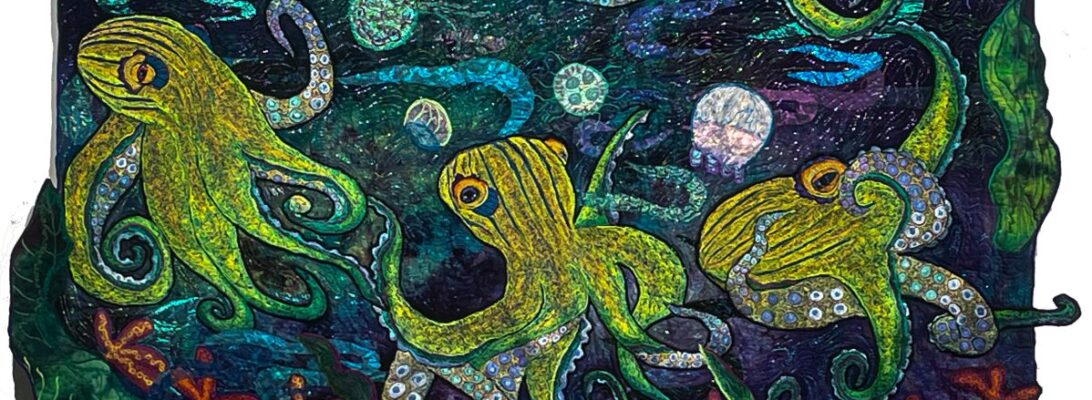
Branching Out: A Tale of Two Branches

I’ve been waiting for a while to finish this quilt. Right now it’s all pinned together. All the components are finished, but not stitched down.

Branches are always hard for me. I’m more comfortable with leaves, but the leaves need to sit on something. And this heron needed a nice dead branch to stand on as she surveys her pond.

I think it’s harder because it’s more abstract. I’m not quite sure how to do the portrait of a tree. So I start with a shape, and I’m trying to make an interesting bark.

I’ve tried some slash applique for branches. I tried that first. I used two layers of hand dye with felt and Stitch and Tear as a stabilizer. I was trying to get the grain of the wood to wrap around the branch.

I stitched it down, straight stitch, trimmed out the shape, stitched in grain lines, and slashed the top layer. Then I hand ironed them with a point turner so they would stand upright, and stitched along the seam.

Once I sliced through the top layer, I roughed up the fabric with the edge of my mustache trimmer. The mustache trimmer was not on, but the blade on it made a nice surface to make the edges fray a bit.

I don’t consider it a success. I don’t like the shape and I don’t like the direction of the bark.

So I did it again. This time I used three layers of cotton, and stitched vertical lines much closer together. I didn’t really savage the upper layers. Instead, I sliced through them like chenille. I tried several methods but it really was easier just with scissors. I roughed it up with the trimmer as well.

This isn’t appliqued down yet, but I’m so much happier with it. The other branch will work in a forest floor piece, but not here.

a Thousand Cranes: Some Thoughts about busyness, Waiting and changing Our Stories

There is a legend that if you fold a thousand cranes, it will change you. Your pain will be relieved. Your luck will change. This repetitive action will change your life.

I had a visitor to the studio remark that there were a lot of processes in each quilt I made. There are. Dyed fabric, oil paint stick rubbing, painted sheers, dyed cheesecloth, free motion applique, direct sheer applique, and then we quilt.

That does represent a lot of busyness on my part. I like the complexity. I want a piece to be exciting when you see it from a distance and exciting if you are inches away from it.

With that said, there is a lot of donkey work. Yesterday, I cut rocks. I use the leftover pieces of fabric that are rock colored and cut them into rocks of several different sizes, waiting for the right quilt. Repetitive. So much of art is. A lot of art is creating a surface, a color, a shape, a texture that makes the piece something splendiferous. That takes a lot of repetition.

I have a price list where I document quilts by size, when they were finished and given a number. The latest quilt is numbered 1125-23, which means it’s the 1,125th quilt made since 1987. I’m going to claim them as my 1,000 cranes. What I’ve learned from 1,125 quilts is that the action of creating something over and over in different ways does change us. Art changes us because it helps us tell our stories in a different light and see ourselves in a different way. But we come to that by a series of actions that seem to be the same thing over and over. If we want the benefit of change and regeneration, it takes a sustained effort. In the Screwtape Letters, C. S. Lewis said we were not capable of any sustained action, only of the undulation towards a goal.  According to Screwtape, Undulation is the repeated return to a level from which we repeatedly fall back, a series of troughs and peaks. God relies more on troughs because it makes us rely on God.

Art is a holy process. It’s a place of honesty, effort, and repetitive actions in hopes of reaching the peaks despite the troughs. What I have learned from 50 years of quilting is that the troughs simply have to be waded through like mud, with the actions over and over again that create our art and ourselves.

Tuesday, I’m going into the hospital to have a stent put in to fix my blockage. I have good hopes, but I can’t say I’m not nervous. But the waiting and the work on my quilts has soothed that some. It’s an office procedure. I expect to be home the same night.

So I do what I do when I’m nervous. Or happy. Or sad. Or confused. I make more quilts.

Leaf Mantises Too: More exploration

After several weeks of playing with leaf mantises, I have discovered several things. First off: a warning! They are addictive. At least they’re not fattening.

Secondly, I need more leaves. Lots and lots and lots of leaves. All the shops are seasonally xmasy, so that means rummage sales, and Yours to Create. Too many is not enough.

They work better if you stitch the leaves and connecting parts separately. I like the running garnet stitch better than a fully connected zigzag.

The head as a leaf doesn’t always work. I don’t know that I’d do that every time. But an embroidered one works just fine.

Straight stitch works best on leaves. Contrasting thread is your friend here.

I hope you get the time to pick something you want to play with and work it out. The exploration and the journey are all the fun.

Free motion Applique: following the Curve

This is under the heading of sneaky secret tricks. I rarely use an applique foot for applique. Instead, I use my darning foot and cover the raw edge in a free-motion stitch.

Why? Mostly because I rarely use a straight edge in my work, except for borders. I’m a curvy girl and I think in terms of curves.

I wanted a curvy vine for my butterflies to fly over and for the flowers to nestle into. layered on another piece of green hand dye, stitched out my vine in a straight stitch, and cut away all the excess. It’s best to get rid of all the extra fabric you can. I use pelican scissors to trim as close as I can get to the seam. Pelican scissors have an odd bend that lets you cut right on the edge.

Then I picked a light, dark and medium set of threads for the edge. Vines have two sides, and one can be done light and the other dark. If it’s a complicated vine, it may take a wider range. You want colors that could be the same if they were in a darker or lighter environment.

Stitching the top and bottom line of the vine in different colors gives it a visual distinction that makes it look dimensional. And because it’s free motion, the line is fluid and follows the curve more graciously.

Here’s my piece, almost ready to back and bind. Free motion applique is just what a curvy girl ordered.

Developing Ideas: Leaf Mantises

You saw something fabulous. And you want to use the idea of it in a piece of work. How do you do that?

I have an obsession with praying mantises. It’s not about their social structure. It’s about how they look and move. I’ve always found them fascinating.

Lady Mantis 2

It’s really true that if you can’t see something, you can’t really draw it. Or design around it. So my first steps is to find a bunch of pictures. I’m not looking for something to copy. I’m looking for how they hold their arms and legs, and what angle the head is at. It’s research.

I love the leaf mantises. Some are green leaf, some are dead leaf. They made me want to scurry over to my leaf collection.

I’ve collected silk leaves for years. They come from craft stores, the Dollar Tree and rummage sales. So, could I make a leaf mantis from silk leaves? It turned out to be a pretty easy trick.

I sat down with my leaves and arranged them into a bug. They stitched down nicely. It was an experiment, but I’m thinking I’m on to something here.

So, more pictures, more research, and maybe several of them dancing in the woods. One of oak leaves, and maple leaves, and who knows what else.

Medical Update 3: Hurry up and wait, Will you?

Late this September I was diagnosed with a leaky heart valve, an aneurysm, and a capillary blockage. Since then I’ve been waiting for the doctors to make up their minds.

It’s serious. It’s very serious. And the doctors seem to need to talk about it very seriously for the next month and a half to figure out what to do first. I’m very frustrated by having to hurry up and wait. They tell me the diagnosis is early enough that we can take some time to decide.

In a way, that’s a good thing. I’ve found myself in a grief process connected with this, and it’s given me time to get past my disbelief, shock, rage, and depression associated with it.

It also gave me some time to sell some quilts to have the funds to take care of whatever else isn’t in Medicare or insurance. For those of you who have purchased quilts to help me, I don’t have words to thank you enough. I feel much more secure and safe because of you.

For the moment, it seems like nothing is going to happen before Thanksgiving. Christmas we’re still figuring out.

So in the middle of that, I’m doing the one thing I know how to do best. I’m working on new quilts, and new techniques. I’m focusing on new work. And I’m grateful for the love and support you’ve all shown me. Especially Don.

I’ll keep you posted. It’s all happening eventually. And until then, it’s all right now.

Shimmer: Making a Minnow Shine

I love minnows! My dad used to bring me home minnows when he’d been fishing, so I could watch them. They aren’t exactly like fish visually. They have parts that are solid, but they also have fins and underbits that are really translucent. How do you do that in thread?

I used to not pay much attention to the kinds of metallic threads I used. I mixed them all together by color and that was that. But lately, I’ve been paying more attention. Metallic thread is not only shiny. It comes in different kinds of transparency.

Why would that matter? A more transparent crystal thread gives a translucency to your embroidery. It’s not quite see-through. Most wound metallic threads are not at all see-through. But the flecked metallic threads can be to some extent.

Most metallic threads are not. They are a strictly shiny surface that reflects, in both ways, the solidity of metal.

Metalic-colored threads have the shine, but they are not see-through either.


Crystal metallics are different. They have a translucency that translates into your stitching as being see-through.

With some careful planning, the bodies of the minnows are mostly solid, but the mixture of metallic silver and iridescent white crystal makes for transparent-looking fins.

It’s a trick, but it’s a cool trick.

These minnows will be in Shadow on the Shore. I’m not sure how many minnows we’ll use, but there’s always room for leftovers.

For more thoughts about translucent thread and embroidery see Translucent: Making Stitching Look Transparent.

Shadow on the shore: Making a shadow from Organza

For some while I’ve been wanting to make reflections in water, and work with shadows. I also have usually only done river and pond water. This image made me want to break out into shore surf. The heron has her wings up, so that they distort the shadow and the fish won’t see her.

I’m a bit uneasy about what the surf should look like. So I did some research. I love Japanese art, and looked through some imagery on waves on shore. Sometimes it helps to have a good idea what something looks like. These drawings were great waves. They gave me a place to start.

I broke down the drawings into simple shapes. And I cut them in a lot of different blues, and a specific glistening white.

But I needed to make the shadow. There may be more sophisticated ways to do this, but I traced the embroidery onto Steam a Seam 2.

I’ve changed backgrounds a lot on this. I finally settled on something a bit brighter, so you could see sand and sky.

The first one I cut was purple. It simply wasn’t dark enough.

Black glitter tulle worked better. I patted on some glitter tulle and cut the shape out.

I cut out wave shapes and layered them together.

The sky is pure sun headed into greenery, and I didn’t want to do something bold with it. Instead, I added spirals heading from gold to green to feel like the sun shimmering down.

I’m pleased with this although I haven’t ironed it down yet. The placing of the heron is really delicate. So I’m looking at it for a while before I commit.

Things to know about layering sheers:

Sheers may look different once you’ve ironed them. Have a test piece so you know what it will look like.

Your Steam a Seam 2 will make your needle skip if it’s not ironed down properly. That’s harder to do with multiple layers. And if you use lace the glue will come through

Layered sheers take more ironing to stick. But you don’t want to melt them. Use a no stick pressing cloth to iron them down and clean it after each piece is ironed. I use a non-stitck Scotch-Brite Scrubby. When you are all done, lay a piece of cotton scrap over the top of it and iron on hot. The excess glue will melt into the scrap. Make sure you don’t transfer glue from the scrap to your piece.

Sheers make wonderful shadows. I’ll stitch all this down with monofilament nylon so there are no hard edges, just shadow, sun and sea.

Thank you!

I need to say “Thank you!” to everyone who has responded to my news about my medical condition. People have been so generous in buying quilts and I now feel confident that I can take care of the immediate unexpected cost that was looming.

I’m going to leave quilts up set for discounts. They’re in my Etsy Shop. If you offer a price, it will either accept it, or you can contact me and we’ll do our best. I want to make sure everyone who wanted either have a quilt or help at this time got what they needed. I’ll take it down once we know for sure exactly what and when my surgery will be, probably mid-November.

The quilt community is full of the best people on earth. I’ve learned that after 40 years of teaching, writing, and showing quilts. That you came behind when I needed you is not a surprise. But it is a huge blessing, and I am so grateful.