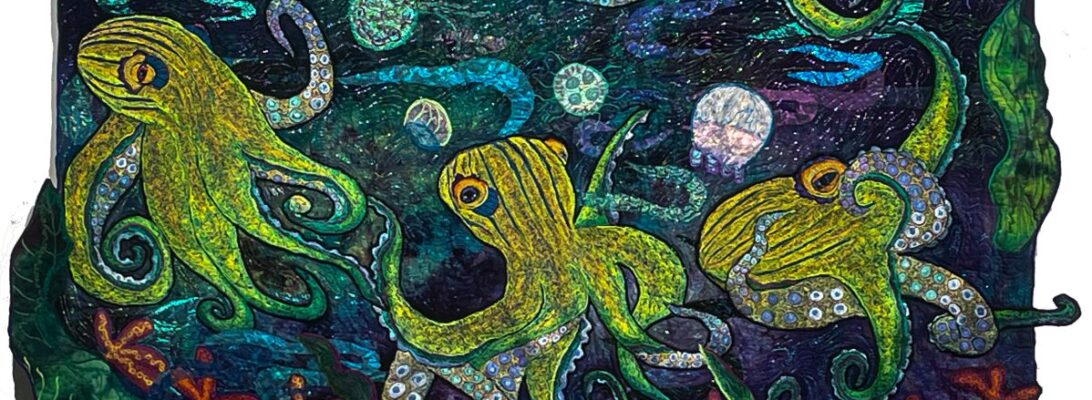
After all those larger pieces, I’ve relaxed into doing some tiny pieces, partially for a rest, and partially for having some new work at the Galesburg Art Center. I’d done a class with some fabric rubbing and had new colors to play with. So I played.
I’ve also been introduced to a new thread called glide which looks metallic without being metallic. It’s a matter of color matching, but I’m impressed. I love metallic but it always behaves better from the bottom than through the needle.
After this, I’m going to push through to the two next bigger pieces, but I needed a break.
The new pieces will be available on Etsy soon. Or you can look them up on my profile page.
I found the Glide thread at Feed Mill Fabrics and Quilts. They have a nice collection. If you’re missing that metallic look and you want to skip the metallic drama.
Building something with dimension usually means it has a recognizable top and bottom. Design-wise, I believe you should be able to flip a piece on any side and have the design still move and work. But it loses a great deal of credibility if you have upside-down fish. It’s not a good look.
Be that as it may, it helps to have a recognizable border between sky, land, and water. How can we make those obviously separate, without just putting a line across it?
There are several subtle ways and some pretty direct ways.
Dyed cotton thread in the sky, thick metallic in the water
The easiest subtle way is to change the kind of thread you are using to stipple. Not the color necessarily. The kind of thread.
Threads separate in how they’re made and how much they shine. Metallic threads usually shine more than poly or rayon, certainly much more than cotton. Sliver-like threads that are flat tinsel shine the most. Next, come the twisted metallics like Supertwist. Then there are the wound metallics like Superior metallics.
Now, if water is shinier than air, and air is shinier than earth, you can separate them out by having different threads stippling the piece. I usually use Sliver or #8 weight metallic threads for water, and Supertwist for sky, and/ or earth. If they shine differently, your eye will automatically sort them out as different.
# eight weight metallic threads in water
But the best way I know to establish earth is rocks. This is not subtle. It’s an in-your-face statement of land. A pile of rocks at the water’s edge defines the water/earth border immediately. Ad it’s so easy to do.
I cut rocks out of leftover hand dye. I pick anything that is rock color, always adjustable to the color of the background, and cut a whole lot of rocks for when I need them. They’re backed with Steam-a-Seam 2 so I can move them around at will until I iron them down.
Fishy Business is a mostly water quilt. But a pile of rocks in one corner establishes the bottom of the pond. I may have globs of thread and some water ferns later to create more movement. Now all I want to do is establish a baseline with the rocks and start getting the water to flow.
I’m using soft edge applique techniques for this. Soft edge has no visible stitching or edge to it. Neither water or rocks are improved by having a hard applique edge around them. Instead, I’ll go around the edges with monofilament nylon and a zigzag stitch. There’s more information on, this in Sun, Clouds Water and Rocks.
I cut some elongated c shapes to make water from. Both in blue and green for the water and yellow for reflected sunlight.
You can see the progression on this in these shots. I started with a corner pile of rocks to establish the bottom of the pond. Then I added in the water ripples made of sheers backed with Steam-a-Seam 2. Since each fish I put in the water changes where the water ought to be, I’ve added them one by one and adjusted the water around them. I added sunlit water shapes across the middle.
I’m pleased with this so far. Nothing is sewn down yet, so I’ll leave it up and look at it in case it needs adjustment.
Having a sticky fusible like Steam-a-Seam 2 lets me design this way. When I’m ready, I’ll commit and iron it down. It’s a very fishy business after all.
I’m cleaning the studio. There is only one reason really I ever clean the studio. I can’t find something.
1006 Twin Dragonflies was missing. Blissfully she showed up in a gallery I’d forgotten about.
I have a small missing quilt. This happens from time to time. Most of the time they’re in a nice safe pile. Somewhere. Except when they’re not.
So one goes through those piles All of them. All 5,378 of them. And that has brought me to several considerations.
You can’t keep everything. You really can’t. The whole idea that you would use every scrap of every fabric is….. monumental at a certain point. At a certain point, drowning in scraps goes from a possibility to an invitability.
Koi, made from embroidered fish I did 8 years ago and didn’t know what to do with.
There’s a theory out there somewhere if you haven’t used something within a year you should chuck it. I’ve found that silly.. So much of what I do is cyclical. I may very well take ten years to find a purpose for something. I almost never throw out an embroidery, even one I consider unsuccessful. It’s too much work to lose. And I never know when they will fit somewhere.
Swish, made with the leftover fish head from Koi
Tools. I’ve had very odd experiences with useless tools I’ve bought that somehow came in useful years later. I’m hesitant to toss those without long thought. Unless they just don’t work well.
Books. I have given up books. At least once I think. They’re books.Throwing away knowledge just seems wrong.
But scraps? They do pile up. I have fancy scraps of sheers and brocades, hand dyed scraps and quilting cotton. And the occasional leftover dress scraps.
For some while, I’ve sorted scraps by size and type. There’s the rock pile, pieces of hand dye that make rocks. On a bad day, I’ll cut rocks all day with Steam a Seam attached, so I have rocks to hand when I need them.
But what about strings? Raggy patches? Snips? Thread ends?
Useful, maybe. But in mountanous proportions? I know someone uses them. But am I drowning? Um, yes. A nice pile of them went to my last class as sample pieces. That worked. But they had to be big enough.So it’s a question of size. I can use a 3″ x 2″ piece but probably not a 1″ anything.
Where can it go? In a land filled with landfills, how do you find them a home? It’s like finding homes forwell-deserving kittens. They need to go to the right place.They need rehoming.
Of course, schools, other crafters, church groups, nursing homes all accept donations. Other artists always need supplies and sharing supplies is a glorious thing to do. But in the same way you’ve found wonderful things at the thrift store, it’s a good place to give them wonderful things. Except that it’s mixed in with household goods and sports equipment.
We have a new store in Galesburg called Yours 2 Create that I am in love with. It’s a thrift store for artists and crafters. Not only can you find all kinds of arts and crafts supplies, but you can also donate all kinds of things for other artists that you no longer want to work with. The range is astonishing. Crayons, paints, fabrics, tools, broken jewelry, trims, silk flowers. I’ve always gone in there on a mission for a particular thing, but they have almost everything from time to time.
some of their trim collection
I wonder how many of these stores exist. This is the first one I’ve ever seen. But it’s an astonishment. What an incredibly smart idea! What a great resource!
Yours 2 Create is located at 2188 Veterans Drive, Galesburg, IL, United States, Illinois, They’re getting a big bag of goodies from me next week. And I may be able to walk through the studio without creating a landslide.
I’m also hoping I find my lost quilt. There may be a few more piles to go through.
We’ve talked a lot about shading. I’m fascinated with making animals that are dimensional, and shading is how we achieve that. Shading is about delineating light from dark. But it can be a rough moment when you start to shade. It can feel really overdramatic.
I was working on this goldfish for a quilt called Fishy Business and I was struck with how very shocking it could be to stitch in with the complementary color all over your image. Every time I do it I take a deep breath and tell myself I haven’t ruined it.
The last color you put on is your lasting impression. Everything else just peaks through. But those sneak peeks are so exciting that they make it all work. Your eye blends the colors so that they stay fresh and don’t brown each other out.
I remember in class once insisting that a woman making an orange/brown squirrel needed to put blue in her stitching. She was appalled. And I understand why. But it all sorts itself out after you come back in with your primary color. It also gives you color under the skin, just like blue veins color our peachy selves.
So here’s to the courage to add the color that really seems like it might be too much. Undershading builds the dimensionality and tone. It creates unbelievable color.
I’ll be at Feed Mill Fabrics and Quilts in Oneida, IL Friday and Saturday with demos,take away classes and a trunk load of quilts and fabrics to show you!
Mary Walck and I filmed from Feed Mill Fabric and Quilts
We’ll be offering two fabulous demos Friday Sept. 29th and Saturday Oct. 1st.
Watch the demo and do it yourself. It’s easy, fun and fabulous! From 11:00 am to 300. Drop in any time, watch the demo and make your own.
Texturized Treasures: Oil Paint Stick Rubbing on Fabric
Sept 30,2022 11:00 AM to 3 :00 PM
Texturized Treasures: Oil Paint Stick Rubbing Create your own texturized fabric with rubbing plates and oil paint sticks. hand dyed cotton. So easy, so fun and so fabulous!
$7.00 fee each person
Gilding the Lily: Christmas Ornaments
October 1, 2022
Gilding the Lily Ornaments
Take those marvelous Christmas prints and gild them with free motion stitchery to make a fabulous Christmas Ornament
$5.00 fee each person
11AM to 3PM each day at Classroom Building Join us For All the FUN!!
Feed Mill Fabrics and Quilting is in Oneida, IL right on Route 34.
Whenever you teach, people want you to give you rules. Directions. Patterns. A safe way to get results.
That’s fair. That’s what they come to class for. What they’d really like is a formula. Add a plus b, divide by six and get your result. I do understand. And underneath it all, I have a list of odd rules as well.
But I do know that they’re odd. They’re based usually on experience. But sometimes they’re annoyingly limiting. And every so often, I test them out. I push the borders, just to see if it’s a superstition I’ve made for myself, or something really helpful. Or if the materials have changed.
This is a process I call gilding the lily. I take a really lovely print or rubbing and accentuate it with thread. I’ve taken to doing it a lot with oil paint stick rubbing.
One of the tricky things is working with metallic, of all sorts. Metallic goes with metallic, right? I used to be quite strict about that.
Until I had something I was embroidering there just wasn’t enough metallic colors for. And then I found my rule was silly. Of course I could dust something with metallic.
So lately I’ve been working with metallic oil stick paint. I’ve been embellishing rubbings with straight stitch and metallic thread, a technique I call Gilding the Lily. Did I have to use metallic thread? I thought so. I thought the poly thread would cover it up too much. I thought it needed the shine.
But I had to work the metallic thread from the top. And metallic thread, even the best metallic thread is touchy in the top of the machine. It goes through the needle 50 times before it lands in your fabric. So I tried it.
How silly of me. I sat down with a pile of rubbings and some beautiful poly neon. The look was different. But lovely. And my rules were so much eye shine.
It’s worth not shutting the doors of creativity because we have a safe sure method, a path we know. Sometimes we simply have to stumble past our safe path to experiment outside those possibilities to something new.
So if I waffled teaching you in class and couldn’t give you a complete formula for a perfect quilt, I hope you understood I’d given you permission to try anything your heart desired. Me too!
I’m working on another fish quilt. I’m not sure quite how these fish will go together, but I’m aiming for three different colorations out of the same color range.
I wanted gold fish. But good fish are not made of the same gold. Why? Well, seven fish all colored identically seems fishy to me. The nature of nature is variance.
So I pulled a range of colors that went through yellow greens and orange golds.
Coloration is about filling in space to a large degree. A large space accommodates a large range of colors. Usually colors are set with a base dark color, a shadow color, a range of progressively lighter colors, a shocker color and a lightest shade on top as a highlight. Except when it’s not. That works very well with large areas.
Fish have scales which usually aren’t that large. Usually there’s room for a base color, a shader, a center color, a shocker and then a highlight. This gets more limited as the fish get smaller.
For each of the small fish there’s a base color, a shader, the next brighter color, a softer shader and the next brightest color. I’m putting a shocker around the eye and in the bottom fins.
So I’ve done four fish in red/green, yellow/purple, orange/blue, and yellow orange/ purple, to explore the progressions on this. You’ll notice all the shaders are complements.
It’s a trick to have a number of elements in a quilt with different colors to match each other in tone. Since I’m choosing threads off the neon fluorescent chart, that kind of takes care of that.
There are three large fish, but I wanted to do several fish in the full range. Here are process shots on four of them.
Fish One
Fish Two
Fish Three
Fish Four
Notice what a difference in makes to outline them for the second time! The stitching inevitably creeps over the outline, so they need to be crisped up, sort of like fish sticks.
So here are the fish in process, small ones finished large ones left to go on the background. I worried about them feeling too different, but the range gives them variation without seeming like they don’t belong.
Part of why they all work together is that the color relationships are complements. That makes the color impacts similar.
Yesterday we had the Pop Up Sale at the Galesburg Art Center. The center is a grand old historic building with much of it’s history in evidence, but the people are warm real artists with wide minds and smiles. It’s been a long time for me.
In your studio, your art is whatever you think it is. Good or bad. Honest or ludicrous. I’ve found those judgements change in a heart beat according to mood and blood sugar. Once you put a piece out where people can see it, there’s a whole other evaluation outside yourself.
I’ve lived a lot of my life out in public. You don’t travel and teach the way I did in a box. There’s a value in that, and a value in sacred space that no one intrudes in such as a studio. The real value is in the balance between.
Thank you everyone who came yesterday to visit! Thank you, Tuesday, for inviting me to show there. And thank you Don for your endless patience and support.
One of the nicest things about finishing up a bunch of quilts is the things left over. I tend to batch my embroideries. Not the big ones. One four foot heron is enough usually. But the little bits that go into a quilt are important, and I tend to make batches of them.
How does that work designwise? You place your big objects, and then you build a pathway of smaller objects around them. Hence the need for a lot of small objects.
I used to sew these directly onto the quilt surface, but they do tend to pucker up. So now adays, I sit down to a batch of things, use what works, and then raid my stash of leftovers to fill things in. I thought it would be fun to show how the same batch shows up in one quilt after another.
I also used to embroider exactly what I needed, well, when I could figure that out. It never quite worked that way. Did I need four frogs, or six or five? They do shrink in process so it’s hard to tell from the drawings.
So I over produce. I draw a whole bunch of whatever it is and then embroider them. They either land on the quilt in mind or they find their home somewhere else.
Sometimes, you just have to embroider the needed bits. These were what I needed to add to the big fish head.
1026-22 Swish
In between? Well, in my younger days, they went into suit cases when I traveled and wandered from one spot to another in the studio when I was home. So they tended most often, to be found on the floor.
Which is not to say that I didn’t understand their worth. I’m just not good at organization. I’m better now. I put them in bags in one place in the studio. Which is good because I raided those bags for these three quilts.
I had extra flowers, fish, frogs, and dragonflies. Can’t go wrong on that.
left over hummingbird drawing filled in
I also had extra drawings. Embroidered applique is a lost wax method, in a way. The pattern goes into the back of the piece and is incorporated in it. But patterns are hand drawn and a bit sketchy, so I tend to trace a smooth copy of them before I embroider. I had some great left over drawings of a frog, some fish and a hummingbird.
All in all, the pieces came together, after I got them off the floor into three new Visual Path quilts. I love left overs!