Not the Same River: Not the Same Piece

Last week I showed you my experiment recreating the elements of a piece I thought was particularly effective. At that point, it was speculative. You can read that at Again? Really. Yes. Really I’ve spent a week on it and here are my results.

I divided the parts into elements. Here are the elements I was working with.

  • The focal image
  • Hand dyed background
  • Oil paint stitck layer
  • Sheers layer’
  • Small elements
  • Background stipple.

What do these elements do?

  • The Focal Image is the answer to who. Ir creates the subject and focus of the piece.
  • The dyed background is the answer to where and when. It creates the light in the piece. It also defines the environment.
  • An oil paint rubbed layer is the texture of a piece. I don’t use it everywhere, but it gives a somewhat translucent surface without sharp edges. You can see the background, but it has shifted in color and appearance.
  • Sheers make another translucent shift across the surface. It transforms the background color and creates movement. Sheers have defined edges, but don’t have a visible thread edge.
  • Small elements can be used to establish a visual path. Flowers, rocks, leaves, bugs, birds and frogs can all point a direction through the piece.
  • Stippling changes the coloration of the surface. It creates dimension and defines light and dark.

I think I’ve failed on this piece. It’s not bad. It just isn’t as good. Why?

I’m reasonably sure of my background and my oil paint rubbing layer. The sheers can be dinked with.

I didn’t get to the small elements because I’m just not content with my drawing. These fish will add movement, but I don’t think they’ll help enough.

Oooops. Sometimes I don’t know until I get the piece embroidered. I drew other fish for this. This was the best of them, but it’s just not dramatic enough. I need a drama queen fish.

Here are the two drawings I rejected. I’ll save them for another piece another day.

I could push through. All the elements are there. But the experiment failed. I took similar elements, and they did not create the same energy.

I could blame it on the weaker drawing. That would be fair. But I suspect that the energy of the piece itself is different, and probably can’t be reproduced.

Will I throw it out? Heaven’s no! I can always use an extra fish. This one just doesn’t belong here.

So, as a rest, I’m back to octopuses. The fish piece is on the wall, aging like fine wine. It will find its time.

Fallow time seems to be an important part of the process as well. Repeating the same elements doesn’t always create the same energy. The parts just aren’t the sum of the whole.

Again? Really? Yes. Really.

I try really hard not to rate my pieces as I make them. I find that my opinions of things change over time, largely in reaction to people’s reactions. If I suspend my judgment of work, I find I learn more from it. Suspending judgment allows me to flesh out ideas and move on. Finish the quilt. Next quilt, please. The learning is the goal. The quilt is almost a byproduct.

But sometimes I do a piece that knocks my socks off and throws me across the room. It’s not an everyday thing. When that happens, I find myself asking some of the same questions that I ask when I do something I hate. What happened here? Why is this piece wonderful? Or awful? What?

Was it the color palette? Technique? Is it about my background? The image itself?

A fabulous piece makes you think, “Can I do this again? How did this happen?”

I love this piece so much. So I’m going to try not to reproduce it, but to focus on its successful elements.

Part of what I love here is the quiet palette. I normally go for eye-sore colors. This was restrained. Luckily, the last batch I dyed had a piece, not exactly in the same palette, but in the same tone.

The fish can be the same threads. And I think it needs to be.

I had trouble with the fish. I wanted a fresh image, not the same, but in the same colorations. So I started several fish, only to find them wrong. I love these. But in terms of direction and size, they’re just not right.

I went through my collection of drawings. My embroidery process uses a pattern drawn on Totally Stable that goes into the back of the piece as a pattern and a stabilizer. So each drawing is consumed by the embroidery itself.

Not to worry. For the last 3 years, I’ve saved a tracing of my drawings for later. It’s turned into a jumping-off point for other pieces, and I consider that collection a treasure. I found a fish that had to be at least 10 years old, which I don’t believe I ever used.

This will be reversed when I’m done. I’m half way through the embroidery.

Originally I used a tree rubbing plate both for the trees themselves and for the reflection in the pond.

And I want to explore the rubbed oil paint trees. This piece of fabric evokes a stream rather than a pond.

Now that I’ve analyzed my elements, we’ll see where it goes. It’s at that awkward spot where everything looks wrong. But that’s the exact moment to suspend judgment and push through.

It may take all those elements and work well. It may not. There’s a mystery here I don’t understand. But I think that part of it is that a piece is not the sum of its parts. Instead, perhaps it’s a whole being itself. Maybe it can’t be reworked with the same success.

Push on. Finish the quilt. Next quilt, please. The learning is the goal.

Lilies of the Field: Embellishing a Background with Oil Paint Stick Rubbing and Stitchery

If you are making wild places you need weeds. And I’m always in search of a better way.

In my search for more rubbing plates, I’ve discovered I can make my own from stencils. Read Modeling past: All it needs is peperment flavor for more information. I did some experiments on the wave stitching earlier. Check out Making Waves: Stitching Waves into Water

What oil paint stick rubbing offers is something less defined by stitching. It offers the coloration and shape of the rubbing, but with a soft blur.By itself, it’s translucent. With stitchery, it’s more defined.

Meadows are wild. That blur reminds us that the meadow is its own quiet chaos.

I found wonderful stencils for weeds and made rubbing plates for them

I wanted browned dried weeds by the pond for this piece.

There are several concerns in working with stitched rubbings.

  • A rubbed background gives a glow around the weeds. Stitching provides definition. You need to decide if you want just the glow, or the definition as well.
  • It’s easier to stitch the whole background and add figures afterwards. It’s harder to stitch around the figures than to stitch the whole area first before applying the image. I stitched all across the weeds, knowing they’d be covered in places by the images.

I wanted a thicker line for the waves so I stitched them from the top with #40 weight embroidery thread, then stitched with #8 weight metallic from the back,

That was less successful. I think it was worth it this time. But it’s hard to stitch exactly into the line you stitched from the top.

Here’s the final pin-up for the piece.

Rubbings add a lot to a piece. But it’s tricky integrating the stitching into the surface. On this piece,I think we’re there.

What Makes A Series?

Series really almost always just happen. You make one fish quilt and suddenly there are six fish quilts. Since you’re working them within a reasonable time of each other, their techniques tend blend in with each other. Instant series.

Series are about obsessions. They’re about images you just can’t let go of. For some reason or other you’re compelled to work an image over and over again, until something settles within you and says you’ve done enough.

But every so often, you choose to make a series. That can be for many reasons. If you’re not compelled by the images you are about to die of boredom But if you’re compelled, you know what you’re doing for the next three to six months. Series are exciting because they get to answer the what-if questions.

I spoke with a gallery that expressed an interest in a show. It’s a smaller gallery, and it made me think of Monet’s Orengaria

For those of you unfamiliar, here’s a short history

The Water Lilies by Claude Monet

“History of the Water Lilies cycle

Offered to the French State by the painter Claude Monet on the day that followed the Armistice of November 11, 1918 as a symbol for peace, the Water Lilies are installed according to plan at the Orangerie Museum in 1927, a few months after his death. This unique set, a true « Sixtine Chapel of Impressionism » in the words of André Masson in 1952, testifies to Monet’s later work. It was designed as a real environment and crowns the Water Lilies cycle begun nearly thirty years before. The set is one of the largest monumental achievements of early twentieth-century painting. “

What an astonishing thing, to have a circular space, filled with Monet’s waterlilies

Monet is really the poster boy for series. His waterlilies illuminated his whole life. He painted many other things, but when I think of Monet, I think of waterlilies in the pond

Not to agrandize myself, but this little gallery would offer a chance to do an in the round kind of show experience.

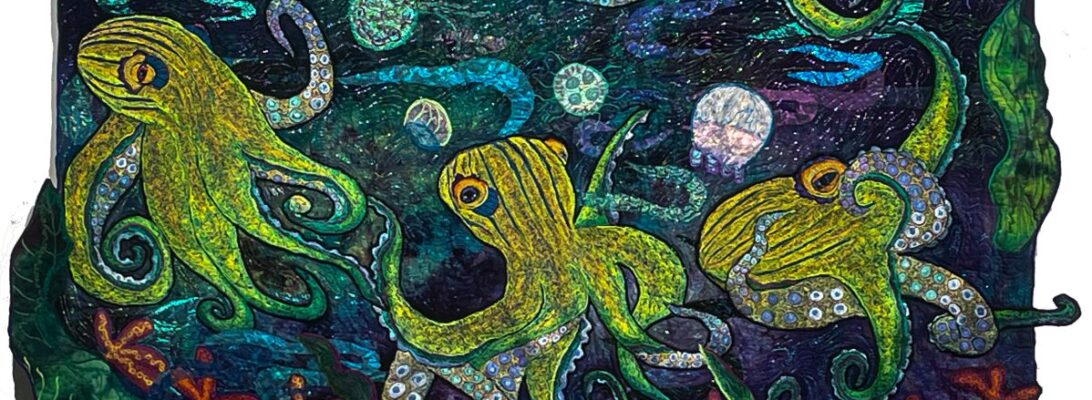
Lately I’ve had a fascination with octopuses. My passions in images have to do with movement. So much of my life I’ve been constrained with a body that just doesn’t move as well as it might, I’m fascinated by the movement of creatures who are not resrrained. Nothing can move like an octopus. They also change color. I don’t know if some of the pictures I’ve been looking at are ai or not. I’m playing. They can just be wild. Why not put them in a gallery in the round?

Here are my two prior octopus quilts. I think they’re a good start

So here are my drawings for the series. There might be more. I’m not sure if they are three quilts or four. I’ll know when they’re embroidered.

So we have one octopus mostly embroidered. I’ll keep you posted as I work up the others. Encircled by octopuses. Sounds pretty wild.