Finished, Except that Nothing Really Ends

I have a very hard time when things finish. I’m an INFP for those who know Myers-Briggs. I’m happier with things left open, possibilities, choices, options. That moment when something is finished is joyous, but it’s also an end, a loss, as well as a win.

This could be an excuse for the large pile of unbacked and unbound quilts sitting by my machine.

.I have a friend I just heard is dying. One of those good and bad things about getting older is that we sometimes have thirty-year-old friendships. It’s like the world shuts a window that was a bright and different view.

I don’t know how to say goodbye to a friend from that long ago. He brought me wonderful art books helped me write and publish my first fiction writing, and took me to my first country dance. Wonderful gifts. I sent chocolate Haagen-Dazs, soup, and M&Ms. We bring whatever bits we have.

I hate watching things end. Even in art.

There’s an energy to art that might be its largest purpose. There is a connection between you and your art that wizzes around the room, even in the duller processes. I do believe art is alive. It has an energy of its own, and it communicates what should happen next. It is not your child. It’s a partner in co-creation. While you are making it, it’s remaking you.

There is a finish line, a moment where the last stitch is stitched. The energy stops swirling. There is an end. It’s wonderful, but something is lost.

But at that separation, something else happens. The connection between the art and the artist is cut like an umbilical cord. But art finds its own place. In someone else’s world or heart, it goes on to do other things for other folk. Art soothes people, riles them, teaches them, inspires them, but most of all, it changes them. If art is really good, it lives past you. Nothing really ends. It moves into the next space. Other challenges. Other purposes.

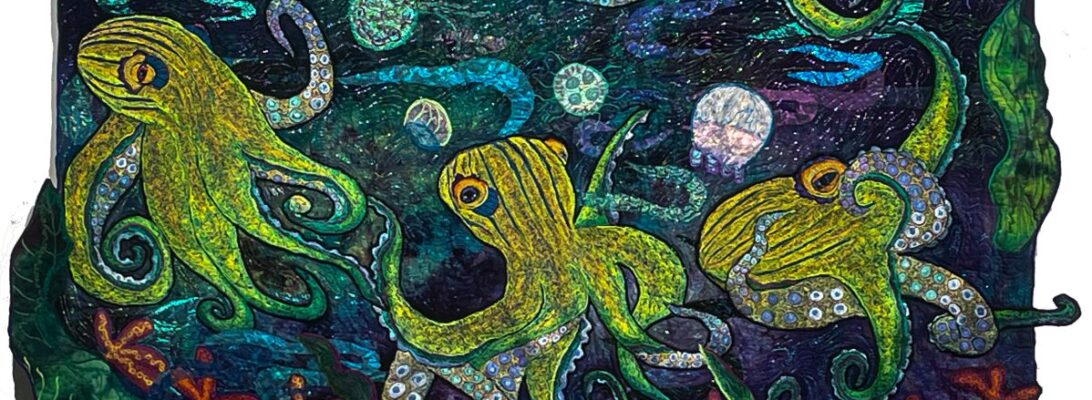
I’ve peppered this post with photos of the quilt I’m currently finishing. We’re stippling today. Almost done. It’s a good thing I have another quilt waiting in the wings.

Step-by-Step Guide to Using Color Theory for Thread Art

Outline, dark base, shader, and the beginning of the blue range

The nice thing about color theory is that it works across all kinds of media. What changes isn’t the color theory, but the way the media is applied.

Color theory for thread is different only in the fact that you really don’t mix colors. Instead, you lie them next to each other, and your eye mixes them.

These nurse sharks are part of my octopus garden. I don’t have their octopus stitched yet, but they were compelling. I love the spiky shapes. They will have orange-yellow stripes. I’m not quite there yet. Right now, I want them round and shaded, with a clear indication of which side is up. I need smooth color for that.

Smooth color creates a color range.

The formula for it is

  • A dark base color
  • A dark complementary color as a shader
  • A range of colors in the base family
  • A bright color as a shocker
  • A lighter or brighter shade of the base color to finish.
  • If the subject is too large, I can zone the areas of the image and repeat the formula in a set of lighter or darker shades.
  • I usually work light to dark. The last color will be the most prevalent, so keep that in mind. Sometimes with fish or frog bellies, I color the dark to middle section, add the lightest color on the other edge, and work in my darker colors, so the tummies aren’t so blatant.
Green as a shocker

I chose green as my shocker color. Usually, I would have used either the blue or purple complement, but orange is so strident. I will use yellow for the stripes, but I think I’ll brown them out so they don’t scream at me.

It takes a fair amount of courage to add the shocker. The shader layer makes visual sense. The shocker layer screams at you. There’s a terrible urge to rip it out immediately. But it quiets down once you put the next layer of the base color. And the color is smooth without being bland. The shocker is an electric spark in a range of smooth, quiet color.

It’s time consuming, but I love the base colors. Between the shocker and the shader, the color has a splash of excitement, but creates a flow color base.

What will they look like with yellow-orange stripes? I expect they’ll be quite jazzed up. I’ll show you next week.

Flat: The Struggle Continues

I love solid zigzag embroidery. It allows me to detail, shade, and shape an image as effectively as if I were painting, with the difference that I won’t have my media spill on me.

But zigzag embroidery, by its nature, does not always lie flat, The stitches pull together and it shrinks, but not in a regular or even way. Eventually, you are looking at an embroidery that won’t flatten.

Can you avoid it? There are things you can do.

  • Use stabilizer. I use Totally Stable, Decor Bond, felt, and Stitch and Tear, sometimes within the same piece.
  • Use a smaller stitch width
  • Embroider on a separate piece of cotton and stabilizers. Then cut the piece out.

Will that fix it?

Wouldn’t that be nice? No. All you can do is reduce the ruffling. So there comes a point where you are looking at a very unflat embroidery, ready to go on a flat quilt top. Desperate times call for desperate measures.

The outline accomplishes several tasks. It covers the edge. It cleans up the line. But it also gathers in and flattens the embroidery. And outlines of stitched areas make those areas puff just a bit. A lot of things lie flat after the outlining.

Except for the things that don’t. Surgery, along the design lines, is the final answer. Can I stitch over the two embroidered bits. Yes! Will you break needles at that point? Oh, yes. I plan to break 5 needles a day, outlining. I don’t always. But I have the needles in hand in case.

Are you screaming that I cut my quilt? I did. May I explain something? I sewed it. I cut it. I sewed it again. How is that different from any other kind of quilting? Fabric only bleeds in the wash. The rules only apply if I embrace them. And I won’t do that if the rules don’t give me what I want.

Is it worth it? Flat is a quilter’s concept. A bed quilt should lie flat. So we think an art quilt should, too. I’m not sure about that, but they do judge your work by it and it does look bad on the wall

I may have to cut in the surface to finally flatten this piece. We do what we got do.

Pump It Up: Where Size Matters

I never used to think about how a quilt would be viewed. Was it pretty? Did it move? Did it tell a story? Did it change people to see it? I never thought about how the size of the space around it affects what the viewer sees.

Now I’m keenly aware of the space a quilt will hang in. I don’t have any control over that when I sell a quilt. It goes where the owner wishes. It becomes part of their house and their lives.

But small work is viewed differently, just by definition. Small work is made to be examined. You come up close to see it. Every detail matters and is exposed.

Unfortunately, most small work isn’t really that visible at a distance. It’s made to be intimate. Your relationship with it is within its small space. It fills a tiny space with an explosion of color and detail.

Larger works have a harder task. Done well, they will pull you from across the room. The movement and the color should sweep you in. But once you’re up close, the detail should amaze you.

When I first started using rubbed fabric in pieces, they were all experiments. I worked very small, partially to learn and partially to see how they would be received. I was limited by the size of the rubbing plates. The largest were under a square foot.

I’ve worked hard to find alternatives since then. I’ve used ceiling tiles and texturized surfaces. I’ve learned to make my own rubbing plates from modeling paste using stencils. So my options have expanded not only in size but in possibilities.

With these octopus quilts, I’m using the rubbings as objects themselves, rather than backdrops. Mostly, I did seashells and jellyfish.

I love the rubbings I’ve done for this. But they need something to pump them up to be seen across the room.

I usually use straight stitch #40 poly thread to match and shade the rubbings. That’s exquisite on a small piece. It’s almost invisible at a distance. So how do we pump it up?

I chose to stitch my jellyfish in white. I rarely use white. It’s too bossy. But for this piece, white thread pumps the jellyfish up.

I chose to outline with a very small zigzag. It’s a subtle difference. But it does define the line.

For the seashells, I did not outline. Their shapes were visible enough.

The downside of this much stitching is that I have some distortion. We can fix that. Where’s my iron?

We’re ready to back and bind.