Between the cooking of birds and a small blizzard, we’ve had a pause in the world.. Don spent yesterday napping, I believe. I don’t know because I binged watched most of the extended Hobbit with Tolkein, my cat, and started a new sweater. Not what we normally do.
This was not a year for travel. Time and space have not cooperated. But it doesn’t mean that I felt people were distant. How did I manage to make friendships that have lasted 30 years, 40 years? How did that happen?
When we all could travel easier, many of us made friendsgiving, the day after thanksgiving. Now our bodies just aren’t cooperating. But strangely I felt everyone there. Don and I are only kids. We’re both, thankfully considering our parents, orphens. But we have family, rich and strong and very much loved. Thank you all.
Speaking of parents, my father fished as a religion. It was where he found peace, rest, calm and joy. I’ve never wanted to catch a fish in my life, but he took me in his small row boat, and immersed me in that world. Part of me has never left. When I stitch fish, I’m revisiting it. I offer it to you.
I spent the week batching luna moths for my cranes. I’m not sure whether they sit on the coast or not, but they’d be in the adjascent swamp land.
I love batch embroidery. It’s coloring in the zone. I use it for most of the small to medium elements in my quilts. So much can be done with small fish, flowers, frogs, birds, lizards, and anything else you can think of. I always make too many. It’s sort of like too much bacon. How could that happen? And of course, I can always think of a use for another fish or strip of bacon. Many pieces need a left over elements, just to round it out.
Batching elements helps me build a body of things to incorporate into a quilt to make it more love, to make it move, to make it flow.
It may be too much. This is the first pin up. They always shift by the time I get the water in and make adjustments. I think it needs rocks to ground it.
I spent last week working on three cranes. I was fairly pleased with myself, when someone asked, “Are these cranes having sex?
I hadn’t seen it. I still kind of don’t. I looked up a picture of cranes in love, and it didn’t quite look that quiet. But I have my head in my hands trying to figure out what I do next.
I was inspired by a Japanese textile design in a Dover Pictorial Archive book. I’m pretty sure they didn’t see it as cranes in love. It was my own rendering of it, changed in the way we change everything we draw ourselves.
Usually I let people tell me anything about my art. If it comes from them, it’s theirs. I don’t mess with that. I meant what I meant. I’m not responsible for their response.
But this hits me in a place that makes me feel very vulnerable. Sex is about bodies and bodies are about vulnerability. Art is about visual vulnerability. I’m not really secure about body image. I work in animal imagery since I can’t bear to work in human flesh. I have a delicate detent with my body, somewhat riddled by the failures of old age and memories of high school.
It’s a response to really old tapes. I wasn’t just fat. I was born deformed. Admittedly, it was a small genetic oops. But my mother could build a tragedy out a broken nail.
IF you are harmed enough, people can frame you as being inhuman. If you are harmed deeply enough, you may even think that’s true. If other people think it’s true, they can do anything to you because you aren’t a human being. That was my whole childhood. It seems to be going around globally right now.
I’m not taking this anywhere except in my own life. And I don’t want anyone to explain situations where it is somehow ok. Or tell me to get over it. I don’t believe we get to dehumanize people.
The bottom line is that I’m terrified of naked vulnerability. My animals are me in some way. I’ve come to see my self through Don’s eyes and his vision is kinder than my memories. I usually let that stand. I’m not sure I can be a crane in love on a quilt.
I took the time to reoutline the birds. It usually makes things clearer. Maybe this time that’s not such a good idea.
So what do I do with a quilt with cranes possibly delecto inflagrante? Do I finish it? Put a bunch of cat tails around them? Do I stuff it in a drawer until I feel more brave? I tend to not just throw work out, even if I don’t like it. I could put a lower price on it, and it either sells or it doesn’t. That assumes I can bear to finish it. There’s a dark corner in the closet, perfect for storage.
So what do you think? Would you finish it? Show it? Put a fig leaf on it? What?
For those of you who have been following along, you know we had a machine crisis for most of last year. It turns out that what I’m doing is really hard on machines. I’m finding my modern machines are just not up to the challenge.
Enter Ebay and Don!
Don found me a newly restored 930 Bernina, It’s a love. It’s still not a strong enough machine for the denser embroideries, but that’s ok. We have a servo motor for the old industrial Singer 20u. Don says he will be ready to start the switch on the motors perhaps next week.
1169-25 In the Shell
So in celebration for the new baby, and because I finally had the right tool, I got In the Shell finally bound.
Do you remember the feeling when you got a new box of 64 crayons? That’s a large enough number that they had some with silly names like Mac and Cheese. Open up the box. Choose your color. Instant antidepressant!
This quilt had the same effect. It got me through machine withdrawal, over the last months.
Madiera has a line of polyester embroidery thread called Neon. It isn’t all neon color. There are restrained greys and browns. But there are some kick ass oranges, yellows, greens, pinks, and reds, You get the idea.
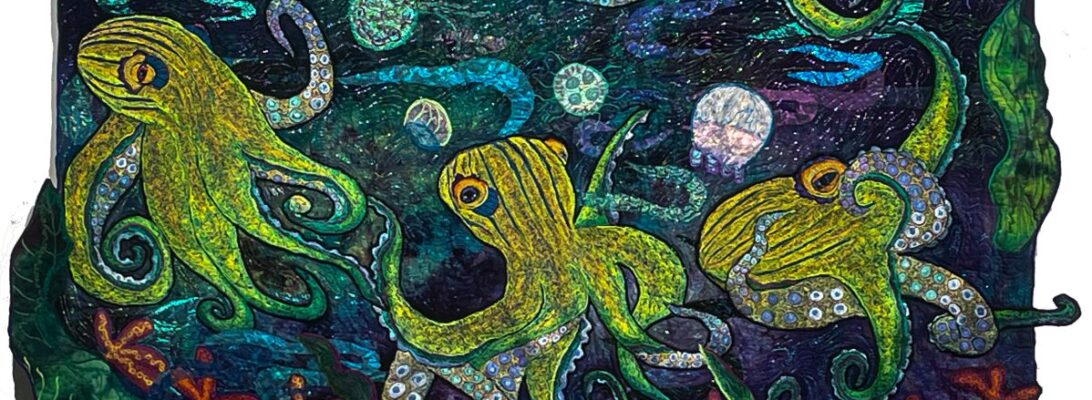
This quilt was a mood lifter. Partially because I love the idea of a baby octopus in a shell, and partially because the colors could knock socks off.
Between the machine and those colors, I’m feeling so much better now.
Never be afraid to use the brightest, boldest colors. They’re not only lovely. They’re good fiber for your diet. And they fight depression. Eat the rainbow!
I started a new quilt this week. like most quilts, it started with an incredible piece of fabric.
It’s been a while since I’ve dyed, so I’m down to the most fabulous, I’m scared to use it wrong fabric, and the stuff I really don’t care about.
This piece took time to figure out because it’s only a half yard. Sometimes that’s plenty of space. Sometimes it’s not.
but it made such a good pond. All that yummy blue purple against yellow.
I wanted herons, and I found a sketch of herons I used for my information.
Unfortunately, when I looked up the specifics, it was a whistling heron.
In case that sounds unfamiliar to you, you’re not alone. A whistling heron is from eastern Asia.
Is it different especially from other herons? Not so much. Heron head, heron wings, heron feathers. But yellow. The body is yellow.
I think you can see my problem. A yellow heron is going to show up on this like a yetti in a snow storm.
OK. How real do I have to be? What do I want to accomplish with this piece? Am I copying life precisely? Am I playing with interesting shapes or colors? How tied am I to “The Real Thing.”
Henry James wrote a story called “The Real Thing.” It was about an artist who had a reduced gentleman and lady offer themselves as models to him. That had to be a pretty harsh come down in the world for them.
They said they were the real thing, but in truth, they were only that one real thing. He found the girl who could be a gypsy, madonna, dance, lady and probably was a lady of the night, a much better model because she could be anything with his imagination.
Modern art launched right around the beginnings of photography. There’s a reason for that. Up until then, the goal was to come closer and closer to real. Suddenly, you could have a completely real image at the click of a button. An artist can’t really compete with that. So different things have to happen.
So where do we go if we’re not more and more “real?” We start exploring, shape, light, color and texture. We start to think what if. We start to let the art define itself. We find it defines us in the process. That’s a whole lot more scary than real.
But worth it.
I decided these herons could just be herons. And little blue herons are the perfect color behind all that lovely lemon yellow.
So these birds can be blue and shine in their yellow, not so realistic but perhaps symbolic, world. That there are pools of water, even in strict drought. That we find them even under extreme conditions and can thrive past the hardships. That we are not completely defined by other people’s real.
You’ll find a free copy of Henry James story, The Real Thing, here if you want to read it. It’s an interesting thing for artists to think about. Why are we painting, sewing, drawing, and create? What do we build in doing that? What reality do we create? Because as artists, that’s our job.
I don’t have much work to show you this week because I was preparing to teach yesterday at the Peoria Art Guild. The Peoria Art Guild is one of the most supportive art centers I’ve ever seen. Not just for these kids but for established artists like myself, and emerging artists first bringing their work to the public, and for people who just enjoy being part of an art community it’s a astonishing place. It’s become my art home. I am so grateful.
So when the Peoria Art Guild asked me to teach for their MAP program I was excited. I had no idea how great these kids are. I’ve done it for three years now.
These pieces are in process.
The Map program is a Mentor Artist Program for seniors and juniors where established artists come in and mentor them.
What are these kids like? They are amazing! Talented, unafraid and energized. I was awed today.
I love teaching. I love the connection, watching their pieces come together, watching them build skills and confidence and find their own art. That has been a privilege.
I teach because I believe that art matters. It’s not about a process or a skill, or what you make. It’s about the ability to work with your heart and your soul to express yourself. It’s emotional literacy. The one thing unique thing each of us has is our vision. When we can share that, the world is a little wider, the bridges a little stronger, the light a bit more illuminating. The darkness stands back. We make art to shift and change the world.
What do we give to other artists? Our techniques. Our inspiration. Our studio workflow. Our vision. Our joy in creation. Our appreciation of their path, as we travel our own.
Would these kids make art any way? I don’t think anything would stop them. But giving them a broad base of skills and experience with different materials means they can better find their way. The MAP program is a fabulous opportunity for them.
The Peoria Art Guild brings this to these kids each year. I saw them grow ten feet tall in one day. It;’s a magnificent experience. For myself as well as for them.
If you have a kid in the Peoria area, Senior or Junior next year, who lives for art, consider this Map program for them. It’s free. You’ll find information on the Peoria Art Guild Site.
And IF you need a breath of art yourself, the Peoria Art Guild is there for you.
What do you do when your techniques are killing your machines?
This is about component embroidery. Lately, I’ve leaned more and more on component embroidery to create large astonishing embroidered images. I love the work it creates. I am completely reliant on my machines.
I have a love/hate relationship with most of my sewing machines. I really love them when they work. I’m in abject hell when they break down.
Since I’m a Bernina girl from way back, I’m used to tough well-built machines. Yesterday, my ancient 930 had a moment. I thought it was a screwdriver fix; It was not. We’re playing mix and match between the two 930s in the studio. Neither is quite ready for prime time. It has brought to mind how intensive my work is.
That was underlined by the 3 220s I managed to break last year, and my 770 which has spent 7 months out of the last year in need of several kind of repairs. And is once again in the shop.
These are lovely machines. They’re built tough, and I’m still having them break under me like I was shooting horses I’m riding on in a battle. I’m devastated. I know better than to have only one functional machine. Because always, inevitably, something will break.
When I talked with my mechanic she said “You do know you sew more than other people..” Which means I stitch very heavily to make my images. Meaning perhaps I’m asking more out of a machine than it’s built for.
Which leads to the question, do I need a different machine? Do I need a commercial machine?
I went through this several years ago when I bought my 770 Bernina. It’s fast. It’s got that nice long arm and some lovely features. It does not put up with mad-speed sewing. I love it. I’m afraid of it too. It threw its hook at me through the door on the bobbin mechanism. I wish I were kidding. And I don’t know what to do about a machine that’s off more than it’s on.
So here’s my 2025 Challenge.
Do I change my work because my machine won’t do it? Do I find another way? Do I look for other tools? Or do I back away from a stunning technique that lets me do things past my earlier abilities?
Which leads me to humming something like a Sheryl Crow song. “Are you tough enough to be my sewing machine?”
Being an artist is only peripherally about making art. It’s mostly about developing skills, ideas and visions. The art is a byproduct. It is a picture of where your art is at a particular moment. This is why I can always let go of a piece of art if it raises my abilities as an artist. Any artist’s first creation is the skills, techniques, and vision you make art from.
I’m looking. I need a zigzag machine that is commercial grade I can control the speed on. And I need to find some money to look with. I’m always willing to give up a piece of art to further what I can do as an artist.
Those of us who live an artist’s life live with constantly unbalanced finances. Don and I are on social security. I don’t discuss my difficulties hoping for a handout. But I have used my art to fund things I couldn’t buy any other way. I’ve offered work of mine at dead rock bottom prices, when the need arises. I’ve never asked for money itself. I’ve offered the work I have to make what I need happen. I’m doing that now.
These pieces represent work I couldn’t have done ten years ago. They’re made with component quilting elements, separately embroidered and incorporated into the quilt itself. It’s changed what I can do. I need a tough enough machine to do it.
If there’s something you are in love with, this is the time. And I’m open to offers. I am a motivated seller. If you wish to see more information on my body of work, it’s also on my Portfolio Page. The price on the portfolio does not reflect the sale price, but you can click through from the portfolio page to the Etsy shop.
Also, if you have knowledge about industrial or particularly tough zigzag machines, I’d love to talk with you. I need more options, and would appreciate your expertise. And if you have questions about a particular quilt, let me know.
I have been known every so often, to make an art joke. Not a play on artists’ names or a verbal exchange. Every so often, I take a fairly well known piece of art and place its content within the artmostphire where I live.
The new roseated spoonbill quilt is named Pinkie, after the Gainsborough Pinkie
Why? Partially because it amuses me. I see most people as animals, not in a negative way, but in the sense that we live as animals do in a flesh-and-blood world. I embroidered my pinkie as a roseated spoonbill in her wild coastal setting.
Does it change the value of my Pinkie, to know that about her? May be. It’s nice to know where things come from.
But like all good art, it changes how we think. My Pinkie is a lovely creature, looking formidable and wild and yet fragile where she is. The girl, Sarah Moulton (1783–1795), is just as formidable. Her ribbons were thrown to the wind, but I get the feeling she could make her commands known and obeyed. Basically, your standard teenager. For all that, her father deserted her and she ended up in school in England where she died of a cough when she was twelve.
My point is that neither beauty or poise keep us safe in this world. It’s an odd mix of good luck and strongminded will that keeps us going,
I know. It’s not funny. But in the tradition of court jesters everywhere, the point is to make us think differently. I’m short enough. I might as well apply for the job.
Usually, Saturday is the day I prep the blog. Sometimes I’m a bit ahead. This week I was not. And last night my leg went out.
So when the ice and rain hit today, Don declared a studio day off. I spent the day working on photos of the new quilts I’ve just finished. And I decided to make meringues.
I’m a good cook, even if I’m a bit heavy in the butter, cream, and beef department. I’m pretty good most of the time. But every year or so, I have a state-of-the-art disaster: the chainsaw chicken massacre, where I tried to bake stewing hens. Or the time I made black and blue cornbread. I was making blue cornbread and the thermostat on the oven broke. Or Treebark in the snow. I had a jelly roll disintegrate while I was trying to roll it. There was no hope for it. I glued it together with raspberry jam, covered it in powdered sugar and called it treebark in the snow. People still ask me for that. I don’t think it can be reproduced/
I wasn’t very mobile, but I thought I could arrange things well enough that it wouldn’t matter. I prepped the meringue, put it in a pipping bag, started to pipe little stars and watched as incredibly sticky meringue oozed out of the top of the bag on to everything on the table. My cutting board. All the spoons and forks. The spice rack. Don’s computer. I had made meringue glue. Very effective.
So here are the quilts I made earlier this week before I glued everything in my kitchen to the piping bag.
It wasn’t a complete fail. Don liked the meringues enough to lick the beaters.
You can see it’s easier if I’m just allowed to quilt.
My leg is better today and the ice is gone, so I’m off to the studio. These quilts will be up on the site shortly.
I have a tendency to lose things. I have four million screwdrivers somewhere. That does not mean that I can find them when I need them. Samuel Delany said that the coathangers turned into paper clips, just when they were needed as coathangers. I believe that, sort of.
I also don’t organize well. I am ashamed that any time I move, I have 100 boxes that are full of the same mix of threads, machine feet, odd tools, and fabric bits. I’m working towards a better sense of that. I can’t find anything because everything is everything.
Most of my machines come with a space for accessories. That’s nice. Except that they have to fit in all the accessories. Which means they’re kind of big and quite clunky. And they don’t fit on my sewing tables. They also make a tremendous crash if they fall off the table due to the vibration when I sew.
So I tend to have kits for different tasks and for the machines I use for those tasks.
I’m obsessed with these tin pencil boxes from Dollar Tree. They come in different patterns so I know which one I need for each machine.
What is in the box? What I need to clean a machine and the feet I use for the tasks I do with that machine. So each box has oil and a good cleaning brush, Each box has fresh 90-topstitching needles, And an appropriate darning foot.
The tools are not the same. The old 930 and the 770 both take different non-standard screwdrivers. The 770 is prone to thread caught in the take-up lever, so I have a tool in the 770 box for slicing through=thread tangles.
I have a box for my 99 and 66 Singers. They are a short shank machine that needs a foot that is completely different from the Berninas. They’re a straight stitch machine so they aren’t set up for cord binding. I use them mostly as piecing machines.
But I use the other machines for corded binding, so there is a regular pressure foot and a Bernina #3 foot for buttonholes along with the darning foot.
Am I more organized? Bless me, I hope.
How can you be more organized?
Analyze the tasks you do in your studio
Gather the tools you use for those tasks
Find a container and space where you can keep those.
I’m not going to live long enough to sort through a bag of all the sewing machine feet I own to find the one I need every time I stitch. If I have a kit set for each machine, I’ve eliminated the time I waste hunting what I need.
Next organization:
I need a place to put in tools for each machine: pins, clips, scissors, bobbins, hemostat, the feet and tools I don’t use all the time but I want available. I have these already, although I’ve moved machines enough that they’ve taken on the quality of “this is where I dumped stuff.”
Then maybe we organize cutting room. If you haven’t seen me in a while I’ll be under the table, trying to find the floor.
Next stop, will I actually try Swedish Death Cleaning? Probably not.