Bringing Books Back to Life: Reprinting My Classroom Books

Over the years I’ve written a lot of books, small and large for quilter. When I was a child I believed that you could always get a book that had been printed. I was in high school when Eileen Driscoll, my English teacher, made us look for books out of print. Then I understood that a book wasn’t necessarily forever. Books go out of print. And then they’re just not available in the same way.

Books are primarily for a particular audience and purpose. We don’t think about that as we buy books, but the publishers always have that in mind. As a writer, I’ve learned to do that too. You need to have a pretty clear image of who you’re writing for and what they’ll use it for.

I’ve done a series of classroom books that were written primarily to be classroom notes for students. I put a lot of love and care into those booklets. They are not a catalog of skills or a huge gallery of pictures. What I was aiming for was a set of notes and pictures you’d want to keep as a reference after a particular class.

I’m proud of those books! They have patterns, step-by-step photos, a gallery, tips, and source information. They were never intended to be comprehensive. And they were self-published, which always costs more than going through a publisher. Some people were disappointed by their size. But they were always meant as classroom support, to as a comprehensive text.

I had a number of these books I’d printed for class. At one point, my printer stopped doing the saddle-stitch format they were in and they went out of print.

For more information about classroom books, see Classroom Books, Some thoughts about what you leave your students with.

But since I’m teaching Dragonfly Sky I decided to reprint two of those books together as one volume.

So Dragonfly Sky and Ladybug’s Garden are reprinted as one book, and are available in paperback now on Amazon. Kindle copy coming soon.

That’s good, because they cover the two classes I’m doing at Peoria Art Guild, September 9-10th.

Peoria Art Guild 

Natural Threads Ellen Anne Eddy Show September 1-28

Peoria Art Guild, 203 Harrison St, Peoria, IL, 61602, 309 637 2787 

Hours: Monday 9-4, Tuesday 9-6:30, Wednesday 9-6:30, Thursday 9-6:30, Friday 9-4 Saturday 9-2, Sunday CLOSED

Fantasy Flowers: Celebrating Sheer Wonders

I’ve never gotten over sheers. As I child, I couldn’t imagine how I could ever wear them. outside They required a life I couldn’t imagine. Or really want. Someone who sat politely in a clean room and was polite to incredibly stuffy people, who made a life of being “beautiful”. It never appealed. But organza! And sparkle fabric! And shot sheers? I was mesmerized.

When I started working at Vogue Fabric in Evanston, I was a quilter and a cotton girl. It was some while before I thought about what would polyester sheers look like on a quilt. But they were pretty. I think I saw Ann Fahl use some tulle on a quilt as shadows. It was eye-opening.

Then I got to thinking about the things that really were see-through. Mist, water, air, clouds, and of course, flowers. Yes you can applique sheers. They’re perfect for direct applique with fusibles.

I’ve been making flowers with sheers for a while. The technique is fused sheers on felt with a lot of free-motion zigzag stitching. It’s not hard. It is time consuming, but you have all the colors of thread for your crayolas. And it’s pretty.

The Sandwich

The surface you stitch on is the sandwich. For this technique I use a layer of Stitch-and -Tear, a layer of felt, and sheers and lace backed with Steam-a-Seam 2, I used to put in a layer of hand dyed fabric either to match the sheer or the background, but I’ve found it unnecessary if I’ve chosen my felt well. The color of the felt will naturally show through. That tends to accentuate the color of the flowers.

Working on a separate sandwich means I don’t have to worry about distortion.

Zigzag stitching always pulls up and distorts the piece. No matter how much it bumples up, I can cut the distortion away at the edge of my stitching and it will be flat enough.

The stitching on them is free motion zigzag gone wild. And the shading is made to make each petal individual and each flower its own star. The color of the flower is largely defined by the sheer and the felt behind it. But the shading of the petals is all threadwork.

For more information about making flowers from sheers, see

Making Coneflowers in the Snow.

I’ll be teaching the Fantasy Flower class for The Peoria Art Guild, Saturday September 16th from 9-12. Sign up now! 309 637 2787 

Peoria Art Guild 

Natural Threads Ellen Anne Eddy Show September 1-28

Peoria Art Guild, 203 Harrison St, Peoria, IL, 61602, 309 637 2787 

Hours: Monday 9-4, Tuesday 9-6:30, Wednesday 9-6:30, Thursday 9-6:30, Friday 9-4 Saturday 9-2, Sunday CLOSED

Fussy Stitching: Where Precision Counts

Normally, when I do a large embroidery, I’m working from the back. This works because I’ve got my pattern drawing on the back and it gives me all the information I need to fill it in. That assumes I can see my stitching.

Well, I do things the way I do unless I don’t. After a week of working on these guinea hens, I turned them right side up last night and stitched from the top.

Why? The stripes on these things are making me crazy. It’s sort of like matching plaid pant seams. Do you remember that hopeless enterprise? These birds depend on precise white stripes. The white doesn’t show up against the stabilizer, so you can’t see if it’s dense enough or smooth enough. What I thought was a bold smooth line looked raggy. These birds are fussy.

But I think they’re worth it. I also wanted you to see that you can overstitch. And sometimes that’s the answer.

I overstitch for a number of reasons: to outline a piece, to clarify the edge line, to add extra texture, or to put in highlight. I can put down a wonderful range of colors. But sometimes thot range needs the context of texture as well.

I wanted the dots separated so they went on first. The stripes went on, but I had no idea how raggy they looked from the front. So now, I’m going back to redefine them so they’re smooth and dense enough to please me.

The point of this is it’s not over until the fat lady sings. Until you say it is. So don’t be afraid to restitch, redirect and redesign something that isn’t quite right

Color Study: Why Red?

I’ve just finished Little Blues! I’m delighted with this quilt. It took me a while to get it finished off. In that process, on a whim I added some red silk flowers to the background.

Why red? Why not orange or blue or white? I did try those. But red was it.

I really think it’s worth the while to put up your color decisions on a color wheel. Just how you can see how they relate.

The color wheel gets a bad rap. It’s old fashioned, it’s boring, we all know how colors are made, it’s incomprehensible…. It’s still the best way I know to show the relationships between colors. It shows how colors are created. But most importantly, it shows how they react to each other.


The farther colors are apart from each other, the more tension there is between them. And like every good soap opera, more tension means more excitement.

At which point, you need to ask, where is this quilt going? If it’s in a baby’s bedroom, you might want to keep the tension and excitement to a minimum. But for a gallery? Bring on the excitement!

I was surprised when I put the colors up on the wheel. I didn’t realize how far around the wheel I had gone. But as you can see, the red zings across from the green. I don’t have much in there, but it wakes up a piece that has that sleepy analogous color thing going on without it. Not much. Just a handful of red silk flowers.

I consider using the whole color wheel a visual trick of sorts. It wins awards, and it’s showy, but color needs to be the focus of a piece for that to work well. But this almost full-color wheel is rich, satisfying, and just red enough to get attention.

For more information about color theory check out Color Theory: The Tug Across the Wheel and Thermal Shock: Shocking Color Choices.

Rethinking Cut-Away Applique

Most of the time when I applique fabric, I use a fusible like Steam a Seam 2 and I cut out my shapes. Except when I don’t.

Cut out applique works well for smaller, stable pieces that can be cut and moved around. Cut-away applique is better for elegant curved lines you just can’t cut out and move around..They shim out of shape too easily. And then they never lie flat.

Direct Applique

  • Attach a layer of fusible to the applique
  • Cut out the object before you glue
  • Stitch down free motion zigzag
  • 1 step process, just stitch it on
  • Thicker lines

Cut- away Applique

  • No fusible glue
  • Lay down a sheet of applique fabric
  • Straigh stitch in the design on top
  • Cut it away excess fabric
  • Stitch it down free motion zigzag
  • 2 step process
  • Softer, smoother lines

For this frog, I wanted a sinuous curved vine with curlicue tendrils. Not something that is easily done in direct applique. Larger cut-away applications can distort a bit. If we put a layer of the applique fabric over the top, stitch it down and cut it away, it’s a much cleaner, smoother line.

In cut-away applique, we stitch the design on an extra layer, and then cut-away what the excess.

Then we stitch down the edge with a free-motion zigzag stitch that can be smooth and lyrical like the design itself.

Here is the cutout vine ready for applique. What has changed? I used to draw and cut the leaves as well. I’ve done those separately to avoid some of the distortion.

Cut-away applique with Lace

The same process works with these lace butterflies. Rather than glue them on, and have the glue show through, I stitched around them straight stitch and then cut away the excess fabric. I had though I was adding butterflies, but I think they look more like the shadows of butterflies, which is much more cool.

Cut-away works as well with lace. These butterflies were part of a lace fabric. I stitched down the leaves and bugs, cut away the background, and stitched down the lace with a small free-motion zigzag stitch.

These techniques are neither right or wrong. It’s about using different techniques to get the results you want. It’s all a part of your tool box, for you to use as you want.

What Happens to the Frog?

I’ve been working on this pair of herons for a while. The working title is Little Blues. When I put it up on Facebook someone asked me, what happens to the frog?

Usually, I talk with you about how I do things. But that’s a why question. Why did I put a frog in that kind of peril?

Why questions are troublesome. Sometimes we’re happier not knowing. Sometimes it just needs to be asked.

And it would be easier to answer if I actually did know why. Sometimes I just don’t. I’m compelled to work with certain images. I’ve learned to follow that down because my nature quilts aren’t strictly just nature quilts. Most of the time it’s people I know in situations. Before they actually happen. Most often, it’s me in some regard. The tricky part is that the part of me that makes art knows things long before the rest of me does.

But in answer to the question: the frog lives! He may be in a perilous state, but he thrives in spite of it. You may notice the butterfly over his head that he has not yet seen. His hunch is here too.

I think most of us live almost unconsciously in a state of peril. It’s a dangerous world out there. But we find our safety and thrive despite it. Art is a part of that. How we build our own stories changes our place in those stories. We make your safe space: physically, emotionally, and spiritually. It may be right next door to uncertainty, but we build our own safety and joy within it.

Is it true? How would I know? I just get images, and they eventually tell me where they should go.

Seeing Spots: Some Strategies for Shading around Garnet Stitch

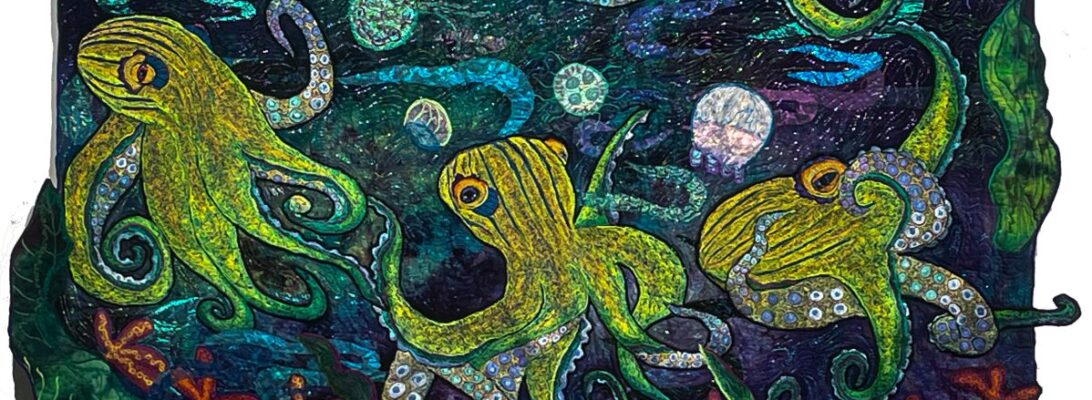
We worked with garnet stitch to do octopi several weeks ago. That was an all-over garnet stitch that could be shaded across the piece. But what if we want separate spots and smooth shading around them? How do we go about that?

What we need to do is to define the spot clearly, and then shade around it. But shading with one color around the spot negates a color range shade. We need to put in our spots and then shade around them defining different sides of the spot with different colors.

We start dark to light with the darkest threads first. The first color needs an outline stitch done at an angle to define the shape. Then we’ll shade out to the side, and then smooth the line between the outline and the shading.

But after that row, there’s more shading than outlining. When we come to each spot we outline the spot on that side and shade past the edges of it. Then in the next color row, we outline it from the other side and shade it into the earlier colors. The spot is clearly in the color range but it’s defined by the outline around it that fits the shading as it changes.

It’s a cool trick for including spots in a smooth range of colored stitchery.

For more information about shading colors check out The Long and the Short of It: Blending Stitches with the Long Stitch.

The Long and the Short of It: Blending Stitches with the Long Stitch

We’ve been talking about the variability of the zigzag stitch in free motion. Most of the time, I’m filling in a space where I want a line of color to show up. This is a trick that will give me a soft blend of color across the image without a hard line. I’ve heard it called the long stitch, although the old-fashioned description you hear with free motioners is the long short stitch. As with all free-motion zigzag stitching, the difference isn’t a setting on the machine. It’s how you move your fabric through the machine as you’re stitching.

Most of the time when I’m filling a space, I stitch a zigzag line at an angle around the edge, I shade the piece by stitching from side to side, and then I smooth the edges with a zigzag that moves straight through.

But when you just move from side to side you get a long blending stitch that flows into itself. The breast of the bird is done from side to side. The feathers are done with an outline, shading, and smoothing. You can see the difference.

You can find more information about the angle of stitching in the Thread Magic Stitch Vocabulary Book or this post, Stitch Vocabulary: Zigzag Stitch.

Jellyfish: Three-d Transparency

After having worked for some while on Octopi Dance, I decided I needed jellyfish to add to the flow of the piece. If you’ve been reading this blog for a while, you know I’m obsessed with creating a visual path through each quilt as a significant design feature. That can be done a number of ways, either through the background, the flora around your subjects, or with smaller objects that the eye follows across the piece.

For the octopi, jellyfish were a simple choice. They float and can be pointed in any direction. And the purple, green, and iridescent qualities are perfect against all that hot yellow.

What I really wanted after all that very solid garnet stitching was something translucent. I can do that fairly with organza and lace. But if I glue organza to the background, the background becomes a major part of the jellyfish. Some of the transparency is lost.

So I decided to make jellyfish with only the organza on the back. There are several ways to do that. One is to use a dissolvable stabilizer.

Dissolvable stabilizer is usually made from some kind of starch. There are a lot of brands but there are really only two types. One is see-through, and one looks like paper. They both dissolve in water. The see-through variety is usually a topping, put over your piece so you can embroider details without having your foot caught in the textures. It can also be worked in a hoop. If you want more information about dissolvable stabilizers, Embroidery Online has a wonderful article about them here.

The paper varieties don’t dissolve quite as well, but they make a better stabilizer for embroidery. Since I didn’t want to fuss with a hoop this time, I used a paper dissolvable called Paper Solvy, available at Amazon. It comes in a pack of 8.5″ x 11″ sheets.

It’s hard to make a stable embroidery just out of thread. You have to be sure you’ve connected all of it to itself, or it will fall apart when you remove the stabilizer. So I glued the organza onto the stabilizer with Steam a Seam 2, partially for color and partially to make the pieces more stable.

You can’t stitch as closely with this stabilizer. It will either tear or jam or both. I also ran a straight stitch around the outside of the pieces and then stitched my zigzag stitch over it. That holds the piece together better after the stabilizer is removed.

There are some good and bad things about this stabilizer It did dissolve quite well. It stitched fairly well, although I had a lot more thread breakage. And one was not enough.

I tried one set with a sheet of Tear Away behind the Solvy, and had to tear away that background. Not recommended. It took forever and it tended to tear away the stitches as well.

I’m quite happy with the ones I did on two layers of Paper Solvy. They dissolved well and the stitching stayed mostly in place. They can join in the dance,

For more information on the visual path check out Building a Path.