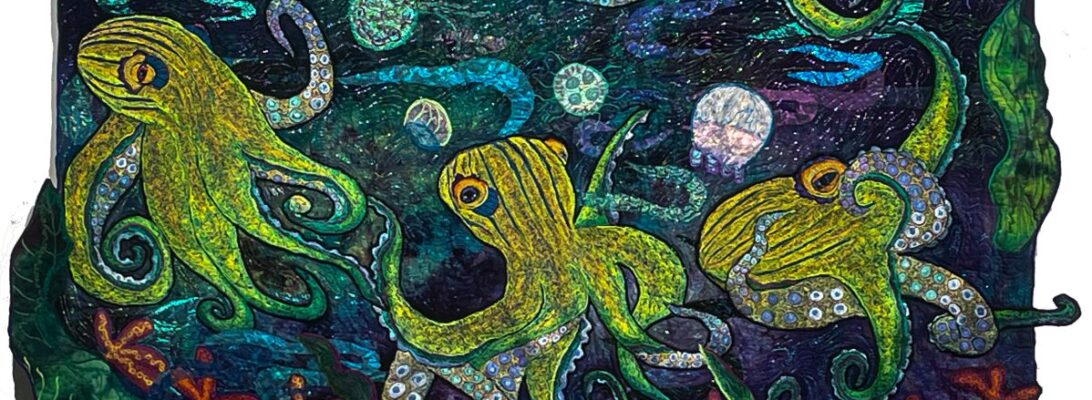
We’ve talked a lot about shading. I’m fascinated with making animals that are dimensional, and shading is how we achieve that. Shading is about delineating light from dark. But it can be a rough moment when you start to shade. It can feel really overdramatic.
I was working on this goldfish for a quilt called Fishy Business and I was struck with how very shocking it could be to stitch in with the complementary color all over your image. Every time I do it I take a deep breath and tell myself I haven’t ruined it.
The last color you put on is your lasting impression. Everything else just peaks through. But those sneak peeks are so exciting that they make it all work. Your eye blends the colors so that they stay fresh and don’t brown each other out.
I remember in class once insisting that a woman making an orange/brown squirrel needed to put blue in her stitching. She was appalled. And I understand why. But it all sorts itself out after you come back in with your primary color. It also gives you color under the skin, just like blue veins color our peachy selves.
So here’s to the courage to add the color that really seems like it might be too much. Undershading builds the dimensionality and tone. It creates unbelievable color.
I’m working on another fish quilt. I’m not sure quite how these fish will go together, but I’m aiming for three different colorations out of the same color range.
I wanted gold fish. But good fish are not made of the same gold. Why? Well, seven fish all colored identically seems fishy to me. The nature of nature is variance.
So I pulled a range of colors that went through yellow greens and orange golds.
Coloration is about filling in space to a large degree. A large space accommodates a large range of colors. Usually colors are set with a base dark color, a shadow color, a range of progressively lighter colors, a shocker color and a lightest shade on top as a highlight. Except when it’s not. That works very well with large areas.
Fish have scales which usually aren’t that large. Usually there’s room for a base color, a shader, a center color, a shocker and then a highlight. This gets more limited as the fish get smaller.
For each of the small fish there’s a base color, a shader, the next brighter color, a softer shader and the next brightest color. I’m putting a shocker around the eye and in the bottom fins.
So I’ve done four fish in red/green, yellow/purple, orange/blue, and yellow orange/ purple, to explore the progressions on this. You’ll notice all the shaders are complements.
It’s a trick to have a number of elements in a quilt with different colors to match each other in tone. Since I’m choosing threads off the neon fluorescent chart, that kind of takes care of that.
There are three large fish, but I wanted to do several fish in the full range. Here are process shots on four of them.
Fish One
Fish Two
Fish Three
Fish Four
Notice what a difference in makes to outline them for the second time! The stitching inevitably creeps over the outline, so they need to be crisped up, sort of like fish sticks.
So here are the fish in process, small ones finished large ones left to go on the background. I worried about them feeling too different, but the range gives them variation without seeming like they don’t belong.
Part of why they all work together is that the color relationships are complements. That makes the color impacts similar.
My show opened Friday night in Havana IL. I had thought Havana was a quiet sort of place. No. Not so much. We had a pleasant stream of people that flooded at around 6:30 and finally trickled out at 8 after we’d sold several quilts and a good chunk of fabric. I was stunned. And very grateful.
Whenever you’ve stopped working your art, restarting it changes it. Different interests. Different subject passions. New tools. Changed abilities. It’s your work, only different. You can’t step in the same river twice. The river is different and so are you. So you have to wonder. Is the new work as good? Will people respond? Is it a new direction or skill, or an obsession that will pass?
Something that is kind of a confirmation is, will it sell? It’s kind of a confirmation because often work that is very good is waiting for exactly the right people and the right home. But it’s a huge compliment to have someone want to take your work home.
I firmly maintain that my is alive and has a life of it’s own. It has jobs to do that have nothing to do with me. It may go places I never get to visit. It is there to change people, to change how they feel, how they think, how they respond to their world. I can’t do that. Sometimes my art can. It certainly changes me.
Here are the quilts that sold last week!
I treat sales as a adoptions. I’m always so delighted when a quilt moves on to it’s right place. It’s one of the reasons I always offer trade up rights. I want you to have the right quilt.
But there’s another thing that happens. Buying a quilt is a transaction, not only in money, but in support. When someone buys a work, large or small, they are giving me the means to continue to work on my art. Whether they know that or not, I do. And I am so grateful! Whatever it is an artist I do, you are helping me continue to do that. I am grateful for the journey and that you travel with me. You are the heart of my art.
And thanks again to Don, who put up with temper tantrums at sewing machines, driving, mobs and show panic. How did I get this lucky?
I am happy to announce two events. I have the first couple of showings I’ve had in 10 years.
Open Studio: Quilted Tapestries of Ellen Anne Eddy Saturday, August 27th Quilts, tapestries, books and hand dyed fabrics available for sale!
Hours:- Saturday 9AM – 3 PM Contact: Ellen Anne Eddy219-617-2021Galesburg Art Center, 309-640-0005
Birds of a Feather: Quilted Tapestries by Ellen Anne Eddy Cove Center, Havana, IL
The Cove Center, in Havana, IL announces Birds of a Feather, a show of quilted nature tapestries by Ellen Anne Eddy August 30 through September, 30th 2022. The Cove Center is in the Wahlfeld Building at 120 N. Plum St., downtown Havana Illinois. Hours: Monday – Saturday8 AM – 1PM CLOSED SUNDAYS ~Gallery Opening: September 2nd 4 – 8 PM Contact: Ellen Anne Eddy 219-617-2021Cove Center: 309-640-0005
Splash!
How do I feel about all of this? I haven’t hung a show in ten years. I’m past panicked.
Now, for an artist, panic is your friend. It’s the thing that helps you through the hoop of finishing, binding, hangers, signage and all the little details you remember the night before the opening. Along with raw terror, there’s all that extra energy if you can harness it. By now I’ve run out of steam and Steam a Seam 2 and most of my larger fabric chunks. My friend, Deborah Christman kindly embroidered a Don’t Panic towel In support.
But here’s the cool thing. I have, due to show panic and a small amount of hysteria, 15 new quilts and two new series to show.
So it’s not like I don’t have something to show. Or cool new work for sale. Please come join me! If you can’t make those dates, call and we can make a time for you to see things at the studio. Let me know what you think about the new work. And buy a quilt if you fall in love with one. I’m still out of Steam a Seam.
One of the hardest things in embroidery work is to get over the match instinct. After years of perfectly matching thread to my project, I’ve had to learn to pick out the highest contrast threads to make an image that really shows up.
In embroidery, contrast is everything. If it all mushes together color-wise then you have a very mushy image indeed. Smooth color exchanges that are analogous and sit next to each other on the color wheel are pretty. But they don’t have much punch. So what you want is color that builds not on similarities but on differences. There are several kind of contrast: color, tone, clarity, and temperature.
Today we’re talking about color ,which is simply the hue. Is it red, blue, or yellow? Or an odd shade of green? It’s not a simple as it looks. There a million reds, blues and yellows and they are not the same.
Thermal shock is about the temperature of a color. Every color, no matter whether it is a cool or warm color, leans either towards having a cool or warm cast. It doesn’t matter if it’s a cool color or a warm color. There are cool yellows, there are hot blues. If all the colors are either cool or warm they’ll flow into each other like analogous colors. But if they’re not? You get thermal shock. Like standing in a cold water sprinkler on a steaming hot day. The effect is kind of visually electric.
Blue and Yellow Don’t Make Green is an excellent book discussing thermal variations and how that creates differing colors.
I wanted this fish to jump off the surface and I’d decided on yellow, to give it some definition from the floral like background. But I wanted it showy. So the colors I picked, cool orange, cool and warm yellows, cool and warm blues left it shimmery and gave it impact.
Of course it helps if you have shocking thread to begin with. This particular florescent is a Madeira polyester 40# called Poly Neon. Neon has a around 800 colors of every hue, but it has a select section that really is neon. I went through my collection of those threads and chose my shockers.
fish scales
FaceTail
Each scale on this fish has a blue outer ridge, a purple, and 2 yellows. It’s been shaded in gradations to create the underside separately from the top.
The face and tail are a looser gradation that just shades from darkest/brightest to softer shades.
Here’s a video showing how that’s stitched.
I’ve written a lot about color because it matters to me. Building color in threadwork is done shade by shade, one color on top of another. The eye mixes those colors, which keeps them clear and crisp. But when the colors are fire and ice, prepare to be shocked!
We talked earlier about soft edge applique. Soft edge is a minimal treatment that simply covers the edge of an applique with monofilament nylon or poly thread with a zigzag stitch. For things like water, air, fire, rocks, mist, suns and moons it’s perfect. Sometimes it’s good for flower petals as well. It’s for anything that doesn’t need a hard defining edge. It creates soft color shifts across the quilt.
But some things need that edge. Bugs, birds, frogs and fish all need that hard definition. Or you can’t really see them at a distance. And it makes a huge difference when you go to photo your piece.
You know I’m a color girl. I’m going to want to use color every time I can. But over the years I have learned, if you want it to stand out, use the black for an outline.
green outlineblack outline
I particularly have tried it with bugs. Metallic thread green thread always gets my attention, and I reach for it much in the way you might reach for cherry cordial chocolates. But I’m mildly disappointed with it in the end, because it never gives as defined a space.
basic outline
I’ve been working on this egret, and the my process shots reminded me how important that outline is. Again, I’ve been working on doing a dimensional white bird, so it has a lot of contrast underneath to shade to white on the top.
The bare bones outline define the areas to shade with color. I’ve come to rely on 40 weight Madeira Poly neon. It comes in several blacks, but the definitive one is color #1800. I’m using a free motion zigzag stitch to outline, which is why the width is variable. (See post Zigging Upended for a tutorial on zigzag stitch).
I build color, from dark to light from the outline. For more information about choosing those colors, check out this post: Into White: The Search for White Thread Painting. But it’s coloring within the lines. As you can guess, I’m not so good at that. The threads encroach over the line and things get mushy. So the final act is that reoutline.
Redefining the outline
You can see the difference that second outline makes. All the edges that are fuzzed and mussy are now tightened up and out there.
The outside edges will be defined as I stitch the bird down. But having the inner edges cleaned with an extra edge of stitchery redefines all the lines.
finished egret
When I applique the bird on, again I’ll use my zigzag stitch with black thread. It gives the outline definition and punch and helps separate the bird from the background.
Years ago I was in an Amish shop, where I made a purchase I really probably only could have made there. I bought 6 yards of black polyester double knit. The poor lady was scandalized. I was dressed in hand dye, obviously not only English but art quilting English. The Amish keep black polyester double knit for men’s suits. Clearly I was not making suits for some nice Amish man.
But it’s the perfect cover for a design board.
I have in the past hung things up on a balcony to the back porch and walked down the alley until I could see it right. That’s a bit hard on a daily basis, and I no longer have a balcony.
Do you need a design board? Yes. Yes you do. You need to really see what you’re piece is doing.
I have a lot of tools in my studio. I love my machines, my irons, my cutting and ironing table. But queen of them all is my design board.
I no longer work in bed quilt sizes. It’s irrelevant to art quilting. But most significant show quilts are largish. Average size for my work is about 36″ x 45″. It’s hard to find a flat surface that size that has nothing on it. Certainly not the floor. Never mind the other things that already on the floor.
The cutting table accommodates that size, but looking at something on a flat surface gives a distorted view. The only way you can really see your quilt is to hang it up.
Different placements for the bird on my photo wall
There’s a rhythm to doing any kind of art, and once you start working makes you want to push through. It feels good to do that. But it’s a trap. If you don’t look at what you’re doing, it’s easy to do something you wish you hadn’t. Does it need to move over an inch? Is the drawing the way I want it? Are the colors working? If you can’t see it, you can’t evaluate what you’ve done. I can’t really see it on the table., either. The perspective is off when you see it lying flat. So up it goes on the wall. It’s worth leaving it there a day or two if you think something’s not right. You can’t see what’s wrong if you don’t look at it.
My wall a sheet of 4″ thick sheet of blue dow insulation snugged up against the longest wall in the sewing room. And it’s covered with that black double knit.
Blue Dow is available at most building stores like Loews and Menards. It comes 4′ by 8′. It is lightweight and you can pin projects up easily. It can be cut to shape with a bread knife.
Any large piece of fabric like a sheet, felt, or double knit can be used for a backdrop. Black, grey or white make good backgrounds. I like double knit because it doesn’t collect lint and the black is a nice dark black.
It’s also my photo wall. Having a photo wall and set up in your studio gives you consistent photos. If you have the same camera, the same lights and the same background, your photos fit better in with each other and are easier to adjust, since you know what to do for them.
I also usually take a picture of the days work as the last thing I do, so I can evaluate my next step. Usually I post it on Facebook if it’s interesting, but at least for myself, I can see what’s going on. And plan what to do next.
The hardest technical thing to deal with in free motion embroidery is the distortion. Any time you stitch rhythmically and close together, the fabric will distort, trying to make room for the extra thread in it. More so if you’re using a zigzag stitch. Zigzag stitching pulls on both sides and can make a top wave like a flag.
There are several easy cures: Using a stabilizer, using a hoop, using smaller width stitches. All that being done you can still end up with a crumpled mess lying like a hat. It’s not a happy moment. It’s made worse by the fact that the fabric made by that kind of stitching is usually pretty fabulous. Just lumpy.
Can you steam it? You can try. Sometimes it helps. Can you cut it apart and put it back together? I’ve done it. It’s a last resort, but it’s better than lying in lumps.
Or you can cure it by cutting off the rumple. I’ve done that a lot with embroidered subjects. But can you do that with elements of the background?Why not!
Cheesecloth mountains
This is a direct applique technique. I have some cheesecloth mountains for this owl in the meadow. If I stitch them down on the quilt surface I will end up waving the flag. So instead, I’m going to glue them on felt and do my detail stitching before we attach it to the front.
Do I lose something by this? Several things. I lose the look of the hand dye behind the cheesecloth, which I like quite a bit. And I lose the distortion. I hate the distortion. Do the math and make your choice.
The felt I’m using is a cheap acrylic felt from Joann’s. It’s stable, doesn’t fray, and stitches well. I’m making my mountains out of cheesecloth and Steam a Seam 2. On the back, I have a layer of Stitch and Tear stabilizer to help control the distortion and give support to the stitching.
Cheesecloth is porous. The glue will come through when you iron it. I’m using a Teflon pressing cloth to protect my iron.
The glue will come through onto my pressing cloth. I can clean that off with a Scotch Brite No Stick Scrubby.
Once I’ve got it glued down and stabilized, I can start stitching.
The stitching on these is moved through the machine from side to side. That creates a long stitch that fills the mountains quite nicely. It also distorts the fabric a lot. You can see the pull of the stitch on the fabric as the stitching fills.
When it’s all cut away the distortion is gone and all is left is a thin margin of felt that can be covered with minimal zigzag stitching. All those textured mountains with two small rows of zigzag that should not distort much.
I’ll pull off the last of the glue before I apply the mountains to the piece. I use a small square of plain cotton (something I never want to see again) as a pressing cloth and iron the embroideries on high heat. The glue will bubble through to the pressing cloth and pull right off. Make sure you remove the pressing cloth while it’s all steamy hot. Throw the cotton pressing cloth away. It will transfer that other bit of glue on to another piece if you reuse it.
This is a hard edge applique technique, because when I stitch it down, the stitching will be a visible line of polyester zigzag stitching.
everything but the owl
Now all I need to do is stitch down the flowers, add the owl and stipple.
For more information about cheesecloth check out: The Miracle of Cheesecloth: It’s not Just for Turkey Anymore and
I love people who show me their quilt sketches. They have plans. They draw them out and then they execute them. It’s a great theory. I wish it worked for me.
It never has. I can plan all I want. Things shift and change under me, and the thing I’ve planned changes too. Quilt pieces shrink. Distort. Turn out to surprise me. All I can do is trim my sail to the wind.
I pieced up this split light source a couple of weeks ago. My hope was that it would go with my meadow owl. Unfortunately the owl was brown and the meadow was bluey green. That doesn’t sound bad but it just didn’t meld. They looked like two different quilts happening because they were.
The owl, with all of it’s purple shading ended up on a lovely purple/yellow backing.
The split light source piece lay folded up by the photo wall. And I looked up and found my left over koi.
These koi go back. They’re aged. I brought them with me when I came to Don from Porter almost 7 years ago. They were supposed to be a part of a koi pond that just never happened.
I’d tried several backgrounds, and they just weren’t easy to place. For one thing, they were red, white and black. That’s not my normal color scheme. I had a top started for them that was humongous. The whole thing left me quite overwhelmed. So they did what half finished pieces do in my studio. They traveled from the floor, to the photo wall, to the chair, to a suitcase, and back again to the photo wall. I don’t ever throw them out. You never know when their day will come.
Last Saturday was that day. I was trying out backgrounds for the owl. The pieced background did not make the cut for the owl. And there were those koi, hanging on the photo wall.
Splush! They fit right in. I made a batch of kelp. One of them was way too big, but the others slid around the fish in a lovely arch. Just add bubbles.
Could I have planned it?
Not a hope, not a prayer. But I’m thrilled.
Why do I think this happens? It could be part of my dyslexia. I’m not able to put things in order or sequence very well. But I have another theory. I think a piece of art has a life of it’s own. It’s more of a birth process than a conscious design exercise. I know pieces of mine have gone places I could not, done things I couldn’t have done. They have their own lives. They are not my children. But like children, they have their own path.