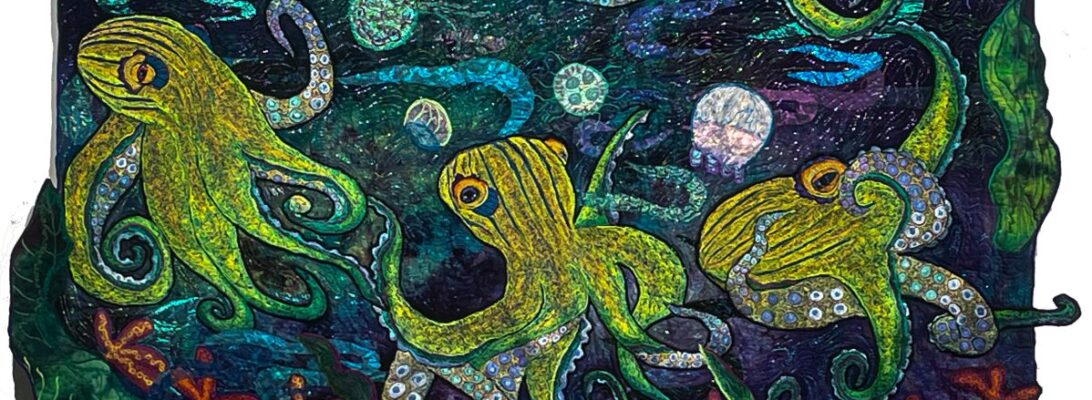
Good Bones: Rocks To Water

923-21 In the Reeds 2

Building something with dimension usually means it has a recognizable top and bottom. Design-wise, I believe you should be able to flip a piece on any side and have the design still move and work. But it loses a great deal of credibility if you have upside-down fish. It’s not a good look.

Be that as it may, it helps to have a recognizable border between sky, land, and water. How can we make those obviously separate, without just putting a line across it?

There are several subtle ways and some pretty direct ways.

Dyed cotton thread in the sky, thick metallic in the water

The easiest subtle way is to change the kind of thread you are using to stipple. Not the color necessarily. The kind of thread.

Threads separate in how they’re made and how much they shine. Metallic threads usually shine more than poly or rayon, certainly much more than cotton. Sliver-like threads that are flat tinsel shine the most. Next, come the twisted metallics like Supertwist. Then there are the wound metallics like Superior metallics.

Now, if water is shinier than air, and air is shinier than earth, you can separate them out by having different threads stippling the piece. I usually use Sliver or #8 weight metallic threads for water, and Supertwist for sky, and/ or earth. If they shine differently, your eye will automatically sort them out as different.

# eight weight metallic threads in water

But the best way I know to establish earth is rocks. This is not subtle. It’s an in-your-face statement of land. A pile of rocks at the water’s edge defines the water/earth border immediately. Ad it’s so easy to do.

I cut rocks out of leftover hand dye. I pick anything that is rock color, always adjustable to the color of the background, and cut a whole lot of rocks for when I need them. They’re backed with Steam-a-Seam 2 so I can move them around at will until I iron them down.

Fishy Business is a mostly water quilt. But a pile of rocks in one corner establishes the bottom of the pond. I may have globs of thread and some water ferns later to create more movement. Now all I want to do is establish a baseline with the rocks and start getting the water to flow.

I’m using soft edge applique techniques for this. Soft edge has no visible stitching or edge to it. Neither water or rocks are improved by having a hard applique edge around them. Instead, I’ll go around the edges with monofilament nylon and a zigzag stitch. There’s more information on, this in Sun, Clouds Water and Rocks.

I cut some elongated c shapes to make water from. Both in blue and green for the water and yellow for reflected sunlight.

You can see the progression on this in these shots. I started with a corner pile of rocks to establish the bottom of the pond. Then I added in the water ripples made of sheers backed with Steam-a-Seam 2. Since each fish I put in the water changes where the water ought to be, I’ve added them one by one and adjusted the water around them. I added sunlit water shapes across the middle.

I’m pleased with this so far. Nothing is sewn down yet, so I’ll leave it up and look at it in case it needs adjustment.

Having a sticky fusible like Steam-a-Seam 2 lets me design this way. When I’m ready, I’ll commit and iron it down. It’s a very fishy business after all.

Under the Skin: Thoughts about Shading

We’ve talked a lot about shading. I’m fascinated with making animals that are dimensional, and shading is how we achieve that. Shading is about delineating light from dark. But it can be a rough moment when you start to shade. It can feel really overdramatic.

I was working on this goldfish for a quilt called Fishy Business and I was struck with how very shocking it could be to stitch in with the complementary color all over your image. Every time I do it I take a deep breath and tell myself I haven’t ruined it.

The last color you put on is your lasting impression. Everything else just peaks through. But those sneak peeks are so exciting that they make it all work. Your eye blends the colors so that they stay fresh and don’t brown each other out.

I remember in class once insisting that a woman making an orange/brown squirrel needed to put blue in her stitching. She was appalled. And I understand why. But it all sorts itself out after you come back in with your primary color. It also gives you color under the skin, just like blue veins color our peachy selves.

So here’s to the courage to add the color that really seems like it might be too much. Undershading builds the dimensionality and tone. It creates unbelievable color.

Another Fishy Story: Thoughts on Color Range

I’m working on another fish quilt. I’m not sure quite how these fish will go together, but I’m aiming for three different colorations out of the same color range.

I wanted gold fish. But good fish are not made of the same gold. Why? Well, seven fish all colored identically seems fishy to me. The nature of nature is variance.

So I pulled a range of colors that went through yellow greens and orange golds.

Coloration is about filling in space to a large degree. A large space accommodates a large range of colors. Usually colors are set with a base dark color, a shadow color, a range of progressively lighter colors, a shocker color and a lightest shade on top as a highlight. Except when it’s not. That works very well with large areas.

Fish have scales which usually aren’t that large. Usually there’s room for a base color, a shader, a center color, a shocker and then a highlight. This gets more limited as the fish get smaller.

For each of the small fish there’s a base color, a shader, the next brighter color, a softer shader and the next brightest color. I’m putting a shocker around the eye and in the bottom fins.

So I’ve done four fish in red/green, yellow/purple, orange/blue, and yellow orange/ purple, to explore the progressions on this. You’ll notice all the shaders are complements.

It’s a trick to have a number of elements in a quilt with different colors to match each other in tone. Since I’m choosing threads off the neon fluorescent chart, that kind of takes care of that.

There are three large fish, but I wanted to do several fish in the full range. Here are process shots on four of them.

Fish One

Fish Two

Fish Three

Fish Four

Notice what a difference in makes to outline them for the second time! The stitching inevitably creeps over the outline, so they need to be crisped up, sort of like fish sticks.

So here are the fish in process, small ones finished large ones left to go on the background. I worried about them feeling too different, but the range gives them variation without seeming like they don’t belong.

Setting Up Shimmer: Moving Color Across the Quilt

Stippling with flecked metallic

The natural world is full of shimmer. Shimmer is about the change of color, and the change of light. The nature of nature is variance.

How can we create that? How do we build a world inside our art? How do we create the illusion of shimmer and light?

Here are several good ways to accomplish that.

Owl at Sunset process shots.

Hand dyed fabric itself establishes the play of color that nature features. But it’s a soft finish and a soft shimmer. It gives the background of shifting color, and a good glow, but it doesn’t catch the light.

Another way is to put sheers in layers over the the hand dye. It changes the color without losing the fabric beneath it. It shifts the shade underneath and adds texture.

I know some people don’t like the idea of the stipple. But stippling creates more texture and plays against the surface of the quilt. Particularly if your threads shine.

I’ve always found it helpful to separate the kinds of threads I use for field and ground. Different threads offer difference in the shine of the surface. Having a different shine for water, for air, for sunlight, and for your creatures helps your eye to sort those out from each other.

There are three kinds of metallic thread that offer different levels of shine.

Madeira Supertwist Metallic Thread

Fish done in flecked metallic

The soft sheen of Madeira Supertwist gives the fish a scale like sheen that is totally different from either the sliver or the thick metallic threads. That sheen separates the fish from the background, the field from the ground.

Sliver like threads
Stippling with sliver

Sliver, Glimmer, and other flat metallic threads are the most shiny. They look like Christmas tinsel. They come in a myriad of colors, particularly if you are willing to mix different brands. There’s no problem doing that.

YLI Candlelight, Madeira Glamour and Superior Razzle Dazzle are # 8 weight heavier metallic threads. Again, the company brands can be easily used together. These threads have a thick chunky look that is strong and works with rhythmic stitching as beautiful running water. Stitching through a range of color accentuates the light and shadow within the piece. It’s not quite as shiny as sliver, but it makes a strong statement.

You can see the separation between the air and the water in the changes between sliver and thick metallic.

Both sliver threads and thick threads should be used in the bobbin only.

I use all of these threads to make light shimmer across my quilt. And I choose a full range of colors to pull the eye across the surface. And to make the eye track the differences between field and ground by the amount of shine in the threads.