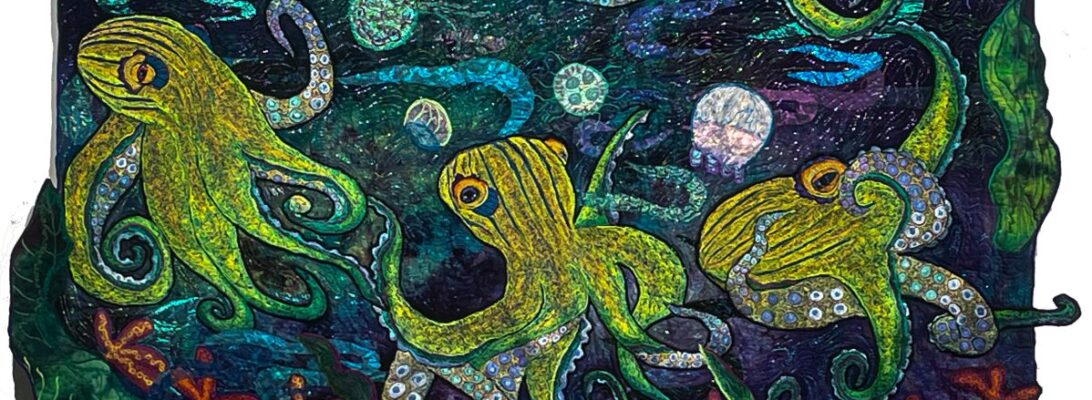
A Series of Lessons

Over the last couple of months, I’ve been working on a series of fish in the waters. This is an important symbol for me. It explores surviving strange waters, rising out of the depths, swimming with the current, and swimming against the current. It’s about flowing water and changes. It really checks all my boxes. It also serves as a connection with my father, whose religion was bass fishing. Since going fishing made better people than going to church, I respect it deeply, even if I won’t eat fish. I live in water.

So I noodle at the fish-in-the-water image often. If you’ve been following the blog, you know I made one quilt I loved, and I wanted to see whether I could recreate the energy. Not the fish or the river, but the energy of the piece.

Epic fail. I made a very nice other piece with similar hand dye, a fish I drew 5 times before I was pleased, and similar oil paint stick rubbing for the forest in the background. I hated the first fish I embroidered. I stitched a more active catfish, that was better.

Then I took a break and went to find the studio floor. Again. Everything flutters to the floor except the things that go clunk.

There it was, the best background for the embroidered fish I rejected. The fabric made a vortex, so I did too, out of stitching a swirl of sheers.

I didn’t learn anything technical from the exercise. But I did confirm what I already knew. It does me no good to recreate something. Another piece will need different components and approaches. I didn’t need to be making arbitrary rules for myself. I needed to listen to each piece to give it what it needs. If I thought I was in control, that was delusional.

Maybe this is a right-brain, left-brain thing. I’ve been struggling to organize both in the house and the studio. That’s a very left side of the brain thing to do. It’s foreign thinking, but it’s less grim than Swedish Death Cleaning. You know what? No one ever did teach me this. Certainly not my mother.But that shouldn’t stop me. If you don’t know how, you can learn.

So cleaning does turn into art. Eventually.

As Don says, “I’m a man. I can change. If I have to. I guess.”

I can too. If I have to, I guess.

Of course, I hung the quilt up and noticed that the wonderful spiral stitching in the center is unnoticeable 3 feet away. Small flowers and thick thread to the rescue. Of course, the pond has floating flowers.

The change isn’t a technique or a new technology, really. The change is learning to listen better.

Woman Proposes, Art Laughs

A while back I decided to see if I could recreate the energy from a piece I was particularly pleased with. If you’ve been following the blog, I’ve documented it as I’ve worked.

I wouldn’t call it a success. I went through three separate fish, not happy with any of them. I embroidered the best of them and still felt bland.

So I passed on the bass and did a catfish, which I’m not displeased with. The bass went back into the pile.

I can plan all I want. There’s a serendipity to art that is inescapable. While I was scraping out the studio, I found a piece of fabric I’d totally forgotten about.

All of a sudden, my wallflower fish had gone dramatic. I built him a whirlpool/vortex.

My fish fooled me again. I spent some time embroidering some nice metallic minnows that shyly blended right into the background.

They are pretty, but they have no punch.

So I’m trying these brighter gold minnows. I’m still not sure. They’re embroidered from poly, and they might stand out too much. I may need to do some from metallic gold.

I’m in charge. Right.

One More Time: We Need Another Fish

Fall Waters the original quilt

Late last year I did a fish quilt that I thought was really successful. As an experiment, I took some of the same elements to see if I could make something that matched it in energy and beauty. Not copying. Just trying for the same feel. It failed. It laughed in my face.

This is not a new thing. I have piles like an archaeologist’s dig of pieces that didn’t work, tucked into the corner or another. And I raid those piles regularly, looking for the next thing.

Here is my failed experiment. I found it tucked in one of those piles. Could it work a different way?

first fish for fish rising

I blame the fish. He’s a nice fish. A little clueless. But not compelling.

New catfish

So we/re trying again. Same background. New fish. Something with more drama going on.

At that point, I abandoned the idea of using the same components. This quilt needs its its own water and world. I put in sun motes across the surface. I decided against small embroidered fish because I already had some wonderful ones rubbed into the fabric in gold.

Fish Rising, with a different fish

Once I added the new fish, I felt more assured. Full disclosure, I cut off the white tail ends since they made it look like Pac-Man. Much improved.

We’re not done yet. Lots of layers of stitching and sheers left to go. But it doesn’t feel like a loser anymore. My experiment was very useful. You really can’t step into the same piece of art twice.

Again? Really? Yes. Really.

I try really hard not to rate my pieces as I make them. I find that my opinions of things change over time, largely in reaction to people’s reactions. If I suspend my judgment of work, I find I learn more from it. Suspending judgment allows me to flesh out ideas and move on. Finish the quilt. Next quilt, please. The learning is the goal. The quilt is almost a byproduct.

But sometimes I do a piece that knocks my socks off and throws me across the room. It’s not an everyday thing. When that happens, I find myself asking some of the same questions that I ask when I do something I hate. What happened here? Why is this piece wonderful? Or awful? What?

Was it the color palette? Technique? Is it about my background? The image itself?

A fabulous piece makes you think, “Can I do this again? How did this happen?”

I love this piece so much. So I’m going to try not to reproduce it, but to focus on its successful elements.

Part of what I love here is the quiet palette. I normally go for eye-sore colors. This was restrained. Luckily, the last batch I dyed had a piece, not exactly in the same palette, but in the same tone.

The fish can be the same threads. And I think it needs to be.

I had trouble with the fish. I wanted a fresh image, not the same, but in the same colorations. So I started several fish, only to find them wrong. I love these. But in terms of direction and size, they’re just not right.

I went through my collection of drawings. My embroidery process uses a pattern drawn on Totally Stable that goes into the back of the piece as a pattern and a stabilizer. So each drawing is consumed by the embroidery itself.

Not to worry. For the last 3 years, I’ve saved a tracing of my drawings for later. It’s turned into a jumping-off point for other pieces, and I consider that collection a treasure. I found a fish that had to be at least 10 years old, which I don’t believe I ever used.

This will be reversed when I’m done. I’m half way through the embroidery.

Originally I used a tree rubbing plate both for the trees themselves and for the reflection in the pond.

And I want to explore the rubbed oil paint trees. This piece of fabric evokes a stream rather than a pond.

Now that I’ve analyzed my elements, we’ll see where it goes. It’s at that awkward spot where everything looks wrong. But that’s the exact moment to suspend judgment and push through.

It may take all those elements and work well. It may not. There’s a mystery here I don’t understand. But I think that part of it is that a piece is not the sum of its parts. Instead, perhaps it’s a whole being itself. Maybe it can’t be reworked with the same success.

Push on. Finish the quilt. Next quilt, please. The learning is the goal.

Creating Color by Underpainting

I talk alot about color theory, choosing of threads and creating color schemes. The nature of thread painting is no different than any other art. It’s a creating of colors from components. How you arrange those components changes the effect you get.

I usually line up colors light to dark and add in a shocker and a shader. That color scheme gives us a smooth layer of color that builds on itself. It’s pretty. But it hasn’t got a whole lot of depth.

Sometimes I separate the the scales into a dark and light zone. That creates a deep separation on the scales without any shading. That’s pretty too.

I wanted something different for this fish. I wanted the scales deeply separated and clear. So I underpainted my fish first in blues, purples and greens, and then over painting with yellows and oranges.

Is it extra work? Yep. Would I do it all the time? Probably not.

But one of the wonders of doing Koi is their textures. The textures of fins and scales and their sense of motion is all of that.

So I started underpainting with the complements of the piece. Since the fish is yellow orange, the underpainting should be blue. green and purple.

He’d be pretty if I just continued in that range. Instead, after establishing the darker underpainting, I painted over with yellow and orange threads.

After that, I added a light layer of turquoise metallic thread for flash and black outline for definition.

This is where I think I’m going with this. The underpainting separates and lifts each scale and the outlining nd flash stitching punches it visually.

If you are keeping score of colors on the color wheel, you’ll notice it has a full range of analogous colors from Yellow, green, purple to blue.

Is one method better. Heavens, no! It’s a matter of having choices and knowing what those choises offer you. Now I’m off to stitch rocks and hostas.

Can I Kelp It? Couching Unusual Yarns

I needed some kelp for the bottom of this shore scene. I wanted something textural and yet not dense.

There aren’t a lot of great pictures of kelp. But I found these in an art nouveau book of botanicals. It twists. And it’s long and narrow with crinkled edges.

As a lucky find, there was this strange yarn at the rescue mission sale. Both of these are loopy yarns. They were in vogue several years ago for scarfs. They have loops woven in that will make great kelp. The color also fits into the scheme, blending with the heron.

It can be spread apart to look like kelp. That’s a difficulty all its own. You can spread yarn apart, but there aren’t enough fingers to hold it that way and free motion over it. You also can’t free-motion it without it being caught in the darning foot.

So I took a two-pronged approach, I knotted the yarn where I wanted it to spread,

I couched it in place with a regular presser foot, so that I could control the width of the yarn.

I covered it with a Dissolvable stabilizer. Then I stitched it all down with the darning foot where I wanted the kelp to be. I wet down the stabilizer to make it go away.

Some yarns need special care. Don’t be afraid to use several approaches to get what you want. In the end, all that matters is the result.

Shimmer: Making a Minnow Shine

I love minnows! My dad used to bring me home minnows when he’d been fishing, so I could watch them. They aren’t exactly like fish visually. They have parts that are solid, but they also have fins and underbits that are really translucent. How do you do that in thread?

I used to not pay much attention to the kinds of metallic threads I used. I mixed them all together by color and that was that. But lately, I’ve been paying more attention. Metallic thread is not only shiny. It comes in different kinds of transparency.

Why would that matter? A more transparent crystal thread gives a translucency to your embroidery. It’s not quite see-through. Most wound metallic threads are not at all see-through. But the flecked metallic threads can be to some extent.

Most metallic threads are not. They are a strictly shiny surface that reflects, in both ways, the solidity of metal.

Metalic-colored threads have the shine, but they are not see-through either.


Crystal metallics are different. They have a translucency that translates into your stitching as being see-through.

With some careful planning, the bodies of the minnows are mostly solid, but the mixture of metallic silver and iridescent white crystal makes for transparent-looking fins.

It’s a trick, but it’s a cool trick.

These minnows will be in Shadow on the Shore. I’m not sure how many minnows we’ll use, but there’s always room for leftovers.

For more thoughts about translucent thread and embroidery see Translucent: Making Stitching Look Transparent.

Quilt Bits that Time Forgot:

There’s a constant pathway in my studio. It’s not the one through the piles of fabric, although that would be useful. Often one quilt sparks another quilt, either in concept or in terms of left overs.

The fish in Swish and Koi were once supposed to be in one quilt. It just didn’t work out that way. I guess if you’re a red fish you need a space of your own.

You know I always make extras of everything. Right now I’m working on some green and silver minnows. I can’t go wrong here. They’re right for the heron I’m working on, but those I don’t use are bound to fit in a quilt somewhere.

These 3 owls all look similar in style. That’s because they were all made for one quilt. That quilt simply didn’t work. I have those moments, like everyone else. It sat in a pile for around 8 years/and I decided to use one of the owls. Then another. Then another. I consider any quilt that sits in a pile for 8 years unfinished to be probably not working. Unless I have a miracle revelation when I find it in the pile.

This is how my studio works. I produce work in many stages. Sometimes those stages work immediately as I envision them. Sometimes they don’t. But there is surprisingly little waste. Almost everything gets used somewhere. It’s a process of finding the right place to put it.

There’s another side to this. I get to take an image and put it into a different place. Which is exciting because a different piece of fabric puts it into a different world. That’s a wonderful experiment. Will the light change it? Will the stippling change the light. So many questions to ask in sequence. And to answer.

The price tag for this is the ability to change your mind. Understand this is a process you are not in control of. And enjoy the ride as your pieces develope under your hands.

Living Large: Strategies for Dealing with Large Quilts

I almost never do bed quilts. I did them when I was younger and watched them die as I used them. It was too depressing. I occasionally will do a baby quilt or a comfort quilt for someone dealing with illness. Mostly I do art.

And since art doesn’t have to be big, I don’t often make something bed-size to put on the wall. Except when I do,

This heron couldn’t be done smaller. At least I couldn’t do it smaller. He’s 60″ x 52″. He’s pretty much the size of God’s underpants.

There are some strategies for dealing with overlarge quilts. The first three are, don’t. But if you’ve decided it must be large, there are several things you can do that will help.

Strategies for Large Quilts

Break it into components. For myself, that means the embroideries. I do them separately and then apply them when the top is ready. But it might be working in rows or in segments. Different quilts will suggest different approaches.

Use larger details. Scaling up the design means there’s less work in it. Sometimes extensive detail just looks ditsy on a larger piece.

Buy extra sewing machine needles. Larger quilts require more tugging and pulling and that will break needles. Promise.

If you have a machine with a wider arm, this is the moment. The arm of your machine is the space between the needle and the mechanical right end. A lot of manufacturers make machines with a longer arm. That’s extra room to shove the quilt through the machine. It can be very helpful.

Use a design wall where you can walk away and really see your design. A design wall should be big enough to accommodate your work and in a big enough space where you can walk away and really look at it. For more information about making and using a design wall, here’s a blog post on it: Studio Essentials: The Glories of the Design Wall.

The other helper is what we used to call bicycle clamps. Roll your quilt, clamp them with these clamps and then you can maneuver it easier.

I don’t do large quilts often. But they do really make a punchline in a gallery show. So this heron is promised to a show at the Peoria Art Guild in September. We should have him crowing by then.