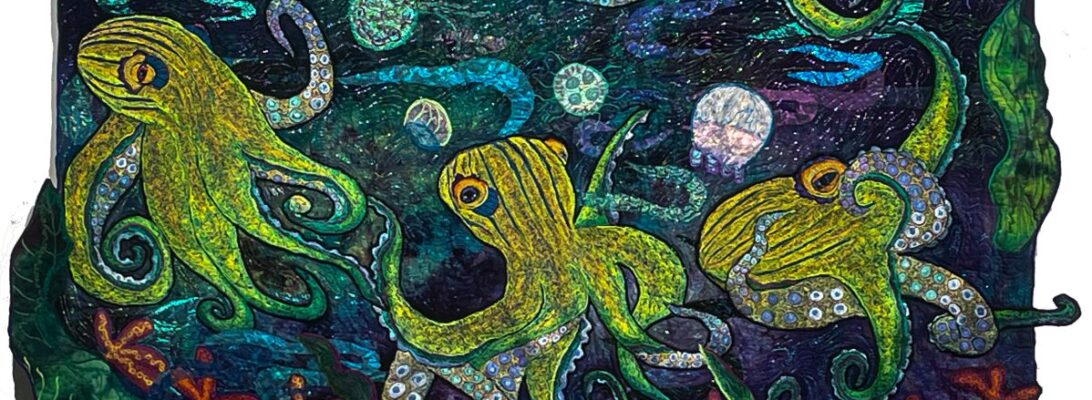
1212-26 Her Royal Shyness

1211-26 Her Royal Shyness Octopus’
Garden Series
34” x42”
$3,570

Materials:
Hand-dyed cotton, felt, stabilizers, commercial sheers, polyester, metallic, nylon threads, oilpaint stick
Techniques:
Machine pieced, machine embroidered, embroidered appliqué, quilted, texture rubbing,  hand dye, cord binding, direct appliqué

Purchase this quilt on Etsy!

1211-26 Drifting

1211-26 Drifting
44” x38″
$ 4,080
Materials: Hand-dyed cotton, felt, stabilizers, commercial sheers, polyester, metallic, nylon threads, oilpaint stick
Techniques: Machine pieced, machine embroidered, embroidered appliquĂ©, quilted, texture rubbing,  hand dye, cord binding, direct appliquĂ©

Purchase this quilt on Etsy!

The MAP Kids: Opening Last Night at the Peoria Art Guild

The MAP kids had their opening last night. Due to car troubles, I couldn’t be there. I’ve taught in this program, and I try to make that opening because it’s a teachable moment for the kids. They see their work celebrated on the wall, and I usually go to the opening and ask them, one by one, to show me their pieces, so I can tell them how wonderful they are. Art is hard. People aren’t always kind. We need to spread that kind of kindness prophylactically against the cruel way people treat kids art. Since I couldn’t be there I sent this note.

The MAP program is an opportunity for teens to study with a number of different artists as mentors. It’s a wide-open learning experience, not from art school, but from people living their art. It’s a free program the Peoria Art Guild offers each year to a select group of young artists.

Hit! I can’t be here tonight to celebrate with you over the wonderful things you made this year. I am so sorry. Our car broke down last night in a way that will take some time for us to get it running. I can’t get there.

I always try to come to the MAP show, because this program is fabulous. Not just the art you make. The way you remake yourself is also fabulous to watch. It’s hard to move to different media and techniques. But it hones your skills and stretches your ability. It changes you. It sets you on different paths. None of that could happen, without your courage, commitment and determination to try things. You’ve done all of that.

You will have people in your life who will either indulge your art or ignore it. They’ll tell you that it’s nice, but not practical. Or necessary. They are wrong.

Art is where we create emotional literacy. Our ability to thrive and survive comes from rewriting our stories in ways that make sense to us, that make us more able, that give us joy and peace, even in chaos, Our art does that. We interact with an image, and it retells the story. Not just for ourselves and our own growth. But we, as artists do it for others as well. People are changed by our art. It incites them with new thoughts. It heals old wounds by seeing them in different lights. We change the world with our art. It doesn’t matter how many people see our work. The person who needs to is right audience. We are the light of the world.

Tonight I hoped to walk with each of you and ask you to show me your pieces. I wanted to tell you how proud I am for you, that it was an honor to have you in class, and that I am waiting for the magnificent things you’ll do next. I hope you have the patience to grind through the practice it takes to hone your skills and find your voice. I am honored to have worked with you.

Congratulations!

All my love,

Ellen

I’m sharing this with you because perhaps you might need to hear that as well. I do too. We’re artists. We hold each other up.

You’ll find this fabulous show through July 31st.

Peoria Art Guild
203 Harrison St,
Peoria, IL, 61602,
3096372787info@peoriaartguild.org

Am I Biased? Making an Angular Border

In working on the Octopus Roclets. I’ve felt a need for angles. They just do’t stay still. And the easiest way to make something feel like it’s in movement is for it to be at an angle.

Which angle? They do read differently. I want to try an isosceles triangle, made from an elongated rectangular strip. I think it will add to the movement of the piece.

Angles mean bias. We talk about fabric being on the straight of grain. If you tore a strip off the fabric, that strip is the straight of grain. That’s a fairly stable piece of fabric. It will stretch very mildly across the width and not at all in the length.

Here’s the definitions of bias from ai on Google.

Fabric bias is any diagonal direction across a woven fabric, while the “true bias” sits at a precise 45-degree angle to the lengthwise and crosswise threads. Cutting or binding on the bias gives the fabric natural elasticity and a fluid, body-hugging drape. [1, 2, 3]

Understanding Bias

True Bias: The diagonal 45° cut between the two; this is where the fabric is most stretchy and flexible. [1, 2, 3, 4]

Lengthwise Grain: Runs parallel to the finished edge (selvage) and has almost no stretch.

Crosswise Grain: Runs perpendicular to the selvage and has slight give.

If we cut our borders across at an angle, that edge will stretch because it’s bias. We really don’t want that. Bias stretches out and makes for wavey borders and seams.

Controlling Bias

Accurate cutting will help. I need to square up my center and use my rotary cutter to make clean edges. But the secret weapon is starch.

Starching your fabric makes it stitch better. And it makes it stretch less.

Here’s the mock up I did to try this out.

Making angled borders

I used:

A center rectangle or square.
A strip of fabric twice the size of your border and a bit longer than your center piece

Liquid spray starch,I’m using Linet Starch.


Tools:
Rotary cutter, ruler and mat
Sewing machine with straight stitch and quarter-inch foot
Iron or rolling seam presser

I starched the two fabrics with a solution of 1-1 starch and water

I cut the yellow strip in half and then cut the strips fro corner to corner diagnally.

For more information about starch, see Getting Fabric Straight.

I pressed my seams with a rolling seam presser

I trimmed my edges square to make

a slightly angled background.

I’ve added shell and rock rubbings to the bottom

Here’s where we think the octopuses will go.

I’m still deciding about that. But I’m happy I tilted the background. It creates the motion I wanted.