
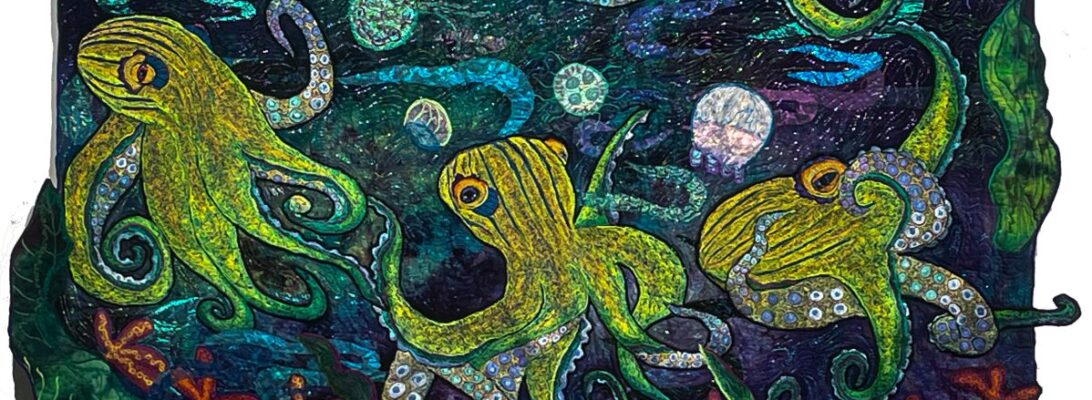

In working on the Octopus Roclets. I’ve felt a need for angles. They just do’t stay still. And the easiest way to make something feel like it’s in movement is for it to be at an angle.
Which angle? They do read differently. I want to try an isosceles triangle, made from an elongated rectangular strip. I think it will add to the movement of the piece.
Angles mean bias. We talk about fabric being on the straight of grain. If you tore a strip off the fabric, that strip is the straight of grain. That’s a fairly stable piece of fabric. It will stretch very mildly across the width and not at all in the length.
Here’s the definitions of bias from ai on Google.


Fabric bias is any diagonal direction across a woven fabric, while the “true bias” sits at a precise 45-degree angle to the lengthwise and crosswise threads. Cutting or binding on the bias gives the fabric natural elasticity and a fluid, body-hugging drape. [1, 2, 3]
Understanding Bias
True Bias: The diagonal 45° cut between the two; this is where the fabric is most stretchy and flexible. [1, 2, 3, 4]
Lengthwise Grain: Runs parallel to the finished edge (selvage) and has almost no stretch.
Crosswise Grain: Runs perpendicular to the selvage and has slight give.
If we cut our borders across at an angle, that edge will stretch because it’s bias. We really don’t want that. Bias stretches out and makes for wavey borders and seams.
Controlling Bias
Accurate cutting will help. I need to square up my center and use my rotary cutter to make clean edges. But the secret weapon is starch.
Starching your fabric makes it stitch better. And it makes it stretch less.

Here’s the mock up I did to try this out.
Making angled borders
I used:
A center rectangle or square.
A strip of fabric twice the size of your border and a bit longer than your center piece
Liquid spray starch,I’m using Linet Starch.
Tools:
Rotary cutter, ruler and mat
Sewing machine with straight stitch and quarter-inch foot
Iron or rolling seam presser
I starched the two fabrics with a solution of 1-1 starch and water

I cut the yellow strip in half and then cut the strips fro corner to corner diagnally.

For more information about starch, see Getting Fabric Straight.

I pressed my seams with a rolling seam presser

I trimmed my edges square to make

a slightly angled background.

I’ve added shell and rock rubbings to the bottom


Here’s where we think the octopuses will go.

I’m still deciding about that. But I’m happy I tilted the background. It creates the motion I wanted.