Am I Biased? Making an Angular Border

In working on the Octopus Roclets. I’ve felt a need for angles. They just do’t stay still. And the easiest way to make something feel like it’s in movement is for it to be at an angle.

Which angle? They do read differently. I want to try an isosceles triangle, made from an elongated rectangular strip. I think it will add to the movement of the piece.

Angles mean bias. We talk about fabric being on the straight of grain. If you tore a strip off the fabric, that strip is the straight of grain. That’s a fairly stable piece of fabric. It will stretch very mildly across the width and not at all in the length.

Here’s the definitions of bias from ai on Google.

Fabric bias is any diagonal direction across a woven fabric, while the “true bias” sits at a precise 45-degree angle to the lengthwise and crosswise threads. Cutting or binding on the bias gives the fabric natural elasticity and a fluid, body-hugging drape. [1, 2, 3]

Understanding Bias

True Bias: The diagonal 45° cut between the two; this is where the fabric is most stretchy and flexible. [1, 2, 3, 4]

Lengthwise Grain: Runs parallel to the finished edge (selvage) and has almost no stretch.

Crosswise Grain: Runs perpendicular to the selvage and has slight give.

If we cut our borders across at an angle, that edge will stretch because it’s bias. We really don’t want that. Bias stretches out and makes for wavey borders and seams.

Controlling Bias

Accurate cutting will help. I need to square up my center and use my rotary cutter to make clean edges. But the secret weapon is starch.

Starching your fabric makes it stitch better. And it makes it stretch less.

Here’s the mock up I did to try this out.

Making angled borders

I used:

A center rectangle or square.
A strip of fabric twice the size of your border and a bit longer than your center piece

Liquid spray starch,I’m using Linet Starch.


Tools:
Rotary cutter, ruler and mat
Sewing machine with straight stitch and quarter-inch foot
Iron or rolling seam presser

I starched the two fabrics with a solution of 1-1 starch and water

I cut the yellow strip in half and then cut the strips fro corner to corner diagnally.

For more information about starch, see Getting Fabric Straight.

I pressed my seams with a rolling seam presser

I trimmed my edges square to make

a slightly angled background.

I’ve added shell and rock rubbings to the bottom

Here’s where we think the octopuses will go.

I’m still deciding about that. But I’m happy I tilted the background. It creates the motion I wanted.

More Pop Octs: Dancing with Design

This has been a rough week of a lot of medical appointments. Nothing bad. Just exhausting and demoralizing. So last night I had a serious dose of color therapy. I watched Yellow Submarine.

This is the best color therapy movie I know. I’d add Fantasia and Avatar to that list as well. Who cares about plot? Endless mixes of impossible color combinations. I’m still half drunk.

If you asked for a description of the color theme, I would say it’s full-color-wheel bright.

But it’s also an outrageous usage of way too many tertiary colors running amok. I’m in love.

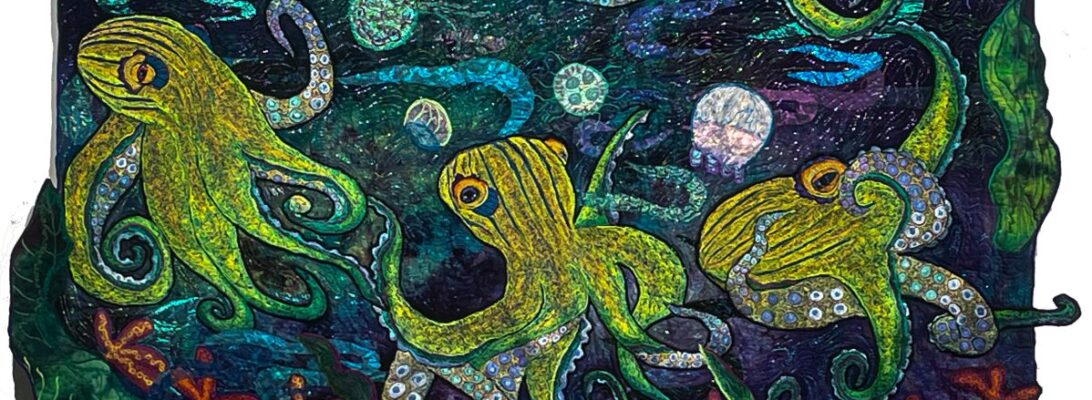
I’ve stitched the rocket octopuses. I started with a background that reminded me of confetti yarn, bright bits of color on a soft background. So my octs had to be bright where the background was softer. I’m thinking of calling them the Octettes.

But now we’re at the fun point. We get to create the design.

This is the first pin-up. I do several pin-ups with each piece. The first pin-up is just the background and the creatures. With that pin-up, I’ll know my colors, my path and where the creatures interact with each other and the viewer.

The second pin-up is after I add the elemental bits. Usually these are sheer unless they’re rocks. Water, rock, air currents, sunlight. It’s also where I add small elements that help establish my visual path. I’m thinking gold and orange fish.

The third pin-up is my final design. After I do the third pin-up, I’m ready to stitch. And my options are in stone.

So now I can try it all out. Different backgrounds, different octs.

If it’s just one or two possibilities, I pin it up and shoot photos. Here I had a bunch of choices so I photoed the elements and put them into photoshop. It’s a cheap thrill, but it’s much less aerobic.

Here are the ones I like best. I really like the ones swimming in opposite directions. The ones weaving tentacles work best on the larger pieces of fabric. I’m still not sure.

I’ve done this before in a blog called Pin Up Girls: Family Planning for Octopuses. There I was trying out a number of different quilts. This is just one. But it is a good way of looking at options, without having to pin everything up physically.

What do you think?

Going Straight: Stretching into Different Stipple Patterns

I’ve been working on the octopuses for around five months. There are seven in all, five finished. I’m pleased to say they make a good start for a show.

But I don’t want quilts that look like the same pieces, only in different colors.

What defines a work? Certainly subject matter. Certainly color. But textures also make pieces stand from with each other.

I’ve leaned heavily into oranges and blues on this collection, but I think there’s a good range of colors. The background is always the color of your sky, the mood of the piece, and its definition

The octopus’s garnet stitch texture connects the grouping.

Something more subtle separates them.

The stipple treatment establishes the movement of the water, but it also visually separates the pieces from each other.

Confession. Left to my own, I have three stipples I use. I really felt I needed to stretch a bit here, particularly because I want the quilts in this series to stand up as separate works.

Version 1.0.0

Leah Day’s book, 365 Free Motion Quilting Designs has become a go-to reference for me. I don’t feel a need to copy her designs, but it’s full of a lot of stimulating ideas. It’s one of the few books I store right by my machine. It’s a worthy resource. I turned to it for some different stipple ideas.

I almost never do straight lines in my work. I’m not very good at them. But I love the bubbles and stripes here. It’s almost like wallpaper for the quilt.

Here are details of the other quilts, showing the different stipples.

Leah’s book is a lovely springboard into other possibilities. It’s available on Amazon

So I went straight on one of them and survived. Maybe I can do straight lines.

A Series of Lessons

Over the last couple of months, I’ve been working on a series of fish in the waters. This is an important symbol for me. It explores surviving strange waters, rising out of the depths, swimming with the current, and swimming against the current. It’s about flowing water and changes. It really checks all my boxes. It also serves as a connection with my father, whose religion was bass fishing. Since going fishing made better people than going to church, I respect it deeply, even if I won’t eat fish. I live in water.

So I noodle at the fish-in-the-water image often. If you’ve been following the blog, you know I made one quilt I loved, and I wanted to see whether I could recreate the energy. Not the fish or the river, but the energy of the piece.

Epic fail. I made a very nice other piece with similar hand dye, a fish I drew 5 times before I was pleased, and similar oil paint stick rubbing for the forest in the background. I hated the first fish I embroidered. I stitched a more active catfish, that was better.

Then I took a break and went to find the studio floor. Again. Everything flutters to the floor except the things that go clunk.

There it was, the best background for the embroidered fish I rejected. The fabric made a vortex, so I did too, out of stitching a swirl of sheers.

I didn’t learn anything technical from the exercise. But I did confirm what I already knew. It does me no good to recreate something. Another piece will need different components and approaches. I didn’t need to be making arbitrary rules for myself. I needed to listen to each piece to give it what it needs. If I thought I was in control, that was delusional.

Maybe this is a right-brain, left-brain thing. I’ve been struggling to organize both in the house and the studio. That’s a very left side of the brain thing to do. It’s foreign thinking, but it’s less grim than Swedish Death Cleaning. You know what? No one ever did teach me this. Certainly not my mother.But that shouldn’t stop me. If you don’t know how, you can learn.

So cleaning does turn into art. Eventually.

As Don says, “I’m a man. I can change. If I have to. I guess.”

I can too. If I have to, I guess.

Of course, I hung the quilt up and noticed that the wonderful spiral stitching in the center is unnoticeable 3 feet away. Small flowers and thick thread to the rescue. Of course, the pond has floating flowers.

The change isn’t a technique or a new technology, really. The change is learning to listen better.

Clean Up in the Fish Isle

The octopuses’ garden series is working up. I finished up with the MAP kids, got enough rest to face the studio, and discovered that we had to find it to face it. Prep for a class leaves endless clutter and many nice neat piles sprawled everywhere.

It will be a while before we find the table. Then we can search for the floor.

But in that process I’ve started the next step for the octopuses.

Why do I need all those fish? The octopuses are all well and good, but they’re not going to be dynamic without something building a path. So we are making fish. The fish are what will make the octopus quilts move.

I mean a lot of fish. Ive got somewhat close to 50 fish drawn for four quilts. Will I use them all? Maybe.

This is about fabric scarcity. A year ago, we could get almost any fabric. This December, I had to beg a dye house for my order of pdf cotton. They had 50 yards in-house that they were portioning out to their clients.

I hate that. I hate depression economics and carefully crafted source shutdowns. I hate the idea of saving rubber bands and string. We’re there. All of a sudden, hand-dye is precious, and I need to be careful to use up the little bits.

Today I went through felt, hand-dye, and stabilizer scraps. It was a good thing I was cleaning up and sorting. There are some scraps I keep good account of. Anything brown, gray or stony ends up as rocks in another quilt.

But here I was scrounging for backgrounds for fish. Normally, I dye fabric especially for the larger embroideries. This last year, normal has fled out the windows.

I’m not going to talk about why. It’s incomprehensible anyway. Why was Joann’s so reckless as to go defunct? I suspect greed and stupidity dancing arm in arm off to court. Joanns is gone. Our place to run out for everything sewing is gone.

Walmart used to have a decent fabric section. Now it has an isle of highly unappealing cuts made from mostly poly blends. I’m deeply underwhelmed. I suppose you could use it for Halloween costumes.

Thank God there are quilt shops. But so much is catch as catch can on the internet. Do you need needles? Sheers? Felt? Not always at the quilt shop.

So all of a sudden, all of my hand-dye is limited. And precious. And I’m digging scraps out of piles to embroider on.

If I sound like I’m whining, I am. I hate scrapping for fabric. I’ve spent the day digging through fabric scraps, trying to make it work out. I’m not open to discussion about this. This is just how I feel.

The real question is, do I really want to do my art? No matter what?

I don’t understand making an arranged shortage of anything. I don’t get it. It’s stupid with a funny hat on it.

But I’m dammed if I won’t do what I can with what I have.

So, how do we find the fabric that is out there? I’m not sure.

This is a brave new world I don’t like very much. Women don’t count. Art doesn’t count. Sewing doesn’t count to the point where it’s not even treated as an industry anymore. Everything plastic glitters golden.

When the quilt world started, men really didn’t notice. It was something women did for each other. Men considered it pin money. Quilt shops flourished from the early 70s to the 80s before men inserted themselves into the industry in a “professional” way. Things changed. Fabric was a big business. They waded in and took over. Now they drop it like a stone.

So if it’s not an industry anymore, what do we do now? We need to figure it out. And since the male fabric industry has no interest in our needs, we need to figure it out together. We’ve always known how to find fabric for each other.

We need to support any fabric store we can. If we need them to be here for us, we have to be here for them now.

We need to find new ways to find fabric.

And I’m finding scraps to embroider fish on, because it’s what my pieces need.

Building An Ocean Floor: Seashells and Pebbles

I’ve been working for some time on my octopuses, and I’ve begun to build up backgrounds. I’m working on three of them simultaneously. It’s complicated. But if I work one piece at a time, changes in construction creep in. It’s almost unconscious. I may have worked the water a different way, or the rocks are different, and won’t fit in. This way, I’ll have three pieces that flow into eachother seamlessly.

This week I worked on seashells and jellyfish. I’ve been collecting stencils ( there are no commercial seashell rubbing plates I know of) to make rubbing plates. I used foam board for a base, and modeling paste to make rubbing plates of the stencils. You’ll find full instructions for this in Modeling Paste: All it Needs Is Peppermint Flavor

I used this rock backsplash I got from Lowes to make the pebbles.

This is one of the backgrounds I chose for the octopuses. I’m still not sure about Octopus 1. I’m tending towards the green-blue background. I wanted seashells and pebbles on the sea floor, and jellyfish floating above. I found I couldn’t place them correctly all at once. I put in the shells, then the jellyfish and finally the pebbles.

It’s a work in process. I’m waiting for them to dry to get the next photos and then we’ll add what’s needed. I think today will be cloudy with a chance of fish drawings.

Lilies of the Field: Embellishing a Background with Oil Paint Stick Rubbing and Stitchery

If you are making wild places you need weeds. And I’m always in search of a better way.

In my search for more rubbing plates, I’ve discovered I can make my own from stencils. Read Modeling past: All it needs is peperment flavor for more information. I did some experiments on the wave stitching earlier. Check out Making Waves: Stitching Waves into Water

What oil paint stick rubbing offers is something less defined by stitching. It offers the coloration and shape of the rubbing, but with a soft blur.By itself, it’s translucent. With stitchery, it’s more defined.

Meadows are wild. That blur reminds us that the meadow is its own quiet chaos.

I found wonderful stencils for weeds and made rubbing plates for them

I wanted browned dried weeds by the pond for this piece.

There are several concerns in working with stitched rubbings.

  • A rubbed background gives a glow around the weeds. Stitching provides definition. You need to decide if you want just the glow, or the definition as well.
  • It’s easier to stitch the whole background and add figures afterwards. It’s harder to stitch around the figures than to stitch the whole area first before applying the image. I stitched all across the weeds, knowing they’d be covered in places by the images.

I wanted a thicker line for the waves so I stitched them from the top with #40 weight embroidery thread, then stitched with #8 weight metallic from the back,

That was less successful. I think it was worth it this time. But it’s hard to stitch exactly into the line you stitched from the top.

Here’s the final pin-up for the piece.

Rubbings add a lot to a piece. But it’s tricky integrating the stitching into the surface. On this piece,I think we’re there.

What Makes A Series?

Series really almost always just happen. You make one fish quilt and suddenly there are six fish quilts. Since you’re working them within a reasonable time of each other, their techniques tend blend in with each other. Instant series.

Series are about obsessions. They’re about images you just can’t let go of. For some reason or other you’re compelled to work an image over and over again, until something settles within you and says you’ve done enough.

But every so often, you choose to make a series. That can be for many reasons. If you’re not compelled by the images you are about to die of boredom But if you’re compelled, you know what you’re doing for the next three to six months. Series are exciting because they get to answer the what-if questions.

I spoke with a gallery that expressed an interest in a show. It’s a smaller gallery, and it made me think of Monet’s Orengaria

For those of you unfamiliar, here’s a short history

The Water Lilies by Claude Monet

“History of the Water Lilies cycle

Offered to the French State by the painter Claude Monet on the day that followed the Armistice of November 11, 1918 as a symbol for peace, the Water Lilies are installed according to plan at the Orangerie Museum in 1927, a few months after his death. This unique set, a true « Sixtine Chapel of Impressionism » in the words of AndrĂ© Masson in 1952, testifies to Monet’s later work. It was designed as a real environment and crowns the Water Lilies cycle begun nearly thirty years before. The set is one of the largest monumental achievements of early twentieth-century painting. “

What an astonishing thing, to have a circular space, filled with Monet’s waterlilies

Monet is really the poster boy for series. His waterlilies illuminated his whole life. He painted many other things, but when I think of Monet, I think of waterlilies in the pond

Not to agrandize myself, but this little gallery would offer a chance to do an in the round kind of show experience.

Lately I’ve had a fascination with octopuses. My passions in images have to do with movement. So much of my life I’ve been constrained with a body that just doesn’t move as well as it might, I’m fascinated by the movement of creatures who are not resrrained. Nothing can move like an octopus. They also change color. I don’t know if some of the pictures I’ve been looking at are ai or not. I’m playing. They can just be wild. Why not put them in a gallery in the round?

Here are my two prior octopus quilts. I think they’re a good start

So here are my drawings for the series. There might be more. I’m not sure if they are three quilts or four. I’ll know when they’re embroidered.

So we have one octopus mostly embroidered. I’ll keep you posted as I work up the others. Encircled by octopuses. Sounds pretty wild.

Rubbing Elementals: Using Oil Paint Stick Rubbing to Create Water, Air, Mist and Trees

What are elementals? They’re not the subject or the background. They are layers of sheers usually that create the ilusion of air, water, clouds, fire. Things that are usually translucent or transparent. They change color and texture within the piece without being obtrusive. Usually they have no hard edges. Instead, we see through them, but they help create the illusion of those elements by shifting the colors.

I put in my elementals directly after I’ve chosen my background and finished embroidering my subject.

Up until now, I’ve made my elementals out of sheers, lace, hand painted lace, and dyed cheesecloth. I love those. But I always want more options.

Since I’ve been able to make my own rubbing plates, I’ve had options to create that layered effect. Most rubbing plates create texture or give you a subject. The ones I made with stencils are created to make trees, clouds, waves and waters. Why does rubbed fabric work for that? It has soft edges, It blends into colors, and you can layer your rubbings just like layers of sheers..

I’m very pleased with the background and the fish. But I wanted the feeling of reflected trees and pond surface.

Fish placed in background rubbed with tree images and water reflectons. Rocks added.

The water and the reflected trees add a hazy elemental layer. What now? I’m unsure. I think it needs a layer of sheer waters as well.

Layers suit water. If you’ve ever walked into a pond, you can feel the layers of water, warmer or colder. It makes sense in fabric as well. I’m hoping to create three worlds, the bottom of the pond, the surface of the water, and the bare trees above the surface. Time to get out the silk leaves and organza.