


Whenever I work in beiges, I get in trouble. Perhaps I’m not in well enough with St. Kim the almost-virgin martyr, who is the patron saint of beige. It’s off my map. Perhaps I should light a candle.
When we think of color, we think of hues. Red, blue, green, yellow.
But color is so much more complicated than that. Which is the frustration of kindergarten crayons in a box. Too simple to be of much use. Hue alone is only a starting point.
Color is defined by many factors. What matters sometimes is not the hue, the raw color itself, but the contrast between the other factors. Extreme contrast sparks our interest and makes the definitions clear.

There’s a quilters’ tradition for this. Log cabins and shade and shadow quilts have always been built on a dark side and a light side. You separate your fabric, not by color, but by value, how dark and how light the fabric is. This quilt is divided dark and light, but the cast of the colors is a soft beige. It’s defined by what they left out as much as what they included.
This trick works for a million and one quilt designs. But all color is color. It works in thread work as well.

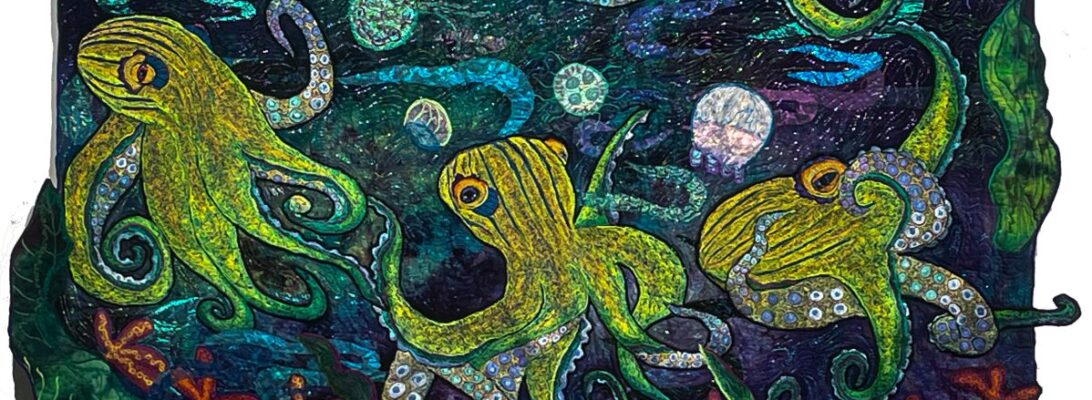
I’ve been working on the next octopus, which is striped in black and white. I could have done that. But it’s dull past hope. Shading black and white is a great exercise, but I didn’t want it for this piece.

Here’s where I got myself into trouble. Those somewhat pink tentacles are a bit disconnected from the sand-and-gravel colors of the octopus’s outside. Pretty but wrong.
The background surprised me too. I had been looking at some murky colors. But when I put up this piece, it was it. I didn’t even pin up something else. But it was loud.

I quieted it with some soft elemental seashells in neutrals. Pretty, but not enough.

I dulled down the yellow fish. I stitched several colors of purple over them to give them some depth and to dull them. Again, not enough.
I made some fish to match the under tentacles.

Of course, I missed the idea of changing the octopus. I gilded the octopus. This odd green-gold thread has become a favorite shader lately. It shifts the tone of the piece. Big change.
Anytime you go off your map with a piece, you’re in for an adventure.
I have high hopes for this piece, but it’s taken a bit of maneuvering to get there. We’ll see how the pieces go together.


