I have a commission that I want to share with you.
I don’t do these often because commissions are hard. Commissions demand a lot of communication that sometimes doesn’t work as well as it should. It’s hard to talk about something that is strictly visual.
But this is for a friend. And it’s a small piece. We’ve talked through what she wants. It’s a 7×10-inch ruby-throated hummingbird with a flower. I’m pretty confident it will be what this lady desires.
Because it’s a small piece, I’ve decided to do a series of articles and videos about making it. It covers different skills and processes. For you, it’s a look behind the scene to see how quilts are made. For my owner, she has full documentation. You can all watch step by step how this quilt is created.
She wanted a red-throated hummingbird.
It all starts with a drawing. I draw out sometimes just my subject. Because this is a commission I drew out a number of birds so my owner could choose. These drawings are on Totally Stable, which is an iron on, removable stabilizer that has a good drawing surface. I use it for all my patterns.
This is the bird she chose. I need that bird flying left to right. But because the pattern goes into the back side, the face side will be left to right.
I also need to zone my pattern. She has a green body, grayish wings, and a red throat. Zoning reminds me what threads to use in the top of my machine. Each zone will have several colors within that range that go on the bobbin side. Since we’re upside down, that’s where they’ll show.
What’s next? Stitching in. And figuring out how to make the video program work better. Next week
Want to see this completed? You’ll find the whole project on my Patreon Page.
One of the hardest things in embroidery work is to get over the match instinct. After years of perfectly matching thread to my project, I’ve had to learn to pick out the highest contrast threads to make an image that really shows up.
In embroidery, contrast is everything. If it all mushes together color-wise, then you have a very mushy image indeed. Smooth color exchanges that are analogous and sit next to each other on the color wheel are pretty. But they don’t have much punch. So what you want is color that builds not on similarities but on differences. There are several kinds of contrast: color, tone, clarity, and temperature.
Today we’re talking about color, which is simply the hue and temperature. Is it red, blue, or yellow? Or an odd shade of green? It’s not as simple as it looks. There are a million reds, blues, and yellows. They are not the same.
Thermal shock is about the temperature of a color. Every color, no matter whether it is a cool or warm color, leans either towards having a cool or warm cast. It doesn’t matter if it’s a cool color or a warm color. There are cool yellows, there are hot blues. If all the colors are either cool or warm they’ll flow into each other like analogous colors. But if they’re not? You get thermal shock. It’s like standing in a cold-water sprinkler on a steaming, hot day. The effect is kind of visually electric.
Blue and Yellow Don’t Make Green is an excellent book explaining thermal variations and how that creates differing colors. It’s set for watercolor, but it applies to all color theory. It’s a worthy book.
So along with the different hues, there are shade and sun versions of primaries. I’ve been playing with them on this phoenix.
I wanted this bird to jump off the surface. I’d decided to outline with in a yellow that leans into the sun to give it some definition. But I wanted it showy. So the colors I picked, cool orange, cool and warm yellows, cool and warm blues left it shimmery and gave it impact.
So here’s another contrast. All that bright sky and bird against misty grey clouds.
For a final contrast, I put small trees up and down the river, to have that clear cool green against all the soft clouds and the fiery bird.
Always look for contrasts. Blending is beautiful, but to give a piece impact with something as small as a line of stitchery, you need heavy contrast, either in hue, value, or temperature. It creates a pathway through your quilt. But it also makes your stitching shine.
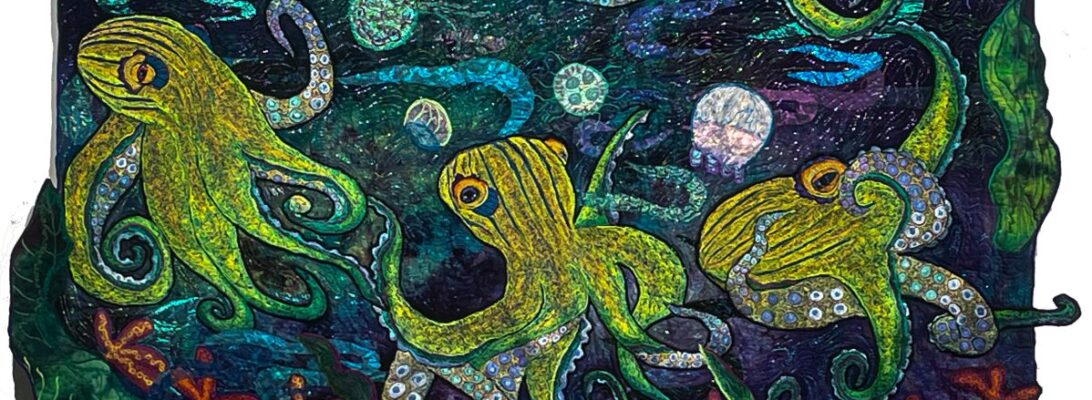
In working on the Octopus Roclets. I’ve felt a need for angles. They just do’t stay still. And the easiest way to make something feel like it’s in movement is for it to be at an angle.
Which angle? They do read differently. I want to try an isosceles triangle, made from an elongated rectangular strip. I think it will add to the movement of the piece.
Angles mean bias. We talk about fabric being on the straight of grain. If you tore a strip off the fabric, that strip is the straight of grain. That’s a fairly stable piece of fabric. It will stretch very mildly across the width and not at all in the length.
Here’s the definitions of bias from ai on Google.
Fabric bias is any diagonal direction across a woven fabric, while the “true bias” sits at a precise 45-degree angle to the lengthwise and crosswise threads. Cutting or binding on the bias gives the fabric natural elasticity and a fluid, body-hugging drape. [1, 2, 3]
Understanding Bias
True Bias: The diagonal 45° cut between the two; this is where the fabric is most stretchy and flexible. [1, 2, 3, 4]
Lengthwise Grain: Runs parallel to the finished edge (selvage) and has almost no stretch.
Crosswise Grain: Runs perpendicular to the selvage and has slight give.
If we cut our borders across at an angle, that edge will stretch because it’s bias. We really don’t want that. Bias stretches out and makes for wavey borders and seams.
Controlling Bias
Accurate cutting will help. I need to square up my center and use my rotary cutter to make clean edges. But the secret weapon is starch.
Starching your fabric makes it stitch better. And it makes it stretch less.
Here’s the mock up I did to try this out.
Making angled borders
I used:
A center rectangle or square. A strip of fabric twice the size of your border and a bit longer than your center piece
Liquid spray starch,I’m using Linet Starch.
Tools: Rotary cutter, ruler and mat Sewing machine with straight stitch and quarter-inch foot Iron or rolling seam presser
I starched the two fabrics with a solution of 1-1 starch and water
I cut the yellow strip in half and then cut the strips fro corner to corner diagnally.
This has been a rough week of a lot of medical appointments. Nothing bad. Just exhausting and demoralizing.
I’ve stitched the rocket octopuses. I started with a background that reminded me of confetti yarn, bright bits of color on a soft background. So my octs had to be bright where the background was softer. I’m thinking of calling them the Octettes.
But now we’re at the fun point. We get to create the design.
This is the first pin-up. I do several pin-ups with each piece. The first pin-up is just the background and the creatures. With that pin-up, I’ll know my colors, my path and where the creatures interact with each other and the viewer.
The second pin-up is after I add the elemental bits. Usually these are sheer unless they’re rocks. Water, rock, air currents, sunlight. It’s also where I add small elements that help establish my visual path. I’m thinking gold and orange fish.
The third pin-up is my final design. After I do the third pin-up, I’m ready to stitch. And my options are in stone.
So now I can try it all out. Different backgrounds, different octs.
If it’s just one or two possibilities, I pin it up and shoot photos. Here I had a bunch of choices so I photoed the elements and put them into photoshop. It’s a cheap thrill, but it’s much less aerobic.
Here are the ones I like best. I really like the ones swimming in opposite directions. The ones weaving tentacles work best on the larger pieces of fabric. I’m still not sure.
I’ve done this before in a blog called Pin Up Girls: Family Planning for Octopuses. There I was trying out a number of different quilts. This is just one. But it is a good way of looking at options, without having to pin everything up physically.
I’m always astonished at how much an image can change with positioning. One of the advantages of component quilting is that it can be moved endlessly to get the placement right. I went to embroidering large images some while back. But I’ve learned several other things component quilting allows me to do, and I use it constantly now.
Changing Processes
Three changes in my process made this work: component quilting, pin-ups, and daily process photos. I work with components rather than images stitched into the work. I do multiple pin-ups for placement, and daily process photos that let me track the changes.
These are all relatively new for me. But it wasn’t something I planned. I just happened to find these processes helpful, and now do them regularly just in my studio work.
Component Batch Quilting
Batching a number of elements at once allows freedom later on in the project. Instead of just doing the larger images, almost all of the embroidery is on a separate sandwich, ready to cut out and use.
I’m free to change my mind about each element. If I embroider a moth in the piece, that’s where it stays. Right or wrong, it’s not going anywhere. You live with your choice. If the moth is separate, I can move it indefinitely.
I can make images from the same color choices that are in the same range but unique.
I can always use whatever is left over. There are never enough fish, frogs, bugs or birds.
The first pin-up is where I design my quilt. Once I put the quilt top on a sandwich, I put my main images in, see where they might fit, to rearrange things.
But the first pin-up is only a beginning. In this case, I did my pin up, added my elementals, and pinned it back up with those included. My original intent was to have the octopus learing over the top kind of like Cthulu. But it was flat.
So I gave it a twist. To make something move, put it on the angle. I angled the octopus, to put him into motion. Then I angled the other elements to echo that motion.
Picture This. by Molly Bang, is the best book about composition. It’s about how people process imagery. First, she illustrates Red Riding Hood with rectangles and triangles. And she made it work.
But she explains how we see things, what meaning we take from images.
If you are an artist, run out and buy this book. Then buy another 5 copies, because you’ll want to give it to every artist you know.
She has some very useful observations. Horizontal lines are stable. Vertical lines are stable. Angled lines look like they’re falling. If they’re falling, they’re in motion.
I angled the octopus to echo the left jellyfish.
Then I angled the nurse sharks to echo the octopus.
Daily photography
Having daily process shots gives me so much information about what is and isn’t working in a piece.
Including a black and white picture to evaluate values.
I’m always surprised at how much a little twist can do.
Outline, dark base, shader, and the beginning of the blue range
The nice thing about color theory is that it works across all kinds of media. What changes isn’t the color theory, but the way the media is applied.
Color theory for thread is different only in the fact that you really don’t mix colors. Instead, you lie them next to each other, and your eye mixes them.
These nurse sharks are part of my octopus garden. I don’t have their octopus stitched yet, but they were compelling. I love the spiky shapes. They will have orange-yellow stripes. I’m not quite there yet. Right now, I want them round and shaded, with a clear indication of which side is up. I need smooth color for that.
Smooth color creates a color range.
The formula for it is
A dark base color
A dark complementary color as a shader
A range of colors in the base family
A bright color as a shocker
A lighter or brighter shade of the base color to finish.
If the subject is too large, I can zone the areas of the image and repeat the formula in a set of lighter or darker shades.
I usually work light to dark. The last color will be the most prevalent, so keep that in mind. Sometimes with fish or frog bellies, I color the dark to middle section, add the lightest color on the other edge, and work in my darker colors, so the tummies aren’t so blatant.
Green as a shocker
I chose green as my shocker color. Usually, I would have used either the blue or purple complement, but orange is so strident. I will use yellow for the stripes, but I think I’ll brown them out so they don’t scream at me.
It takes a fair amount of courage to add the shocker. The shader layer makes visual sense. The shocker layer screams at you. There’s a terrible urge to rip it out immediately. But it quiets down once you put the next layer of the base color. And the color is smooth without being bland. The shocker is an electric spark in a range of smooth, quiet color.
It’s time consuming, but I love the base colors. Between the shocker and the shader, the color has a splash of excitement, but creates a flow color base.
What will they look like with yellow-orange stripes? I expect they’ll be quite jazzed up. I’ll show you next week.
Last week has been spent in fish production. I can’t really put in the octopuses until I have the fish to create the path around them.
Usually, fish have scales, and the scales divide the space..You progress from scale to scale, picking lighter colors as you get to the underbelly. You fill in the scales darker on top and progressing through lighter colors around the belly. It’s pretty. It gives depth.
What if you don’t divide the space? You can stitch row after row of color next to each other. It looks stripy. There’s a place for that, but it’s not very natural.
It doesn’t work for clown fish.They blend from one color through another without separation.
So how do you fill in a larger space? One way is the short and long stitch.
You need to understand that none of this is a stitch on your machine. It’s all zigzag stitching. The change is the angle in which your fabric goes through the machine.
The long and short stitch is done from side to side. The difference that it spreads from both sides and fills in unevenly, shading the area softly and without stripes. The top and bottom of the image has a solid line to outline.
That kind of shading allows us to put in darker contrast colors to shade that blend right in. These fish are shaded with a dark and then a lighter purple. Since the colors are mostly covered with orange thread, your eye blends them into a shaded solid orange.
All of this is for the octopus’s garden. This is my second pin-up. I think it needs one pillar rock and some water, but it’s ready to back, and stitch.
I’ve whined a bit about larger work this month, mostly because I had 6 full sized pieces to finish. Not fun. But all but one is done.
So in response to that, and in giving myself a break, I decided to do something smaller. These Japanese cranes have been on my mind for a wile. Originally they were on a textile.
People talk about making a smaller version of something and then blowing it up. I’ve never found that works. The size changes what you can do with your stitchery.
When I work large, my thread color choices have to fill in a space. It’s a larger space. I do have a formula for that. And a basic color strategy.
I work dark to light.
The color of my background is the light within the piece. So that color has to be part of the choices.
Everything is accentuated. I choose my colors to be more intense than the overall effect I want
Your eye will mix the colors. Even if they don’t seem to go together. Don’t be afraid.
I choose
A dark tone of my desired color.
A shader, usually either purple, brown, dark green or blue.Often I’ll use a complement from my desired color
Several shades of th chosen color.. They can differ in tone and clarity, but they need to be lined up dark to light.
A shocker. Usually the complement in a bright form
A light color that is the color of the piece.
The lightest color. Usually lighter than you want the piece to be as a highlight.
That fills in a lot of space.. It needs to. It allows for some intense coloration.
Smaller work is smaller space. No help for it. The stitching isn’t as intense and you end up with a much small space to fill in. So your choices pull in.
For your thread choices you’ll want.
The darkest tone of your color
A toner, complement, brown, blue, or purple
A mid color
Maybe a shocker
A light color
May be a highlight color
It’s the same theory, but it’s stepped down for smaller spaces. I don’t like to work that way because it makes wild choices feel more intense. It abstracts very quickly
So I worked on these cranes this week. They’re white, but I worked up to that with a lot of soft toned pastels and greys. I was completely worn out on them until I slipped in a bit of turquoise.
I’m not wildly unhappy with this, but I feel limited by it
.The joke is that the ended up fitting into a yard of hand dye, the size I most often use for large quilts.
I don’t often do this, but I have a pervasive urge to redraw the image bigger, and go wild with the colors, just to see what I get.
It’s always good to change things in your work. Any change is a challenge. Chainge the size, change your pallet, change your subject, and certainly at the right moment, change your undies. Change is good.
My work contains a lot of different processes. It can seem a bit overwhelming when you’re looking at the inished piece. But there is a flow to it.How do I start? What makes sense out of what comes first? And next. And why?
I’m using the cat head fountain as my example here because it’s what I’m currently working on. This is a repeat of a quilt that never worked out.( see Try, Try, Again). Every piece has its own challenges and processes, some of which are unique to that piece. This one isn’t reallly typical. I’ve been trying to fix my problem with man made structures for some while. The fountain itself was a separate process I’ll skip over for right now.
I’d like to say none of this is written in stone. This is generally how I approach a piece of art.
Which comes first, the background or the subject?
It can go either way. It’s a chicken and egg problem. I need both. It doesn’t matter which comes first.
Background
The background answers many question. Sometimes there’s a piece of hand dye has really strong opinions and tells you exactly what to put on your quilt. It’s worth listening. So I put the background up on the wall and let it tell me the story. Is it a swamp? A meadow? A river? The background often tells me exactly where I am. What time it is? This background was a piece of oil paint stick rubbing on gray hand dyed that made perfect old stone.
Sometimes there’s a piece that’s perfect but it’s just too small. I may strip piece it to stretch it. I did piece a border to this, to get it to the right side.
Subject
The background does all of that xcept when it doesn’t. Then I go looking for images. I do use books for reference. I’m a poor enough artist that once I’ve drawn it, it’s pretty much unrecognizable. But I do like to get the numbers correct on how many toes my creature should have.
I draw on Totally Stable, an inron on, removable stabilizer. The stabilizer stays witin the piece. It’s drawn backwards because I’m stitching from the back.
Either road, I never prep the back until I’ve embroidered the subject. The embroideries shrink. And not in an even way. The shrinkage comes from the width of the zigzag stitch you’re using. Usually it’s around 11 percent, it’s not consistant, or predicable.
Stabilize the Background
Once the subject is embroidered, I stablize the back with felt and Decor Bond.
Elementals
Elementals are things that are see through fire, water, air,clouds, flower petals. If it’s a flat applique, I back it wit Steam a Seam 2, iron it down, and stitch it in a loose zigzag with monofilament clear thread.
First Pin Up
Once I have the elements in place, I pin up my subject into the background and assess what I need to make a pathway
Components
These can be any smaller images that direct the eye through the piece: bugs, fish, birds, or stones. In this case it’s leaves, roses and small yellow birds
Second Pin Up
I add in the components to create a visual path. This it that last moment to adjust for everything The smallest angle of a leaf or bird can change it dramatically.(see Turn of the Head) After it’s stitched down, I’m committed. This is where I currently am with this quilt. The next part is to leave it on the wall for several days to be sure everything is where it should be.
Stitch Down
At this point I stitch the elements into the background
Stipple
Most pieces do not lie flat unless they’re stitched all over. Some kind of stipple will accomplish that.
Back, Quilt, and Bind
Finally I back the piece, quilt it, and cord bind it. Check out Way over the Edge for instructions on cord binding.
This is not always the path. But these are all things that need to be accomplished.
I regularly walk you through my projects step by step. But I don’t often show it in a more macro form. For more information on work flow check Deciding Rather than Designing.