
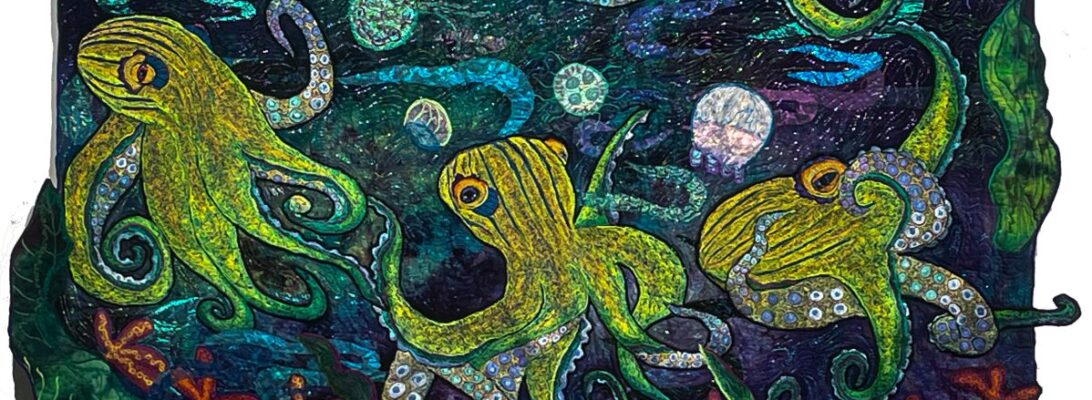

For some while, I’ve bound my quilts with a buttonhole binding. It’s a buttonhole with a cord inside. At first, I wanted to accommodate a leaf or a frog leg coming out of the piece. Then I wanted to bust out in all kinds of places.

I wrote this 4 years ago. It’s pretty good instruction but it leaves out something I thought was obvious at the time.
I started out as a traditional quilter. And for years I bound all my quilts with bias tape. But as my work became more organic, it felt terribly strange to put my work in a square box.

“The corded buttonhole is a standard technique from couture sewing. Translated from there to the quilt world, it gives us a way to finish both quilts and art clothing in a new way that’s literally out of the box. Instead of the square edges and gentle curves that are the limit of bias binding, we have the freedom to follow any shape. That means that the edge of our pieces is not defined by straight lines, but by their internal design. It also means a quilt can have an external shape that fills a wall in a much more exciting way. And because our binding is thread, we have the full range of polyester thread colors for our palette.
I prefer to do this on my Bernina because of the specific feet and the stitch quality. You can use a regular utility foot and a couching foot off another kind of machine.
We’ll be using two basic feet for our binding.
What largely counts is the thread escape on the bottom of the foot.


The #1 foot has a top groove we can use to couch down the cord. The #3 foot has a thread escape groove on the bottom for the zigzag stitching to pass through. The #3 foot is the older style buttonhole foot (without the electronic eye) that has exactly the right thread escape to accommodate the buttonhole binding
- You’ll need
- #3 Crochet cotton
- A quilt/ or quilted object backed, quilted, and ready to bind
- Polyester #30-40 weight embroidery thread the color of your choice
- A#3 foot and a #1 foot
- A Bernina
- A rotary cutter and mat
Binding
We’ll bind our piece with a corded binding that’s a corded buttonhole all around the edge.
Preparing your quilt:
Stitch around the edge either with monofilament nylon or with a neutral embroidery thread so that all the layers are together
Using your rotary cutter, cleanly cut away all the extra bat and backing fabric, exactly the shape you want your quilt to be.
You don’t have to have a square. It can be any shape at all. To keep sharp 45 degree corners or points, you need to clip the tips off them.
Thread your machine top and bottom with a polyester embroidery thread that you want for the color of your binding. You can use rayon or metallic thread, but the breakage makes things so much more difficult.
Attaching the cord:

Set your machine on a zigzag stitch, with the needle placed one position over from full left. Your stitch length should be at between the button hole setting at a # 4 width.
Position your quilt so the stitch falls just over the right hand edge of your quilt.
Start your stitching somewhere in the lower edge, not on a corner or direct curve.
Zigzag your cording all around the edge.
When you come to the end, drop your feed dogs and make several stitches to anchor the cord.
Clip your threads and cord.
Tip: If you have a quilt that ruffles at the edge, you can pull the cord and gather in the ruffle. This will not solve severe distortion problems, but it will fix minor ones. You should pull the cord before you change directions or turn a corner.

Covering the cord:
Your second pass should cover your cord with smooth zigzag stitching.
You’ll find certain areas may not have been included in the stitching. This will give you a chance to address that.
Set your sewing machine for the widest stitch it will give, and the densest stitch length it can handle. Put your needle position to the far right.
Use your #3 foot, with the double channel thread escape.
Position your quilt so that the stitch to the right ends over the edge of your quilt
Start at a lower edge, not on a corner or a curve.
Stitch around the edge of your quilt.
When you come to the beginning, move your needle position to the far left, set onto a straight stitch and stitch in place to anchor the stitching.
Sometimes I get enough coverage on the second pass, but that’s rare. Usually it takes a third time around. Turn the piece over. If you still have wisps sticking up through the binding, trim them as best you can, and go around another time.
Corners, curves and points:
These all take a bit of finesse. Your standard button hole stitch isn’t set up to cover them. But you can get good coverage on them by rocking your stitch over them. As you’re stitching, you can pull back just a bit from the front to make sure your stitch line covers everything. Curves may also need that assist. For corners and particularly for points stitch up to them and turn the piece at slightly different angles as you go round the edge. You can put the needle down within the point and pivot and stitch several times until you have coverage.
Tips:
A clean cut edge to your piece is always easier to cover with stitching. Use your rotary cutter and make a nice solid cut line.
Use a new topstitching #90 needle for the best stitch and for less thread breakage.
Sewers Aid applied to the thread also helps with thread breakage.
Organic quilts don’t have to be stuck in a box. A corded buttonhole binding lets your quilt go over the edge.”
This was my original article, four years ago. Here’s the secret ingredient I didn’t think to factor in. Almost all of the shapes going off the edge. What I forgot to say, is that almost all of the items going over the edge have been embroidered to a fare-the-well. That means they have 2 other layers of stitch and tear and felt. They can literally stand up of their own accord.

It does make a difference. And I hate to be someone who will give you a recipe with something essential left out.

I am excited to make quilts that are exactly the shape they should be. None of that square for the sake of square stuff.
Buttonhole finished edge is excellent.
Thank you for this – I kinda did something like this this week for my Art Group. One of the quilters gave me a piece of fabric with a oval raw edge stitched. I combined this challenge with the one due for all of us to use all the colors of the rainbow. I made tiny prairie points and positioned them around her raw edge applique on the square of fabric. Then to cover the raw edges of the prairie points I satin stitched around the oval in black – using a wider stitch each time. I think I went aound 4 times. It looks fair but I can see your point. I will try to make something with part going off the edge and see what happens. Thanks for giving me the opportunity to PLAY.
Mary Carter
This was so fun and instructive for me to read, and to look at. I want to share the basics with my friend Ron, who is an 80 year old artist, sign painter, and retired art teacher. He’s a vital member of our local art gallery, of which I’m on the board, town of 500!!! 13 years of our art organization (all and any art, including sponsoring a couple of concerts every year.) Three months ago, our monthly show was quilts, mostly non traditional. Ron made a comment that the quilts, and of course, much of the other art displayed, were kind of in a box or frame, always confined. That comment stuck with me, and I pondered what I might want to do differently. My own work is mostly my photos onto fabric, “dimentionally stitched” which is my own way of trying to make a photo look more 3D, but somewhat different technique than I’ve seen in quilt books.
Now I see you describing a way to make the subject of the art piece be its own border. Yes yes yes. Of course, I’ve seen panel printed fabric where the subject doesn’t stay within the lines, but you take this to the much further next several levels.
I think I will be dreaming on this for something I do in the future. I’m certainly not in a place, so to speak, right now where I can handle going out on a limb, (two recent spine surgeries) but certainly I can dream and see about some visions. LoieJ, Minnesota