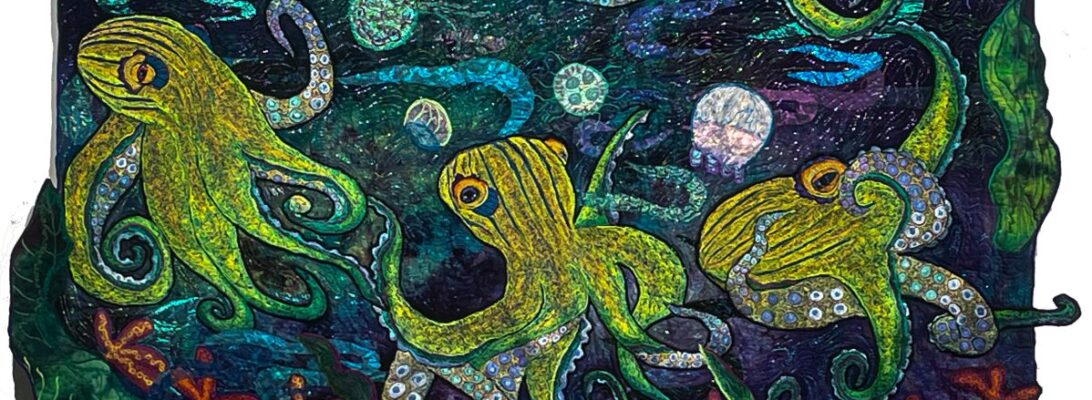
FENCED IN: Making Fences

Most artists have something they do specially. The secret to that is that special focus usually camouflages that which they are not good at. I’m no different. I can’t sew a straight line to save myself. So I don’t. I do nature images where straight lines aren’t a problem. I don’t do well on straight line piecing either.

Except that that is a limit. And I hate limits. So every so often I push past that and try no matter how bad I am at it.

I’ve been working on a garden series called bird feeders. The premise is that every good garden feeds and cares for everything that lives within that garden. And some things just don’t grow without support. Which means a fence. Of course I’m not talking about clean new straight fences. What fun is that?

I’m not good at fences. You should be able to piece a good fence. But I’m really not good at piecing. These are three things I’ve tried instead of that.

Years ago, I did a child’s book called Tigrey Leads the Parade. It was about my dog who ran away daily as an art form. Since it involved escaping from the yard, it involved a lot of fences. This is a fence, embroidered with #5 pearl cotton on a tea towel.

Tigrey Leads the Parade

I love these stitched fences. But they were tiny. When I wanted something bigger, I tried something with an oil paint stick rubbing. I found a border edging at Menards and rubbed the fence texture on to my background fabric.

Bird Feeder: Sunflower

I consider this a mixed success. I like the fact that the fence looks crooked and old. But the distortion, even with straight stitching and stabilizer was pretty ferocious. Were I to do it again, I’d use another layer of Stitch and Tear.

So when I went to do the next piece I had some left over gray pieces I’d used as sidewalk. I used them to make the fence. The wood grain stipple helps it, I think,

They didn’t quite work as realistically, but I think they made a good fence. And good fences, as Mr. Frost knows makes good neighbors. And better quilts.

Do I have it down yet? I don’t think so, but I think I’m closer. If we don’t push past our limits, the limits are real. No one wants that, right?

Fade to Black: Shading black objects for dimension

Envy

Black and white have the same problems. They’re absolute colors that are really harsh statements in their full form. I almost never do a completely black or white object because they are so overwhelmingly strong and so flat. They overwhelm instead of fitting in.

I’ve worked on creating a white dimensional bird out of different pastels and greys. You can see the result on this post, Into White.

But would the same approach work with black? Instead of using tinted pale colors to create depth, use toned darker colors to create shades of black and greys? That’s what I’m going to try. I’ll take step by step photos so you can see if it works.

Indigo Blues

Have I ever done this one this before? Sort of. I’ve done black before, but when it comes to the contrast shades I’ve turned to purple and blues all of which because they were in my stash were a bit bright. The effect was essentially a purple and blue bird. It’s a fun art statement, but it wasn’t what I was aiming for. I really did want black.

I found this great drawing of a raven I did years ago. It fits into my birdfeeder series, so we’ll see what we get.

This turned out to be hard. I ordered the darkest threads in blue, grey, brown, and purple for it. When they arrived they did look ugly.

The other hard thing was telling which were darker. The tones were very close. I used my red, and green color filters and did the best I could to arrange them dark to light.

The real question is, is this a brown/black raven or a blue/black raven? I’ve tried to mix both blues and browns for a neutral black.

It’s not uncommon for this process for the stitching to be discouraging. It doesn’t look really impressive half way through. So I’ve taken step by step photos so you can see the change.

It didn’t work the way I expected. I was quite disappointed. Then I did what I had planned in the beginning. I used black metallic as my last color. The last color is always your strongest color and the one you will see the most.

The final thing that helps this out is the background. I’m using this piece of hand dye that pulls towards the brown/grey shades even with the yellow reds in it. The color of your fabric is the light source of your piece. This background echoes the brown/blue/black quality of the bird.

Is this a final answer? It is for this piece. I want to play more with it after I’ve had a color fix working on something bright and showy. All these neutral darks are depressing, but I think I got my bird where he should be. I think he needs to be flying over conifers. Maybe I do too.

Into White: The Search for White Thread Painting

Some things are an experiment. Some things are a quest. Some things are like the holy grail and you keep searching for them interminably.

White is one of those things. When you’re working with thread painting, the easy answer is many shades of grey and then white, or many shades of beige and then white. Both are incredibly boring.

Why couldn’t you just make it white? I hear you say. You could. If you want it to shine out stronger than any other element in the quilt and you don’t care about dimension, you could. Pure white can be like an out of place spotlight in a quilt.

So the quest is, what mix of colors, greys and beiges will make a white that will have good depth, cast and drama. And look like it’s white.

In that quest, I’ve done a step by step photo study on this bird, in hopes to study it.

I’ve talked about zoning and shading before so I won’t flog that in this blog. “Rethinking White” is a post about shading white applique flowers. It’s a bit different than totally building color in thread. Because it’s built on sheers instead of strictly thread. But you may find that a useful difference.

Dimension is made by arranging colors from either dark to light or light to dark. It builds the illusion of shape. The progression of colors creates shade and shadow.

Here is my thread range I chose. It’s a mix of blues, purples, greens greys and beige, laid out dark to light.

I’ve put together some process shots to help explain.

Head Shots

Dimension comes from having a dark, medium and light area in each color zone in your piece. If you can establish dark, medium and light, you can make depth, something that isn’t by nature flat. Then for interest’s sake I added a shocker and a shader color to spark it. Of course the beak and the eye bring it to life.

Changing Cast

The two things you are building are cast and dimension. Cast is the color under the color. Most colors either lead towards the sun or the shade. You get the clearest colors by using only sun or shade colors in an embroidery.

But sometimes clear color isn’t the goal. If you want to come to a neutral shade, you mix both. And try not to go too far from the center. It makes a fabulous blended shade, but it’s hard to accomplish.

The cast on the under feathers was more yellow than the rest of the bird. An over stitched layer of a bluer grey pulls the color closer to center.

White doesn’t have to be boring. Or grey, or beige. With a little thinking and a close eye we can create a blended white with dimension.

Drawing on Distortion: Give it a Kiss, Because It’s Going to Pucker Up

One of the issues with free motion embroidery is that it always puckers up. You always have some distortion. The worst is that the distortion is uneven and unpredictable. Sometimes it pulls the piece out of shape or makes it unrecognizable. Free motion objects take a lot of time. It’s heart breaking to have them distort past usability. It’s best to adjust for that from the start.

There’s some time honored ways to deal with distortion. First make the embroidery off the surface of the quilt. It can be applied afterwards with minimal distortion. I will be talking about separate embroideries in this article, although the information works for both off and on the quilt surface.

Stabilizers help a lot. Small embroideries under 2″ use three stabilizers all together. The drawing itself is on Totally Stable. It’s a lightweight stabilizer that irons on and is removeable. Stitch and Tear is the next layer. It’s a stiff tear away Pellon. Then I use a layer of acrylic felt that absorbs much of the stitching. I prefer the thinner versions. I attach the stitch and tear and felt with 505 spray. For anything larger, I use a layer of hand dyed fabric as the top layer.

Do remember that the drawing on the back will face the opposite side on the front. I know, I know. Think of it as looking through a slide backwards.

Now it gets confusing. My drawing layer is on the back. I’m going to turn it upside down to stitch. I’m not going to call them top and bottom. The sandwich has a front and the back. For stitching purposes the front is on the bottom and the back is on top. Got it?

I am using two hoops. Sharon Schamber’s red weighted halo hoop is my very favorite. It has a weighted core and a rubber coating. It grips and the weight supplies support.

Now it’s all up to the drawing. We can’t accurately predict the distortion but we can take some good guesses. To do that we need to look at the zigzag stitch

The zigzag stitch pulls across the stitch. The more layers of stitching, the more distortion. For a larger piece, you need to draw to adjust for that distortion. Mostly that means that things need to be a lot wider and bit longer. But you need to analyze the drawing to see where the distortion is likely to be bad.

So if you’re doing a straight zigzag stitch down the legs, it will shrink in the width. You’ll want to make it a bit wider there so it doesn’t become pencil thin.

Bird feathers end with a band of stitching around the end of the feather. Again, making the feathers longer and a bit too wide gives your a bit of extra space there will help eliminate the shrinkage effect.

I’ve elongated the wings and body on the kingfisher. I wasn’t able to get it completely embroidered to show you, but you can see the shrinking on the feather and the wings

It’s not a science. But you can hedge your bets for your best look. Keep watching my face book page to see how this bird looks finished.

What happens if you guess wrong? Several things. Sometimes that wrong guess works better than a correct guess. Sometimes I cut into an embroidery and anchor it with stitching to address the error. One thing is certain. Perfect happens somewhere else. I’m content with beautiful.

I’ll Be Feathered: Creating Feathers in Thread

Green heron

Feathers are perfect subjects for thread. Birds too, but there are many kinds of feathers, defined as always by the angle of the zigzag stitch.

I’ve been working on two birds this couple of weeks: a green heron and a goldfinch.

Goldfinch

It starts with a drawing. This is a drawing on Totally Stable. It goes on the back of the sandwich so it’s my pattern.

The head and underbody of the bid are soft overall feathers. These can be made with a back and forth zigzag stitch done side to side. Layer after layer of thread blends the colors.

Underbelly and leg
Head
top section of wings

The upper part of the wing follows the arc of the feather, shaded with the side to side zigzag The feathers are lined with gold and soft yellow to define them.

Pinions

The pinion feather stitching is made with angled stitches down the feather with a curved arc at the end.

The streak

These feathers have a streak of yellow defining the quill.

Quills do

All in all the stitching separates the kinds of feathers. And creates a bird made strictly of thread and stitchery.

Nothing Exceeds Like Excess

Nothing Exceeds Like Excess

962-21 Queen Bee

I’m not the sort of person who does things half way. I’m just not built that way. So when I did a little experiment with some oil stick rubbed fabric, it sort of got out of hand. I had a handful of some smallish scraps and tried some straight stitching with 40 weight metallic in a manner I hadn’t used for a while. I spent about a week on it and found myself with a good dozen little quilts.

They were also experimental in the sense that they’re smaller than I usually work. Tiny. We’ve talked about working in different sizes. Size is actually about your art filling the space where it lives. Intricate small art fills small places. Large art tends to lose the intimacy of tiny work.

Small work fills in differently. Attaches to the eye differently. But there is another nice thing about small work. It can sell for a lot less money.

Which is a good idea right now. Remember that thing about me not being able to do things half way? Two weeks ago, I found an old Elna Supermatic green sewing machine.

Actually I found 2. One perhaps for parts. I’m a Bernina girl from way back. I love the stitches on the Bernina. But the old Elna has a different bobbin mechanism that’s set up to adjust for thick thread.

Remember that large pile of #10 pearl cotton I dyed up? That kind of thick thread. Don needs to do some repair on them, but I can’t wait.

Which is how I find myself needing to catch up after having bought two older sewing machines out of budget. So the new quilts are going on sale, to help me catch up.

I’ll have all my work at my Etsy Shop on sale for 20 percent off for a month. If you’ve wanted a quilt, this might be your moment. And there’s new experimental stuff I think you’ll enjoy seeing. Do let me know what you think. It’s not like I can really do anything by half.

New Threads:

There’s nothing like new threads. You know I love thread. It’s the most important component in my art. I love my fabric but I am nuts over thread.

One of the things that is different for me now that I am no longer on the circuit, is that I don’t have to make threads that are commercially saleable. I’m not constrained by that so I can explore threads that can’t be reproduced in regular quantities for students. I’ve used # 8 pearl cotton because it came in dye hanks. I could easily dye it for myself but also for also for students who were in my class and needed access to the threads I worked with.

#10 pearl cotton

Now that I just in my studio working my own art, I have the freedom to work with things that can’t easily be put up for sale. This last dye load, I dyed up a load of thread that I’m so excited by. I’m looking forward to trying out my #10 pearl cotton.

You can’t dye thread wound in a ball. You can hank it off with a swift, but there’s no way to make even skeins without counting accurately. Those of you who know me know how likely that is.

8 and 10 pearl cotton

The smaller ball is #8 pearl. The larger on is #10 pearl. The larger the number the smaller the thread. The #10 still needs to be worked in the bobbin case, but it will give a finer grain stitching. I’ve started the first row on this frog in the #10 so you can see how it stitches up. I am so excited!

frog in #10 pearl cotton

Sometimes a change in materials changes our work immensely. Sometimes it makes a little change. Sometimes it changes nothing. There’s no way to know until you work with things. But the possibilities make me giddy.

Skimming the Surface: Bobbin Work as Stippling: Part 4

Up until now in this series, we’ve worked on images both in thick and thin threads, in zigzag and straight stitching. There’s one other place I use bobbin work. I use it for stippling.

Why? More of those wonderful, beautiful, difficult threads.

It’s no secret I’m a magpie. I love things that are shiny. And I always want to pull the eye across the quilt.

I often use Sliver, which I’ve shown you before, as a stippling thread. It’s fragile. It can be used with Sewer’s Aid and a #90 topstitching needle but it’s always easier to put it in the bobbin and match it with a polyester or rayon 40 weight. I’ll start with the lightest color around my light source, and shade outward one color after another. It helps define the light source, carry your eye across the piece and make it all shine.

I love sliver as a sky stipple or as water. So many colors! And so many ways to shift the color across the surface of the quilt.

But sometimes I like to do something different with water though. I love sliver, but it doesn’t show up as well over organza or lace. So I like to use the #8 weight metallics, again in the bobbin. They make wonderful waves and rivulets. This is a thread you can use only in the bobbin. It defines the movement of water beautifully.

Everyone always worries about not being able to see from the back, but it ‘s not that hard. Here’s an unfinished piece almost ready for stippling. You can see the sun, the dragonfly and the rocks all on the back side, All you have to do is stipple.around them.

I hope this series leaves you excited and able to try all kinds of threads you thought were too hard or too difficult to work with in the bobbin. It’s a brand new world of possibilities, and beautiful choices.

Zigging Upended: Zigzag Machine Applique: Bobbin Work 3

The last two posts we did looked at bobbin work for thick thread. This time we’ll look at a whole other reason to work from the bobbin and a whole different result.

Everyone loves metallic thread. It’s beautiful. I’ve heard it described as candy. I concur. That is until you start to stitch with it. There are a number of things that make it “easier” to work with metallic thread. But no one ever says it’s easy.

Why? If you look at the construction of metallic thread, it’s pretty obvious. Metallic thread comes in a twisted flecked thread, a metallic colored lurex wrapped around a core, and a thin strand of lurex. Either way, it’s thread made to be shredded. It’s not one solid strand of one thing. It’s a combination that uncombines with ease.

How do we get around that? Sewers Aid (silicon treatment for thread) and a number 90 topstitching needle help. But the easy answer is to put it in the bobbin and work from behind.

I know. I know. I can hear you screaming “What????” at me through the computer screen. Sensibly enough. But any time my thread goes through the top of my machine, it goes through the needle 50 times. It gets pulled up through the bobbin once. Are you wondering why your thread broke? It’s so much easier to put the breakable thread in the bobbin.

Madeira Supertwist Metallic Thread

For this, I used #40 weight metallic thread. I really like Madeira’s Supertwist for it’s color and shine and the color range. So we don’t need an adjusted bobbin case. We can use the regular bobbin case. But we still want to match the needle thread color to the metallic thread color. You will see both threads on the right surface of the quilt.

I do these most often as appliques. Why? Because they really pucker up. The distortion on zigzag stitching is ferocious. I make the same sandwich as last week, my drawing on Totally Stable, Stitch and Tear, felt, and hand dyed fabric.

I’ve talked a lot in this blog about free motion zigzag stitching. What matters is the angle that the fabric goes through the machine. Straight through gets a thick clunky line. At an angle gets you a very nice outline. Going from side to side gets you a great shading stitch. All out of the same zigzag.

I started by zoning my piece so I know the areas where the color changes.

I began with a black out line zigzag. Then I built my colors in, first with an outline, then the shading and then that clunky line to smooth it out, one shade after another, starting from dark to light. The last color I put on will be the color I see the most.

Here’s the process shots for this frog.

After I’ve stitched it completely, the stitching lay flat, but the area around it ruffled like a party dress. I cured the whole thing by simply cutting off the background.

To apply it to my quilt, I stitched it down with the same black thread outline, run through at an angle to make a great smooth edge.

What is the difference between thin thread and thick thread?

Thick Thread

Bobbin Case Only

Adjusted Bobbin Case

Always Abstracted by Stitching

Puckers Up Some

Thin Thread

Use in Needle or Bobbin Case

Regular Bobbin Case

Can Be More Detailed and Shaded

Puckers Up Mightily

The other major reason to use bobbin work with thin thread is because you can tie up the ends on the back. Every time you clip your threads from the front, there’s two thread ends poking up. For multiple layers of stitching, that can make the whole piece look fuzzy. I always prefer to work from the back and tie my ends up from behind, to keep them out of sight. This works just as well for poly/and or rayon threads as well. These moths were done upside down as well, but with poly threads only.

Don’t be afraid to work upside down! You’ll find all kinds of threads that have been fiends are now your best friends.