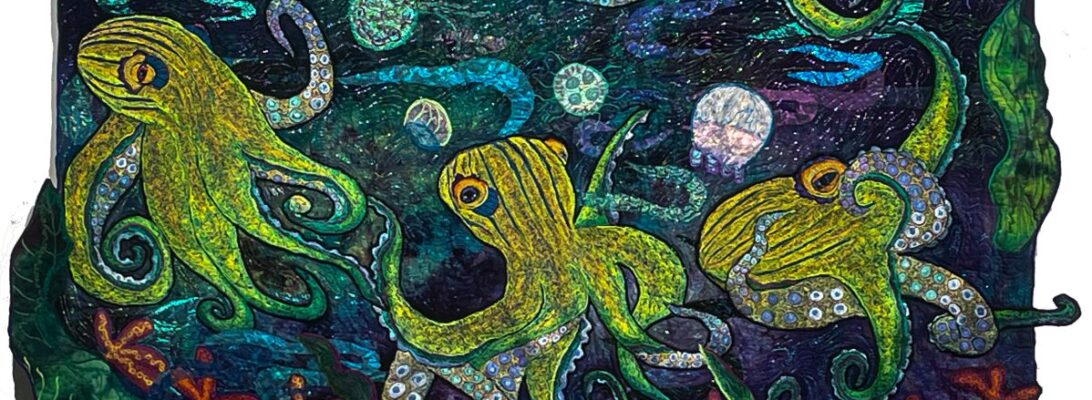
I love organza and lace for natural elements. I can make water easily with some fusible and sheers. I cut c shapes in various sizes and colors, and fit them into pond or river water.
This is a process I usually do right before I put on my embroidered components. I get everything embroidered, so I’m sure it fits in, and then add the elements (air, wind, water, clouds, smoke) to the background itself before I stitch down any of the embroideries. Only after tthe sheers are stitched on, do I stitch the components down.
There is one problem with that. It leaves my fish and reeds all out of the water. They are in front of the water, but not in it.’
What I’m looking for is the feeling of layers. I usually cut c shapes and swirls. Then I mix them together until I have water amalgamated with different temperatures and depths.
If you think about real water, it’s always in layers. You put your toes in, and maybe you feel the sun warmed top layer, Go further in, and the lower levels feel colder. How do we express that as art? I think the deeper the colors are, the colder they feel. We can make layered water, warm on the top, but colder as we go further in.
So the last thing I often do is to lay a few pieces of organza and lace over top of the fish. Not completely. but enough that they’re completely clearly in the water.
20 weight cheesecloth with organza trapped underneath
I’ve used cheesecloth for years. It’s an unexpectedly versatile sheer that dyes beautifully, takes iron heat, and fuses easily. It’s a studio staple for me. When I dye other fabric, I almost always dye a fresh batch of cheesecloth.
40 weight cheesecloth flower
But I wasn’t aware that there were different kinds. No one ever mentioned that it came in different grades. I just bought the box I found at Joann’s. If it had a grade marking, I missed it. My guess is that it would have been perhaps grade 40.
The grades have to do with the purpose of the cheesecloth. As the name suggests, it’s about how it’s used in food prep.
“Grade 10: The thinnest and most open weave, ideal for applications requiring good airflow and water drainage, such as straining some types of broth or when a very open weave is needed for crafting.
Grade 40: A versatile medium-weight cheesecloth, good for general food straining, polishing, and crafting.
Grade 50: Another versatile option, often used for food prep and crafts.
Grade 60: Suitable for straining, polishing, and cleaning, and is also used in testing for fire hazards.
Grade 90: The most durable and tightly woven, suitable for tasks requiring strength and fine filtration, like making cheese or nut milk. It’s also washable and reusable, making it a good choice for repeated use in the kitchen.
Grade 100: The highest grade, providing the tightest weave and greatest durability.
The grade number reflects the number of threads per square inch, with higher numbers indicating a denser weave according to Organic Cotton Mart. For example, Grade 10 has 20 x 12 threads per square inch, while Grade 90 has 44 x 36 threads per square inch according to Online Fabric Store. “
The box I bought before must have been a 1. It was wide open, pilled easily and very formless.
#20 Cheesecloth pine trees.
My last box was 60 You can actually iron it onto fabric without a pressing cloth.
Your best clue for unmarked cheesecloth is the usage they suggest for it. If they’re making craft ghosts out of it, you know it’s a lower grade. If they’re straning jam with it, it’s a 90-100,
60 weight cheesecloth leaves
What will I do with that information? I’m almost tempted to have several grades in the studio for different applications. Cheesecloth is my go to for leaves and flowers. Nothing is as light or as easy to iron on and the texture is fabulous. But it never occurred to me that it came in different textures. I have a fish that will need some surf to swim through. It may end up as cheesecloth to the rescue.
Arkwright Cheesecloth was the one that was most clearlly marked on Amazon, and the widest number of choices.
Along with a number of other studio failures, my wringer washer is not wringing. There are several answers for this. Most of them demand manual strength. I suspect we’ll call the mechanics at Dillan’s before that’s over. The wringer washer is really old. But then again, so am I.
But for right now, I need to dye fabric. Which means I need to soak fabric. Which means I need to wring out fabric. Which means a lot of wringing of hands.
I have in the past, asked for help. I think it’s geographically more difficult right now. If anyone would like to help me dye fabric, I will send you home with a pile of lovely hand dye as a thank you. But everyone I know to ask is too far away to ask.
Time to get creative. What else holds wet fabric and wrings it out?
Modern washing machines. It’s an idea. It is, constitutionally, wasteful. Washing soda lasts forever if it isn’t contaminated. I can hold water in the washer. I can get it to wring it out. But the soak water will only be good for one shot. It’s discarded in the rinse process.
And it’s a large shot. I looked up the capacity of washing machines. It suggests that an older top loading machine that the capacity is between 15-20 gallons for a small rinse load. I’m not sure if that includes just the rinse water or the wash water as well.
The formula for washing soda soak is 1 cup of washing soda per gallon of water. 15 cups of washing soda per load is a lot. Then again, what would it cost in chiropractic dollars? Chiropractic dollars measures how many trips to the chiropractor you’ll need after accomplishing your task the hard way. If it costs less than the chiropractor, it’s a bargain.
So I did it. I have 25 yards of fabric ready to wash out today. We’ll know if it got enough washing soda for the fabric to connect with the dye.
Short answer, it worked sort of. It’s massively wasteful of washing soda, It also leaves fabric dryer than I like. But I didn’t have to wring out anything. It still wore me down to a dirty rag at the end of the day. I also didn’t get the most intense color I rely on. I will not be doing this again.
The washer isn’t the only one who’s getting older.
I also just found out they don’t make StaFlow starch any more. Stay flow has been my secret weapon against wimpy fabric. Rather than mix it and spray it, I put it in the last rinse in the softener cup of the washer with a dolop of milsoft fabric softener.
Starch gets a bad rap. We usually wash out our fabric from the store, partially to remove the startch but mostly to get any bleeding and shrinking out of the way. And it removes other bad chemicsls, But starch give your fabric body, and the softener gives it a beautiful hand.
I sent Don into Walmart for Sta Flow. There is no more Stay Flow being made.. There are left over bottles available for $28 dollars a bottle on Amazon. I refuse to mix my own cornstarch. So we’re trying a new liquid starch called Linit Starch. I hate having to try new products. It leads to uncertain outcomes, where you once knew what the results would be. It’s another learning experience. I’ll keep you posted.
Things change, products change, methods change. We change too. Sometimes it’s even better. At least I’m telling myself that. And I have fabric again. If it takes longer, that’s just how we need to roll.
I’m about to get crafty on you. I usually don’t do a lot of Pinterest. But this is a Pinterest-inspired answer that I’ve been looking for for a while. I’ve been reworking my studio storage. Which is a nice way of saying I’ve been clearing out all the stuff cluttered in the corners.
I create heaps of scraps. Of all kinds of things. They silt up. some of those are cut shapes I use for design. I have collections of clouds, water ripples, leaves, suns, moons, and flower bits cut out of lace, cheesecloth, and sheers. If they’re in one place and I can find them, they help create the elementals in my backgrounds. If they’re not contained, they float across the studio floor under immovable objects. Sometimes never to be seen again. Sometmes found years after the project is finished.
Hence the cheese puff jars. Don has an addiction to cheese puff balls. I can’t eat them without setting off my celiac, but the containers are great. They’re small plastic barrels with a pop-on lid.
I’ve used these for years to store scraps. or to store threads, paints, dyed yarns, thread ends. Unfortunately, they tend to float back and forth over the floor. You can accidentally step in one, with predictable results. They’re somewhere between an answer and an accident waiting to happen.
I was trying to figure out how to make a storage container for them. I tried mesh shelving. Not quite the right size. I was considering making a shelf system out of PVC. Then I saw a Pinterest post of cans glued together as a pencil sorter.
Gluing bendy plastic bins sounded awful. Then I thought of elastic.
It sounds like you could just wrap elastic around them and pin them together. That was harder than it sounds. I used 1″ rolled elastic and #2 safety pins. I cut elastic the right length, and pinned them together. Then I pinned the elastics together with safety pins into a harness. I slipped the barrels into the harness. Two rows of elastic gave me more stability.
I’m pleased. I have a collection of fabric rocks all together where I can find them. And a water/cloud sun collection. I can put them right by my photo wall and design with them. And a station for 3 different kinds of scraps all in one place. Those have open lids so I can slide bits in as I cut things. I can either use them on their sides, or upend them. It’s all within reach.
I stacked mine in multiples of three. That makes a pyramid and it’s possible to move them as a unit. Groups of three are easier to move than groups of six. I wouldn’t try for groups of nine unless I didn’t plan to move them.
It remains to be seen, if groups of three can be stacked.
Haven’t tried working with them yet, but I’m excited. How long did it take to make the pyramids?
Some thoughts:
Cleaning the jars is essential. they’re greasy. The new Dawn Power wash spray does a really good job.
You could take off the labels, but that seemed like work.
There might be something else out there that is sold in a barrel, that doesn’t leave as much residue, but I don’t know about it. Let me know if you find it.
I’m a big fan of silk flowers and leaves. I love them as an inclusion. They add extra texture and color in a marvelous way.
So I was delighted when I went into the Galesburg Mission sale to find a pile of fake silk ferns.
I love swamps and wet lands, and ferns are just part of that. But they’re not easy to do either as stitchery or as applique. They are detailed, fussy and wonderful. But I haven’t ever stitched a fern I was truly happy with.
Not every fake fern will do. You need one that’s fabric rather than plastic. They usually come with a plastic support glued to the middle of the fern. That peels right off.
Your left with a lovely fern. They can be bent in any direction to fit right into your piece.
I’ve been working on this spoonbill quilt for some while now and I’m almost done. But my trees had bare bottoms. Ferns to the rescue!
I’ll show you how to stitch the ferns down next week. I could try to trace the edges, but they’re bound to do the shimmy under the needle. So instead, I’ll add a layer of cornstarch clear topping (Solvy) pinned over the top and stitch through that. The topping makes everything lie flat. If you use monofilament nylon, the stitching is invisible. When it’s all stitched down, you spritz the topping with water and it dissolves.
I don’t piece well. It’s not my skill. Anything that takes accuracy and careful cutting really isn’t my skill. The new 770 Bernina came with a foot that does make it better, but I don’t normally do large pieced tops. I know better. It’s not pretty when I do.
But there are rare occasions when I piece a split light source top.
Why? Why walk into accuracy land and piecing?
A light source brings you fabric with direction, and a built-in world. That world can be integral by itself. But if you want to filter the light as if it were through haze, woods, or shadow, you can piece two light source fabrics to create that shaded look. There are several approaches, with different effects.
Vertical Piecing
Where the Heart is
Where the Heart Is was pieced from two separate yards of the same blue/orange color range. I lay both pieces together on the cutting board and cut them in gradated strips, 2″, 3″, 4″, etc. Then I sewed them together with the narrowest light of one to the widest side of the other, in gradation. Set in a vertical arrangement, it makes for light flowing through the trees.
Horizontal Piecing with a Frame
Envy
Envy was one horizontal light source yard, split in gradations with a half yard cut in 2″ strips put between. The piecing creates a sense of space. The narrowest strip in the gradation defines the horizon line.
Piecing within Multiple Frames
Sometimes I split the two fabrics with the light at the widest on one side and the dark widest cut so they can carry the light across the piece. Twightlight Time was also double framed with a 2″ and a progressive border. Having a narrower border on the top weights the bottom of the piece.
Piecing Machines
Lately, Don found me a Singer 99 at a yard sale. For those of you not familiar with these darlings, they are a featherweight industrial drop-in bobbin Singer. They only straight stitch, but the stitch is impeccable. They are tougher, and faster and they use bobbins that are still commercially available. I’d never seen one before, but I fell in love instantly. It took a little work and some creative parts searching, but Don got it working for me and it’s perhaps the best piecing machine I’ve ever had. Did I mention Don is my hero?
So I pieced the guinea hen’s background on it.
How do you keep it straight? It’s tricky. If I get them out of order the fabric doesn’t progress correctly through its colors. I make all my cuts, leave the fabric on the cutting board until I can number the pieces all on the back side. Since there are two pieces of fabric cut, I label my fabric, 1a,2a, etc. and 1b, 2b, etc. and chalk in the sequence on the ends so I can always keep them in order.
Expanding Fabric Size
Sometimes there’s just a beautiful fabric that needs to be bigger. That’s been known to happen too.
I needed a background for What the Flock, a grouping of guinea hens. I’m low on fabric and money right now, so I have to make do. I found a purple piece that should make a great meadow, but a yard was just a bit small. So I pieced in another half-yard to expand it. I cut the half yard in 2.5″ widths and graded the yard-long piece in segments of 9″, 8″, 7″, 6″, and 5″,
Seam Rollers
For those of you like me, who hate to run back and forth to the iron, there is a seam roller. You can use this gadget to flatten your seams right where you’re sewing. Roll it over the seam and you’ll have flat, ready-to-sew seams without the iron woman run.
I don’t piece often, but these backgrounds are worth it. I love the shaded light and the action of light of the fabric across the piece.
This week I painted a batch of lace and organza. I love using these soft laces because they offer texture and shifting color as another overlay on the surface.
These are not especially elegant laces. The organza is plain poly organza. I often find them in rummage sales. I hit the jackpot at some point when I bought a pile of remanents from a wedding seamstress.
Painting lace is easy. I use acrylic paints from Walmart or Joann’s and mix them with fabric media (available at Amazon) to make the hand of the fabric better. Mix in a little extra water until the paint is the consistency of cream, and paint the lace with sponge brushes. It’s a lovely, messy wildly colored afternoon. You let it dry completely and iron it on a synthetic heat setting.
I’ve heard a lot of people argue for the real thing. Silk organza. Real lace. I love those things too, but it’s not about fiber content. It’s about color, transparency, translucency, and texture. And it’s about whether they work well under the needle and as applique. It helps to know the content so you don’t burn it under the iron.
There’s a short story by Henry James called The Real Thing. It’s about an artist who has a noble couple offer themselves as models. They argue that they are the real thing and that they will add accuracy to his work as his models. But the truth is, he finds the woman who is his ordinary model from a humble and somewhat criminal life could be anything: a gypsy, a fairy, a queen, a courtesan, or a saint. And since she can be anything, she makes his artwork ultimately real.
Painted lace is a test tube baby, made of nylon and polyester. But it creates a wonderful surface overlay. And I really don’t care how real it is.
So, if you know of anyone who is rehoming white poly lace and organza, let me know. I finally used up my stash.
I sat down yesterday and mixed the colors for dyeing. It felt like I was sitting in a circle of old friends. Scarlet, sitting next to Fuschia who had just made friends with a new color Dragonfruit, and was waving across the color wheel to the Lemon/lime.
I’m dyeing fabric today in preparation for surgery. If I’m going to have to go through heart surgery, there better be a really big pony after all the poop. So a pile of fresh fabric waiting for me is sensible. It fills the time while I’m waiting and it leaves me with a lovely pile of fabric to dream about until I can sew again. It’s good preparation I think. And a good way to fill the waiting time.
I started dyeing fabric at thirteen. I found a book in the library that blew me out of the water, with it’s papercut illustrations. The Emperor and the Kite, by Jane Yoland used paper in variegated colors that resembled the hand dye I still do. I wanted to work with the technique and it never occured to me to dye or paint paper. I dyed fabric with Rit.
This all happened in the kitchen sink and my father who was the major cook in the house had opinions about it. My father was almost non-verbal, but he looked like I’d kicked his puppy when he saw the kitchen after I was done. He unblocked the sink, scrubbed it down and said nothing. He always understood the passion around projects. He had his own, and he often helped with mine.
But it set something in me. I don’t really want colors that stand apart from each other .I want them to mingle and to dance within the fabric itself. I’ve been dyeing fabric in some form ever since.
Colors are about relationships. They have relationships with each other that depend on how they are formulated. I am not a dye master. Or someone who can responsibly measure dye and mix it reliably. I dump dye into a cup. I buy a bevy of colors and use them knowing how they relate to each other.
“Knowing the definition of a word is a pinpoint on a map. It tells you where you are. It doesn’t tell you how to get where you want to go. It’s the rawest of beginnings.
In the same way, color theory feels like the the dreariest driest subject in the catalog of art education. We look at the wheel and say the canticle, red and blue make purple, red and yellow make orange…. It feels like a recitation from kindergarten. And sadder still, it’s not always true. We’ve all mixed yellow and blue to get the most grizzly browns. It feels like finding out about Santa Claus or the Easter Bunny. A nice story for children but not really true.
Part of what we’re missing with that is the reality that it’s a theory. It works, simply when it does work and when it doesn’t, we need to explore why. Color theory doesn’t account for imperfect color. Color me surprised. Another thing that is imperfect in a imperfect world.
The most interesting distinction with mixing color for me is the contrast in thermal energy. Each color in its imperfections leans a bit towards the yellow sunny side, or the greenish shady side. If you mix all sun colors or a shade colors, the combinations are clear and bright. If you mix sun and shade, you get earth colors.
So if I place Lavender and Orchid together, as sun colors they blend into each other. If I add Lilac, a shade color, the combination browns out a bit. Still light purple but with a browned quality. If I add a sun color like Clear yellow, it will stay clear. Lemon yellow with its shade qualities will brown it out.
The real question is not where we are on the map but where can we go. What color theory really describes is the relationships between colors. Within the color wheel, the spots within that wheel define the same kinds of relationships between different colors. Those relationships go back to that primary list of monochromatic, complementary, and analogous color themes that seem so very dull. Because they define the tension between colors.
For dyeing, you have to know the name and know the color. They all lean one direction or another. There are no perfect primaries, secondaries or tertiaries. If you know which way they lean, you can predict the effect. But you never know exactly what the dye on fabric will do. And it’s never the same. Each piece of fabric is unique.
The distance between colors, creates the pull across the wheel. The closer they are to each other, the least pull. The least tension. The least excitement.
The farthest distance any color combination has is directly across from each other, as complements. Those are combinations that tug and pull and electrify us. Colors right on top of each other are smooth and slide into each other.
It’s not one combination. It’s a circle of combinations that create the same feeling. We can move the circle endlessly and get the same energetic result.”
Which is why it’s such a good thing I know these colors as my friends. I know who the mix with and who they fight with and what it will look like after they have a party together.
I’m spending two days dancing with color to pour myself into that joy, instead of the apprehension about the surgery. After all, color is really an antidepressant. And I’ll have a lovely pile of new fabric to play with after I’m back and healed.
I’ve just finished Little Blues! I’m delighted with this quilt. It took me a while to get it finished off. In that process, on a whim I added some red silk flowers to the background.
Why red? Why not orange or blue or white? I did try those. But red was it.
I really think it’s worth the while to put up your color decisions on a color wheel. Just how you can see how they relate.
The color wheel gets a bad rap. It’s old fashioned, it’s boring, we all know how colors are made, it’s incomprehensible…. It’s still the best way I know to show the relationships between colors. It shows how colors are created. But most importantly, it shows how they react to each other.
The farther colors are apart from each other, the more tension there is between them. And like every good soap opera, more tension means more excitement.
At which point, you need to ask, where is this quilt going? If it’s in a baby’s bedroom, you might want to keep the tension and excitement to a minimum. But for a gallery? Bring on the excitement!
I was surprised when I put the colors up on the wheel. I didn’t realize how far around the wheel I had gone. But as you can see, the red zings across from the green. I don’t have much in there, but it wakes up a piece that has that sleepy analogous color thing going on without it. Not much. Just a handful of red silk flowers.
I consider using the whole color wheel a visual trick of sorts. It wins awards, and it’s showy, but color needs to be the focus of a piece for that to work well. But this almost full-color wheel is rich, satisfying, and just red enough to get attention.