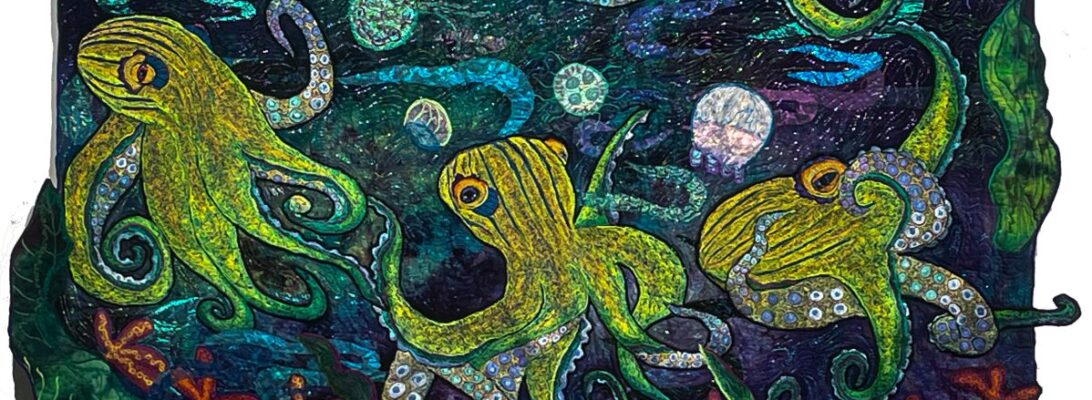
Water Ripples: Adding an Extra Splash

I love organza and lace for natural elements. I can make water easily with some fusible and sheers. I cut c shapes in various sizes and colors, and fit them into pond or river water.

This is a process I usually do right before I put on my embroidered components. I get everything embroidered, so I’m sure it fits in, and then add the elements (air, wind, water, clouds, smoke) to the background itself before I stitch down any of the embroideries. Only after tthe sheers are stitched on, do I stitch the components down.

There is one problem with that. It leaves my fish and reeds all out of the water. They are in front of the water, but not in it.’

What I’m looking for is the feeling of layers. I usually cut c shapes and swirls. Then I mix them together until I have water amalgamated with different temperatures and depths.

If you think about real water, it’s always in layers. You put your toes in, and maybe you feel the sun warmed top layer, Go further in, and the lower levels feel colder. How do we express that as art? I think the deeper the colors are, the colder they feel. We can make layered water, warm on the top, but colder as we go further in.

So the last thing I often do is to lay a few pieces of organza and lace over top of the fish. Not completely. but enough that they’re completely clearly in the water.

Anything less would be all wet.

Painted Lace: The Real Thing

This week I painted a batch of lace and organza. I love using these soft laces because they offer texture and shifting color as another overlay on the surface.

These are not especially elegant laces. The organza is plain poly organza. I often find them in rummage sales. I hit the jackpot at some point when I bought a pile of remanents from a wedding seamstress.

Painting lace is easy. I use acrylic paints from Walmart or Joann’s and mix them with fabric media (available at Amazon) to make the hand of the fabric better. Mix in a little extra water until the paint is the consistency of cream, and paint the lace with sponge brushes. It’s a lovely, messy wildly colored afternoon. You let it dry completely and iron it on a synthetic heat setting.

I’ve heard a lot of people argue for the real thing. Silk organza. Real lace. I love those things too, but it’s not about fiber content. It’s about color, transparency, translucency, and texture. And it’s about whether they work well under the needle and as applique. It helps to know the content so you don’t burn it under the iron.

There’s a short story by Henry James called The Real Thing. It’s about an artist who has a noble couple offer themselves as models. They argue that they are the real thing and that they will add accuracy to his work as his models. But the truth is, he finds the woman who is his ordinary model from a humble and somewhat criminal life could be anything: a gypsy, a fairy, a queen, a courtesan, or a saint. And since she can be anything, she makes his artwork ultimately real.

Painted lace is a test tube baby, made of nylon and polyester. But it creates a wonderful surface overlay. And I really don’t care how real it is.

So, if you know of anyone who is rehoming white poly lace and organza, let me know. I finally used up my stash.