Most of my work centers around threads, so I fuss about them quite a bit. Most threads divide into their components: metallic, rayon, cotton, and polyester. Fs 2/20 is a bit different. It has a black core the metallics are wrapped around and when it’s used in zigzag embroidery looks like little beads.
Madeira Threads Metallic Thread Color Chart FS 2/20
These lizards were stitched as bobbin work, out of FS 2/20. The eyes are sliver.
\
In contrast, these butterflies were all out of Supertwist Madiera metallic, with FS 2/20 bodies. Again, shiny Sliver eyes.
Why does all that matter? Because those three kinds of thread offer a totally separate look that makes the objects embroidered in them automatically different from each other. Your eye sorts for shiny first. That means that first, it sees the shiny eyes, then the supertwist butterflies, and finally the rich beaded looking lizards. Now, how cool is that?
FS 2/20 is not an easy thread to find. To my knowledge, you need to get it from Madeira. But I do think it’s one of the most beautiful threads I know of. They also have Poly Neon and Supertwist and a bevy of embroidery stabilizers.
Being someone who does nature quilts, it seems unnatural to frame a background with a border. Nature doesn’t fit into a picture frame very well. Of course, there are times when you simply have to. You have a 50″ subject that needs a background and 45″ fabric just won’t stretch far enough to accommodate.
But there are other reasons to create a border.A border can emphasize a light source in the center. A border can bind your subject into the frame of the piece, capturing it almost. Breaking through that border establishes the idea that your subject can’t be contained. That it’s moving so hard and so fast you can’t keep it in a box.
This heron just turned out to be too big for any of the fabric I had. I considered splitting a light source, but the background was just too good to cut up. So instead, I bordered it.
Borders are basically a frame. And like other frames they either offer something special or they really detract. You can use a border to create a different atmosphere, to give a boundary, or to simply expand the fabric. In this case, I needed the fabric extended, but I didn’t want to make it a square box for my subject.
Unbordered, Equal Borders, Gradated Borders
These rectangles show three options: an unbordered piece, a piece with equal borders, and a piece with gradated sizes. Equal borders make a plain frame for the subject. But a gradated border gives weight to the bottom, gives a travel direction to the eye, and starts the movement of the piece before the subject is even applied.
I cut my outside strips at 5″, 6″, 7″ and 8. Narrowest on the top. Widest on the bottom. The green inner border is almost the same value (black/white) as the purple so it doesn’t make as hard a border statement.
The head of the bird is in the lightest (narrowest) spot and his feet are where the sun don’t shine.
The frame also creates a light source in the center, illuminating the bird.
Using a border, not only to make more space, but to define light and direction is an easy way to make a frame. And pulling your imagery out side the box breaks the border in a way that makes the whole piece move. What could be easier?
I love creating color with thread. The threads available make an endless choice of colors. You’re eye blends the bits f thread that peek out from their layers. It makes colors that are rich, dense, and complicated. What’s not to love?
But sometimes it gets too monochromatic. I was working on this heron and I wanted some fish companions for him.
When I picked out my threads for these, I wanted them red to stand out from all that grey in the heron. Red is funny. Like every color, it can lean either to the sun or the shade. A balanced red would use threads of both tempuratures. I used both kinds, a little purple and teal for shaders. And I threw in a green just to spark it.
By the time I got to the green, the whole mass was bland. Pretty. Stripy. Bland. I put in the green and it just woke up. Then more reds and finally oranges.
The green stitching on top is garnet stitch, in small circles. It changed everything!
Yellow overstitching creates a swirl on the fish face that helps round the face. Overstitching adds a color layer, but it also breaks through that bland smooth color.
It helps, of course that the yellow complements the purple, and the green complements the reds. But the textural elements also wake up the fish and feed our eyes.
Nothing is quite as daunting as a really large embroidery. This babe is almost as tall as I am (4′ 10″). I haven’t measured him yet, but he doesn’t fit on a yard of fabric and we’ll have to sort that out soon.
Part of what is daunting is seeing the whole on a piece like this. Part of it is that when things go through that awkward half-embroidered stage, they look really weird for quite some time while you’re finishing off.
I’ve always made a point of showing you all of my errors. Partially because I view that kind of honesty as helpful and partially because I don’t necessarily view them as errors. They are the path through that particular piece of art. Sometimes they even turn out to be helpful.
I finished binding one quilt in a bright green in the middle of working on this quilt. Went back the next morning, and finished a large swath of feathers, only to find they were that very bright green. I was appalled. I picked up the mustache trimmer, looked at the immense patch of green, and quailed.
Then I thought for a while. Part of the problem with herons is that they are mostly grey and dark blue. With bits of rust. They are exquisitely formed but the color scheme leaves much to be desired.
But what is grey? Any color can be made into grey either by adding a lot of white or a lot of black. It’s a matter of value.
So I gathered up all the colors I had that were the same values, not colors. I added a lot of rust that gives it a warmer color, which means I’ll need a background with warmer shades as well.
All those colors sort of made it rainbow-colored. And rainbow colors make iridescence. But since they’re the same values, it’s still greyish. I think it’s going to be all right. I’ll know in several days when it’s all stitched in.
A word about the photography. I just got a new to me iPhone 12 mini. I do think the pictures are an improvement. Let me know what you think.
If you’d like more information about ripping with a mustache trimmer, see the blog To Rip or Not to Rip.
I’ve been working for a week on a flamingo quilt. It’s a commission of sorts, so I’m working with the owner’s druthers. Blissfully, we have similar druthers and I think she’s quite pleased.
Part of this week’s fun has been choosing the background The flamingo is all embroidered, so the next step is building her world. I was looking at colors when I pulled out fabric opportunities, but I discovered quickly that what really happened is that the background changed the time of day.
The different backgrounds suggest different times of day
The background changes the time of day and that in itself is a powerful statement. One way or another she’s walking in surf but is it night? Is it in moonlight? Twilight? Afternoon? Early cool morning?
Those are more than logical questions. They make a statement about the quilt itself and what it conveys. They tell me about this bird, who she is, where she is, and what her world is like.
All done by a simple choice of cloth. It never ceases to amaze me. Mostly the fabric choice is about letting the subject shine, but that choice carries meaning as well as color. Hand dye is a miracle that happens all the time but only once for each piece. The miracle we choose opens all kinds of choices and shuts other possibilities out. I’m thinking this will be the “right” background
Final Choice!
I turned around the darker one so that her face is in the light. We have a winner!
Still deciding about the moons. Do I want arced moons or just one? Decisions…..decisions.
Years ago someone asked me how many mushrooms go in a quiche. I asked back, “How many mushrooms do you have?”
I don’t make copies of things. I do make variations, and I find it useful to rethink some things I’ve done before, or more importantly tried to do before. I might get lucky. You never know.
But there are some things I know I can always use. There are never enough dragonflies, daisies, frogs, or mushrooms. They make an excellent point of interest for a visual path through a piece. And every so often I make batches of them.
The last two quilts had lots of frog and mushroom action. But they are such different pieces. Why did that work? Why do the same color elements work in two really different color backgrounds?
I’ve thought about it a bit and have decided that bright is a color all of its own. Green Heron Hunting features a bright fall-red sky, a stream, and some rocks. High Rise Living is a soft-colored background as a garden with lobster claw plants dangling in the breeze. The backgrounds couldn’t be different. But both backgrounds are a strong contrast to the mushrooms and frogs. High Rise Living is almost pastel. Green Heron Hunting is a bit somber. Both of them are high-contrast against the backgrounds
Batching regular elements has changed my work a lot. I find I can do larger elements with much less distortion. The downside is they need to be stitched down afterward. The mushrooms get stitched down with the most prevalent color on the edge. The frogs and other elements usually get stitched down with black. I don’t always like the heavier black borders, but it eliminates a lot of pucker and distortion.
So I continue to make batches of the elements I know I’ll use again and again, Contrast, any contrast makes elements work together. And there’s always room for one more frog.
I have two quilts I’m finishing right now that you’ve been watching me work on. The threads I choose make all the difference in their background effects. Shinier threads will create a shimmer, a wet or wild area. Less shiny threads are more indicative of air or ground. I’m treating them with different threads and patterns to create a specific effect in each case.
For a very wet look, I’ll use Sliver and other flat threads. These really shine across the surface. I prefer them for either starry nights or for water.
The other thread I’m using is Madeira’s bug body thread, FS2/20. This amazing thread has a black core that gives it a very different texture. Zigzagged it does look like bugs. As a stipple it has a sharp look without the intense shine.
I consider both these threads incredibly beautiful and essential. But I use them very differently. Because they create an incredibly different texture. Why is that important? The texture defines the area for our eyes. Shiny thread will create that wet feeling. A sharp undefined metallic does excellent air or dirt, all defined in our thread choices, with no more work to it than that.
Green Heron Hunting is set with water, air, leaf, and ground elements. The air and the ground are very similar. I don’t want a soft look. It’s fall, so I want it to be crisp and textured. So I chose Sliver for my stream. But the ground area with the frogs and the leaf tree tops are stippled zigzag with the FS2/20. There’s a glint of metallic, but it’s different from the high sheen of the water and the eye separates them immediately.
For the air, I chose a driving straight stipple pattern to suggest wind. But I put in a repetitive garnet stitch in it to make it look more driven.
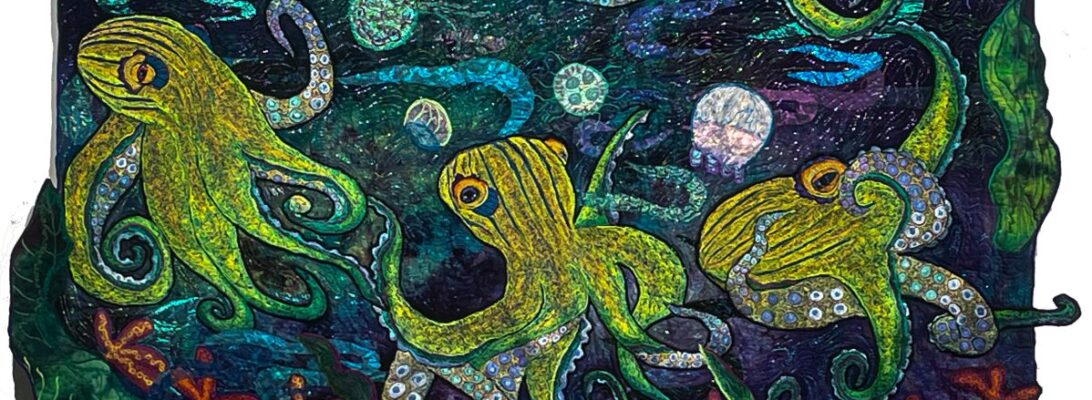
For Fishy Business, the background is all water. So I used Sliver-type threads exclusively. The very shimmery background contrasts highly with the completely poly-embroidered fish. They both shine, but in very different ways.
Your thread choices and stipple patterns define the background. Contrast is the key. If your background and images contrast each other, they will stay visually separate, and help your eye to see the separation.
I don’t follow trends well. If it interests me it interests me. If it doesn’t, it’s background noise. So the snippet thing just went right past me. It’s an interesting technique, but it didn’t work with what I was doing.
So I was working on Green Heron Hunting and I needed to do something different with the leaves. I’ve often used green sheers with stitching to create folliage.
snips arranged on Steam a Seam 2
But I wanted fall leaves. Small fall leaves. I didn’t want them to be detailed. Just bits of color. So for this, the snippet thing made sense. I sat down with a pile of hand dyed scraps, and cut some bits. I cut a cloud shape of Steam a Seam 2. I arranged the bits on to the Steam a Seam 2 backing and pressed them on high heat with a non-stick pressing cloth.
The trick with a pile of snippes is stitching them down without them getting caught in the darning foot or having them go all over. I’ve seen snippets done with tulle over them to control the bits. Personally, I don’t like the look. I can always see the tulle. It looks either too dark or too light and it spoils the effect for me. So i decided to stitch them down with a top layer of dissolvable stabilizer, to keep things from getting tangled.
Dissolvable stabilizers have been around for a while. They are a film made from cornstarch and dissolve in water. They have a lot of commercial uses for computerized embroidery, but they also work well for free-motion embroidery. I don’t know that they stabilize so much as they keep the machine feet from getting tangled in the thread and bits of fabric. Originally they showed up in the 80s as Brama Bags, a dissolvable laundry bag for hospitals, where they were concerned about contagion from people’s laundry. It’s only gotten better since then. There are lots of different brands. The difference is in how thick the film is and how easily it dissolves. I like Aqua Film, which is now called StitcH2O, by OESD. But there are also Solvey, and Badgemaster and new ones come out all the time. What you are looking for is a film that’s steady enough to stitch over without being too thick. Thick ones take forever to dissolve.
That made a tree top I could iron onto the piece itself. But I never trust glue. It sometimes just comes loose. So it needs to be stitched over. And all those little bits of fabric, even glued, are going to go everywhere. So this is where I used my Aqua Film. I pinned over a sheet of the film, and stitched it with a zigzag stitch and a metallic green/brown Metallic thread calledFS2-20.
After all that stitching, I trimmed away any extra stabilizer.
I put it up on my photo wall, got out a spray bottle, and spritzed the stabilizer. It’s not instant. You need to get it really wet. But it dissolves. I put a fan on the piece and it was dry the next day. The color darkened a bit, but I’m still happy with the result.
So these trees work for me. The frogs and heron are so busy, there needed to be similar excitement going on up top.
I’ve also used dissolvable topping film for a technique I call globbing, where you stitch down a glob of thread onto a quilt. Just put the thread where you want it, pin the stabilizer on top, and stitch in circles until it’s significantly attached. They work well for stitching over delicate things like Angelina Fiber, where, again your pressure foot is likely to get caught. You can read about it in Another Fine Mess: Globbing, What’s on Your Floor
I love my big embroidered appliques. I can get such great detail and texture out of that technique. But it has a downside. It’s days and days of embroidery.
Not that I mind that. I find that fascinating! It builds color and if it’s color, well, I can be lost for days. But it’s terribly disappointing if I find after I’ve embroidered something that my pattern just wasn’t what I needed. If I ignore the fact that it’s off, I can spend 30-40 hours only to have an embroidery that disappoints me.
I draw my own patterns. Tracing someone else’s art leads to very flat imagery, legal issues, and huge size limits, so I always draw. But I don’t always get what I want at first. And I don’t always know what is wrong with it.
So every drawing sits on the photo wall for a while. I may not know why it’s off, but after 20 minutes I know that it’s off. It sits until I know. Then I go back to the drawing-room, as it were.
This frog is a good enough frog. But he has all the movement of a pet rock. I put him up and immediately knew changes would have to be made. The first change, for all drawings, is to flip them horizontally. The drawing goes in the back and the embroidery shows from the front. So it needs to be flipped.
In this frog’s case, we needed more help. So I treated him like a paper doll. I cut out his legs and arms so I could move them at different angles.
My drawing paper is Totally Stable, an iron-on removable light stabilizer that takes drawing well and traces easily. it also can be ironed back together after you find the position you want.
I moved his back leg at a further angle, moved his farm back so his weight was on it, and stretched the other arm out so it was reaching. Then I used my drawing to enlarge my pattern since it will shrink with the stitching.
I’m much happier with this. We’ll see how it stitches up.
For more information about adjusting patterns, see Drawing on Distortion. For patterns of mine, you are welcome to work with for noncommercial work, check out Patterns for Embroidery, a pattern book I prepared for free motion.