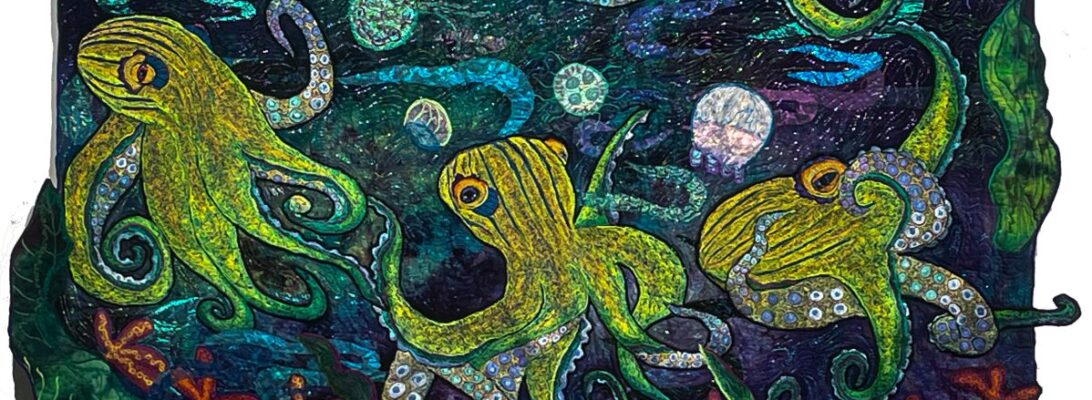
Codifying Your work: Making Your Own Rules

Yesterday I gave a lecture on the Visual Path at the Peoria Art Guild. The best thing about lectures is that they help you think about what you do without thinking. I know that a major component of my design decisions is largely about making work move. Lectures give you a reason to think it through so you can talk about it.

Every artist has conundrums they are trying to solve within their work. For myself, making movement is one of those. If I’m filling the world with images of birds, bugs, lizards and frogs, I would hope that they would be breathing, living, moving birds, lizards and bugs. So how do I do that?

Here’s a section of my lecture with some of the rules I’ve decided help me.

These rules may seem silly or simple. But I use them every day. If I want to make things move, I can tilt them, change the size dimensions, create the illusion that they’re falling, or put them in a progressively larger or smaller conga line. All of those are cheap tricks. But they work.

That got me thinking, how many artists have rules they’ve made for themselves that help them to do what they want with their art? And what happens when we break those rules? Are we reminded why we thought to do that in the first place? Or are we liberated by realizing that rule isn’t all that ironclad?

The very cool thing about all this is that no one gets to apply those rules to us as artists except ourselves. It’s not so much a box we’re stuck in as a useful gridwork we can choose to use, or not.

My visual path pieces always make me think about how to make my eye travel through my whole quilt, just for fun. So if I were to bend my rules a bit, what would that look like? Each quilt is an answer to a question that I haven’t figured out just yet.

Peoria Art Guild 

Natural Threads Ellen Anne Eddy Show September 1-28

Peoria Art Guild, 203 Harrison St, Peoria, IL, 61602, 309 637 2787 

Hours: Monday 9-4, Tuesday 9-6:30, Wednesday 9-6:30, Thursday 9-6:30, Friday 9-4 Saturday 9-2, Sunday CLOSED

Opening Night: When the Private Part of Art Becomes Public

Last Friday night, we opened my show at the Peoria Art Guild! It was a lovely opening. Lots of folk. Lots of friends. Lots of artists I just met. I couldn’t have been more pleased. Or more humbled.

For all of us, who do art seriously, it’s a really private process. Even if you share your process online or in class, there are some things you really do in a very private space. All the left turns, small errors, large disasters and turn-arounds happen in that private space with presumably no one watching.

I’ve never felt very precious about that. I treat my mistakes as learning curves and have always tried to share them, just as a point of being real with students and other artists. It’s especially true if you teach. You owe people the truth about your process.

But when it’s in front of the public that feels very exposed. All the things you wished were better, smoother, flatter are out there, just as they are.

It reminds me what art is for. Art is about retelling our story. It’s the ability to see our world in a way that changes us, and the things around us to be stronger, better, more beautiful, more whole, more brave inside or out. And the journey we take as a storyteller is much more transformative than the story itself. and an inscrutable process, all of its own.

I love when my friends come to a show. They’ve walked with me sometimes close by, sometimes at a distance as I’ve made this work. It’s as much a part of them as it is me.

I love when I meet other artists in this same inscrutable process, doing something no one ever thought of doing before and finding their way to put it into being. They are a privilege. The glimpses we share of our processes are like watching thoughts take form, flesh, and flight.

And then there are the people who come to see that transformation. And respond. I’m always humbled that the images I have to work with have meaning to other people. And grateful for their kindness. This was a huge gift for me, and I want to thank the Peoria Art Guild, Shannon, John and Jeff, and Dana for opening this amazing opportunity for me. And Don for his endless help and support!

So come see the show! It will be up for the month of September. And come join me next weekend for classes. We’ll learn how to make Fantasy Flowers and Bobbinwork Dragonflies next weekend. And talk about how to build a visual pathway through your art.

Peoria Art Guild 

Natural Threads Ellen Anne Eddy Show September 1-28

Peoria Art Guild, 203 Harrison St, Peoria, IL, 61602, 309 637 2787 

Hours: Monday 9-4, Tuesday 9-6:30, Wednesday 9-6:30, Thursday 9-6:30, Friday 9-4 Saturday 9-2, Sunday CLOSED

The Next Piece: What is the Next Passion?

I’ve just finished two pieces I started earlier this year. It’s a good thing because the show at the Peoria Art Guild hangs next Saturday. I’m fighting off a summer cold and feeling drained. Except that I wish my nose would drain.

Endings are hard for me. It’s hard for me to finish a quilt. All that passion, all that energy stopped. It feels wrong in some ways. I’m a bit like the artist who is done when someone takes the piece away from them.

Except that at some point, you really are done.

So this is why I almost always have a number of pieces in process. I still need to work through the last of Great Blue. I’m lost after I finish a major piece. I’m hunting for the next passion. And it needs to be a passion. To go through the drawing, the stitching, the dyeing, the quilting, and the embellishment is an immense amount of work. That takes endless energy, which is fueled by passion.

What am I looking for? What is it that I need?

color

Amazing color is always a draw! It can come through the dyed background or from my subject, but I can’t work without color. The images have their own color, but the light of the piece is the fabric background itself. Like a colored lense it sets the tone of the art. Everything is seen through that lense.

Form

The shape of things is incredibly exciting! Bird wings, frogs jumping, the intricacy bugs, the Fibonnacci progression numbers in space and time leave me breatheless.

Movement

The way those forms move. To see them in flight, in water, in repose, in play. I want to play with them.

Memory

Some moments change your life. Watching a heron land on a friend’s pond. Standing eye to eye with a Komodo dragon at the National Zoo. Standing in a training pond with dolphins. Watching the sun rise over a little waterfall at Spring Lake, through a fringe of wildflowers. I am imprinted with memories that always call me back to that point of wonder.

A Male Cassowari watching me …

So what do I do, when a piece finishes? I wander through books looking for the color, the form and the movement for the passion for the next piece. Do I know what’s next? I’m finding Cassowaries interesting. It’s like a thug dressed up for the ball. How dare you be that blue, that red with that yellow? Maybe.

Bringing Books Back to Life: Reprinting My Classroom Books

Over the years I’ve written a lot of books, small and large for quilter. When I was a child I believed that you could always get a book that had been printed. I was in high school when Eileen Driscoll, my English teacher, made us look for books out of print. Then I understood that a book wasn’t necessarily forever. Books go out of print. And then they’re just not available in the same way.

Books are primarily for a particular audience and purpose. We don’t think about that as we buy books, but the publishers always have that in mind. As a writer, I’ve learned to do that too. You need to have a pretty clear image of who you’re writing for and what they’ll use it for.

I’ve done a series of classroom books that were written primarily to be classroom notes for students. I put a lot of love and care into those booklets. They are not a catalog of skills or a huge gallery of pictures. What I was aiming for was a set of notes and pictures you’d want to keep as a reference after a particular class.

I’m proud of those books! They have patterns, step-by-step photos, a gallery, tips, and source information. They were never intended to be comprehensive. And they were self-published, which always costs more than going through a publisher. Some people were disappointed by their size. But they were always meant as classroom support, to as a comprehensive text.

I had a number of these books I’d printed for class. At one point, my printer stopped doing the saddle-stitch format they were in and they went out of print.

For more information about classroom books, see Classroom Books, Some thoughts about what you leave your students with.

But since I’m teaching Dragonfly Sky I decided to reprint two of those books together as one volume.

So Dragonfly Sky and Ladybug’s Garden are reprinted as one book, and are available in paperback now on Amazon. Kindle copy coming soon.

That’s good, because they cover the two classes I’m doing at Peoria Art Guild, September 9-10th.

Peoria Art Guild 

Natural Threads Ellen Anne Eddy Show September 1-28

Peoria Art Guild, 203 Harrison St, Peoria, IL, 61602, 309 637 2787 

Hours: Monday 9-4, Tuesday 9-6:30, Wednesday 9-6:30, Thursday 9-6:30, Friday 9-4 Saturday 9-2, Sunday CLOSED

Show panic: Getting Ready with Grace

I’m delighted to announce I’ll be doing a show of my work for the Peoria Art Guild this September, 2023. Right now I’m running around the studio like a frenzied ferret. It’s not pretty. But it’s show panic. It’s how it’s done.

The show will open Friday, September 1st. I am so excited. I have a pile of new work to show and I’m so pleased to be able to do that in person with you.

These last two years have been a renaissance for me. I’m working larger, in wilder images and on fire with the art happening. Not bad for a lady at the other side of seventy.

So here is a review of last year’s work.

Major quilts

There are some large unfinished pieces almost ready to go.

small Works

As you can see it’s been a busy year!

The show will start at the

Peoria Art Guild September 1-30

Opening
First Friday, September 1
Gallery talk: 4pm
Opening 5-8 PM

Classes:
Fantasy Flowers: making flowers from sheers and embroidery. Saturday. September 16th, 9-12
Dragonfly Sky: Working with bobbin work. Sunday, September 17, 9-3

Free Lecture: The Visual Path Designing Art in Motion. Saturday 16th, 1-3

Peoria Art Guild, 203 Harrison St, Peoria, IL, 61602, 309 637 2787 

Hours: Monday 9-4, Tuesday 9-6:30, Wednesday 9-6:30, Thursday 9-6:30, Friday 9-4 Saturday 9-2, Sunday CLOSED

To celebrate, and to pay for some of the show costs, I’ve put my current small quilts on sale on Etsy at 25% off. Check them out
Are you excited yet? I’m exhausted. But thrilled. Come join me!

Color Study: Why Red?

I’ve just finished Little Blues! I’m delighted with this quilt. It took me a while to get it finished off. In that process, on a whim I added some red silk flowers to the background.

Why red? Why not orange or blue or white? I did try those. But red was it.

I really think it’s worth the while to put up your color decisions on a color wheel. Just how you can see how they relate.

The color wheel gets a bad rap. It’s old fashioned, it’s boring, we all know how colors are made, it’s incomprehensible…. It’s still the best way I know to show the relationships between colors. It shows how colors are created. But most importantly, it shows how they react to each other.


The farther colors are apart from each other, the more tension there is between them. And like every good soap opera, more tension means more excitement.

At which point, you need to ask, where is this quilt going? If it’s in a baby’s bedroom, you might want to keep the tension and excitement to a minimum. But for a gallery? Bring on the excitement!

I was surprised when I put the colors up on the wheel. I didn’t realize how far around the wheel I had gone. But as you can see, the red zings across from the green. I don’t have much in there, but it wakes up a piece that has that sleepy analogous color thing going on without it. Not much. Just a handful of red silk flowers.

I consider using the whole color wheel a visual trick of sorts. It wins awards, and it’s showy, but color needs to be the focus of a piece for that to work well. But this almost full-color wheel is rich, satisfying, and just red enough to get attention.

For more information about color theory check out Color Theory: The Tug Across the Wheel and Thermal Shock: Shocking Color Choices.

Time is Spiral

This is a special week for me. After 10 years, I’m teaching in a guild again. I’ll be lecturing at Gems of the Prairie Wednesday, May 3rd, and teaching the class The Stitch Vocabulary Book on May 4th. The class is full, but I’m told the guild welcomes non-members for the lecture. You are all very welcome to come!

It’s my developmental lecture.: How I became an artist. That’s a misnomer by the way. We are artists by the way of being human. It’s how I stumbled into my own art, and where it has taken me.

Every year I try to do something I’ve never done before. for my birthday. This year, I’m teaching a lecture and class, after a ten-year hiatus.

And on May 5th, I turn 70. I’ve always dreaded that. It sounds so old. Yet here we are. And if you’re a contemporary, so are you. As someone quite wise said to me, “If you made it, you celebrate it.” I intend to.

My life has always been a bit upside down. I’m too dyslexic to do things in a rational linear order. I started doing my art in my 20s. I married at 62. I borrowed other people’s children, although I always gave them back. And I had a lot of physical limits. 10 years ago, I pretty much stopped doing art and wrote books instead. And then Don gave me his old house for a studio. And my art flared up like a forest fire. Only a bit less destructive. It was back.

Making art is an expression of vision. Teaching is the sharing of technique. They really aren’t very similar. But they balance each other on the see-saw for good art is always bound by technique, and the ability to share technique extends everyone’s ability to share vision.

Thread Magic Stitch Vocabulary Book

In prepping for class, I’ve done some things I really haven’t done for a while. I wrote and published a new classroom book for the class. Classroom books are all about technique, and this one is chocked full of different ways to use free motion: zigzag stitching, straight stitching, garnet stitch, hard edge applique, soft edge applique and bobbin work, with extra chapters on silk flowers, globbing and Angelina fiber. Bookmaking is a skill. It was nice to come back to that again.

You’ll find the Thread Magic Stitch Vocabulary Book on Amazon in both Kindle and hard copy.

And I’ve brushed up that lecture. It was shocking to realize how much my technique had changed in three years. The revised lecture needed to cover that. My stabilizer techniques, my drawing techniques, and my stitching techniques are massively different.

To celebrate the class, I’ve put quilts on sale. I’ll have them at lecture and class but you can also purchase them on my Etsy site at www.etsy.com/shop/EllenAnneEddy

What was more shocking, was that I had enough quilts to do a full trunk show out of that three years of work, with no older work included. Old work is fun for a lecture, but I think my new work is much more exciting. Yes. I will let you touch them. It’s astonishing what gets done if you are doing it daily.\

My point is that life isn’t linear. It’s a spiral, just like time in a garden. It doesn’t start at one place and just go to another. It cycles, it stalls, it spins out, It shoots up. Flares down. But even when things stop, they come back again in a different form at a different time in a different way. I don’t think I need a thing for this birthday, except, note to Don, some new books. The journey is the gift.

You are so welcome to come to my lecture. for Gems of the Prairie. It’s at St Paul Lutheran Church 1427 W Lake Avenue, Peoria, IL, United States, May 3rd, at 6:30 PM. I’m bringing piles of fabric, books and hand-dyed threads so people can play with the toys I use.

All time is a spiral. Wait long enough and things lost come back in their own way and time. I am grateful.

Living Large: Strategies for Dealing with Large Quilts

I almost never do bed quilts. I did them when I was younger and watched them die as I used them. It was too depressing. I occasionally will do a baby quilt or a comfort quilt for someone dealing with illness. Mostly I do art.

And since art doesn’t have to be big, I don’t often make something bed-size to put on the wall. Except when I do,

This heron couldn’t be done smaller. At least I couldn’t do it smaller. He’s 60″ x 52″. He’s pretty much the size of God’s underpants.

There are some strategies for dealing with overlarge quilts. The first three are, don’t. But if you’ve decided it must be large, there are several things you can do that will help.

Strategies for Large Quilts

Break it into components. For myself, that means the embroideries. I do them separately and then apply them when the top is ready. But it might be working in rows or in segments. Different quilts will suggest different approaches.

Use larger details. Scaling up the design means there’s less work in it. Sometimes extensive detail just looks ditsy on a larger piece.

Buy extra sewing machine needles. Larger quilts require more tugging and pulling and that will break needles. Promise.

If you have a machine with a wider arm, this is the moment. The arm of your machine is the space between the needle and the mechanical right end. A lot of manufacturers make machines with a longer arm. That’s extra room to shove the quilt through the machine. It can be very helpful.

Use a design wall where you can walk away and really see your design. A design wall should be big enough to accommodate your work and in a big enough space where you can walk away and really look at it. For more information about making and using a design wall, here’s a blog post on it: Studio Essentials: The Glories of the Design Wall.

The other helper is what we used to call bicycle clamps. Roll your quilt, clamp them with these clamps and then you can maneuver it easier.

I don’t do large quilts often. But they do really make a punchline in a gallery show. So this heron is promised to a show at the Peoria Art Guild in September. We should have him crowing by then.

The Thread Magic Stitch Vocabulary Book is Ready to Order

The Thread Magic Stitch Vocabulary Book is available to order in print!

This classroom book takes you through all the techniques I use to create my art in 5 easy exercises on 9″ squares. Then you take those exercises and bind them into your own reference book, there to remind you what works best for you.

I love classroom books. I think it’s important to give people the whole recipe for something, with nothing left out. That’s what I tried to do here.

It includes free motion techniques on straight stitch, zigzag, bobbin work, hard edge applique, soft edge applique, rocks, Angelina fiber, globbing, couching, silk flowers and leaves, and all machine binding.

If you are taking the class at Gems of the Prairie, your book is part of your class fee and will be waiting for you at class. For everyone else, you can order it now on Amazon. https://www.amazon.com/…/173228…/ref=tmm_pap_swatch_0…