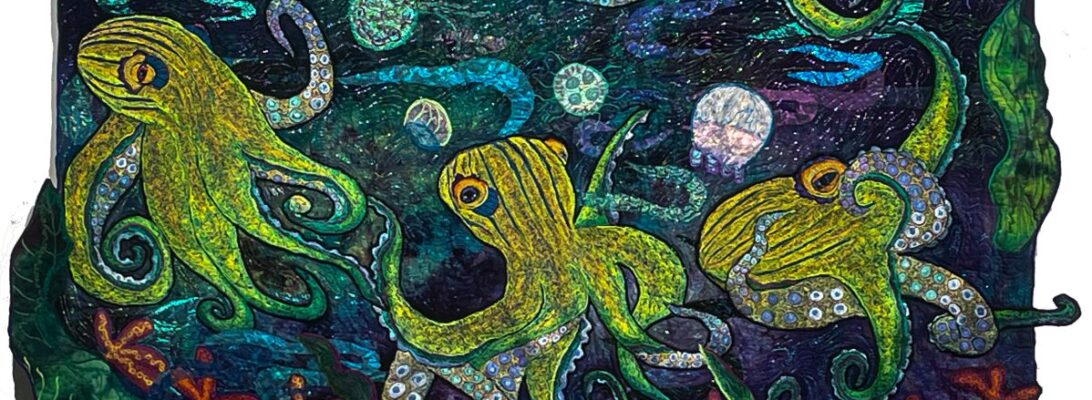
The Thread MAgic Stitch Vocabulary Book is Available in Kindle!

The Thread Magic Stitch Vocabulary Book went up yesterday on Kindle and is now available! I’ve been sharing my chapters with you so you can get a taste. This is the classroom book that shows you most of the technique

es I use for my work.

I will be teaching the class, Thread Magic Stitch Vocabulary Book for the Gems of the Praire Guild in Peoria on May 4th with a lecture on May 3rd.

This is my first guild gig in about 10 years. There are a lot of reasons for that, and I don’t know that I’m back to a gig I have to travel for yet. But I am so excited to be back in a classroom, and I’ve found there are so many techniques that have changed or modified over that period of time. And so many more things I can do with those techniques..

So I did this booklet, especially for this class. But it should stand alone as a set of exercises you can use to build your skills and stretch your abilities. There is a full toolbox of free motion techniques you can include in your work with just a little practice.

You can see several chapters up on earlier blog posts.

Product or Process. How Do You Learn Best

Bobbin Work

Hard Edge Applique

Skills covered
Free motion straight stitch
Free motion zigzag
Bobbin work
Hard edge applique
Soft edge applique
Working with Angelina Fiber
Working with dyed cheesecloth
Couching
Adding silk flowers and leaves
Globbing

I tried to write a book that would cover a lot of information in a small space. I’m hoping you find it useful. You can order the Kindle Stitch Vocabulary Book right now. The print book will be out at the end of the month, and it’s part of your kit if you are taking the class.

I’m so excited to be sharing this material with you and to be out teaching again with the best people in the world. Quilters!

Stitch Vocabulary Book: Hard Edge Applique

Most people don’t think about free motion being an applique technique, but it gives you lovely curved edges with great textural lines. Here’s a sneak peek of the chapter on Hard Edge Applique.

In Black and White: Using Black and White Photography as a Design Tool

I have a secret design tool. You probably have it too. In your pocket. Yes! It’s your camera phone.

We’ve most of us succumbed to using our cell phones as our cameras. It’s one less thing to stuff in my bra, since most of my clothes lack pockets.

One of the hardest things to evaluate in your art is value. Value is the darks and lights in a piece. Color is like candy. Or antidepressants. You reach for them because it feels great.

But value is so much harder. And vital. Texture and color shine out. But value separates the different components in your piece. The best way is to see it in black and white.

I haven’t mussed much with black and white photography since you had to give black and white pictures to newspapers. I’m really dated by now.

But a black and white image will show how the values are playing in your quilt. And will help show you how your design is moving. Your eye will follow a path made by the brightest object. If you make those objects into a path through the piece, you have a visual path that will showcase your work best.

And current cell phones make it simple. There’s a preset in your camera program that will give you a black-and-white photo.

I used this technique when my friend Sharon asked for some design help on her quilt. You’ll find it at A Visit to the Studio: Dsignng with Another Pair of Eyes,

Every design has a path through it. It can be clear and obvious. But what if it isn’t? And how can you tell?

The black and white photos tell us everything we need to know.

This is the beginning picture with the fish with reeds. This didn’t quite move the way I wanted it to. The reeds didn’t form a clear enough path.

Here we see the placement for the smaller fish. But you’ll also find the placement of the reeds moves things better.

Here’s the final picture with bubbles. The eye travels through the piece with grace.

I always encourage you to take pictures of your piece as you work on it. It’s great to have documentation about your work. But it’s also a great design tool.

The next time you’re unsure about the design of a piece, take out your phone, take a picture, and see it in black and white. It will tell you all you need to know.

Turning Over a New Leaf

We’ve talked about ways to make leaves more real. Leaves are wonderful shapes in themselves, but because they bend and fold and move, they add movement to your piece.

I’ve been working on a fish quilt that I wanted to frame roughly in kelp leaves, and it seemed like a good study on making leaves fold. Kelp is a water plant that bends completely to the movement of the water. But it has a definite back and front. We’re going to experiment with making the leaves fold for this quilt. Here we have just raw cut leaves.

I can see some purples in this as shadows, perhaps, but what I really want my thread color to do is to define the front and the back of the leaves. I intend to stitch the edges pretty heavily, so I’m going to do the leaves separately. I’ve cut leaves freehand from several scraps of green and glued them to felt with Steak a Seam 2. On the back, I have Stitch and Tear which is a crisp tear-away non-woven interfacing. So my embroidery sandwich is my hand dye, Steam a Seam 2, and Stitch and Tear.

I took a piece of the release paper from the Steam a Seam 2 leaf cuts and have folded it in different ways so you can see how that affects the leaf. The front side edges will have heavy crenellation on them. The back sides will be smooth where the folds are.

My thread zones are back and front sides. The front needs to be bright/dark /intense colors. The back needs to be muddy, greyed, soft colors.

It seems like the fabric should define the leaves completely, but I’ve found that’s never really so. What defines much of the leaf color is the thread. If the thread is purple it’s at least a purplish leaf. Sometimes that’s the way to go.

stitching the leaves

Here’s a video showing the crenelated stitched edges.

The leaves fold in the water. On the front side, their edges are crinkled and bright. The edges on the back sides are smooth and greyed out. once they’re applied to the quilt I can take sheers and lace and overlay them with water so they look wet.

Here are some of my separate leaves, made to fold in the water.

I’m not so sure about this layout. I think I need to leave it on the wall for a while and see if I have the placement right. I may have overdone. But since nothing is stitched down, nothing is written in stone. I’ll see how it looks in the morning.

To explore more ways to make leaves check out my previous blog post, Over and Under

Does Anybody Know What Time It Is?-Establishing time of Day with your Background

I’ve been working for a week on a flamingo quilt. It’s a commission of sorts, so I’m working with the owner’s druthers. Blissfully, we have similar druthers and I think she’s quite pleased.

Part of this week’s fun has been choosing the background The flamingo is all embroidered, so the next step is building her world. I was looking at colors when I pulled out fabric opportunities, but I discovered quickly that what really happened is that the background changed the time of day.


The background changes the time of day and that in itself is a powerful statement. One way or another she’s walking in surf but is it night? Is it in moonlight? Twilight? Afternoon? Early cool morning?

Those are more than logical questions. They make a statement about the quilt itself and what it conveys. They tell me about this bird, who she is, where she is, and what her world is like.

All done by a simple choice of cloth. It never ceases to amaze me. Mostly the fabric choice is about letting the subject shine, but that choice carries meaning as well as color. Hand dye is a miracle that happens all the time but only once for each piece. The miracle we choose opens all kinds of choices and shuts other possibilities out. I’m thinking this will be the “right” background

Final Choice!

I turned around the darker one so that her face is in the light. We have a winner!

Still deciding about the moons. Do I want arced moons or just one? Decisions…..decisions.

Want more information about backgrounds and hand dye? Check out Where will it land? Spotlight on Backgrounds

Leafmeal Lie: Making snippet scrap Leaves

I don’t follow trends well. If it interests me it interests me. If it doesn’t, it’s background noise. So the snippet thing just went right past me. It’s an interesting technique, but it didn’t work with what I was doing.

So I was working on Green Heron Hunting and I needed to do something different with the leaves. I’ve often used green sheers with stitching to create folliage.

snips arranged on Steam a Seam 2

But I wanted fall leaves. Small fall leaves. I didn’t want them to be detailed. Just bits of color. So for this, the snippet thing made sense. I sat down with a pile of hand dyed scraps, and cut some bits. I cut a cloud shape of Steam a Seam 2. I arranged the bits on to the Steam a Seam 2 backing and pressed them on high heat with a non-stick pressing cloth.

The trick with a pile of snippes is stitching them down without them getting caught in the darning foot or having them go all over. I’ve seen snippets done with tulle over them to control the bits. Personally, I don’t like the look. I can always see the tulle. It looks either too dark or too light and it spoils the effect for me. So i decided to stitch them down with a top layer of dissolvable stabilizer, to keep things from getting tangled.

Dissolvable stabilizers have been around for a while. They are a film made from cornstarch and dissolve in water. They have a lot of commercial uses for computerized embroidery, but they also work well for free-motion embroidery. I don’t know that they stabilize so much as they keep the machine feet from getting tangled in the thread and bits of fabric. Originally they showed up in the 80s as Brama Bags, a dissolvable laundry bag for hospitals, where they were concerned about contagion from people’s laundry. It’s only gotten better since then. There are lots of different brands. The difference is in how thick the film is and how easily it dissolves. I like Aqua Film, which is now called StitcH2O, by OESD. But there are also Solvey, and Badgemaster and new ones come out all the time. What you are looking for is a film that’s steady enough to stitch over without being too thick. Thick ones take forever to dissolve.

That made a tree top I could iron onto the piece itself. But I never trust glue. It sometimes just comes loose. So it needs to be stitched over. And all those little bits of fabric, even glued, are going to go everywhere. So this is where I used my Aqua Film. I pinned over a sheet of the film, and stitched it with a zigzag stitch and a metallic green/brown Metallic thread called FS2-20.

After all that stitching, I trimmed away any extra stabilizer.

I put it up on my photo wall, got out a spray bottle, and spritzed the stabilizer. It’s not instant. You need to get it really wet. But it dissolves. I put a fan on the piece and it was dry the next day. The color darkened a bit, but I’m still happy with the result.

So these trees work for me. The frogs and heron are so busy, there needed to be similar excitement going on up top.

I’ve also used dissolvable topping film for a technique I call globbing, where you stitch down a glob of thread onto a quilt. Just put the thread where you want it, pin the stabilizer on top, and stitch in circles until it’s significantly attached. They work well for stitching over delicate things like Angelina Fiber, where, again your pressure foot is likely to get caught. You can read about it in Another Fine Mess: Globbing, What’s on Your Floor

Good Bones: Rocks To Water

923-21 In the Reeds 2

Building something with dimension usually means it has a recognizable top and bottom. Design-wise, I believe you should be able to flip a piece on any side and have the design still move and work. But it loses a great deal of credibility if you have upside-down fish. It’s not a good look.

Be that as it may, it helps to have a recognizable border between sky, land, and water. How can we make those obviously separate, without just putting a line across it?

There are several subtle ways and some pretty direct ways.

Dyed cotton thread in the sky, thick metallic in the water

The easiest subtle way is to change the kind of thread you are using to stipple. Not the color necessarily. The kind of thread.

Threads separate in how they’re made and how much they shine. Metallic threads usually shine more than poly or rayon, certainly much more than cotton. Sliver-like threads that are flat tinsel shine the most. Next, come the twisted metallics like Supertwist. Then there are the wound metallics like Superior metallics.

Now, if water is shinier than air, and air is shinier than earth, you can separate them out by having different threads stippling the piece. I usually use Sliver or #8 weight metallic threads for water, and Supertwist for sky, and/ or earth. If they shine differently, your eye will automatically sort them out as different.

# eight weight metallic threads in water

But the best way I know to establish earth is rocks. This is not subtle. It’s an in-your-face statement of land. A pile of rocks at the water’s edge defines the water/earth border immediately. Ad it’s so easy to do.

I cut rocks out of leftover hand dye. I pick anything that is rock color, always adjustable to the color of the background, and cut a whole lot of rocks for when I need them. They’re backed with Steam-a-Seam 2 so I can move them around at will until I iron them down.

Fishy Business is a mostly water quilt. But a pile of rocks in one corner establishes the bottom of the pond. I may have globs of thread and some water ferns later to create more movement. Now all I want to do is establish a baseline with the rocks and start getting the water to flow.

I’m using soft edge applique techniques for this. Soft edge has no visible stitching or edge to it. Neither water or rocks are improved by having a hard applique edge around them. Instead, I’ll go around the edges with monofilament nylon and a zigzag stitch. There’s more information on, this in Sun, Clouds Water and Rocks.

I cut some elongated c shapes to make water from. Both in blue and green for the water and yellow for reflected sunlight.

You can see the progression on this in these shots. I started with a corner pile of rocks to establish the bottom of the pond. Then I added in the water ripples made of sheers backed with Steam-a-Seam 2. Since each fish I put in the water changes where the water ought to be, I’ve added them one by one and adjusted the water around them. I added sunlit water shapes across the middle.

I’m pleased with this so far. Nothing is sewn down yet, so I’ll leave it up and look at it in case it needs adjustment.

Having a sticky fusible like Steam-a-Seam 2 lets me design this way. When I’m ready, I’ll commit and iron it down. It’s a very fishy business after all.

The Public Eye: Out there in front of Everyone

Yesterday we had the Pop Up Sale at the Galesburg Art Center. The center is a grand old historic building with much of it’s history in evidence, but the people are warm real artists with wide minds and smiles. It’s been a long time for me.

In your studio, your art is whatever you think it is. Good or bad. Honest or ludicrous. I’ve found those judgements change in a heart beat according to mood and blood sugar. Once you put a piece out where people can see it, there’s a whole other evaluation outside yourself.

I’ve lived a lot of my life out in public. You don’t travel and teach the way I did in a box. There’s a value in that, and a value in sacred space that no one intrudes in such as a studio. The real value is in the balance between.

Thank you everyone who came yesterday to visit! Thank you, Tuesday, for inviting me to show there. And thank you Don for your endless patience and support.

It Was Sitting On The Floor: Swept Up in the Left Overs

One of the nicest things about finishing up a bunch of quilts is the things left over. I tend to batch my embroideries. Not the big ones. One four foot heron is enough usually. But the little bits that go into a quilt are important, and I tend to make batches of them.

How does that work designwise? You place your big objects, and then you build a pathway of smaller objects around them. Hence the need for a lot of small objects.

I used to sew these directly onto the quilt surface, but they do tend to pucker up. So now adays, I sit down to a batch of things, use what works, and then raid my stash of leftovers to fill things in. I thought it would be fun to show how the same batch shows up in one quilt after another.

I also used to embroider exactly what I needed, well, when I could figure that out. It never quite worked that way. Did I need four frogs, or six or five? They do shrink in process so it’s hard to tell from the drawings.

So I over produce. I draw a whole bunch of whatever it is and then embroider them. They either land on the quilt in mind or they find their home somewhere else.

Sometimes, you just have to embroider the needed bits. These were what I needed to add to the big fish head.

1026-22 Swish

In between? Well, in my younger days, they went into suit cases when I traveled and wandered from one spot to another in the studio when I was home. So they tended most often, to be found on the floor.

Which is not to say that I didn’t understand their worth. I’m just not good at organization. I’m better now. I put them in bags in one place in the studio. Which is good because I raided those bags for these three quilts.

I had extra flowers, fish, frogs, and dragonflies. Can’t go wrong on that.

left over hummingbird drawing filled in

I also had extra drawings. Embroidered applique is a lost wax method, in a way. The pattern goes into the back of the piece and is incorporated in it. But patterns are hand drawn and a bit sketchy, so I tend to trace a smooth copy of them before I embroider. I had some great left over drawings of a frog, some fish and a hummingbird.

All in all, the pieces came together, after I got them off the floor into three new Visual Path quilts. I love left overs!

1029-22 Forest Floor detail 1