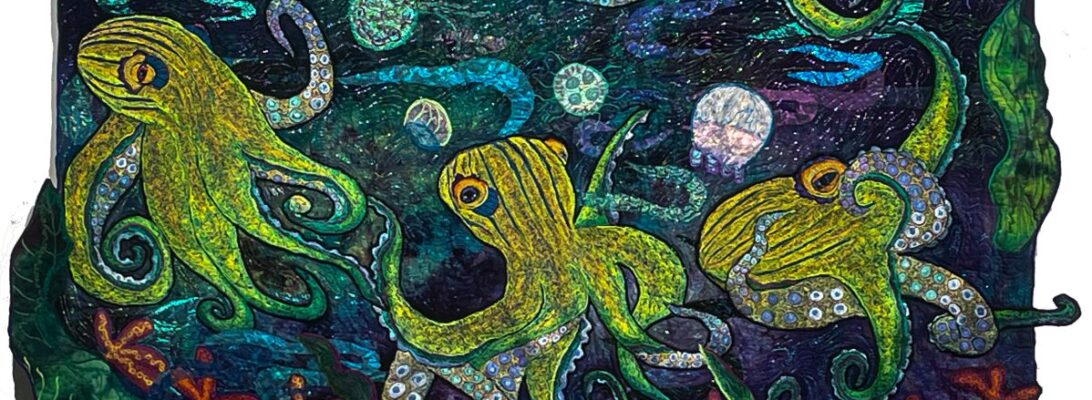
Time is Spiral

This is a special week for me. After 10 years, I’m teaching in a guild again. I’ll be lecturing at Gems of the Prairie Wednesday, May 3rd, and teaching the class The Stitch Vocabulary Book on May 4th. The class is full, but I’m told the guild welcomes non-members for the lecture. You are all very welcome to come!

It’s my developmental lecture.: How I became an artist. That’s a misnomer by the way. We are artists by the way of being human. It’s how I stumbled into my own art, and where it has taken me.

Every year I try to do something I’ve never done before. for my birthday. This year, I’m teaching a lecture and class, after a ten-year hiatus.

And on May 5th, I turn 70. I’ve always dreaded that. It sounds so old. Yet here we are. And if you’re a contemporary, so are you. As someone quite wise said to me, “If you made it, you celebrate it.” I intend to.

My life has always been a bit upside down. I’m too dyslexic to do things in a rational linear order. I started doing my art in my 20s. I married at 62. I borrowed other people’s children, although I always gave them back. And I had a lot of physical limits. 10 years ago, I pretty much stopped doing art and wrote books instead. And then Don gave me his old house for a studio. And my art flared up like a forest fire. Only a bit less destructive. It was back.

Making art is an expression of vision. Teaching is the sharing of technique. They really aren’t very similar. But they balance each other on the see-saw for good art is always bound by technique, and the ability to share technique extends everyone’s ability to share vision.

Thread Magic Stitch Vocabulary Book

In prepping for class, I’ve done some things I really haven’t done for a while. I wrote and published a new classroom book for the class. Classroom books are all about technique, and this one is chocked full of different ways to use free motion: zigzag stitching, straight stitching, garnet stitch, hard edge applique, soft edge applique and bobbin work, with extra chapters on silk flowers, globbing and Angelina fiber. Bookmaking is a skill. It was nice to come back to that again.

You’ll find the Thread Magic Stitch Vocabulary Book on Amazon in both Kindle and hard copy.

And I’ve brushed up that lecture. It was shocking to realize how much my technique had changed in three years. The revised lecture needed to cover that. My stabilizer techniques, my drawing techniques, and my stitching techniques are massively different.

To celebrate the class, I’ve put quilts on sale. I’ll have them at lecture and class but you can also purchase them on my Etsy site at www.etsy.com/shop/EllenAnneEddy

What was more shocking, was that I had enough quilts to do a full trunk show out of that three years of work, with no older work included. Old work is fun for a lecture, but I think my new work is much more exciting. Yes. I will let you touch them. It’s astonishing what gets done if you are doing it daily.\

My point is that life isn’t linear. It’s a spiral, just like time in a garden. It doesn’t start at one place and just go to another. It cycles, it stalls, it spins out, It shoots up. Flares down. But even when things stop, they come back again in a different form at a different time in a different way. I don’t think I need a thing for this birthday, except, note to Don, some new books. The journey is the gift.

You are so welcome to come to my lecture. for Gems of the Prairie. It’s at St Paul Lutheran Church 1427 W Lake Avenue, Peoria, IL, United States, May 3rd, at 6:30 PM. I’m bringing piles of fabric, books and hand-dyed threads so people can play with the toys I use.

All time is a spiral. Wait long enough and things lost come back in their own way and time. I am grateful.

The Thread Magic Stitch Vocabulary Book is Ready to Order

The Thread Magic Stitch Vocabulary Book is available to order in print!

This classroom book takes you through all the techniques I use to create my art in 5 easy exercises on 9″ squares. Then you take those exercises and bind them into your own reference book, there to remind you what works best for you.

I love classroom books. I think it’s important to give people the whole recipe for something, with nothing left out. That’s what I tried to do here.

It includes free motion techniques on straight stitch, zigzag, bobbin work, hard edge applique, soft edge applique, rocks, Angelina fiber, globbing, couching, silk flowers and leaves, and all machine binding.

If you are taking the class at Gems of the Prairie, your book is part of your class fee and will be waiting for you at class. For everyone else, you can order it now on Amazon. https://www.amazon.com/…/173228…/ref=tmm_pap_swatch_0…

The Thread MAgic Stitch Vocabulary Book is Available in Kindle!

The Thread Magic Stitch Vocabulary Book went up yesterday on Kindle and is now available! I’ve been sharing my chapters with you so you can get a taste. This is the classroom book that shows you most of the technique

es I use for my work.

I will be teaching the class, Thread Magic Stitch Vocabulary Book for the Gems of the Praire Guild in Peoria on May 4th with a lecture on May 3rd.

This is my first guild gig in about 10 years. There are a lot of reasons for that, and I don’t know that I’m back to a gig I have to travel for yet. But I am so excited to be back in a classroom, and I’ve found there are so many techniques that have changed or modified over that period of time. And so many more things I can do with those techniques..

So I did this booklet, especially for this class. But it should stand alone as a set of exercises you can use to build your skills and stretch your abilities. There is a full toolbox of free motion techniques you can include in your work with just a little practice.

You can see several chapters up on earlier blog posts.

Product or Process. How Do You Learn Best

Bobbin Work

Hard Edge Applique

Skills covered
Free motion straight stitch
Free motion zigzag
Bobbin work
Hard edge applique
Soft edge applique
Working with Angelina Fiber
Working with dyed cheesecloth
Couching
Adding silk flowers and leaves
Globbing

I tried to write a book that would cover a lot of information in a small space. I’m hoping you find it useful. You can order the Kindle Stitch Vocabulary Book right now. The print book will be out at the end of the month, and it’s part of your kit if you are taking the class.

I’m so excited to be sharing this material with you and to be out teaching again with the best people in the world. Quilters!

Stitch Vocabulary Book: Hard Edge Applique

Most people don’t think about free motion being an applique technique, but it gives you lovely curved edges with great textural lines. Here’s a sneak peek of the chapter on Hard Edge Applique.

telling the Story: How backgrounds Change Everything

Today I needed a color break. I’ve been frantically finishing the Stitch Vocabulary Book for three weeks, and I was terribly tired of computer work. So I sorted out the fabric I intend to bring to sale at Gems of the Prairie in May, That meant I set aside the pieces I wanted to work up.

Of course, that was an immense pile, Somewhere in it, I found this owl.

He really wasn’t lost. I knew he was around. I just wasn’t sure what pile. He was the third of three owls I made for a quilt that simply never worked.

I found several pieces that I thought would be amazing backgrounds. But a very strange thing happened. It wasn’t just that the fabric made the owl feel different. They actually started telling really different stories about him.

So this had a golden open door he’s going through.

Investigating a flower in the garden. Perhaps with small mice or butterflies.

Flying toward a red moon. Or is it a rose?

Is that a fire or a sunset? Is he flying towards it or in flight away from it?

Or somehow a moonlit winter night. Perhaps with snow. Or a flowering tree with moths?

I’m always astonished by hand-dyed fabric. It’s so versatile and offers so much to design. But I hadn’t seen it as a backdrop to a story. And that’s exactly what it did.

Which will I choose? I’m not sure yet. Normally I’m drawn to color. But there’s something fabulous about that winter moon. And while I work on it, perhaps it will tell me its story.

Stitch Vocabulary: Zigzag Stitch

Zigzag Stitch Vocabulary

What can you do with a free-motion zigzag stitch? Draw, outline, fill in, thread painting, sign your name, and more.

Translucence: Making Stitchery Look Transparent

I’ve been rethinking how I usually make my dragonflies for my quilt Great Blue. I picked up some new research books and I was struck how very transparent and translucent their wings were. How could I do that?

Dissolvable stabilizer really is transparent and has that look. But it’s made to dissolve if it gets wet. I can’t promise that won’t ever happen. Humidity itself might dissolve the stabilizer.

I’m pretty sure Saran Wrap would tear. Sure enough not to try it.

I I have used organza or lace. It’s a neat look and I like it. But I wanted a more integrated stitched effect. I wanted them to appear to be see-through.

So I thought about it in terms of thread choices. I love Madeira Supertwist. It’s my go-to metallic thread. There are several color ranges. One range is of solid metallic colors. But one of the color ranges is opalescent and crystal. It’s translucent in itself. So I used it in the transparent part of the wings, and the metallic parts in the exoskeleton of the dragonflies.

It doesn’t look transparent exactly. It looks reflective, like glass or water. Not quite what I had in mind, but I think it does the job.

Here’s the difference. This bug is out of solid metallic thread. It makes a bolder statement, more like an exoskeleton than like see-through wings.

All stitchery is a gigo proposition. Good things in, Good things out. When you use excellent threads and get excellent although sometimes unexpected results. I’m going to try these crystalline threads in other ways where I want a translucent look.

In Black and White: Using Black and White Photography as a Design Tool

I have a secret design tool. You probably have it too. In your pocket. Yes! It’s your camera phone.

We’ve most of us succumbed to using our cell phones as our cameras. It’s one less thing to stuff in my bra, since most of my clothes lack pockets.

One of the hardest things to evaluate in your art is value. Value is the darks and lights in a piece. Color is like candy. Or antidepressants. You reach for them because it feels great.

But value is so much harder. And vital. Texture and color shine out. But value separates the different components in your piece. The best way is to see it in black and white.

I haven’t mussed much with black and white photography since you had to give black and white pictures to newspapers. I’m really dated by now.

But a black and white image will show how the values are playing in your quilt. And will help show you how your design is moving. Your eye will follow a path made by the brightest object. If you make those objects into a path through the piece, you have a visual path that will showcase your work best.

And current cell phones make it simple. There’s a preset in your camera program that will give you a black-and-white photo.

I used this technique when my friend Sharon asked for some design help on her quilt. You’ll find it at A Visit to the Studio: Dsignng with Another Pair of Eyes,

Every design has a path through it. It can be clear and obvious. But what if it isn’t? And how can you tell?

The black and white photos tell us everything we need to know.

This is the beginning picture with the fish with reeds. This didn’t quite move the way I wanted it to. The reeds didn’t form a clear enough path.

Here we see the placement for the smaller fish. But you’ll also find the placement of the reeds moves things better.

Here’s the final picture with bubbles. The eye travels through the piece with grace.

I always encourage you to take pictures of your piece as you work on it. It’s great to have documentation about your work. But it’s also a great design tool.

The next time you’re unsure about the design of a piece, take out your phone, take a picture, and see it in black and white. It will tell you all you need to know.

Turning Over a New Leaf

We’ve talked about ways to make leaves more real. Leaves are wonderful shapes in themselves, but because they bend and fold and move, they add movement to your piece.

I’ve been working on a fish quilt that I wanted to frame roughly in kelp leaves, and it seemed like a good study on making leaves fold. Kelp is a water plant that bends completely to the movement of the water. But it has a definite back and front. We’re going to experiment with making the leaves fold for this quilt. Here we have just raw cut leaves.

I can see some purples in this as shadows, perhaps, but what I really want my thread color to do is to define the front and the back of the leaves. I intend to stitch the edges pretty heavily, so I’m going to do the leaves separately. I’ve cut leaves freehand from several scraps of green and glued them to felt with Steak a Seam 2. On the back, I have Stitch and Tear which is a crisp tear-away non-woven interfacing. So my embroidery sandwich is my hand dye, Steam a Seam 2, and Stitch and Tear.

I took a piece of the release paper from the Steam a Seam 2 leaf cuts and have folded it in different ways so you can see how that affects the leaf. The front side edges will have heavy crenellation on them. The back sides will be smooth where the folds are.

My thread zones are back and front sides. The front needs to be bright/dark /intense colors. The back needs to be muddy, greyed, soft colors.

It seems like the fabric should define the leaves completely, but I’ve found that’s never really so. What defines much of the leaf color is the thread. If the thread is purple it’s at least a purplish leaf. Sometimes that’s the way to go.

stitching the leaves

Here’s a video showing the crenelated stitched edges.

The leaves fold in the water. On the front side, their edges are crinkled and bright. The edges on the back sides are smooth and greyed out. once they’re applied to the quilt I can take sheers and lace and overlay them with water so they look wet.

Here are some of my separate leaves, made to fold in the water.

I’m not so sure about this layout. I think I need to leave it on the wall for a while and see if I have the placement right. I may have overdone. But since nothing is stitched down, nothing is written in stone. I’ll see how it looks in the morning.

To explore more ways to make leaves check out my previous blog post, Over and Under