Do You Need an Industrial Sewing Machine?

This has been a burning question for me over the last 6 months. I live and die by my sewing machines. It’s what I do. I sew every day around 4-5 hours a day.

Over that time, I;ve locked up 2 220s, 2 930s and a 770, all Berninas known to be tough and durable. I’ve felt like a general who’s horse has died, getting on another horse and inadvertently shooting the new one. It’s been ghastly.

What it’s about is the intense embroideries. They feel like the heart of my work. They’re intense, detailed, textured, and, pardon my vanity, show stopping.

I can’t seem to make them without breaking machines.

I went through this a long time ago. I burned the brushes off my 930 and bought an industrial 20U Singer. It was not a perfect answer. It was way too fast. It chomped through thread. It was incredibly noisy. And impossible to control.

Eventually, I stopped making those larger embroideries.

Lately I’ve needed to work those large embroideries. And we rescued the 20 U from where I left it at Porter.

It was the right decision. Don put a servo motor on it to slow it down. It did a very nice job with my #40 polyester threads.

What is a servo motor?

I’m not sure of the mechanics of the thing. Functionaly it’s an industrial motor with a rhiostat. You can adjust the speed to your taste. It’s infinately more quiet, and takes up a lot less energy.

I wouldn’t say it was the right thing for everyone.

What can an industrial machine offer you?

It is

  • An incredibly tough machine
  • An incredibly fast machine
  • An extra wide zigzag stitch

Those are very different skillls from a home machine.

There is a down side.

  • They are huge. They take up a large footprint in studio space.
  • They are harder to manuver. I’m still finding my way about managing stitch angle with it.
  • Unless you slow them down, they’re too fast for many threads and applications. The servo motor is the best way to control that.
  • You can’t pick it up and take it to a mechanic. You’ll need to fix it yourself or find a mechanic who does house calls.
  • They’re kind of crude. They’re rough machines mechanically. Simple to work with but they’re not sophisticated.

Don made this work for me by installing a servo motor. That motor is a miracle. So is Don. I’m grateful for both.

Am I sorry to be working with an older machine? No. They don’t change that much. As far as the changes in machines over the last 50 years, the most important one was being able to set needle up, needle down. With the servo motor, it’s in excellent fighting shape. These machines are indestructable.

Am I thrilled? Yes. Downside and all, I can tackle those big pieces without making a collection of broken sewing machines. Will I use if for everything? Probably not. Again, hard to control.

Want to come play with my new machine? Give me a call and come over. It’s like running a tyranasarus that sews.

There’s No Antidepressant Like Color. Except for a New Machine

For those of you who have been following along, you know we had a machine crisis for most of last year. It turns out that what I’m doing is really hard on machines. I’m finding my modern machines are just not up to the challenge.

Enter Ebay and Don!

Don found me a newly restored 930 Bernina, It’s a love. It’s still not a strong enough machine for the denser embroideries, but that’s ok. We have a servo motor for the old industrial Singer 20u. Don says he will be ready to start the switch on the motors perhaps next week.

1169-25 In the Shell

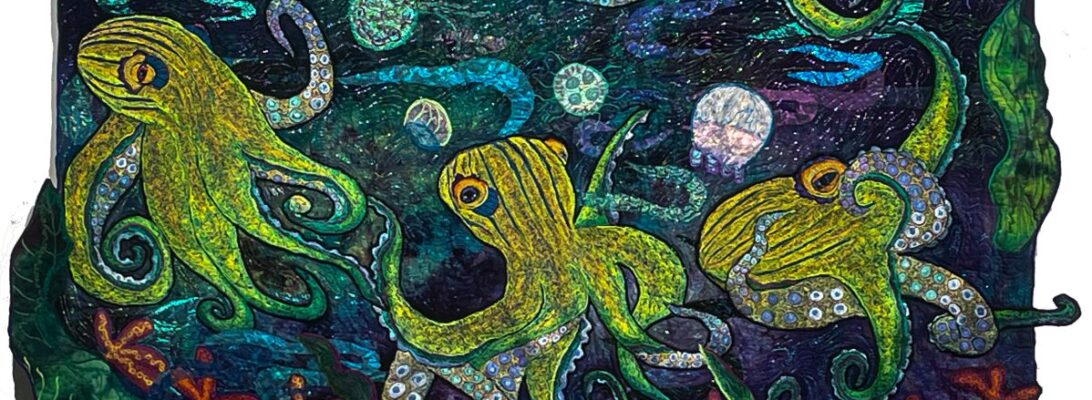
So in celebration for the new baby, and because I finally had the right tool, I got In the Shell finally bound.

Do you remember the feeling when you got a new box of 64 crayons? That’s a large enough number that they had some with silly names like Mac and Cheese. Open up the box. Choose your color. Instant antidepressant!

This quilt had the same effect. It got me through machine withdrawal, over the last months.

Madiera has a line of polyester embroidery thread called Neon. It isn’t all neon color. There are restrained greys and browns. But there are some kick ass oranges, yellows, greens, pinks, and reds, You get the idea.

This quilt was a mood lifter. Partially because I love the idea of a baby octopus in a shell, and partially because the colors could knock socks off.

Between the machine and those colors, I’m feeling so much better now.

Never be afraid to use the brightest, boldest colors. They’re not only lovely. They’re good fiber for your diet. And they fight depression. Eat the rainbow!

She Sells Sea Shells: A Study in Contrast

I haven’t made a lot of shells before. Starfish, yes. Jellyfish, inevitable. I find shells daunting. They’re not easy to draw, and they can’t be made to look like they’re moving. So this was an experiment.

Designg for contrast

One way to look at design is how to separate the field from the ground. You need to create differences that help the eye sort out what it’s looking at. The shells should be immediately different from the octopus and the sea.

This quilt required a shell for the octopus, And a tangible difference between them to be visually clear. The way to make things pop is to create a visual difference between differnt design elements of color, texture and size.

The color palate makes a clear separationg. The octopus is strongly orange, contrasted by the complemetary blue sea, and the off white and browns of the shells.

But we can make that contrast even stronger through the texture. Texture is made by stitching patterns, thread content, and thread size. Those design decisions clarify the design.

Shells are deeply textured with a smooth inside. I didn’t show the shiny insides of these shells. So the outsides needed to be crunchy and rough.

So the octopus is garnet stitch in polyester thread. The shells are out of both wound and flecked metallic threads. The threads contrast strongly. Metallic thread is much rougher than the smooth polyester. Both threads are 40 weight.

I also used a zigzagged scallop pattern for the shells. I stitched the rows irregularly with ribbed veins, so they’d seem more natural.

The water is stiched with an 8 weight metallic to separate it from the shells and the octopus.

Thread choices help the eye separate the shells, the octopus, and the water, ‘It helps your viewer unnderstand what is happening in your piece in a glance.

This piece is ready to back and bind. I’m just waiting for a cool enough day.

Saint Don of the Dead Sewing Machine

This is a cautionary tale. I’m hoping someone can learn from my mistakes.

Maybe you can sew too much.

This has been a bad year for sewing machines. I’m trying to figure out whether I’m really sewing that much more or whether it’s attrition, or just bad luck. I’ve broken 3 220s, been told my 770 is worn out at 31 million stitches (in four years) and had two 930s break down.

My mechanic has two of my machines in shop. I was down to working with a 807 minimatic. I love my mechanic. She’s meticulous. On average, she takes 2 months to fix a machine. It’s not an instant fix.

For this discussion, I’m leaving brand names off the machines. You’ll probably know what the numbers mean. They are all machines known for their tough durability. That doesn’t seem to be enough right now.

Thank you, God, for Don.

I knew Don had worked on vacuum cleaners in the deep dark past. I didn’t understand what that meant. Don is a small motor specialist. Sewing machines are about small motors. He had fuddled with several older machines and got them working. I had no idea how skilled he was.

I had two 930s. One was my machine from when I started. I picked up the second because the first was soooooooo good.

I had put them up on the rack and not used them for a while. But as machines kept going down it got more desperate. We pulled them down, decided which was less beat up. It sewed like a top for around a month and then locked. We brought out the second machine, made some adjustments. I got two months out of that. Then it jammed.

I was so upset I couldn’t even cry.

In came St Don. He watched a bunch of videos, took both machines apart. We saw what was fixable, and was not. Then we had the kind of transplant surgery where really only one patient survived. He dusted it off, I oiled everywhere and now I have Frank En 930. But it’s working.

What did I learn?
What would I say to anyone doing the kind of embroidery I’m doing?

  • Skip the bells and whistles. You need something tough. I do think most of the machines today are much more fragile.
  • If you have a machine that’s working for your craft, don’t ever turn it in for another machine. It’s not necessarily able to do the same things for you.
  • If you have an older machine that’s working for you, find an extra one for a parts machine. It doesn’t need even to run. But it means you have the parts to fix things, even down to the right screws.
  • You’ll probably need someone like Don. You can’t have him but you can find a reasonable facsimile. If you do, feed him plates of brownies and videos. Other treats may be applicable. You need someone able and willing to hunt the snark (whatever is wrong with your machine), and brave enough to take the back off the machine. I’m fixing his third batch of cookies today. We can’t let him run out.

My next sewing machine

This has changed how I feel about my machines. Instead of looking for the great new features (which are a wonder) I’m looking for something with alligator blood. Pulling out my 40 year old Berninas was a really good patch on this.

So I pulled out another old machine I hadn;t even moved with me when I moved to Ga;lesburg. Luckily, the man renting my house had left it in a safe place and not disposed of it. A 20 u is the machine I bought when I blew the brushes off my 930 for the first time. It’s the machine you’d find at a drycleaners. Very fast. Uncontrolable except for straight stitch clothes construction. In the end, I stopped doing the elaborate embroideries.

But those are at the heart of what I’m currently doing. I can’t give them up. They are at the heart of my art right now. They are the flame I’m drawn to.

Things change. My threads and stabilizers have changed since then. And what is available for a fix has chnged too.

I’m putting a servo motor on my 20u industrial to see if we can tame that machine to a reasonable speed for embroidery. And I’m looking for another 930. Other than for demo, I’m done with plastic toys.

Don, neither plastic or a toy, is a total keeper. So he is now St Don, for healing the halt, the lame, and the blind stitch.

Wisteria Blossoms

Sometimes hand-dye designs your quilt for you.

I had embroidered a radiated spoonbill landing, and I needed a background for her. This purply brown piece seemed nicely swampy and I loved the range of purple running in an arc through it. It looked like a bower of wisteria, so that’s what I went through.

I’ve done wisteria before. I sometimes feel I can smell them in the studio as I stitch on them

I wanted particularly soft glowing wisteria for this very dark swamp. These were done mostly from hand-painted lace, stitched with poly neon.

And small bright birds sitting in them.

On thing leads to another. The bird leads to the swamp background. The swamp leads to a wisteria bower. And the wisteria need bright little birds.

Wisteria, like roses, sunflowers, and hollyhocks, are part of the garden of my dreams. I can’t help but slip them in wherever their fragrance and illumination are needed.

The next step is to fit everything in together with a pond at the bottom, birds, and small fish.

On the other side of the studio, we have 2 torn-up 930 Berninas. Don has been heroically deciding which will live and which will be a parts machine. I’m working on the only functional embroidery machine, an 807 Bernina from around 1970. It’s a tiny machine, originally for classroom. We’re waiting for the resurrection, which sometimes spreads more slowly than you would like. It means I’m not able to work the 2 large quilts I have laid out at the moment. So….

An ocean floor, several external tenacles lots of jellyfish, I think. On a much smaller piece of fabric.

fluffy: Making Feathers with the Long and Short Stitch

This is what I did this week. She’s a secretary bird.

I have to thank John Muir Laws book Law’s Guide to Drawing Birds for its descriptions and information about different kinds of feathers. I’ve been pleased with my pinions, tails and wing feathers for some while, although I wanted them to be less stripey.

I like these pinions. But even with overstitching, they look a bit stripey to me. I’ve been working at overcoming that look by more irregular uneven stitching on the feathers and overstitching.

Body feathers are different. They’re fluffy. They aren’t a part of the flight system. Instead, they are a body cover.

The Long-Short Stitch

I went back to an old embroidery stitch pattern that gave me exactly what I needed, The long short stitch is made by moving your hands unevenly from side to side with your stitching. I made the scallops I would have made for breast feathers, but ragged and without outline so they blend into each other.

Long-short stitch

  • Fills in beautifully.
  • Doesn’t need an outline.
  • Doesn’t need to completely cover the fabric to be effective.
  • Is easy and forgiving.
  • Utilizes a simple zigzag stitch moved from side to side.
  • Progresses nicely. You can add multiple colors of stitchery to build shadow and form without adding a hard line.

The long short stitch in freemotion embroidery has nothing to do with a machine stitch set on your machine. It’s all in how you move your fabric through the needle.

The piece shades from dark underneath to brighter up the neck. But because there’s no internal outline, it looks like fluffy feathers. It’s a bit tougher because we’re shading to white. It needs to look white without actually being a white hot spotlight.

I’m planning this background and sun. Not sure what happens after that. Heavy grasses, I think.

For more information about the long-short stitch check out The Long and the Short of It.

Bird Feet: The Difference in the Details

One of the reasons I like working larger is that I get to play with the details. Smaller images sometimes only need a line of stitching to define things. Larger images allow me to play with color and texture. And the space to make the details count.

There are a couple of defining factors. Are the legs and feet segmented? A solid line of black stitching defines that.

These feet were stitched with progressive colors in garnet stitch, small circles intertwined together.

Does the stitching flow into itself? These have simpler feet and legs with segments.

Does it have patterned stitching? These were stitched in u-shaped scales.

Garnet stitch textures these feet with quieter tones.

Of course, the angle of the legs creates the movement of the bird.

And you can cheat by putting the feet in water.

Different textures, different treatments make the kind of details that define the piece.

Avoiding the Easter Bunny Look: Shading with Pastels

Anatomy of a Color Scheme

There’s no help for it. If you are shading a pink bird, you’ll need to use pastels at some point. I’m not a fan. But you don’t get to throw out a section on the color wheel. Eventually, you’ll need all the values: tones, jewels, and pastels. Tones and jewels. Yes! Pastels. not that much.

Let me break down the color scheme for you.

There are six color zones, in the feathers of this bird, and then a zone for the neck and thighs, the feet, the head and the bill.

There are two progressive color themes going on. The pink under body and feathers, and the green overstitching. Both progress from dark to light.

Where did it go wrong? I chose the wrong yellow.

White objects are rarely pure white, unless you want a posterized deco look. They’re made up of other colors pale enough to be perceived as white. The bird itself is pink. I pulled in bits of lavender and yellow to blend it and to create a shadowed projection. I chose the wrong yellow. If you look at the top feather, you can see a strip of yellow that’s pretty loud.

You know that kind of Easterbunny pastel. Yellow, pink, blue, purple, and maybe green. It’s only appealing if you’re under the age of five. It missed here. I stitched some cream and natural white thread all over it.

Then I added the overstitching. The overstitching takes center stage, and the yellower bits back off. I think I’ve saved it. It also browns out the pinks a bit. They’re all there, but quieter for the green.

What should I have done? I should have lined up that yellow in a row with the other colors and taken a black and white picture of it. I would have known right there. But I’m happy with it now.

I’m ready for the next step, which is the background. And I think it needs yellow fish and birds.

Rethinking retooling

This last year has been a disaster for my sewing machines. Most of my work depends on intense embroidery. Lately I’ve depended more and more on that stitchery for my images. I love it. But it does wear and tear on the machines. I had 6 major machine breakdowns. last year. I broke down 3 220s, my 770, my 630 and a 930. Some have fixed. Some have not.

I’m a Bernina girl from way back and have been a Bernina Ambassador for most of my career. I work with Berninas because they are tough and they stitch accurately. That doesn’t mean they don’t break down, Particularly if you’re sewing at speed demon speed for hours on end. I was told this is my fault.

I suppose it is. It’s what I do. I can either back away from this kind of stitching or find another way.

Zigzag embroidery allows for intense detail and color, I can’t step away from it. I also can’t keep breaking machines. So something has to change.

Don is my miracle in this. He’s a wizard with older small motors. He’s not specialized in sewing machines, but very mechanically savvy. He’s collecting manuals and parts machines. As always, he’s my hero.

I really can’t function though without a working machine and I prefer 2 backups. I’m not exa sane without a sewing machine.

Years ago I bought a 20 U Singer for intense embroidery. That’s not what these machines are known for. In a way, they’re the cockroach of the sewing machine world. Not in the sense that they hide under the cupboards, but because they are pretty much unkillable. You find them most often in dry cleaner shops for repairs.

It was a mixed success. This thing eats babies and cats, breaks thread constantly, and is fast—too fast—even with different slower pulleys. And it was the weight of a tiny elephant. When I left Porter, I left it in my studio, where it has sat.

Ken, the person renting my house, offered to bring it to me. That in itself is a huge glft But I’ve had my reservations about making this machine work. I first felt I was stepping backward, Is it an answer to the same problem? Is this machine tough enough?

Well, we know it’s tough. Can we make it work with embroidery thread? There’s the question. It’s also paid for.

It had its problems before. But things have changed. I now use stronger threads. I no longer work in a hoop. And we found that a servo motor would step down the speed. So it’s coming to the studio sometime this month, and we try it out. I’ve gone from feeling like I’m stepping back to seeing new possibilities.

You can’t step in the same river twice. You are different and the water is different.

I’m digging out the studio this week to make room, which is why I don’t have new work to show you. I’ll let you know what happens next.

Wish me luck. I think it’s time for another spoonbill.