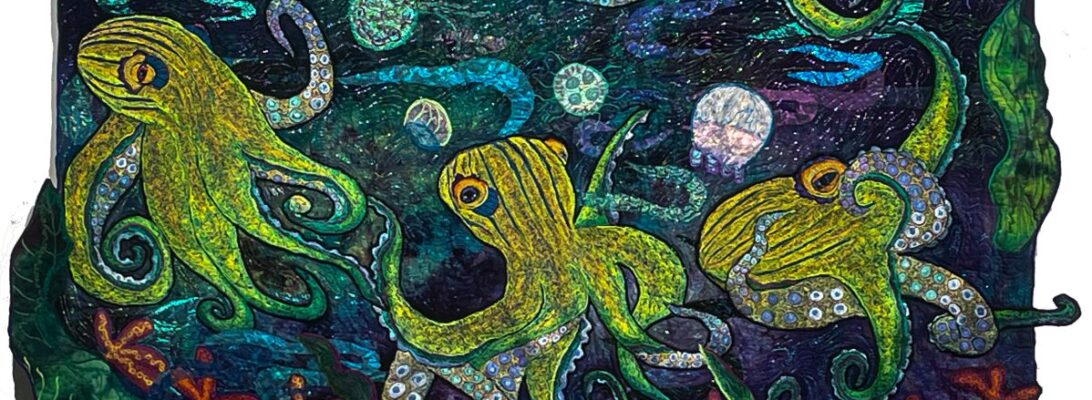
Every image has to be attached to a quilt at some point. There’s more than one way to accomplish that. But the one I use most is a solid black line of polyester zigzag embroidery.
That sounds dull, doesn’t it?
The black poly outline does more than you would suppose. It creates a crisp outline.
I’ve tried using other colors. Bright, light, neon colors. Nothing gives the same punch as black.
It’s not true of flowers. I can use a bright color outline on a flower that pops it perfectly.
The outline defines the edge visually. If you want it to show up across the room, you’d better make it bold. The outline is the finish line.
I’m just finishing outline octopus 4. One nurse shark is outlined. One is not.
But it does two more things. It makes the image puff just a little. I like the 3-D effect.
And it holds images down solidly. These embroideries wave around the edges like the flag on a windy day. A light line of stitching does not hold them down well enough.
I did not need to cut either the sharks or the octopuses, to get them to lie flat for this quilt. All of it was done with a heavy black outline. The thread traps the edges and mashes it into place.
I used to use black metallic thread to outline metallic images. But since that has to be done with metallic thread in the top, it’s an all-day sucker. Takes forever. Endless breakage. The polyester thread doesn’t have the same shine. But I only have so much hair I can pull out in one afternoon of sewing.
I’m always astonished at how much an image can change with positioning. One of the advantages of component quilting is that it can be moved endlessly to get the placement right. I went to embroidering large images some while back. But I’ve learned several other things component quilting allows me to do, and I use it constantly now.
Changing Processes
Three changes in my process made this work: component quilting, pin-ups, and daily process photos. I work with components rather than images stitched into the work. I do multiple pin-ups for placement, and daily process photos that let me track the changes.
These are all relatively new for me. But it wasn’t something I planned. I just happened to find these processes helpful, and now do them regularly just in my studio work.
Component Batch Quilting
Batching a number of elements at once allows freedom later on in the project. Instead of just doing the larger images, almost all of the embroidery is on a separate sandwich, ready to cut out and use.
I’m free to change my mind about each element. If I embroider a moth in the piece, that’s where it stays. Right or wrong, it’s not going anywhere. You live with your choice. If the moth is separate, I can move it indefinitely.
I can make images from the same color choices that are in the same range but unique.
I can always use whatever is left over. There are never enough fish, frogs, bugs or birds.
The first pin-up is where I design my quilt. Once I put the quilt top on a sandwich, I put my main images in, see where they might fit, to rearrange things.
But the first pin-up is only a beginning. In this case, I did my pin up, added my elementals, and pinned it back up with those included. My original intent was to have the octopus learing over the top kind of like Cthulu. But it was flat.
So I gave it a twist. To make something move, put it on the angle. I angled the octopus, to put him into motion. Then I angled the other elements to echo that motion.
Picture This. by Molly Bang, is the best book about composition. It’s about how people process imagery. First, she illustrates Red Riding Hood with rectangles and triangles. And she made it work.
But she explains how we see things, what meaning we take from images.
If you are an artist, run out and buy this book. Then buy another 5 copies, because you’ll want to give it to every artist you know.
She has some very useful observations. Horizontal lines are stable. Vertical lines are stable. Angled lines look like they’re falling. If they’re falling, they’re in motion.
I angled the octopus to echo the left jellyfish.
Then I angled the nurse sharks to echo the octopus.
Daily photography
Having daily process shots gives me so much information about what is and isn’t working in a piece.
Including a black and white picture to evaluate values.
I’m always surprised at how much a little twist can do.
Octopuses have put me in the land of the garnet stitch. It creates. textire and pattern, all within it’self.
Garnet stitch is one of the great non-programmed stitches. it’s simply moving your hands free motion in circles. Check out the Variable Garnet Stitch for more information about the stitch.
Garnet stitch has another very useful feature. You can always see the background behind it. Sometimes that is to be avoided. I pick my embroidery background to match the overall background carefully, so only the stitching stands out.
But sometimes I want the embroidery background to shine through.
This was one of those times. The background for this piece is darker and moodier than the other pieces in the series. I needed something to lighten it up. So I used a very odd cream and green background. I love it. I have a green and cream light octopus in a dark sea.
We are on to the pin up stage for octopus 4. That’s always the moment of truth. You know if it’s going to work at that point.
Because I’ve made small metallic fish and 2 nurse sharks, I have my components to fill the space and set a path. I’ll tweek it some, but the design is pretty much there.
There’s a lot of stitching left, and I need to do my water layer. But I’m confident I’m going to like this piece.
Just to show you where I am in the octopuses garden, here’s the pieces so far.
One more at least to go. Does it look like a show yet?
I have a very hard time when things finish. I’m an INFP for those who know Myers-Briggs. I’m happier with things left open, possibilities, choices, options. That moment when something is finished is joyous, but it’s also an end, a loss, as well as a win.
This could be an excuse for the large pile of unbacked and unbound quilts sitting by my machine.
.I have a friend I just heard is dying. One of those good and bad things about getting older is that we sometimes have thirty-year-old friendships. It’s like the world shuts a window that was a bright and different view.
I don’t know how to say goodbye to a friend from that long ago. He brought me wonderful art books helped me write and publish my first fiction writing, and took me to my first country dance. Wonderful gifts. I sent chocolate Haagen-Dazs, soup, and M&Ms. We bring whatever bits we have.
I hate watching things end. Even in art.
There’s an energy to art that might be its largest purpose. There is a connection between you and your art that wizzes around the room, even in the duller processes. I do believe art is alive. It has an energy of its own, and it communicates what should happen next. It is not your child. It’s a partner in co-creation. While you are making it, it’s remaking you.
There is a finish line, a moment where the last stitch is stitched. The energy stops swirling. There is an end. It’s wonderful, but something is lost.
But at that separation, something else happens. The connection between the art and the artist is cut like an umbilical cord. But art finds its own place. In someone else’s world or heart, it goes on to do other things for other folk. Art soothes people, riles them, teaches them, inspires them, but most of all, it changes them. If art is really good, it lives past you. Nothing really ends. It moves into the next space. Other challenges. Other purposes.
I’ve peppered this post with photos of the quilt I’m currently finishing. We’re stippling today. Almost done. It’s a good thing I have another quilt waiting in the wings.
Once I find something that works, I tend to stick to it. A creature of habit, like anyone else. What pushes me out of the box? Mistakes! Misorder! An inability to find what I need! Basically, it takes a catastrophe. Fortunately, it doesn’t have to be a big catastrophe for it to do the job.
I really love using rocks in my work. They weigh a piece. They can form a visual line. They add a dark shadow or highlights depending on your color choices that frames the piece. They identify the bottom of a piece.
I sat down and started cutting rocks for the Octopus surround and realized, I didn’t have enough rock fabric. I dye greys and browns specifically for rocks, But there is almost never enough. And greys and browns are regular backing colors I use all the time. But if you’re working on three quilts at once, that’s a lot of rocks.
They also need to be differing colors. Rocks are never all the same. That’s part of their charm. They need to fit well enough to be identified as rocks, but they need a separate individuality to work.
Earlier this year, I ordered a box of cheesecloth. I use dyed cheesecloth for leaves, flowers, and other translucent things. I bought a box of cheesecloth at Joann’s every year or so. That cheesecloth was a uniform open weave,
Now that Joann’s is gone, I found that cheesecloth is graded in sizes by the number of threads per inch. Makes sense. It’s how we class thread and fabric.
I overestimated and ended up with a much tighter weave of cheesecloth. At first, I thought it wasn’t a problem. Then I realized it was much less transparent and much more like regular cotton.
I’d dyed a batch that sat on my table for a long time. It lacked the same transparent grid of the lighter-weight cheesecloth, and didn’t do the texture of leaves as well.
When I went to clear the table, there it was, in about a dozen browns and greys.
So if I use cheesecloth for rocks, what changes? I have to choose a background that will show through. The weave will show through as a grid of sorts, but that can be pulled in different directions and stretched.
Normally, I stitch my rocks on black felt, because it gives me an edge that fits with the stitching. If it’s all backed in felt, it should work.
Interestingly enough, what changes is how the stitching looks. Straight stitching sinks into the texture of the cheesecloth and is less visible. But the cheesecloth makes it more textured.
I’m not sold on cheesecloth for rocks, but I think it works here. I can always stitch heavier.
Over the last couple of months, I’ve been working on a series of fish in the waters. This is an important symbol for me. It explores surviving strange waters, rising out of the depths, swimming with the current, and swimming against the current. It’s about flowing water and changes. It really checks all my boxes. It also serves as a connection with my father, whose religion was bass fishing. Since going fishing made better people than going to church, I respect it deeply, even if I won’t eat fish. I live in water.
So I noodle at the fish-in-the-water image often. If you’ve been following the blog, you know I made one quilt I loved, and I wanted to see whether I could recreate the energy. Not the fish or the river, but the energy of the piece.
Epic fail. I made a very nice other piece with similar hand dye, a fish I drew 5 times before I was pleased, and similar oil paint stick rubbing for the forest in the background. I hated the first fish I embroidered. I stitched a more active catfish, that was better.
Then I took a break and went to find the studio floor. Again. Everything flutters to the floor except the things that go clunk.
There it was, the best background for the embroidered fish I rejected. The fabric made a vortex, so I did too, out of stitching a swirl of sheers.
I didn’t learn anything technical from the exercise. But I did confirm what I already knew. It does me no good to recreate something. Another piece will need different components and approaches. I didn’t need to be making arbitrary rules for myself. I needed to listen to each piece to give it what it needs. If I thought I was in control, that was delusional.
Maybe this is a right-brain, left-brain thing. I’ve been struggling to organize both in the house and the studio. That’s a very left side of the brain thing to do. It’s foreign thinking, but it’s less grim than Swedish Death Cleaning. You know what? No one ever did teach me this. Certainly not my mother.But that shouldn’t stop me. If you don’t know how, you can learn.
So cleaning does turn into art. Eventually.
As Don says, “I’m a man. I can change. If I have to. I guess.”
I can too. If I have to, I guess.
Of course, I hung the quilt up and noticed that the wonderful spiral stitching in the center is unnoticeable 3 feet away. Small flowers and thick thread to the rescue. Of course, the pond has floating flowers.
The change isn’t a technique or a new technology, really. The change is learning to listen better.
Last week has been spent in fish production. I can’t really put in the octopuses until I have the fish to create the path around them.
Usually, fish have scales, and the scales divide the space..You progress from scale to scale, picking lighter colors as you get to the underbelly. You fill in the scales darker on top and progressing through lighter colors around the belly. It’s pretty. It gives depth.
What if you don’t divide the space? You can stitch row after row of color next to each other. It looks stripy. There’s a place for that, but it’s not very natural.
It doesn’t work for clown fish.They blend from one color through another without separation.
So how do you fill in a larger space? One way is the short and long stitch.
You need to understand that none of this is a stitch on your machine. It’s all zigzag stitching. The change is the angle in which your fabric goes through the machine.
The long and short stitch is done from side to side. The difference that it spreads from both sides and fills in unevenly, shading the area softly and without stripes. The top and bottom of the image has a solid line to outline.
That kind of shading allows us to put in darker contrast colors to shade that blend right in. These fish are shaded with a dark and then a lighter purple. Since the colors are mostly covered with orange thread, your eye blends them into a shaded solid orange.
All of this is for the octopus’s garden. This is my second pin-up. I think it needs one pillar rock and some water, but it’s ready to back, and stitch.
A while back I decided to see if I could recreate the energy from a piece I was particularly pleased with. If you’ve been following the blog, I’ve documented it as I’ve worked.
I wouldn’t call it a success. I went through three separate fish, not happy with any of them. I embroidered the best of them and still felt bland.
So I passed on the bass and did a catfish, which I’m not displeased with. The bass went back into the pile.
I can plan all I want. There’s a serendipity to art that is inescapable. While I was scraping out the studio, I found a piece of fabric I’d totally forgotten about.
All of a sudden, my wallflower fish had gone dramatic. I built him a whirlpool/vortex.
My fish fooled me again. I spent some time embroidering some nice metallic minnows that shyly blended right into the background.
They are pretty, but they have no punch.
So I’m trying these brighter gold minnows. I’m still not sure. They’re embroidered from poly, and they might stand out too much. I may need to do some from metallic gold.
The octopuses’ garden series is working up. I finished up with the MAP kids, got enough rest to face the studio, and discovered that we had to find it to face it. Prep for a class leaves endless clutter and many nice neat piles sprawled everywhere.
It will be a while before we find the table. Then we can search for the floor.
But in that process I’ve started the next step for the octopuses.
Why do I need all those fish? The octopuses are all well and good, but they’re not going to be dynamic without something building a path. So we are making fish. The fish are what will make the octopus quilts move.
I mean a lot of fish. Ive got somewhat close to 50 fish drawn for four quilts. Will I use them all? Maybe.
This is about fabric scarcity. A year ago, we could get almost any fabric. This December, I had to beg a dye house for my order of pdf cotton. They had 50 yards in-house that they were portioning out to their clients.
I hate that. I hate depression economics and carefully crafted source shutdowns. I hate the idea of saving rubber bands and string. We’re there. All of a sudden, hand-dye is precious, and I need to be careful to use up the little bits.
Today I went through felt, hand-dye, and stabilizer scraps. It was a good thing I was cleaning up and sorting. There are some scraps I keep good account of. Anything brown, gray or stony ends up as rocks in another quilt.
But here I was scrounging for backgrounds for fish. Normally, I dye fabric especially for the larger embroideries. This last year, normal has fled out the windows.
I’m not going to talk about why. It’s incomprehensible anyway. Why was Joann’s so reckless as to go defunct? I suspect greed and stupidity dancing arm in arm off to court. Joanns is gone. Our place to run out for everything sewing is gone.
Walmart used to have a decent fabric section. Now it has an isle of highly unappealing cuts made from mostly poly blends. I’m deeply underwhelmed. I suppose you could use it for Halloween costumes.
Thank God there are quilt shops. But so much is catch as catch can on the internet. Do you need needles? Sheers? Felt? Not always at the quilt shop.
So all of a sudden, all of my hand-dye is limited. And precious. And I’m digging scraps out of piles to embroider on.
If I sound like I’m whining, I am. I hate scrapping for fabric. I’ve spent the day digging through fabric scraps, trying to make it work out. I’m not open to discussion about this. This is just how I feel.
The real question is, do I really want to do my art? No matter what?
I don’t understand making an arranged shortage of anything. I don’t get it. It’s stupid with a funny hat on it.
But I’m dammed if I won’t do what I can with what I have.
So, how do we find the fabric that is out there? I’m not sure.
This is a brave new world I don’t like very much. Women don’t count. Art doesn’t count. Sewing doesn’t count to the point where it’s not even treated as an industry anymore. Everything plastic glitters golden.
When the quilt world started, men really didn’t notice. It was something women did for each other. Men considered it pin money. Quilt shops flourished from the early 70s to the 80s before men inserted themselves into the industry in a “professional” way. Things changed. Fabric was a big business. They waded in and took over. Now they drop it like a stone.
So if it’s not an industry anymore, what do we do now? We need to figure it out. And since the male fabric industry has no interest in our needs, we need to figure it out together. We’ve always known how to find fabric for each other.
We need to support any fabric store we can. If we need them to be here for us, we have to be here for them now.
We need to find new ways to find fabric.
And I’m finding scraps to embroider fish on, because it’s what my pieces need.