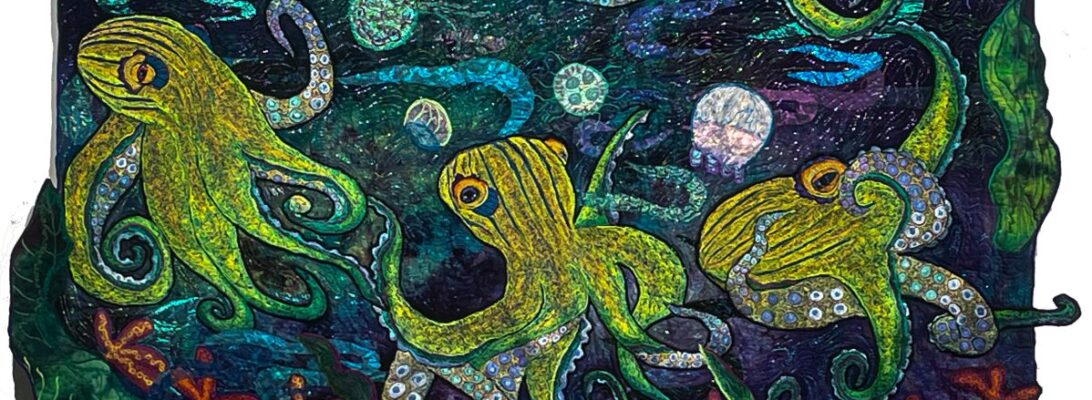
What do these two quilts have in common? Not that much. They’re a different shape. They’re a different color space. They’re a different time of day. They’re clearly both heavily embroidered and oil paint rubbed. But other than that?
They both needed small elements to guide the visual path within. I made all the bugs for White Garden. But I didn’t need them all. The others went into Fire Flies.
Large embroideries take time. I draw them, look at them with some scruteny and eventually embroider them after I’m sure they’re right. It takes time. And effort. Usually a larger embroidery takes about a week to a month. They are a long term investment in time and energy.
If I’ve drawn them well, they should have energy and movement within them. But a good moving image needs to be placed in motion. One easy way to create movement is by the stepping stones of smaller elements. I often use rocks, bugs, butterflies, frogs, flowers and other natural images to help direct that path.
So it stands to reason, I need a lot of those. I do make batches of them for specific projects. But I always make way more than that one project needs. I used to stitch them directly into the quilt. I’ve changed to stitching them separately because it allows me much more flexability.
Why? It’s time effective. I don’t need to set up the thread, redraw the cartoons, and go through just enough flowers or bugs. A batch of them, with leftovers is as good as extra waffles the day after you made them. It’s just smart.
It’s also fun to sit down to a sheet full of little fish or flowers. It’s a lovely 2 day project, usually.
Do I have a collection of these things? You betcha. But they go away fast. There’s always another quilt that needs a trail of bugs.
I’m worn out after doing a bunch of big pieces. Big is of course, relative. I consider anything past 33″ x 43″ largish. I like workin that size. But the last ones have stretched larger, and I’m tired of shoving large wads of fabric through the machine.
I’ve been working on a white garden piece. The idea came fromThe White Garden, a speculative fiction about Virginia Wolf. She was thinking about an all white garden for the blackout, so that the moon would show on the white petals. I found some embossing plates that were wonderful prarie grasses. I put them on dark blue hand dye in shades of white and blue.
I’ve never had the dicipline to plant only white flowers. Too much of a color junkie. But I love the idea.
This is a visual path piece. It’s about 12″ x 45″ So everything has to be tiny.
So I made a strip of white and pale flowers. But then it needed moonlight and bugs. No one said the bugs had to be white.
How is tiny embroidery different than large pieces. Several things work differently. First off, I want to avoid a thick outline. So instead of embroidering on a sandwich of hand-dye, felt, stitch and tear, and totally stable, I left out the hand dye, and embroidered on the felt instead. Since I wqs using black outlines, I used black felt. Using felt reduces the bulk, but I found it could not be ripped out or sewn over. This is partially why I made a lot more bugs than I would need.
I could have embroidered tiny pieces within the piece. But I chose not to this time. It still makes for a lot of distortion. So I did a batch of moths, fireflies, snails and rocks.
Embroidering tiny pieces insists upon simplification. The usual shocker-shader colors are too much. A simple range works better: gold and green, white and blue, green and blue.
The fireflies are also mostly unshaded. There’s no room for anything except the primary colors of red and green.
So my white garden is full of wild color, very tiny bugs. I think I could find my way in it.
As quilters, we are excellent borrowers. Quilting as an art form is relatively new. Art quilting really didn’t exist until the 1970s. Rotary cutters were originally used by fashion semstresses. Surgical seam rippers and hemostats are medical tool that tranformed instantly into quilt tools. Men’s fishing bags, now designed in woman’s colors are the package of choice for sewing kits. We know a good thing when we see it. And we’re not too proud to use it. It doesn’t even need to be pink.
Those tools were life-changing for me. I will never work the same way I did without them. I didn’t personally develop them. Most of them were handed to me by a quilter who knew how life changing they would be.
My dad had a saying about horrible projects. “If it’s too hard, takes too long, or is just too awful, you have the wrong tool.” His other saying was, “You can use a hammer for a saw, but it’s hard on the hammer and what ever you are sawing.”
So this week, I found a new tool box to raid. I’ve been playing for some time with rubbing plates and oil paint sticks. This is another borrowed technique, and I love the textures and colors it adds in my work. But I’ve run out of rubbing plates. I’ve kind of bought all the ones that weren’t Christmas, sentiments, and animal prints. I’ve used them to a lather. I’m working on routing my own patterns. But I’m still looking for anything else that will serve.
They are a bit deceptive. They are not in pretty colors. They’re all metal dies used for embossing. They work just fine for oil paint stick rubbing. They are smaller than I expected. But I was most excited that there were weeds and grass flowers in them. I’ve wanted some wild weed rubbing plates forever!
Plain silver, celedon, sand, and metallic white against blue.
I have a brand new set of tools for my tool kit! And a new tool box to raid.
Where does this go?
Version 1.0.0
I read a fabulous book called “The White Garden”. It’s speculative fiction about Virginia Woof. It sugguested planting a white garden in WW2 that you could see in the blackout. I was charmed by it. But my self control is not good enough for me to do that in a garden of my own. I always choose color. It’s a character flaw. The concept still makes a great image. I love these glowing weeds at night. All it needs moths and/or fireflies.
So who’s tool kit do we borrow from? If we’re smart, we’ll grab anything that works. Most of the time you get a look at something being used in a way you’ve never thought of before. Like cutting chiffon with a sodering iron. Yep. That’s a thing. I can’t wait to try it.
Where’s the best place to learn about the unauthorized tools? Other quilters of course!
I was a teacher before I became a quilter. So I’ve never stopped being a teacher. It’s one thing to work out solutions as an artist. But it’s always seemed wrong to me that those solutions should be secret.
It’s back to what defines your art. If technique is what defines you, then you might want to hold on to your technical secrets. A special way to do applique, or bind a quilt or dye fabric will define your work.
Dacning in the Light
But that’s never happened between myself and my students. I’ve always tried to pour out information for them to use in any way that helps. For all of the thousands of women I’ve taught, no one has tried to take my style as their own. Instead, they’ve taken technique and used it for their own vision. That’s inevitable. And excellent. Who else would make a series of 6 foot praying mantises? It could be arguable that no one else needed to. They’ve had their own visions. What I’ve taught was nothing more or less than a tool kit.
Because that’s what art really is: vision made visable. What matters most, is can you manifest the things you see in your head. And how you do that. Tech is a tool kit. Usable, valuable but no end in itself.
The how changes regularly without warning. They stop making your favorite stabilizer. Or fusible. Almost everything needs to be reworked at this point.
But sometimes you just outgrow tech. I started on a quilt where the rocks I made looked stupid and childish and I had to change it. They needed shading and distinction, and that prompted me to change my technique.
The rocks I’ve been working on for two weeks just needed more than that approach. I suppose it was making a rock face for a waterfall. I put up simple rock shapes and was appalled.
For some while I’ve made rocks with simple hand dye, fused directly to the top, and stiched with freemotion stitchery with smoke monofilament. It kept the rock edge from being one solid color and the hand dye does echo the variations within rock surfaces. If you look up Sun, Clouds, Water and Rock: Making Elements with Soft Edge Applique, you can see my original thinking on it.
Why talk about it? Because I hate giving a recipe for a cake that won’t rise. Perhaps you might have learned to make rocks from me and are frustrated too. Perhaps you’re trying to resolve how to make rocks for your own work. Perhaps it might make better lizard skin. My point is we never know how other people use our techniques, but I beleive it to be unholy not to share.
So I worked on two kinds of stitching with the rock: zigzag stitcing to creaate shadow and shading, and straight stitching to define the grain of the rock and the top edge. Because it takes that extra amount of stitching, I made them on a layer of felt and tear away, so that any gathering gets cut off when I’m finished.
Stitching down those two kinds of edges takes two different kinds of thread. The bottom edge needs a tight zigzag stitch in black polyester. A straight stitch line defines the top of the rock edge. But the top edge needs soft edge zigzag stitch with monofilament, to maintain the grain edge of the rocks and stitch it solidly down.
It’s different thqn whqt I taught before, so I’m updating for you. If you ask me, I always will. I look forward to the rocks you might make in your journeys. And your vision which is your’s alone.
Just like I’m not a desert girl, I’m not a rock girl either. I don’t think in terms of dry. As an artist it’s always good to stretch past what you know how to do.
For the longest time, I’ve cut rocks out of hand dye, and been satisfied with them. But I really wanted to do a waterfall with carp. And you can’t have a waterfall without somewhere from the water to fall from. That would be rocks.
I put up some cut grey and brown rocks and looked at them. They looked hopelessly childish and wrong.
It’s a bad moment. It’s also a great invitation. You dig deep, you look at it in different ways, and try to morph what you already know into what you need to do next.
That sent me spinning off to my library to look at how other people handle rocks. I have a book of Elizabeth Doolittle that’s full of great mountain imagery. And a great book on Glacier National Park with some fabulous waterfalls.
The real treasure was my Mustard Seed Garden Manual of Painting, the classic sumi painting text. It said that trees were all about the veins in the leaves, but that rocks were about the grain in the rocks.
I thought about that for a while. Then I realized, the occlusions in the hand dye are the grains in the rock.
I replanned the rocks for the waterfall. Instead of making strips of rocks, I cut chunks. I filled in areas with smaller rocks and gravel.
Then I texturized the rocks, putting on a dark under edge and shading at the bottom third, and followed the patterns of the hand dye as grain. I used black thread and a zigzag stitch to establish the bottom of the rock and then shaded with a long-short stitch. Finally I followed the grain of the rock using the elements of the hand dye. Since I did a lot of stitching, I made them separate from the piece on stitch and tear and felt as stabilizers.
I’m still unsure. But I’m closer. I need to make the rocks that define the pond underneath and sort out the waterfall, but I think it’s on its way.
These rocks need to be less regular. I tried to use perspective to determine the shading, but simple shading seemed to work better.
It’s a slower process. I’m stymied on the desert quilt while I’m waiting for the books I ordered to figure out sand textures. It’s not just sewing, it’s thinking.
What do you think? Are these rocks over-fussy, or do they add the right amount of texture.?
I’ve been working on a koi fish quilt for a while. I wanted those heavily scaled koi with repetitive black background under orange-red scales. If it sounds easy, I’m saying it wrong.
This is a zoning issue. You have a black zone and a colored scale zone. They need to be crisply separated.
The gold standard approach is to make each scale separately, tie them off, and start the next one. By one. By one.
It does make a nice separation. It also asks the question, “How long do you expect to live?” It takes forever.
The other answer is to do one zone at a time and find a pathway through your stitching that makes the least mess getting from one spot to another. You need to find a stitching pattern.
It’s different every time. You want to cover the areas where you’re moving from one square to another with the smallest, least visible stitch.
What works best is the stitch moving your zigzag directly out from the side. You’ll get a straight line that later can be covered over. Or if it’s tiny enough, ignored.
I chose to take black thread afterward and clean up the image. This is half fixed, half not. I’m sure you can see the difference.
It’s always simpler to blend colors. But sometimes what you want is that crisp distinction between zones.
This has been a counter-productive week. My leg went out ( still not sure why), and I’ve had some low-grade flu. So my studio work didn’t happen. Instead, I worked a bit in my library.
When I married Don and moved, I stripped my library down. I have several libraries. One is for personal information and entertainment. Small kitchen library. And a pile of art books. Somehow that has continued to grow.
Where does our art come from? We’d like everything to be completely out of ourselves. I’m not sure that’s possible.
We have several illusions about art. We’d like to believe all art is original. But it’s not. Art comes from our response to other images. All art is in some way derivative. Different pieces of art hold a conversation over time. Art changes how other art is made.
We are told only artists are artists. That’s just wrong. Art is not unique to artists. It’s a part of our genome. It’s the ability to view our world differently. In our view of the world, we begin to change our world. when we work with those images, we change ourselves, and that changes the world. Just a little bit. It’s the creation of sense, beauty, and order. We have to silence the voice that says we are not artists. Because it’s the voice that tells us we can’t. Because it strips us of power that has always been our own.
So how do we kick start art? We need to feed our eyes and refuse to hamstring ourselves. What our senses bring gives us all kinds of inspiration.
But back to art being derivative: We work with the images that set us on fire, move our inners, pop out our own eyes or perhaps someone else’s. And there is never any reference like a book. The zoo is closed. The science program moves too fast. The web pictures are tiny. Your own library is a wide world portal that never closes; Not even at three am.
So I look for books with enough animal pictures to know how many toes a frog has and what angle the leg is at. I look for landscape books, garden books. pet books, pictorial archives, amazing art artists, and how-to techniques. And beautiful kid books.
I love my library. It fills my eyes. it fills my head. It fills my life.
I jus made myself bookplates for the Galesburg address. This is sneaky. I get to open every book, if nothing else but to put the plate in.
Take your inspiration where you find it, but build up inspiration where it waits for you, like treasure in heaven.
For some while, I’ve bound my quilts with a buttonhole binding. It’s a buttonhole with a cord inside. At first, I wanted to accommodate a leaf or a frog leg coming out of the piece. Then I wanted to bust out in all kinds of places.
I wrote this 4 years ago. It’s pretty good instruction but it leaves out something I thought was obvious at the time.
I started out as a traditional quilter. And for years I bound all my quilts with bias tape. But as my work became more organic, it felt terribly strange to put my work in a square box.
“The corded buttonhole is a standard technique from couture sewing. Translated from there to the quilt world, it gives us a way to finish both quilts and art clothing in a new way that’s literally out of the box. Instead of the square edges and gentle curves that are the limit of bias binding, we have the freedom to follow any shape. That means that the edge of our pieces is not defined by straight lines, but by their internal design. It also means a quilt can have an external shape that fills a wall in a much more exciting way. And because our binding is thread, we have the full range of polyester thread colors for our palette.
I prefer to do this on my Bernina because of the specific feet and the stitch quality. You can use a regular utility foot and a couching foot off another kind of machine.
We’ll be using two basic feet for our binding.
What largely counts is the thread escape on the bottom of the foot.
The #1 foot has a top groove we can use to couch down the cord. The #3 foot has a thread escape groove on the bottom for the zigzag stitching to pass through. The #3 foot is the older style buttonhole foot (without the electronic eye)that has exactly the right thread escape to accommodate the buttonhole binding
You’ll need
#3 Crochet cotton
A quilt/ or quilted object backed, quilted, and ready to bind
Polyester #30-40 weight embroidery thread the color of your choice
A#3 foot and a #1 foot
A Bernina
A rotary cutter and mat
Binding
We’ll bind our piece with a corded binding that’s a corded buttonhole all around the edge.
Preparing your quilt:
Stitch around the edge either with monofilament nylon or with a neutral embroidery thread so that all the layers are together
Using your rotary cutter, cleanly cut away all the extra bat and backing fabric, exactly the shape you want your quilt to be.
You don’t have to have a square. It can be any shape at all. To keep sharp 45 degree corners or points, you need to clip the tips off them.
Thread your machine top and bottom with a polyester embroidery thread that you want for the color of your binding. You can use rayon or metallic thread, but the breakage makes things so much more difficult.
Attaching the cord:
Set your machine on a zigzag stitch, with the needle placed one position over from full left. Your stitch length should be at between the button hole setting at a # 4 width.
Position your quilt so the stitch falls just over the right hand edge of your quilt.
Start your stitching somewhere in the lower edge, not on a corner or direct curve.
Zigzag your cording all around the edge.
When you come to the end, drop your feed dogs and make several stitches to anchor the cord.
Clip your threads and cord.
Tip: If you have a quilt that ruffles at the edge, you can pull the cord and gather in the ruffle. This will not solve severe distortion problems, but it will fix minor ones. You should pull the cord before you change directions or turn a corner.
Covering the cord:
Your second pass should cover your cord with smooth zigzag stitching.
You’ll find certain areas may not have been included in the stitching. This will give you a chance to address that.
Set your sewing machine for the widest stitch it will give, and the densest stitch length it can handle. Put your needle position to the far right.
Use your #3 foot, with the double channel thread escape.
Position your quilt so that the stitch to the right ends over the edge of your quilt
Start at a lower edge, not on a corner or a curve.
Stitch around the edge of your quilt.
When you come to the beginning, move your needle position to the far left, set onto a straight stitch and stitch in place to anchor the stitching.
Sometimes I get enough coverage on the second pass, but that’s rare. Usually it takes a third time around. Turn the piece over. If you still have wisps sticking up through the binding, trim them as best you can, and go around another time.
Corners, curves and points:
These all take a bit of finesse. Your standard button hole stitch isn’t set up to cover them. But you can get good coverage on them by rocking your stitch over them. As you’re stitching, you can pull back just a bit from the front to make sure your stitch line covers everything. Curves may also need that assist. For corners and particularly for points stitch up to them and turn the piece at slightly different angles as you go round the edge. You can put the needle down within the point and pivot and stitch several times until you have coverage.
Tips:
A clean cut edge to your piece is always easier to cover with stitching. Use your rotary cutter and make a nice solid cut line.
Use a new topstitching #90 needle for the best stitch and for less thread breakage.
Sewers Aid applied to the thread also helps with thread breakage.
Organic quilts don’t have to be stuck in a box. A corded buttonhole binding lets your quilt go over the edge.”
This was my original article, four years ago. Here’s the secret ingredient I didn’t think to factor in. Almost all of the shapes going off the edge. What I forgot to say, is that almost all of the items going over the edge have been embroidered to a fare-the-well. That means they have 2 other layers of stitch and tear and felt. They can literally stand up of their own accord.
It does make a difference. And I hate to be someone who will give you a recipe with something essential left out.
I am excited to make quilts that are exactly the shape they should be. None of that square for the sake of square stuff.