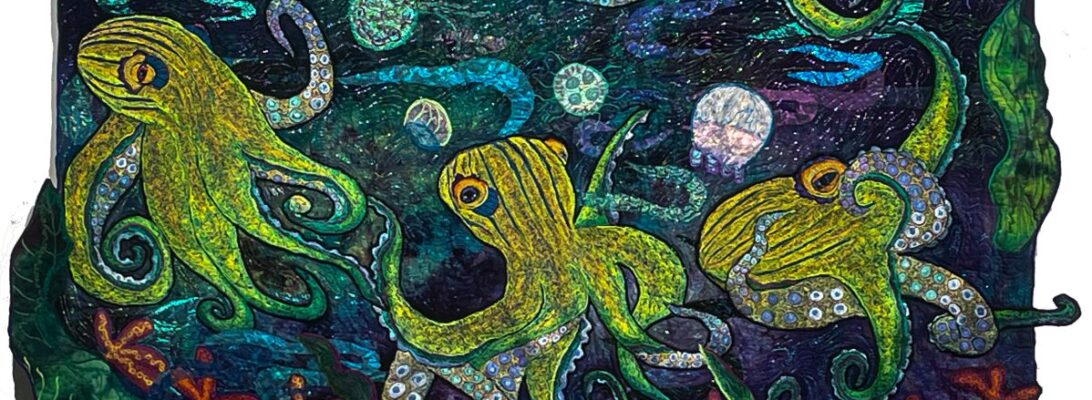
There are people who tell me they can plan a quilt. They make drawings. They decide what they’re going to do. And that’s what they do.
Personally, I’m in awe. I can design until I’m blue. Somewhere in the middle, the quilt lets me know what it needs. And I need to follow that down whatever road it leads me down.
I fell in love with this mockingbird image. But it’s off my map a bit. Once I got it embroidered, I realized it was strictly a desert bird.
I don’t do desserts. I’m a water creature. I live in moonlight and water. But this is a bird full of sun and fire.
So I went looking for a background. I happened to have some purple behind the piece of orange I put up. And it had the bright green aura of cactus in it. The purple added a night and day element.
I needed to decide on plants. If I were to do anything it had to be cactus.
You can tell the fact that I don’t think in terms of deserts when I tell you I had nothing to make cactus and desert from. I had to dye more greens.
Which is when I found these wonderful pictures of owls in cactus.
So now I’m making owl heads. I need to do them before I make the cactus so I can make holes and fit them in.
One decision leads to another. I can’t make one until I’ve made that. Then new questions get asked and new things get included. If I think I’m in charge, I’m delusional.
But I believe in my art. I believe in what it demands. I am its servant. And I am willing to listen to what it would like me to do next.
This week I painted a batch of lace and organza. I love using these soft laces because they offer texture and shifting color as another overlay on the surface.
These are not especially elegant laces. The organza is plain poly organza. I often find them in rummage sales. I hit the jackpot at some point when I bought a pile of remanents from a wedding seamstress.
Painting lace is easy. I use acrylic paints from Walmart or Joann’s and mix them with fabric media (available at Amazon) to make the hand of the fabric better. Mix in a little extra water until the paint is the consistency of cream, and paint the lace with sponge brushes. It’s a lovely, messy wildly colored afternoon. You let it dry completely and iron it on a synthetic heat setting.
I’ve heard a lot of people argue for the real thing. Silk organza. Real lace. I love those things too, but it’s not about fiber content. It’s about color, transparency, translucency, and texture. And it’s about whether they work well under the needle and as applique. It helps to know the content so you don’t burn it under the iron.
There’s a short story by Henry James called The Real Thing. It’s about an artist who has a noble couple offer themselves as models. They argue that they are the real thing and that they will add accuracy to his work as his models. But the truth is, he finds the woman who is his ordinary model from a humble and somewhat criminal life could be anything: a gypsy, a fairy, a queen, a courtesan, or a saint. And since she can be anything, she makes his artwork ultimately real.
Painted lace is a test tube baby, made of nylon and polyester. But it creates a wonderful surface overlay. And I really don’t care how real it is.
So, if you know of anyone who is rehoming white poly lace and organza, let me know. I finally used up my stash.
I spent yesterday in a whirlwind of classroom at the Peoria Art Guild. The Guild supports a number of artists in so many ways. But one of the things they do each year is give a handful of teens an art immersion experience, with all kinds of working art and artists.
It was a privilege. It made me wonder. These kids are 14-17, maybe. But they’re already there. They know they’re doing art and they are unabashed about it. And what they could learn in technique is more than made up for by their passion, their courage, and their already formed vision. They spent 5 hours building images in sheers and hand dye. That may have been new to them. But the creative spark is something they are already solidly committed to. It was a delight to see them work. I’ll be back in two weeks and we’ll do the stitching part of it.
When does that switch happen? I run into a lot of people who tell me they aren’t artists. Usually, that’s because they’re more verbal than visual. If you talk with them they can explain their images and the concepts in a way that brims with art.
Perhaps the problem is how do we define art?. If it has to be set in a mold, like figure drawing, or landscapes, that’s a pretty big limit on a much wider world.
But if art is, vision out of chaos., order out of disaster, and the creation of beauty and sense in the retelling of ourselves., that may be where my definition hovers. Art is life. The way we live creates our own beauty, our own songs, soothes our worst fears, and helps us to see ourselves in a different mirror that focuses on our strengths and beauty, instead of our failures and misgivings.
Art simply flows out of that. The things we produce our wonderful. But they are largely the byproduct of the process of restructuring who we are through our imagery. These kids already have it. I believe we all do, from birth.
ThePeoria Art Guild is a haven for artists and people who love and live art. You’ll find it at
I hope you will forgive a tech blog today. I’ve been unable to reach the studio for several days this week and I don’t have the normal weeks’ process to show you.
While I was working on all those silk leaves I added a candle to my studio.
Don was appalled. And he’s right. Fabric and fire don’t mix.
But fire does bring everything to its elements.
Silk leaves aren’t silk. They’re usually polyester of some sort. I can’t bring myself to care about that. They’re too pretty.
I was cutting the leaves apart to make smaller leaves. Of course, on the better quality leaves they heat the edges so they melt a little and don’t fray. I set up a candle to melt the edges of the parts I cut.
Boy, does polyester burn. Really fast, too. I set my candle in a container, put the candle into a tray of water, and ran the leaf edges through the flames. If they started to burn, I could drop the leaves into the water as a safety thing. You can hold the leaves with tweezers, but you still can’t control them once they start to burn. Being poly, they drip dry with their edges fused. If they blacken a bit, it makes them even more like fall leaves.
The same setup for this makes it safe to burn test fabric as well.
Burn testing has been around forever. It’s hard to tell fibers just by feel. Even if you’re very experienced. If you burn a small sample you can tell at once a lot about the fiber the fabric is made from.
Cotton burns to a soft fine white ash. Rayon burns black but also has a soft ash. Wool stinks like burnt hair. Polyester usually melts to a hard black edge. Nylon melts to a hard white edge. Silk burns to a hard crunchy edge.
It’s not foolproof, but it does tell you the most important thing about fiber. Is it plant, animal, or vegetable? Why does that matter?
It answers questions: will it dye? Will it fade? Will it shrink? Will it melt? You don’t need precision for that. You need to know if it’s synthetic or natural.
Synthetics, nylon, or poly will melt. They won’t shrink, bleed or fade. But they can’t be dyed except with dyes, especially for them.
Cotton, linen, bamboo, and rayon are all plant fibers. They dye beautifully with fiber-reactive dyes. But they may shrink, bleed, and fade.
Wool and silk are animal fibers. They can be dyed with certain dyes. They also shrink, bleed, and fade.
As they say, knowledge is power. Most of the time there’s a content listed on the bolt. Except when there isn’t, or it comes to you as a scrap. If you know what your fabric will do, you know how best to use it.
The same method I used for burning leaves, works with a burn test. A candle in a tray of water makes it safe. If it gets out of control you just drop it into the water.
Stay safe wherever you are! The snow has to melt sometime.
I work a lot with embroidered appliques. These are embroidered separate pieces I can apply to the surface of my piece. Because they’re separate, they don’t distort the piece as much, and they can be moved endlessly until you stitch them down.
I discovered several working hacks for applique rescue doing this. A 2-foot lily pad takes up way too much space to have as a double layer. It’s just too bulky, and I wanted to stitch frogs to the lily pads which would have made a very dense surface.. I’d heard about cutting out behind appliques, but I hadn’t tried it before. It worked quite well. I was able to stitch down my frogs without an extra layer of felt, stabilizer, embroidery, and hand dye. I was worried about the integrity of the piece, but once it was stitched and trimmed, it was quite stable.
This works if you’re sure of what you have designed. What if you stitch it down and change your mind? Artists call this pentimenti. The artist chooses something and changes their mind. On a painting, it would be a layer underneath with different images. On fiber art, it’s a series of small holes where you ripped something out.
This was a week of set backs. I’ve been working on finishing the purple heron. When I get towards the end, I sometimes make decisions I regret.
This happened with my purple heron this week. I was working with some larger lily pads than I usually do, and I put them in first before the heron. In between the heron and the lily pads were the butterflies. When I finally got the heron stitched in, the butterfly was way too close and personal.
Removing an applique is a drastic thing to do. It’s been stitched down with a free-motion zigzag stitch that is quite dense. I’ve done it with a mustache trimmer. I also love my surgical scalpels. That’s what I used here. You can cut through the stitch on the backside. I have a layer of protective felt and stabilizer between that and the front.
But be prepared for holes. I hoped the needle holes would shrink when I steamed the piece. Not enough.
Here’s another rescue. A roll of tape can remove a lot of excess thread after ripping out.
Not to worry about the holes. I got out some left-over spirals and placed them in a design where the hole was. What hole? After that, I replaced my butterfly in a better spot.
Here it is fixed. I need to stipple in the water next.
,Does it happen to me? Of course, it does. Rather regularly. But it isn’t what goes wrong with a piece of art that defines it. It’s what you do after to fix it.
I’ve been waiting for a while to finish this quilt. Right now it’s all pinned together. All the components are finished, but not stitched down.
Branches are always hard for me. I’m more comfortable with leaves, but the leaves need to sit on something. And this heron needed a nice dead branch to stand on as she surveys her pond.
I think it’s harder because it’s more abstract. I’m not quite sure how to do the portrait of a tree. So I start with a shape, and I’m trying to make an interesting bark.
I’ve tried some slash applique for branches. I tried that first. I used two layers of hand dye with felt and Stitch and Tear as a stabilizer. I was trying to get the grain of the wood to wrap around the branch.
I stitched it down, straight stitch, trimmed out the shape, stitched in grain lines, and slashed the top layer. Then I hand ironed them with a point turner so they would stand upright, and stitched along the seam.
Once I sliced through the top layer, I roughed up the fabric with the edge of my mustache trimmer. The mustache trimmer was not on, but the blade on it made a nice surface to make the edges fray a bit.
I don’t consider it a success. I don’t like the shape and I don’t like the direction of the bark.
So I did it again. This time I used three layers of cotton, and stitched vertical lines much closer together. I didn’t really savage the upper layers. Instead, I sliced through them like chenille. I tried several methods but it really was easier just with scissors. I roughed it up with the trimmer as well.
This isn’t appliqued down yet, but I’m so much happier with it. The other branch will work in a forest floor piece, but not here.
There is a legend that if you fold a thousand cranes, it will change you. Your pain will be relieved. Your luck will change. This repetitive action will change your life.
I had a visitor to the studio remark that there were a lot of processes in each quilt I made. There are. Dyed fabric, oil paint stick rubbing, painted sheers, dyed cheesecloth, free motion applique, direct sheer applique, and then we quilt.
That does represent a lot of busyness on my part. I like the complexity. I want a piece to be exciting when you see it from a distance and exciting if you are inches away from it.
With that said, there is a lot of donkey work. Yesterday, I cut rocks. I use the leftover pieces of fabric that are rock colored and cut them into rocks of several different sizes, waiting for the right quilt. Repetitive. So much of art is. A lot of art is creating a surface, a color, a shape, a texture that makes the piece something splendiferous. That takes a lot of repetition.
I have a price list where I document quilts by size, when they were finished and given a number. The latest quilt is numbered 1125-23, which means it’s the 1,125th quilt made since 1987. I’m going to claim them as my 1,000 cranes. What I’ve learned from 1,125 quilts is that the action of creating something over and over in different ways does change us. Art changes us because it helps us tell our stories in a different light and see ourselves in a different way. But we come to that by a series of actions that seem to be the same thing over and over. If we want the benefit of change and regeneration, it takes a sustained effort. In the Screwtape Letters, C. S. Lewis said we were not capable of any sustained action, only of the undulation towards a goal. According to Screwtape, Undulation is the repeated return to a level from which we repeatedly fall back, a series of troughs and peaks. God relies more on troughs because it makes us rely on God.
Art is a holy process. It’s a place of honesty, effort, and repetitive actions in hopes of reaching the peaks despite the troughs. What I have learned from 50 years of quilting is that the troughs simply have to be waded through like mud, with the actions over and over again that create our art and ourselves.
Tuesday, I’m going into the hospital to have a stent put in to fix my blockage. I have good hopes, but I can’t say I’m not nervous. But the waiting and the work on my quilts has soothed that some. It’s an office procedure. I expect to be home the same night.
So I do what I do when I’m nervous. Or happy. Or sad. Or confused. I make more quilts.
This is under the heading of sneaky secret tricks. I rarely use an applique foot for applique. Instead, I use my darning foot and cover the raw edge in a free-motion stitch.
Why? Mostly because I rarely use a straight edge in my work, except for borders. I’m a curvy girl and I think in terms of curves.
I wanted a curvy vine for my butterflies to fly over and for the flowers to nestle into. layered on another piece of green hand dye, stitched out my vine in a straight stitch, and cut away all the excess. It’s best to get rid of all the extra fabric you can. I use pelican scissors to trim as close as I can get to the seam. Pelican scissors have an odd bend that lets you cut right on the edge.
Then I picked a light, dark and medium set of threads for the edge. Vines have two sides, and one can be done light and the other dark. If it’s a complicated vine, it may take a wider range. You want colors that could be the same if they were in a darker or lighter environment.
Stitching the top and bottom line of the vine in different colors gives it a visual distinction that makes it look dimensional. And because it’s free motion, the line is fluid and follows the curve more graciously.
Here’s my piece, almost ready to back and bind. Free motion applique is just what a curvy girl ordered.
I don’t piece well. It’s not my skill. Anything that takes accuracy and careful cutting really isn’t my skill. The new 770 Bernina came with a foot that does make it better, but I don’t normally do large pieced tops. I know better. It’s not pretty when I do.
But there are rare occasions when I piece a split light source top.
Why? Why walk into accuracy land and piecing?
A light source brings you fabric with direction, and a built-in world. That world can be integral by itself. But if you want to filter the light as if it were through haze, woods, or shadow, you can piece two light source fabrics to create that shaded look. There are several approaches, with different effects.
Vertical Piecing
Where the Heart is
Where the Heart Is was pieced from two separate yards of the same blue/orange color range. I lay both pieces together on the cutting board and cut them in gradated strips, 2″, 3″, 4″, etc. Then I sewed them together with the narrowest light of one to the widest side of the other, in gradation. Set in a vertical arrangement, it makes for light flowing through the trees.
Horizontal Piecing with a Frame
Envy
Envy was one horizontal light source yard, split in gradations with a half yard cut in 2″ strips put between. The piecing creates a sense of space. The narrowest strip in the gradation defines the horizon line.
Piecing within Multiple Frames
Sometimes I split the two fabrics with the light at the widest on one side and the dark widest cut so they can carry the light across the piece. Twightlight Time was also double framed with a 2″ and a progressive border. Having a narrower border on the top weights the bottom of the piece.
Piecing Machines
Lately, Don found me a Singer 99 at a yard sale. For those of you not familiar with these darlings, they are a featherweight industrial drop-in bobbin Singer. They only straight stitch, but the stitch is impeccable. They are tougher, and faster and they use bobbins that are still commercially available. I’d never seen one before, but I fell in love instantly. It took a little work and some creative parts searching, but Don got it working for me and it’s perhaps the best piecing machine I’ve ever had. Did I mention Don is my hero?
So I pieced the guinea hen’s background on it.
How do you keep it straight? It’s tricky. If I get them out of order the fabric doesn’t progress correctly through its colors. I make all my cuts, leave the fabric on the cutting board until I can number the pieces all on the back side. Since there are two pieces of fabric cut, I label my fabric, 1a,2a, etc. and 1b, 2b, etc. and chalk in the sequence on the ends so I can always keep them in order.
Expanding Fabric Size
Sometimes there’s just a beautiful fabric that needs to be bigger. That’s been known to happen too.
I needed a background for What the Flock, a grouping of guinea hens. I’m low on fabric and money right now, so I have to make do. I found a purple piece that should make a great meadow, but a yard was just a bit small. So I pieced in another half-yard to expand it. I cut the half yard in 2.5″ widths and graded the yard-long piece in segments of 9″, 8″, 7″, 6″, and 5″,
Seam Rollers
For those of you like me, who hate to run back and forth to the iron, there is a seam roller. You can use this gadget to flatten your seams right where you’re sewing. Roll it over the seam and you’ll have flat, ready-to-sew seams without the iron woman run.
I don’t piece often, but these backgrounds are worth it. I love the shaded light and the action of light of the fabric across the piece.