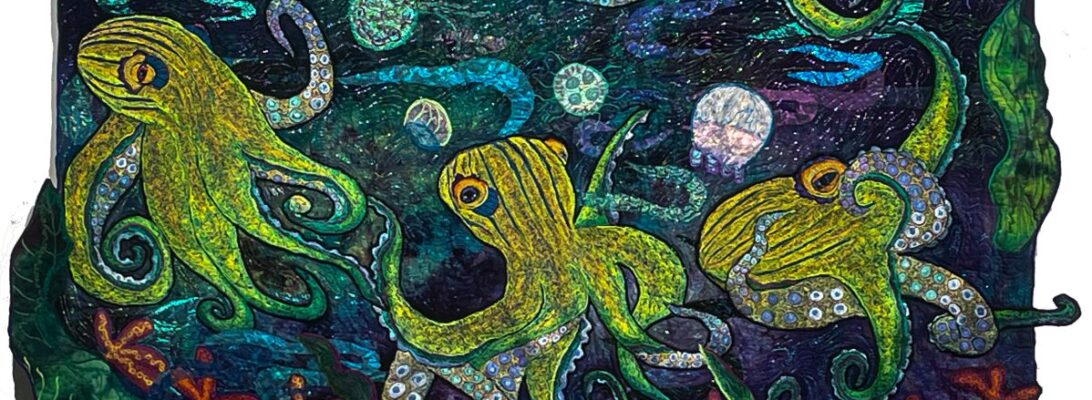
There’s a lot of repetition in any form of art. There’s that moment of ignition, those moments of planning, and pretty soon, you come down to those hours of creation. And they’re full of repetition. Small tasks over and over.
If it sounds like purgatory of a sort, it is. It’s infinately better than the hell of an overactive imagination on a bad day. Repetitious art has saved my life more than once.
Part of it is that repetitious actions put us in a different mode and zone. It’s been called right brain thinking, but I think it needs the reinforcement of physical action, particularly action that doesn’t take a lot of thought.
It may be borking but like everything there is an upside. Art is about need. Need to express yourself, need to fill up space, need for stimulation all turns itself into artwork, given the right emphasis. How would I know? What do you think?’
I’ve kind of had a tough couple of months, but it’s been mostly about friends. We’re all in that just-turned-70 club. Paul Simon was right. “How terribly strange to be seventy.” It is. All of a sudden there are serious things wrong with all of us.v All of a sudden we’re old.
There’s nothing to be done about it. Time doesn’t stop. The warantee runs out. We’re all there, in a way. All we can do is to refuse to run away from each other, no matter how bad it gets.
I’m trying to figure out what I do with this. If you’re one of the people I’m talking about, you can know this. I won’t run and I won’t hide. We’re in this together.
Thank God for repetition. For mindless tasks that eventually build art. They also bring quiet, piece, peace and courage.
On the other side, enough blue, purple, orange and yellow is an excellent color therapy. Color really is an antidepressant.
For those of us who use bobbin work, there is always the quest for empty bobbins. For every color of thread I use, I need a bobbin with that color of thread.
So it’s no surprise when I get a new kind of machine, I usually buy 200 new bobbins for the machine.
Unfortunately, bobbins cost more. My Bernina 770 uses a $5 bobbin. They are pricy. But truly, like being too rich or too thin, there are never enough.
Thread is pricey too. It won’t go back on the spool. So you either use it up or pull it off the bobbin and waste it.
So when I went to do a run of minnows, I looked at my bobbin box and made a plan.
I didn’t want the fish to be in any way identical. That’s not the nature of nature. Nature is endlessly variable. So I decided on green fish and yellow fish, and planned to empty each yellow or green bobbin dark to light, top to bottom.
The fish I’d drawn had cross hatched details. I lined up my bobbin colors and made a progression of colors square by square, dark to light. I think I filled 4 bobbins for the whole batch. How many did I empty? The empty bobbin count at the end was 16.
Here’s the finished fish. Because I wasn’t micromanaging the colors, they clash a little and contrast not only in color but in tempurature. Which makes them shimmer a bit. Like fish.
My dad would have been pleased to make that catch. And I have enough empty bobbins to tackle the birds next.
Let’s start this by saying, it’s just one woman’s opinion. I mean no disrespect to anyone.
It’s been a tough couple of weeks. Two weeks ago I had to change web hosts. It was an ungodly mess and I did almost nothing except try to fix it. I wrote that the dog had eaten my homework which is why I didn’t have a new blog up.
This week I can almost honestly say that dinosaurs broke into my computer room, pooped in my computer, packaged me up in a box and sent me to California where I kept hearing a cat near by. That bad.
We got it straightened out. It’s three weeks of my life I’ll never get back, so I am deeply grateful for the guy at FixRunner who found me an answer within an hour.
And I don’t have much work to show. So I thought I’d talk about something a lot of us are finding distressing.
I have some problems with AI. I have not, in fairness, tried it. I may never. It offends me in a baseline way. But that’s not the real reason. I think perfectified art really misses the point.
There’s no getting around the fact that it’s theft. I wish that were new. One cave man copied another woman’s art they found in a cave 3 miles up the road. Art has always been derivative. We learn art skills by copying other people’s work. It’s how you learn art in college, largely. You copy the masters, not because your copy has value, but so that you can build your skills for your own work.
We are still always influenced. If I see a quilt with a heron, and I make a heron quilt, it will have a lot of things in common. Like the heron. And the water. I can’t tell you how many heron quilts I’ve seen over years that mimicked Lady Blue. It’s a compliment, I think. Or it may have nothing to do with anything except their interest in beautiful birds. I’ll never know.
That’s the benign kind of theft. We influence eachother with what we do. Art speaks to art. We respond to other people’s work by working with either their imagery or their materials. If we’re good, it’s enough ours that no one notices.
It’s usually hopeless to ask someone why they copied you. They’ll either say they didn’t beause they don’t recognize that they did, or they’ll tell you it’s all completely originally theirs. Either way, it’s not a worthy conversation. Nor is it strictly the truth. But strict truth is a bad fitting shoe. It hurts more than it helps sometime.
The real thieves are the ones who want to use your design commercially. I had someone offer my quilt, Dancing in the Light as a fleecy blanket you could own for $90. When I was over being furious, I realized none of the blankets they offered were produced. It was strict sham. I was torn between being appalled and wanting one. I told them not to do that in an official manner and they stopped listing my piece. I don’t think they stopped. It appears to be a Chinese thing. I found a number of listings on Temu and Etsy.
Part of this is a change in technology. There’s technology out there that we have the ability to use, and no sense about why you shouldn’t. We have the technology to make those blankets. Had they paid me millions of dollars for that blanket’s rights, I might have gone on to join Van Gogh and Degas in the world where people print your work on blankets. We all have our weaknesses.
But technology breaks down all kinds of limits. I can see that cave woman wishing for a world where she didn’t have to paint with her fingers. Imagine her joy when she realized that she could apply paint by blowing through a tube. Or by using a brush.
When I started quilting in the seventies, it was quickly clear that I was wretched at hand quilting. I started to quilt by machine. I would have people come up to my piece, sometimes touch it and say, “Oh, that’s just machined.” It was. Unabashedly. The technology allowed me to do something more than was possible before. Both Harriet Hardgrave and Caryl Bryer Fallert changed the quilt world with magificent machine quilting. It took us a while to accept that different technologies give us different possibilities. I still have people who somehow think what I do is computer generated. I disillusion them when I can. One color at a time, one thread per layer of stitching. Don’t tell me it’s not art.
I somehow hear that when I hear someone say, that’s just AI. It’s an interesting technique that may lead to all kinds of things.
The real reason I dislike the idea of AI is that it tends towards perfection. A perfect picture plucked from someone elses work. At some time, I suspect we’ll have an upstanding collection of AI work set up legally to use, like clip art. I suspect it will look very much like that.
I have a deep fondness for oriental art. I like the aesthetics. This come from the Impressionists who embraced Japanese art. Chinese art tends to be perfect. Japanese art celebrates imperfections. I am much more moved by the imperfections of art, than sleek perfection. People are not perfect. Perfect art doesn’t show the value of of our humanity. I don’t think AI has a way to offer us that.
This has been a counter-productive week. My leg went out ( still not sure why), and I’ve had some low-grade flu. So my studio work didn’t happen. Instead, I worked a bit in my library.
When I married Don and moved, I stripped my library down. I have several libraries. One is for personal information and entertainment. Small kitchen library. And a pile of art books. Somehow that has continued to grow.
Where does our art come from? We’d like everything to be completely out of ourselves. I’m not sure that’s possible.
We have several illusions about art. We’d like to believe all art is original. But it’s not. Art comes from our response to other images. All art is in some way derivative. Different pieces of art hold a conversation over time. Art changes how other art is made.
We are told only artists are artists. That’s just wrong. Art is not unique to artists. It’s a part of our genome. It’s the ability to view our world differently. In our view of the world, we begin to change our world. when we work with those images, we change ourselves, and that changes the world. Just a little bit. It’s the creation of sense, beauty, and order. We have to silence the voice that says we are not artists. Because it’s the voice that tells us we can’t. Because it strips us of power that has always been our own.
So how do we kick start art? We need to feed our eyes and refuse to hamstring ourselves. What our senses bring gives us all kinds of inspiration.
But back to art being derivative: We work with the images that set us on fire, move our inners, pop out our own eyes or perhaps someone else’s. And there is never any reference like a book. The zoo is closed. The science program moves too fast. The web pictures are tiny. Your own library is a wide world portal that never closes; Not even at three am.
So I look for books with enough animal pictures to know how many toes a frog has and what angle the leg is at. I look for landscape books, garden books. pet books, pictorial archives, amazing art artists, and how-to techniques. And beautiful kid books.
I love my library. It fills my eyes. it fills my head. It fills my life.
I jus made myself bookplates for the Galesburg address. This is sneaky. I get to open every book, if nothing else but to put the plate in.
Take your inspiration where you find it, but build up inspiration where it waits for you, like treasure in heaven.
For some while, I’ve bound my quilts with a buttonhole binding. It’s a buttonhole with a cord inside. At first, I wanted to accommodate a leaf or a frog leg coming out of the piece. Then I wanted to bust out in all kinds of places.
I wrote this 4 years ago. It’s pretty good instruction but it leaves out something I thought was obvious at the time.
I started out as a traditional quilter. And for years I bound all my quilts with bias tape. But as my work became more organic, it felt terribly strange to put my work in a square box.
“The corded buttonhole is a standard technique from couture sewing. Translated from there to the quilt world, it gives us a way to finish both quilts and art clothing in a new way that’s literally out of the box. Instead of the square edges and gentle curves that are the limit of bias binding, we have the freedom to follow any shape. That means that the edge of our pieces is not defined by straight lines, but by their internal design. It also means a quilt can have an external shape that fills a wall in a much more exciting way. And because our binding is thread, we have the full range of polyester thread colors for our palette.
I prefer to do this on my Bernina because of the specific feet and the stitch quality. You can use a regular utility foot and a couching foot off another kind of machine.
We’ll be using two basic feet for our binding.
What largely counts is the thread escape on the bottom of the foot.
The #1 foot has a top groove we can use to couch down the cord. The #3 foot has a thread escape groove on the bottom for the zigzag stitching to pass through. The #3 foot is the older style buttonhole foot (without the electronic eye)that has exactly the right thread escape to accommodate the buttonhole binding
You’ll need
#3 Crochet cotton
A quilt/ or quilted object backed, quilted, and ready to bind
Polyester #30-40 weight embroidery thread the color of your choice
A#3 foot and a #1 foot
A Bernina
A rotary cutter and mat
Binding
We’ll bind our piece with a corded binding that’s a corded buttonhole all around the edge.
Preparing your quilt:
Stitch around the edge either with monofilament nylon or with a neutral embroidery thread so that all the layers are together
Using your rotary cutter, cleanly cut away all the extra bat and backing fabric, exactly the shape you want your quilt to be.
You don’t have to have a square. It can be any shape at all. To keep sharp 45 degree corners or points, you need to clip the tips off them.
Thread your machine top and bottom with a polyester embroidery thread that you want for the color of your binding. You can use rayon or metallic thread, but the breakage makes things so much more difficult.
Attaching the cord:
Set your machine on a zigzag stitch, with the needle placed one position over from full left. Your stitch length should be at between the button hole setting at a # 4 width.
Position your quilt so the stitch falls just over the right hand edge of your quilt.
Start your stitching somewhere in the lower edge, not on a corner or direct curve.
Zigzag your cording all around the edge.
When you come to the end, drop your feed dogs and make several stitches to anchor the cord.
Clip your threads and cord.
Tip: If you have a quilt that ruffles at the edge, you can pull the cord and gather in the ruffle. This will not solve severe distortion problems, but it will fix minor ones. You should pull the cord before you change directions or turn a corner.
Covering the cord:
Your second pass should cover your cord with smooth zigzag stitching.
You’ll find certain areas may not have been included in the stitching. This will give you a chance to address that.
Set your sewing machine for the widest stitch it will give, and the densest stitch length it can handle. Put your needle position to the far right.
Use your #3 foot, with the double channel thread escape.
Position your quilt so that the stitch to the right ends over the edge of your quilt
Start at a lower edge, not on a corner or a curve.
Stitch around the edge of your quilt.
When you come to the beginning, move your needle position to the far left, set onto a straight stitch and stitch in place to anchor the stitching.
Sometimes I get enough coverage on the second pass, but that’s rare. Usually it takes a third time around. Turn the piece over. If you still have wisps sticking up through the binding, trim them as best you can, and go around another time.
Corners, curves and points:
These all take a bit of finesse. Your standard button hole stitch isn’t set up to cover them. But you can get good coverage on them by rocking your stitch over them. As you’re stitching, you can pull back just a bit from the front to make sure your stitch line covers everything. Curves may also need that assist. For corners and particularly for points stitch up to them and turn the piece at slightly different angles as you go round the edge. You can put the needle down within the point and pivot and stitch several times until you have coverage.
Tips:
A clean cut edge to your piece is always easier to cover with stitching. Use your rotary cutter and make a nice solid cut line.
Use a new topstitching #90 needle for the best stitch and for less thread breakage.
Sewers Aid applied to the thread also helps with thread breakage.
Organic quilts don’t have to be stuck in a box. A corded buttonhole binding lets your quilt go over the edge.”
This was my original article, four years ago. Here’s the secret ingredient I didn’t think to factor in. Almost all of the shapes going off the edge. What I forgot to say, is that almost all of the items going over the edge have been embroidered to a fare-the-well. That means they have 2 other layers of stitch and tear and felt. They can literally stand up of their own accord.
It does make a difference. And I hate to be someone who will give you a recipe with something essential left out.
I am excited to make quilts that are exactly the shape they should be. None of that square for the sake of square stuff.
There are people who tell me they can plan a quilt. They make drawings. They decide what they’re going to do. And that’s what they do.
Personally, I’m in awe. I can design until I’m blue. Somewhere in the middle, the quilt lets me know what it needs. And I need to follow that down whatever road it leads me down.
I fell in love with this mockingbird image. But it’s off my map a bit. Once I got it embroidered, I realized it was strictly a desert bird.
I don’t do desserts. I’m a water creature. I live in moonlight and water. But this is a bird full of sun and fire.
So I went looking for a background. I happened to have some purple behind the piece of orange I put up. And it had the bright green aura of cactus in it. The purple added a night and day element.
I needed to decide on plants. If I were to do anything it had to be cactus.
You can tell the fact that I don’t think in terms of deserts when I tell you I had nothing to make cactus and desert from. I had to dye more greens.
Which is when I found these wonderful pictures of owls in cactus.
So now I’m making owl heads. I need to do them before I make the cactus so I can make holes and fit them in.
One decision leads to another. I can’t make one until I’ve made that. Then new questions get asked and new things get included. If I think I’m in charge, I’m delusional.
But I believe in my art. I believe in what it demands. I am its servant. And I am willing to listen to what it would like me to do next.
I work a lot with embroidered appliques. These are embroidered separate pieces I can apply to the surface of my piece. Because they’re separate, they don’t distort the piece as much, and they can be moved endlessly until you stitch them down.
I discovered several working hacks for applique rescue doing this. A 2-foot lily pad takes up way too much space to have as a double layer. It’s just too bulky, and I wanted to stitch frogs to the lily pads which would have made a very dense surface.. I’d heard about cutting out behind appliques, but I hadn’t tried it before. It worked quite well. I was able to stitch down my frogs without an extra layer of felt, stabilizer, embroidery, and hand dye. I was worried about the integrity of the piece, but once it was stitched and trimmed, it was quite stable.
This works if you’re sure of what you have designed. What if you stitch it down and change your mind? Artists call this pentimenti. The artist chooses something and changes their mind. On a painting, it would be a layer underneath with different images. On fiber art, it’s a series of small holes where you ripped something out.
This was a week of set backs. I’ve been working on finishing the purple heron. When I get towards the end, I sometimes make decisions I regret.
This happened with my purple heron this week. I was working with some larger lily pads than I usually do, and I put them in first before the heron. In between the heron and the lily pads were the butterflies. When I finally got the heron stitched in, the butterfly was way too close and personal.
Removing an applique is a drastic thing to do. It’s been stitched down with a free-motion zigzag stitch that is quite dense. I’ve done it with a mustache trimmer. I also love my surgical scalpels. That’s what I used here. You can cut through the stitch on the backside. I have a layer of protective felt and stabilizer between that and the front.
But be prepared for holes. I hoped the needle holes would shrink when I steamed the piece. Not enough.
Here’s another rescue. A roll of tape can remove a lot of excess thread after ripping out.
Not to worry about the holes. I got out some left-over spirals and placed them in a design where the hole was. What hole? After that, I replaced my butterfly in a better spot.
Here it is fixed. I need to stipple in the water next.
,Does it happen to me? Of course, it does. Rather regularly. But it isn’t what goes wrong with a piece of art that defines it. It’s what you do after to fix it.
After several weeks of playing with leaf mantises, I have discovered several things. First off: a warning! They are addictive. At least they’re not fattening.
Secondly, I need more leaves. Lots and lots and lots of leaves. All the shops are seasonally xmasy, so that means rummage sales, and Yours to Create. Too many is not enough.
They work better if you stitch the leaves and connecting parts separately. I like the running garnet stitch better than a fully connected zigzag.
The head as a leaf doesn’t always work. I don’t know that I’d do that every time. But an embroidered one works just fine.
Straight stitch works best on leaves. Contrasting thread is your friend here.
I hope you get the time to pick something you want to play with and work it out. The exploration and the journey are all the fun.
This is under the heading of sneaky secret tricks. I rarely use an applique foot for applique. Instead, I use my darning foot and cover the raw edge in a free-motion stitch.
Why? Mostly because I rarely use a straight edge in my work, except for borders. I’m a curvy girl and I think in terms of curves.
I wanted a curvy vine for my butterflies to fly over and for the flowers to nestle into. layered on another piece of green hand dye, stitched out my vine in a straight stitch, and cut away all the excess. It’s best to get rid of all the extra fabric you can. I use pelican scissors to trim as close as I can get to the seam. Pelican scissors have an odd bend that lets you cut right on the edge.
Then I picked a light, dark and medium set of threads for the edge. Vines have two sides, and one can be done light and the other dark. If it’s a complicated vine, it may take a wider range. You want colors that could be the same if they were in a darker or lighter environment.
Stitching the top and bottom line of the vine in different colors gives it a visual distinction that makes it look dimensional. And because it’s free motion, the line is fluid and follows the curve more graciously.
Here’s my piece, almost ready to back and bind. Free motion applique is just what a curvy girl ordered.