
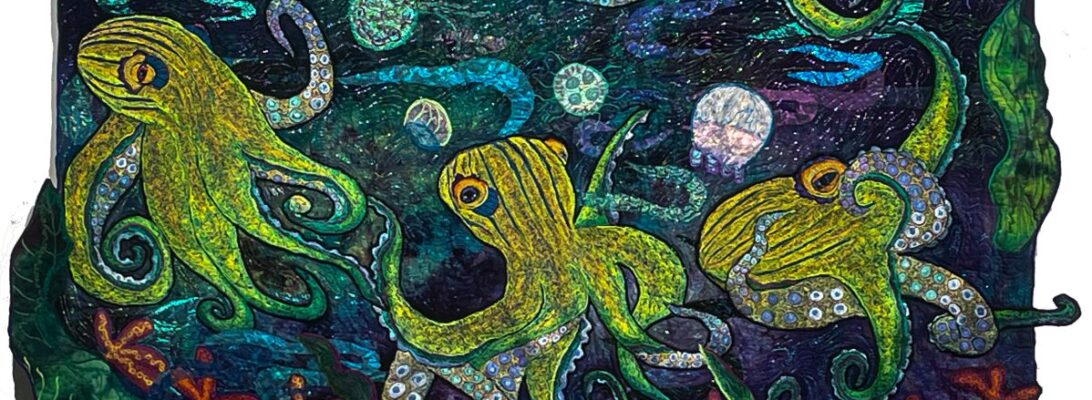


One of the hardest things in embroidery work is to get over the match instinct. After years of perfectly matching thread to my project, I’ve had to learn to pick out the highest contrast threads to make an image that really shows up.
In embroidery, contrast is everything. If it all mushes together color-wise then you have a very mushy image indeed. Smooth color exchanges that are analogous and sit next to each other on the color wheel are pretty. But they don’t have much punch. So what you want is color that builds not on similarities but on differences. There are several kind of contrast: color, tone, clarity, and temperature.

Today we’re talking about color ,which is simply the hue. Is it red, blue, or yellow? Or an odd shade of green? It’s not a simple as it looks. There a million reds, blues and yellows and they are not the same.
Thermal shock is about the temperature of a color. Every color, no matter whether it is a cool or warm color, leans either towards having a cool or warm cast. It doesn’t matter if it’s a cool color or a warm color. There are cool yellows, there are hot blues. If all the colors are either cool or warm they’ll flow into each other like analogous colors. But if they’re not? You get thermal shock. Like standing in a cold water sprinkler on a steaming hot day. The effect is kind of visually electric.

Blue and Yellow Don’t Make Green is an excellent book discussing thermal variations and how that creates differing colors.
I wanted this fish to jump off the surface and I’d decided on yellow, to give it some definition from the floral like background. But I wanted it showy. So the colors I picked, cool orange, cool and warm yellows, cool and warm blues left it shimmery and gave it impact.

Of course it helps if you have shocking thread to begin with. This particular florescent is a Madeira polyester 40# called Poly Neon. Neon has a around 800 colors of every hue, but it has a select section that really is neon. I went through my collection of those threads and chose my shockers.


Each scale on this fish has a blue outer ridge, a purple, and 2 yellows. It’s been shaded in gradations to create the underside separately from the top.
The face and tail are a looser gradation that just shades from darkest/brightest to softer shades.
Here’s a video showing how that’s stitched.
I’ve written a lot about color because it matters to me. Building color in threadwork is done shade by shade, one color on top of another. The eye mixes those colors, which keeps them clear and crisp. But when the colors are fire and ice, prepare to be shocked!
Other blogs discussing color
Canva has an excellent page on color theory.
You’ll find Blue and Yellow Don’t Make Green on Amazon.
Polyneon Threads are available at Madeira USA


