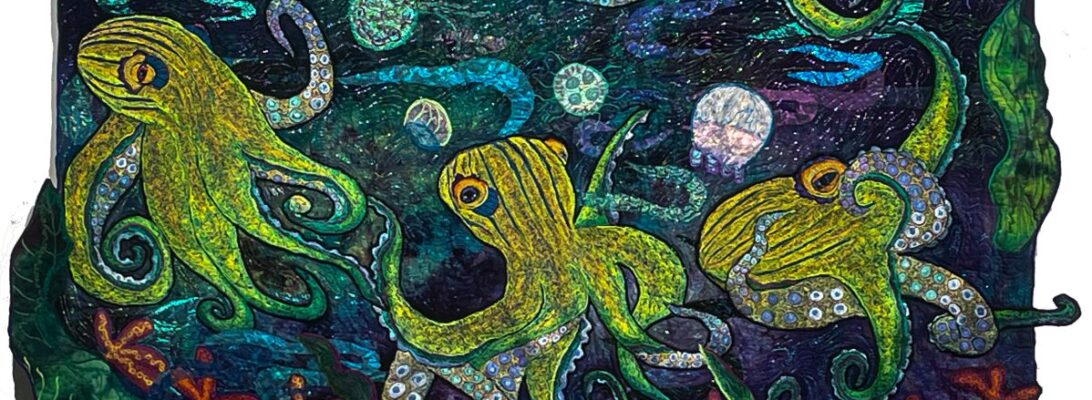
I’m delighted to announce I’ll be doing a show of my work for the Peoria Art Guild this September, 2023. Right now I’m running around the studio like a frenzied ferret. It’s not pretty. But it’s show panic. It’s how it’s done.
The show will open Friday, September 1st. I am so excited. I have a pile of new work to show and I’m so pleased to be able to do that in person with you.
These last two years have been a renaissance for me. I’m working larger, in wilder images and on fire with the art happening. Not bad for a lady at the other side of seventy.
So here is a review of last year’s work.
Major quilts
There are some large unfinished pieces almost ready to go.
Opening First Friday, September 1 Gallery talk: 4pm Opening 5-8 PM
Classes: Fantasy Flowers: making flowers from sheers and embroidery. Saturday. September 16th, 9-12 Dragonfly Sky: Working with bobbin work. Sunday, September 17, 9-3
Free Lecture: The Visual Path Designing Art in Motion. Saturday 16th, 1-3
Peoria Art Guild, 203 Harrison St, Peoria, IL, 61602, 309 637 2787
To celebrate, and to pay for some of the show costs, I’ve put my current small quilts on sale on Etsy at 25% off. Check them out Are you excited yet? I’m exhausted. But thrilled. Come join me!
Normally, when I do a large embroidery, I’m working from the back. This works because I’ve got my pattern drawing on the back and it gives me all the information I need to fill it in. That assumes I can see my stitching.
Well, I do things the way I do unless I don’t. After a week of working on these guinea hens, I turned them right side up last night and stitched from the top.
Why? The stripes on these things are making me crazy. It’s sort of like matching plaid pant seams. Do you remember that hopeless enterprise? These birds depend on precise white stripes. The white doesn’t show up against the stabilizer, so you can’t see if it’s dense enough or smooth enough. What I thought was a bold smooth line looked raggy. These birds are fussy.
But I think they’re worth it. I also wanted you to see that you can overstitch. And sometimes that’s the answer.
I overstitch for a number of reasons: to outline a piece, to clarify the edge line, to add extra texture, or to put in highlight. I can put down a wonderful range of colors. But sometimes thot range needs the context of texture as well.
I wanted the dots separated so they went on first. The stripes went on, but I had no idea how raggy they looked from the front. So now, I’m going back to redefine them so they’re smooth and dense enough to please me.
The point of this is it’s not over until the fat lady sings. Until you say it is. So don’t be afraid to restitch, redirect and redesign something that isn’t quite right
I’ve just finished Little Blues! I’m delighted with this quilt. It took me a while to get it finished off. In that process, on a whim I added some red silk flowers to the background.
Why red? Why not orange or blue or white? I did try those. But red was it.
I really think it’s worth the while to put up your color decisions on a color wheel. Just how you can see how they relate.
The color wheel gets a bad rap. It’s old fashioned, it’s boring, we all know how colors are made, it’s incomprehensible…. It’s still the best way I know to show the relationships between colors. It shows how colors are created. But most importantly, it shows how they react to each other.
The farther colors are apart from each other, the more tension there is between them. And like every good soap opera, more tension means more excitement.
At which point, you need to ask, where is this quilt going? If it’s in a baby’s bedroom, you might want to keep the tension and excitement to a minimum. But for a gallery? Bring on the excitement!
I was surprised when I put the colors up on the wheel. I didn’t realize how far around the wheel I had gone. But as you can see, the red zings across from the green. I don’t have much in there, but it wakes up a piece that has that sleepy analogous color thing going on without it. Not much. Just a handful of red silk flowers.
I consider using the whole color wheel a visual trick of sorts. It wins awards, and it’s showy, but color needs to be the focus of a piece for that to work well. But this almost full-color wheel is rich, satisfying, and just red enough to get attention.
Most of the time when I applique fabric, I use a fusible like Steam a Seam 2 and I cut out my shapes. Except when I don’t.
Cut out applique works well for smaller, stable pieces that can be cut and moved around. Cut-away applique is better for elegant curved lines you just can’t cut out and move around..They shim out of shape too easily. And then they never lie flat.
Direct Applique
Attach a layer of fusible to the applique
Cut out the object before you glue
Stitch down free motion zigzag
1 step process, just stitch it on
Thicker lines
Cut- away Applique
No fusible glue
Lay down a sheet of applique fabric
Straigh stitch in the design on top
Cut it away excess fabric
Stitch it down free motion zigzag
2 step process
Softer, smoother lines
For this frog, I wanted a sinuous curved vine with curlicue tendrils. Not something that is easily done in direct applique. Larger cut-away applications can distort a bit. If we put a layer of the applique fabric over the top, stitch it down and cut it away, it’s a much cleaner, smoother line.
In cut-away applique, we stitch the design on an extra layer, and then cut-away what the excess.
Then we stitch down the edge with a free-motion zigzag stitch that can be smooth and lyrical like the design itself.
Here is the cutout vine ready for applique. What has changed? I used to draw and cut the leaves as well. I’ve done those separately to avoid some of the distortion.
Cut-away applique with Lace
The same process works with these lace butterflies. Rather than glue them on, and have the glue show through, I stitched around them straight stitch and then cut away the excess fabric. I had though I was adding butterflies, but I think they look more like the shadows of butterflies, which is much more cool.
Cut-away works as well with lace. These butterflies were part of a lace fabric. I stitched down the leaves and bugs, cut away the background, and stitched down the lace with a small free-motion zigzag stitch.
These techniques are neither right or wrong. It’s about using different techniques to get the results you want. It’s all a part of your tool box, for you to use as you want.
I’ve been working on this pair of herons for a while. The working title is Little Blues. When I put it up on Facebook someone asked me, what happens to the frog?
Usually, I talk with you about how I do things. But that’s a why question. Why did I put a frog in that kind of peril?
Why questions are troublesome. Sometimes we’re happier not knowing. Sometimes it just needs to be asked.
And it would be easier to answer if I actually did know why. Sometimes I just don’t. I’m compelled to work with certain images. I’ve learned to follow that down because my nature quilts aren’t strictly just nature quilts. Most of the time it’s people I know in situations. Before they actually happen. Most often, it’s me in some regard. The tricky part is that the part of me that makes art knows things long before the rest of me does.
But in answer to the question: the frog lives! He may be in a perilous state, but he thrives in spite of it. You may notice the butterfly over his head that he has not yet seen. His hunch is here too.
I think most of us live almost unconsciously in a state of peril. It’s a dangerous world out there. But we find our safety and thrive despite it. Art is a part of that. How we build our own stories changes our place in those stories. We make your safe space: physically, emotionally, and spiritually. It may be right next door to uncertainty, but we build our own safety and joy within it.
Is it true? How would I know? I just get images, and they eventually tell me where they should go.
We worked with garnet stitch to do octopi several weeks ago. That was an all-over garnet stitch that could be shaded across the piece. But what if we want separate spots and smooth shading around them? How do we go about that?
What we need to do is to define the spot clearly, and then shade around it. But shading with one color around the spot negates a color range shade. We need to put in our spots and then shade around them defining different sides of the spot with different colors.
We start dark to light with the darkest threads first. The first color needs an outline stitch done at an angle to define the shape. Then we’ll shade out to the side, and then smooth the line between the outline and the shading.
But after that row, there’s more shading than outlining. When we come to each spot we outline the spot on that side and shade past the edges of it. Then in the next color row, we outline it from the other side and shade it into the earlier colors. The spot is clearly in the color range but it’s defined by the outline around it that fits the shading as it changes.
It’s a cool trick for including spots in a smooth range of colored stitchery.
After having worked for some while on Octopi Dance, I decided I needed jellyfish to add to the flow of the piece. If you’ve been reading this blog for a while, you know I’m obsessed with creating a visual path through each quilt as a significant design feature. That can be done a number of ways, either through the background, the flora around your subjects, or with smaller objects that the eye follows across the piece.
For the octopi, jellyfish were a simple choice. They float and can be pointed in any direction. And the purple, green, and iridescent qualities are perfect against all that hot yellow.
What I really wanted after all that very solid garnet stitching was something translucent. I can do that fairly with organza and lace. But if I glue organza to the background, the background becomes a major part of the jellyfish. Some of the transparency is lost.
So I decided to make jellyfish with only the organza on the back. There are several ways to do that. One is to use a dissolvable stabilizer.
Dissolvable stabilizer is usually made from some kind of starch. There are a lot of brands but there are really only two types. One is see-through, and one looks like paper. They both dissolve in water. The see-through variety is usually a topping, put over your piece so you can embroider details without having your foot caught in the textures. It can also be worked in a hoop. If you want more information about dissolvable stabilizers, Embroidery Online has a wonderful article about them here.
The paper varieties don’t dissolve quite as well, but they make a better stabilizer for embroidery. Since I didn’t want to fuss with a hoop this time, I used a paper dissolvable called Paper Solvy, available at Amazon. It comes in a pack of 8.5″ x 11″ sheets.
It’s hard to make a stable embroidery just out of thread. You have to be sure you’ve connected all of it to itself, or it will fall apart when you remove the stabilizer. So I glued the organza onto the stabilizer with Steam a Seam 2, partially for color and partially to make the pieces more stable.
You can’t stitch as closely with this stabilizer. It will either tear or jam or both. I also ran a straight stitch around the outside of the pieces and then stitched my zigzag stitch over it. That holds the piece together better after the stabilizer is removed.
There are some good and bad things about this stabilizer It did dissolve quite well. It stitched fairly well, although I had a lot more thread breakage. And one was not enough.
I tried one set with a sheet of Tear Away behind the Solvy, and had to tear away that background. Not recommended. It took forever and it tended to tear away the stitches as well.
I’m quite happy with the ones I did on two layers of Paper Solvy. They dissolved well and the stitching stayed mostly in place. They can join in the dance,
For more information on the visual path check out Building a Path.
This is a special week for me. After 10 years, I’m teaching in a guild again. I’ll be lecturing at Gems of the Prairie Wednesday, May 3rd, and teaching the class The Stitch Vocabulary Book on May 4th. The class is full, but I’m told the guild welcomes non-members for the lecture. You are all very welcome to come!
It’s my developmental lecture.: How I became an artist. That’s a misnomer by the way. We are artists by the way of being human. It’s how I stumbled into my own art, and where it has taken me.
Every year I try to do something I’ve never done before. for my birthday. This year, I’m teaching a lecture and class, after a ten-year hiatus.
And on May 5th, I turn 70. I’ve always dreaded that. It sounds so old. Yet here we are. And if you’re a contemporary, so are you. As someone quite wise said to me, “If you made it, you celebrate it.” I intend to.
My life has always been a bit upside down. I’m too dyslexic to do things in a rational linear order. I started doing my art in my 20s. I married at 62. I borrowed other people’s children, although I always gave them back. And I had a lot of physical limits. 10 years ago, I pretty much stopped doing art and wrote books instead. And then Don gave me his old house for a studio. And my art flared up like a forest fire. Only a bit less destructive. It was back.
Making art is an expression of vision. Teaching is the sharing of technique. They really aren’t very similar. But they balance each other on the see-saw for good art is always bound by technique, and the ability to share technique extends everyone’s ability to share vision.
In prepping for class, I’ve done some things I really haven’t done for a while. I wrote and published a new classroom book for the class. Classroom books are all about technique, and this one is chocked full of different ways to use free motion: zigzag stitching, straight stitching, garnet stitch, hard edge applique, soft edge applique and bobbin work, with extra chapters on silk flowers, globbing and Angelina fiber. Bookmaking is a skill. It was nice to come back to that again.
And I’ve brushed up that lecture. It was shocking to realize how much my technique had changed in three years. The revised lecture needed to cover that. My stabilizer techniques, my drawing techniques, and my stitching techniques are massively different.
To celebrate the class, I’ve put quilts on sale. I’ll have them at lecture and class but you can also purchase them on my Etsy site at www.etsy.com/shop/EllenAnneEddy
What was more shocking, was that I had enough quilts to do a full trunk show out of that three years of work, with no older work included. Old work is fun for a lecture, but I think my new work is much more exciting. Yes. I will let you touch them. It’s astonishing what gets done if you are doing it daily.\
My point is that life isn’t linear. It’s a spiral, just like time in a garden. It doesn’t start at one place and just go to another. It cycles, it stalls, it spins out, It shoots up. Flares down. But even when things stop, they come back again in a different form at a different time in a different way. I don’t think I need a thing for this birthday, except, note to Don, some new books. The journey is the gift.
You are so welcome to come to my lecture. for Gems of the Prairie. It’s at St Paul Lutheran Church 1427 W Lake Avenue, Peoria, IL, United States, May 3rd, at 6:30 PM. I’m bringing piles of fabric, books and hand-dyed threads so people can play with the toys I use.
All time is a spiral. Wait long enough and things lost come back in their own way and time. I am grateful.