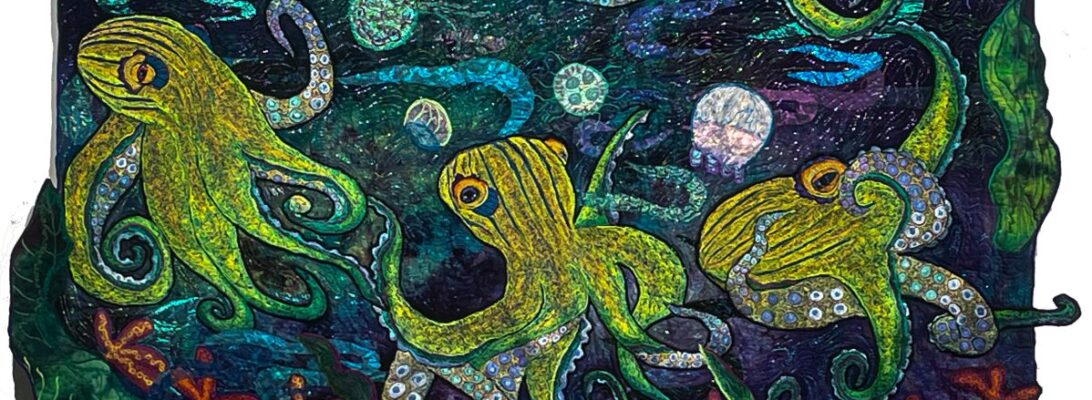
Rubbing Elementals: Using Oil Paint Stick Rubbing to Create Water, Air, Mist and Trees

What are elementals? They’re not the subject or the background. They are layers of sheers usually that create the ilusion of air, water, clouds, fire. Things that are usually translucent or transparent. They change color and texture within the piece without being obtrusive. Usually they have no hard edges. Instead, we see through them, but they help create the illusion of those elements by shifting the colors.

I put in my elementals directly after I’ve chosen my background and finished embroidering my subject.

Up until now, I’ve made my elementals out of sheers, lace, hand painted lace, and dyed cheesecloth. I love those. But I always want more options.

Since I’ve been able to make my own rubbing plates, I’ve had options to create that layered effect. Most rubbing plates create texture or give you a subject. The ones I made with stencils are created to make trees, clouds, waves and waters. Why does rubbed fabric work for that? It has soft edges, It blends into colors, and you can layer your rubbings just like layers of sheers..

I’m very pleased with the background and the fish. But I wanted the feeling of reflected trees and pond surface.

Fish placed in background rubbed with tree images and water reflectons. Rocks added.

The water and the reflected trees add a hazy elemental layer. What now? I’m unsure. I think it needs a layer of sheer waters as well.

Layers suit water. If you’ve ever walked into a pond, you can feel the layers of water, warmer or colder. It makes sense in fabric as well. I’m hoping to create three worlds, the bottom of the pond, the surface of the water, and the bare trees above the surface. Time to get out the silk leaves and organza.

Don’s Quilts

As a woman who was a 62 year old spinster, I’m not much of a romantic. But life is about surprises. It’s almost our 10th reunion. Don was the biggest surprise of my life.

He’s also impossible to buy any thing for. He wears clothes he’s had for over 10 years. If I buy him toys or tools, he rarely uses them.

I don’t quite understand that, but I find married life is not about understanding, necessarily. It’s about accepting. And enjoying the differences.

He does like cards.

I’m not a paper person. For years I’ve worked with fabric, and it’s my media. I make him cards in cloth.

These aren’t my art quilts. They’re funky, and sentimental,, and full of commercial fabric. And the fabric of our lives. But if we can’t be silly…..well, you have to be a bit silly. So here is his current collection.

They say you spend the first part of your life figuring out who you are, and the last part stretching into the other parts These quilts are that stretch. They’re a measure of Don more than myself, who is much more of a romantic.

New Rubbing Plates: What did you want these for?

This is a continuation of the last two posts. I’ve been making rubbing plates from modeling paste and stencils. Hunting for Rubbing Plates, and Modeling Paste: All it Needs is Pepperimnt flavor

Now I’m going to show you how that works with paint sticks and hand dye.

Working with rubbing plates is a bit like collage. You fit things in until you get the image you want. Usually I put in whatever I want as my focus, and choose other textural plates to fit in. It’s a dance of design.

The result is sort of like batik, because you have a textured pattern over shifting color. But you have so much more control over the pattern.

You can use it for images, but it does very well building texture, atmosphere, and elementals like clouds, water, smoke and flame.

IIt als works for filling in background. You can either create space or texture that builds the shapes.

I still wish I could do this with my own drawings. A girl can dream. I’ve gone through pretty much all of the rubbing plates that aren’t for the nursery, animal tracks and Christmas. But stencils…there seem to be a million stencils.

I also found Japanese stencils. I’m always wowed by Japanese art and these moved my furniture. Last week I showed you how to make the rubbing plates. Here is what I did with them.

The fish and crane images are great fun. But what I’ve really been pushing for is water: waves, ripples, eddies, streams, mist and waterfalls.

The backtround is filled in with several rubbing plates made from stencils made into rubbing plates.

I’m not even what comes next on this. Beach Grass? Maybe beach roses? The water itself is pretty powerful here.

Modeling Paste: All It Needs Is Peppermint Flavor

This is an ongoing series about making rubbing plates, part two.You’ll find part 1, Hunting for Rubbing Plates in last week’s blog. I’ve been exploring making my own rubbing plates with modeling paste and stencils.

Modeling paste costs the earth. And it comes in pretty tiny jars. Not to fear. It turns out to be easy to make with dirt cheap supplies.

I’ve seen several recipes, but none of them seem fussy. People just pour in ingredients and mix them until it’s the right consistency for their work. The peppermint comment is a rememberance to school paste and a joke. PLEASE DON”T EAT THIS STUFF.

Basic Recipe

  • Corn Starch
  • Colored Acrylic Paint
  • White School Glue
  • Container with Lid
  • Spritz bottle with water

Roughly equal parts glue and corn starch. Add a dash of acryllic paste, mix, sprits with water if it’s too thick.

Something no one seems to say is that the cornstarch seems to thicken quickly. It may help to spritz it several times in a session. Covered it will last for 3-4 days.

Colored acrylic paint is a nicety I discovered by accident. I didn’t have white. You can see how your stencil is working if you are working with colored paste. Much recommended.

I’m using foam board as a background. It’s a compromise. Wood is just too heavy and cardboard is to light. I’m using washer weights to hold down the larger pieces from curving as the dry. I cut the foam board into stencil sizes with a boxcutter and a plastic ruler. Foam board can come apart at the edges. I’m using blue masking tape around the edges to hold it together.

Picking Stencils

There is a staggering amount of stencils available. Once you banish the cute puppies and cats, there is an endless amount of choice.

Look for stencils that:

  • Don’t have large empty spaces within the design
  • Have a moderate amount of internal design
  • The right size for the designs you intend. This won’t stretch or shrink in any way.
  • Are made of tough plastic you can reuse
  • Don’t have really tiny lines in them

Making the Rubbing Plate

Set your stencil where you want it. Use a pallet knife to apply the past. A flat scraper or dead credit card is a good tool for smoothing things. Cover your design thouroughly and scrape off all the extra. Lift the stencil off carefully.

I have a bucket of water I put the used stencils in. That makes clean up easier.

You’ll find the design is lightly raised from the surface.

I usually smooth the edges a bit with some sylicon brushes and water.

Let it dry thoroughly.

That’s it. After it dries, you can take a nail file and smooth any rough edges.

Next week I’ll explore what I can do with these plates and some fabric.