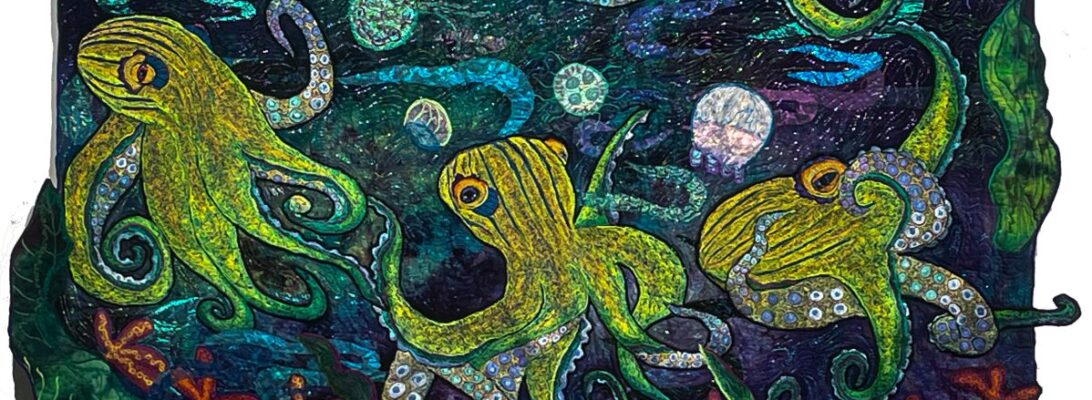
Two dimensional art is by nature static. It’s a flat image on a wall. So how do we make the image move? How do we make a two dimensional thing take flight?
There are several good tricks. Movement can be crafted in several small design decisions that convince our eye that the picture is in movement. This quilt I’ve been working on has a number of these features.
I was delighted when I saw a picture of a caterpillar perched on a fiddle head fern. I imagined a mob of caterpillars on the move, looking for lunch.
I started this quilt with some good movement in the fern heads themselves.
The Stems thrust upwards and the curved fern heads move at a spiral angle. Anything headed at an angle as if it’s falling is already in motion.
embroidery backembroidery front
I embroidered a number of caterpillars so I’d have some choices in color and shapes
I placed them several times, looking for the right flow.
This is the one I liked best. I went off the edge with my butterflies.
I like the flow, but it also works because of the interactions of the caterpillars. The angles of the bugs also suggest movement.
Finally I supplied lunch. It doesn’t really add that much to the movement, but the leaves with bites out of them makes me smile.
So to add movement to your art:
Put things at an angle
Go off the edge
Place elements where they interact together.
Put things into a path through the quilt.
The purpose of that movement is to send the eye through the journey of the visual path, to experience each part of the quilt through movement across it.
Some people spend a lot of time designing their art. They sketch. They plan. They build models. I’m so impressed. They can even tell you what it means.
I wish I could do that. I just can’t. It seems all of my art comes from random things, started but not finished, that I found later and made or put more random things on them. It sounds like a dreadfully chaotic way to make art. It is. It’s hellish for commissions. But it’s how I am. And if you want me to tell you what it’s about, you’ll need to wait several years until I get that straightened out. I am not in control of my art. All I can do is attend to it regularly, and do what it demands.
What is central to the process is the time stuff sticks around, on a photo wall before I commit to the next step. Is it right? Does it need to move three inches left? I’ve ruined many pieces by bulling through and finishing them without taking time to really look at them first.
I’m not helpless about this. And I’m not unskilled.It’s just the way it is. I suspect I’m not alone.
Art is a living thing, and a piece of art will tell you what it wants. And in the end, you didn’t so much make it as assist in it’s birth.
I laid out the background for this almost a year ago. Decided it needed white flowers on a pond edge. Didn’t know what else it needed. Lost it. Found it again. Lost it once more and then it resurfaced in the last cleaning. Somewhere in there I’d drawn a swimming frog in a batch of frogs. He didn’t get embroidered with the other batch, and I found him and thought, I really ought to finish him but I didn’t have a place to put him.
Then the piece of fabric surfaced. So I embroidered the frog, put in some water and rocks and a moon. Looked at it a while. HATED the moon. That almost never happens. But it just didn’t work.
When I was embroidering a batch of bugs and did three luna moths. One left over one just fluttered on to my quilt where the unfortunate moon was. White flowers and more water later it was done.
Did it take me two weeks? Or the two years to have the pieces fall together? Even I don’t know. I do know that fallow part of the process where you just stare at it, or lose it, or find it in a pile is an important part of the process, not to be missed or dissed.
I don’t know how to teach this kind of design. I can only show it in process. But I believe in it. I believe art grows like life, randomly, without sense, half by purpose but largely by accident, as it is. I can only stand back and watch.
I was talking to a friend who wanted a quilt for her mother. She was looking over a number of quilts, none of them right. “Can you do it it Monet colors?” Well, yes. It’s not like I don’t like Monet colors. They were my childhood favorites. I grew up on them. By now I would say I out grew them. But they are pretty and they suit people’s needs. So off to sky blue pink land we go!
Actually color is the least difficult thing for an artist to change within their work. It’s a good exercise. Working with a color you just don’t like is a great way to stretch your art.
Most people who are not artists think of color in terms of the colors that look best on them. That’s deeply sensible. If it’s in your environment, you might as well feel pretty next to it. I spoke to one woman who had done interior design. She’d go into people’s closets and ask them for their favorite shirt or dress. Genius!
The best book on color choices I ever read came out in the late 1980s. Color Me Beautiful, divided people into warm and cool colors, clear and muddy colors, Summer, Fall, Winter and Spring. It was never foolproof, but for the most part it works for people. If you were a winter you would pick clean clear colors in jewel or ice tones. A fall would pick oranges, browns taupes and beiges. Knowing the colors that will suit yourself or suit others gives you a strong tool for making art you love and that others will love.
But past that, it’s always worth taking the color you really hate out and and using it. If you’re doing natural art, all the colors will come in eventually anyway. And if your being impressionistic, it never hurts to go to the colors you never use. Or that you’ve felt were worn out. You may surprise yourself.
For me, it’s always been peach. After she asked for some Monet colors it occurred to me that it might be my time to sit down and work with the colors that would make some people happier. Even yucky peach pink.
Commissions always ask more of us that we are used to. Sometimes they are an invitation to something new. Or a revisitation of something old. Or a stretch. Or an impossibility.
But it’s always good to stretch.
You’ll find Color Me Beautiful on Amazon. It’s an excellent way to explore the colors that make you your best.
I had someone I knew well recently ask me if I knew I was different. Well. Yes. Actually the hardest thing for me has been to connect with other ordinary people. My life has not followed ordinary patterns or currents. Sorry about that. I get most places other people go, but I’m not on the same schedule. I’m not particularly ordinary. It’s fairly embarassing.
I know, even past her irritation with me that that would only matter if there were any ordinary people.
There are people who say they aren’t artists. I don’t buy that. We are not artists by what we do. We are by our genome. We are artists because we are human and that’s part of our humanity. We may not choose to make art or need to make art, but our humanity makes us artists. It’s common to us but it’s not ordinary.
There are always artists who are better than who we are. More ability. More output. More glory. Sorry about that. They’re not ordinary either.
Perhaps the only thing we have to offer as artists is our viewpoint. Skill is something we learn over time. We develop all kinds of abilities, and they change our lives. They are a wheel that runs smooth or rough against the road of time. We gather skills, we drop what disinterests us, lose them as we age, change them as we grow.
Our vision is who we are. What we see, the images we must work with, those sometimes change, but they are personal. They are all we really have to offer. Talk about different! None of us are much like other people.
I tend to see people as animals. It’s not a comment on their humanity. It’s just my vision. All those bugs and frogs and birds, they’re people I know. That especially includes myself.
I am not like other people. I don’t think anyone really is. Our uniqueness is a sign and a symbol of that. I can’t help but wonder if ordinary is a part of exhaustion. Of giving up. Of giving in. Of course it could always simply be that I’m not trying hard enough to blend. But if you have this confusion where you see yourself as a large frog, well, there you are.
I remember being told I should color within the lines. It’s probably just as well I never was able to do that. I’m certainly not about to start now.
I’ve been totally hooked on paintstick rubbing. Like everything else, it’s a tool to be used with other tools. I’ve been exploring more and more how to incorporate different plates with each other in design. Here’s the latest batch.
I love them. And I’ve recently found some iridescent paint sticks in colors that didn’t come in the kits.
There’s only one limit I don’t like. The plates tend to be small. You can repeat all you like. But they don’t lend themselves to larger pieces. Not to worry. I decided there needed to be a way. I went looking for more kinds of rubbing plates. The choices are limited.
I tried drawing with glue on placemats. I tried carving foam. I got desperate and bought some fondant plates. All too small or not quite enough. Or a huge mess. Not satisfactory.
Not everything that works marvelously was made for that purpose. Some of the best tools of the quilt world have been borrowed from some odd places. My favorite thread bags were originally worm bags for fishing. Rotary cutters started as carpet cutters, I’m told. Surgical seam rippers really are a surgical tool some brilliant nurse brought in to their quilting studio.
So in that same spirit, I bought some ceiling tiles. They’re two feet by two feet. And beautiful! Stiff textured plastic. Exactly like a rubbing plate, only bigger.
Here’s what they look like rubbed. I’m in love!
So I’m not supposed to use ceiling tiles that way? Isn’t a good thing I didn’t pay any attention to those rules? I think so.
I’ve never understood people who worry about unfinished work. I treasure my unfinished quilts because they are springboards to more new quilts, just waiting for their time.
I learned a while back that it was easier to set the machines for one process and work a number of pieces at a time. It seems a bit scattered, but it works for me. I spent yesterday working on 8 quilts at once.
It makes sense to do all your dyeing at one time. It also works to do oil rubbed fabric in batches. I could do one at a time, but the mess is prodigious for both of those. Here’s the rubbed pieces of fabric I used for my quilt batch today.
Once I started straight stitching with metallic, some quilts needed more. Some need couching, some need extra flowers, some needed either applique or embroidered applique. So I line them up by the techniques involved. Then I set my machine for the next process and do them all at once.
It creates a lot of work in a hurry. Which is good right now because I’ve sold a number of small quilts over the sale, and am going to add these to the sale as soon as they’re done.
So, no guilt! Unfinished quilts are invitations to new work. And they finish quicker if you do each process at a time.
I find myself taking things in batches. Each quilt gets exactly what it needs. But I can work smoother and quicker by taking them in batches and working one process at a time, not just one quilt.
This is another modified blog from almost ten years ago. It’s still an interesting story. And an interesting way to think about how we design our art.
It’ss almost impossible to talk about our art without talking about the art that comes before us. Before we talk about design, it’s worth saying that there are many different design aesthetics. It’s not that a design is good or bad necessarily. It’s designed to be part of the statement. The notions that fuel our art choices are a statement loud and clear past subject matter and past our technical handling of fabric and thread.
As quilters, a lot of us have backed into art by accident. We started with squares and one day found ourselves with an odd quilt that somehow was an art quilt. Maybe it had too much orange in it or you found yourself like me, embroidering frogs and bugs into the borders. There’s a tender soft spot in most quilter’s artistic persona. The part that said that you should have gone to art school or studied water color. So our first designs spring out of a personal view. Later, as we become more facile, we realize that the choices in design are a huge statement all their own.
My first artistic love was the impressionists. I grew up near Chicago, and there was a pilgrimage every year to the Art Institute. I strolled through the halls looking for paintings like old friends. Since they were my first real introduction to art, they felt bland to me. Safe. Something soft and soothing out of my childhood.You know it’s become mainstream when you see it on a birthday cake. This astonishing cake is by Megpi, a pastry chef in Silver Lake. California. You can see her work if you follow the link to Flickr.
impressionist cake, a photo by megpi on Flickr Since you can buy Van Gogh’s work on umbrellas and coffee cups, it’s easy to miss the point that he was a raving revolutionary in his time. His work nauseated the current critics, got him hospitalized, was refused for all the important salon shows, and the subject of ridicule in the press. Time and familiarity have made him a lionized artist, but that was not who he was when he began.
I was immediately in love when I discovered Japanese prints. It was a while before I realized why. The Impressionists took much of their new artistic vision from the prints out of Japan. The first prints that came out of Japan hugely influenced them as beginning artists.
In contrast, this is a painting called Nocturne from around 1825 by Turner. Turner would have represented the design aesthetics from the early 19th century, that Van Gogh and the other impressionists and Post Expressionists blew out of the water.
Early 19th Century Western art was about permanence. It honored stability. It was a world of people in their proper places, forever and ever. It used Greek and Roman scenes and portraits of nobility as an way of saying we had an eternal understanding of a changeless world.
Japanese art was about the moment. It moved. It created a path for the eye to follow. It went off the page. The impressionists saw it, fell in love with the concept and incorporated it into the designing of their art. The movement is called Japanisme. It was in my humble opinion, the beginning of modern art. And changed us all.
Myself, I cherish movement. I plot my quilts to travel from one side to another, taking the eye on a journey across the surface. The visual path and vertical path quilts I’ve been exploring are all about the traveling eye.
The decisions behind design are the most telling. Without a word they say so much about what we create, what we find important, and what we value. The way we structure our art is at least half the story we have to tell.
For fun I was looking at some old posts of mine. I found this fun and wanted to share it with you.
I am a redirected Drama Queen, Daughter of a Drama Queen Delux. My mother was not a happy girl until she had a drama 10 feet high and too wide to get through the door. It was all about telling stories.
Now Margaret Eddy was the queen of all stories. And a serious fan of silly. She told amazing whoppers, one-liners, true tales spun into gold from straw, hopeless lies and astonishing steaming piles. She loved her drama. She had a somewhat loose relationship to truth. She was a devastating school teacher, because much of that could indeed come out in a teacher conference meeting or a family reunion. But she had a special gift for looking within and without. First she’s build you a verbal image of herself as she felt about the story. But then she’d draw you into an outer view, where you could see her spinning in what she knew was a silly situation, build for howling laughter.
It happens to me in my quilts. I’m quilting along and I realize that this silly thing I’ve drafted is someone I know. Or worse, me. There with all my rather small fears and desires. I’m not overly deep. I’m just noisy. At that point, it seems just to the point to let it be silly. I am. It is. And the world is better for it.
This quilt, The Orchid Olympics, wasn’t meant to be funny. It just happened. I’d found a great picture of a frog in an odd pose and worked with it. One afternoon in a class demo, I was placing it into the piece and trying to put a sun over his head. It wouldn’t go. It just wouldn’t go. Not over. Not to the side.
I looked again at the frog and thought, “If you get into that pose, it has to be for something like the Olympics. No one would willingly bend like that otherwise.” The sun fell into her hand like an award and there we were.
Mirror, mirror on the wall, I am my mother after all. But I try never to tell a story on myself until I’ve found the funny part. Perhaps it helps to be short, round and have a pug nose. My gray hair also seems to give me an amnesty for silliness. And why not?
I’ve written a lot about color because I think a lot about color. I It fascinates me, from dye, to fabric to thread. I’ve been working on a batch of mushrooms for some new quilts and I decided to look at the colors through the color wheel just to codify what I was choosing.’
I’m not going to talk about color theory here, precisely. Instead I’m going to talk about relationships in color. Color theory can be deeply and obscurely discussed in millions of ways. I’ve seen it discussed as building blocks, tonal poems, wave lengths and light waves. I’m not sure how much of that is useful. I thought it might be helpful to simplify instead. I’m not dissing color theory. But I am trying to think about it differently.
I’m also not going to use color names. I want you to look at the relationships of the colors instead. But here’s the distinction I find most helpful. Color harmony has to do with how close colors are on the wheel. Contrast has to do with how far away they are. Harmony is of course beautiful. But contrast is what draws our eyes, It is what makes colors pop.
Contrasts come in several style. The colors themselves are their positions on the wheel. Darkened and lightened colors make the tones and tints. Then there is the clear colors. So for fun, sit back, get drunk on the colors and ignore the names. But look where the contrasts and the harmonies are in these color choices.
Notice the range of purples together that create a smooth section of colors and the yellow and greens that contrast. Notice the differences between the dark blues and purples and the lighter yellow and greens. The further distance colors are from each other, the stronger the contrast. The contrast creates the pop.
It’s not as simple as a recipe. It’s not what I was doing. But I did pick full swaths of colors next to each other with a few colors opposite from them. I also actively chose light/dark ranges for harmony and for contrast. It’s not about what we name colors. It’s about their relationship together. The very light green makes the sparkle on this ‘sroom. It looks white. But the green heightens the contrast.
Shading looks different than colors put side by side, but they still meld into each other. The eye blends thread colors that are sitting side by side.
Where are they going? They’re not in place yet, and I’m hoping for smaller frogs to go with, but bright kick ass mushrooms are exactly what I had in mind. I think I’m going to make it rain.
In process forest floor with mushrooms
I’m going to leave you with a small gift here. There are two color wheels here that I made for this blog, one empty and one fully colored. I invite you to use them to chart your own color on a project as you work. Down load them, print them up and use them to see how the colors you use chart up and relate to each other. And let me know what you find. It can be eye opening.
You are welcome to download these two pictures to chart your own colors!