
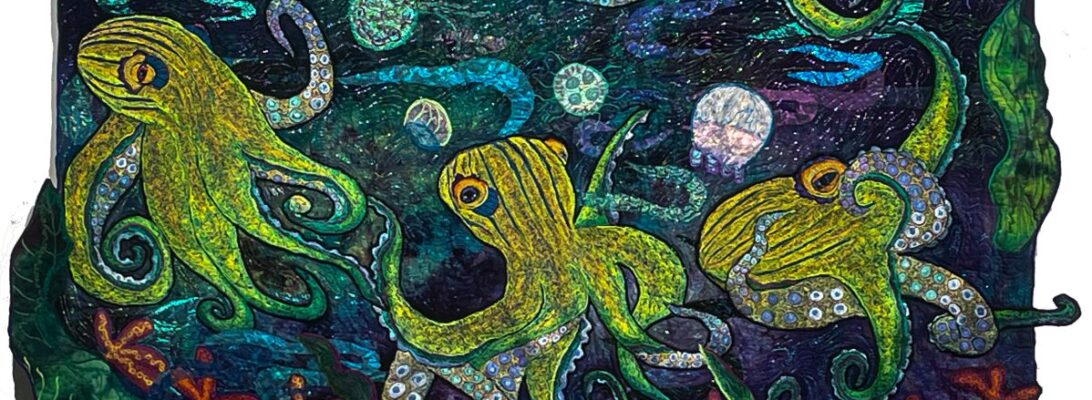


My work contains a lot of different processes. It can seem a bit overwhelming when you’re looking at the inished piece. But there is a flow to it.How do I start? What makes sense out of what comes first? And next. And why?
I’m using the cat head fountain as my example here because it’s what I’m currently working on. This is a repeat of a quilt that never worked out.( see Try, Try, Again). Every piece has its own challenges and processes, some of which are unique to that piece. This one isn’t reallly typical. I’ve been trying to fix my problem with man made structures for some while. The fountain itself was a separate process I’ll skip over for right now.
I’d like to say none of this is written in stone. This is generally how I approach a piece of art.
Which comes first, the background or the subject?
It can go either way. It’s a chicken and egg problem. I need both. It doesn’t matter which comes first.
Background

The background answers many question. Sometimes there’s a piece of hand dye has really strong opinions and tells you exactly what to put on your quilt. It’s worth listening. So I put the background up on the wall and let it tell me the story. Is it a swamp? A meadow? A river? The background often tells me exactly where I am. What time it is? This background was a piece of oil paint stick rubbing on gray hand dyed that made perfect old stone.
Sometimes there’s a piece that’s perfect but it’s just too small. I may strip piece it to stretch it. I did piece a border to this, to get it to the right side.
Subject


The background does all of that xcept when it doesn’t. Then I go looking for images. I do use books for reference. I’m a poor enough artist that once I’ve drawn it, it’s pretty much unrecognizable. But I do like to get the numbers correct on how many toes my creature should have.
I draw on Totally Stable, an inron on, removable stabilizer. The stabilizer stays witin the piece. It’s drawn backwards because I’m stitching from the back.


Either road, I never prep the back until I’ve embroidered the subject. The embroideries shrink. And not in an even way. The shrinkage comes from the width of the zigzag stitch you’re using. Usually it’s around 11 percent, it’s not consistant, or predicable.

Stabilize the Background
Once the subject is embroidered, I stablize the back with felt and Decor Bond.
Elementals

Elementals are things that are see through fire, water, air,clouds, flower petals. If it’s a flat applique, I back it wit Steam a Seam 2, iron it down, and stitch it in a loose zigzag with monofilament clear thread.
First Pin Up
Once I have the elements in place, I pin up my subject into the background and assess what I need to make a pathway

Components

These can be any smaller images that direct the eye through the piece: bugs, fish, birds, or stones. In this case it’s leaves, roses and small yellow birds
Second Pin Up

I add in the components to create a visual path. This it that last moment to adjust for everything The smallest angle of a leaf or bird can change it dramatically.(see Turn of the Head) After it’s stitched down, I’m committed. This is where I currently am with this quilt. The next part is to leave it on the wall for several days to be sure everything is where it should be.
Stitch Down
At this point I stitch the elements into the background
Stipple
Most pieces do not lie flat unless they’re stitched all over. Some kind of stipple will accomplish that.
Back, Quilt, and Bind
Finally I back the piece, quilt it, and cord bind it. Check out Way over the Edge for instructions on cord binding.
This is not always the path. But these are all things that need to be accomplished.
I regularly walk you through my projects step by step. But I don’t often show it in a more macro form. For more information on work flow check Deciding Rather than Designing.


